Qianwen’s Version of ‘Being Inside the Nails’
 06/09 2026
 569
569
In Alibaba's strategic blueprint to establish a super gateway in the AI era, Qianwen and DingTalk are the two closest to the mark, much like a pair of swallows.
Content/Ode to the Goose
Proofread by/Foolhardy
A seemingly absurd incident involving the online resale of cultural artifacts was quickly drowned out by the daily deluge of information before it could fully unfold.
A photo of a museum artifact, casually taken by a visitor at the Shaanxi History Museum, was identified by Xianyu's AI as an antique ornament. The AI automatically generated descriptions like "natural patina, suitable for collection" and listed it on the user's homepage for 6,000 yuan. It wasn't until a potential buyer inquired about the price that the account owner realized they had inadvertently become a suspect in the illegal resale of cultural relics.
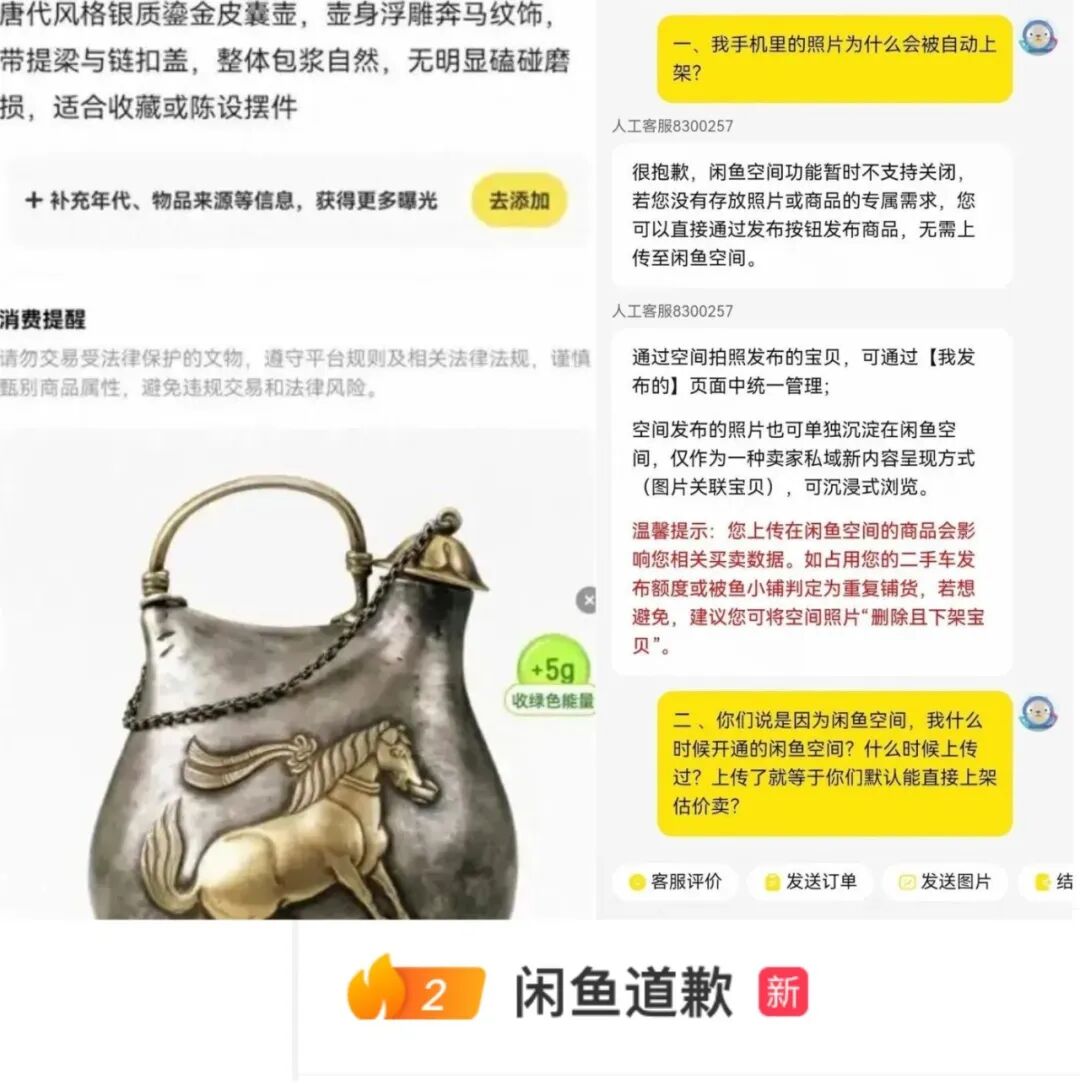
The official team at Xianyu quickly issued an apology, attributing the issue to "deficiencies in product interaction design," and promptly accessed the National Cultural Heritage Administration's database to block such listings.
This follows a standard public relations crisis management approach: acknowledge the mistake, soothe emotions, provide a solution, and limit responsibility within the framework of "inadequate notification of certain features." The application layer takes the blame, maintains a low profile, and successfully reduces a trust crisis involving AI overstepping its authority to a mere interaction error by a product manager.
Behind this automated chain of "recognition-generation-pricing-publishing," Qianwen, the superbrain providing the core visual and generative capabilities for Xianyu's newly launched AI camera feature, remains concealed.
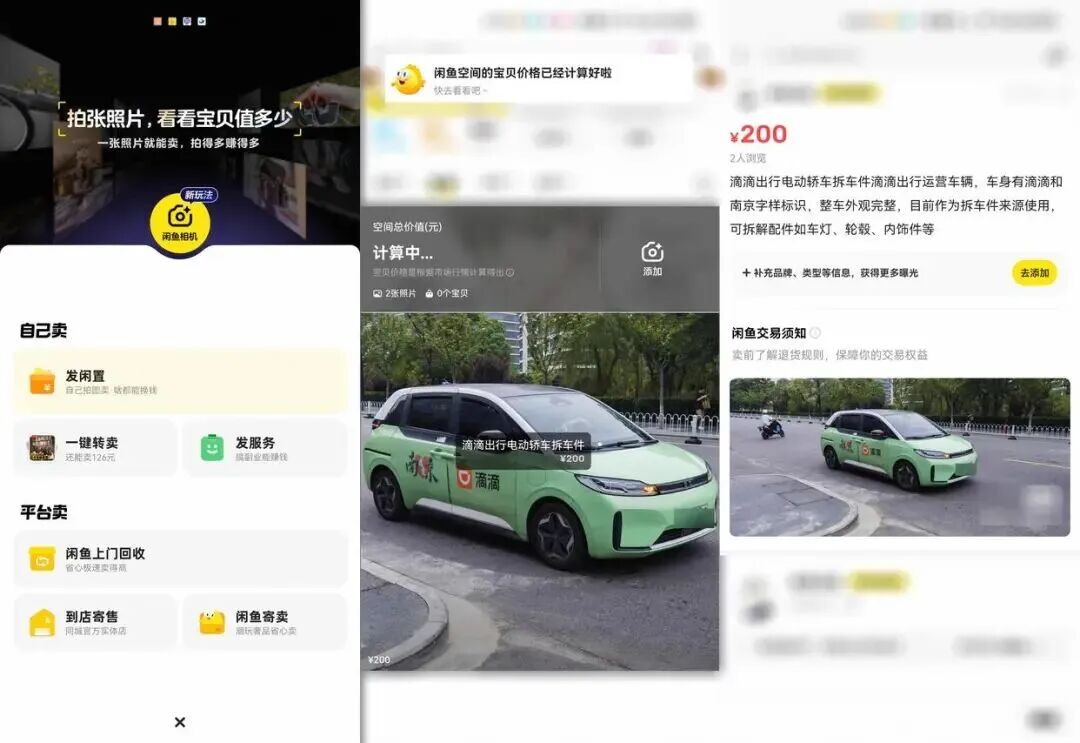
This silence is a calculated move to mitigate damage. However, if we simply move on after reading Xianyu's apology and the news that Qianwen will open up to third-party Agents and Skills, we will miss an excellent opportunity to discuss the boundaries of AI rights and the attribution of responsibility.
This is not an isolated incident but an inevitable mishap in Alibaba's AI strategy as it advances simultaneously in the consumer (C-end) and business (B-end) markets.
Comparing Qianwen's aggressive approach on Xianyu with the struggles of DingTalk's AI project "ONE," as depicted in the recent 75,000-word essay "Being Inside the Nails" that stirred discussion on Alibaba's internal network, a converging picture emerges. Qianwen's overstepping of user intentions on the C-end and its oppressive gaze on employee autonomy on the B-end essentially stem from the same driving force.
Driven by a belief in efficiency-first radicalism, powerful machine logic is employed to strip users of control, allowing AI to take over transaction and work processes. Under the goal of conversion rates, user intentions and privacy become mere fuel.
Part 1: The Greed for Efficiency
Let's first debunk a highly misleading technological facade. The real issue with Xianyu this time is not that the AI misidentified a cultural relic photo.
Even if the visual capabilities of large models evolve for ten more generations and accurately recognize the national treasure "Tang Dynasty Gilt Dance Horse Holding a Cup in Its Mouth Silver Pot," the core problem remains. There is still an insurmountable gap between item recognition and listing for sale in terms of the user's true intentions.
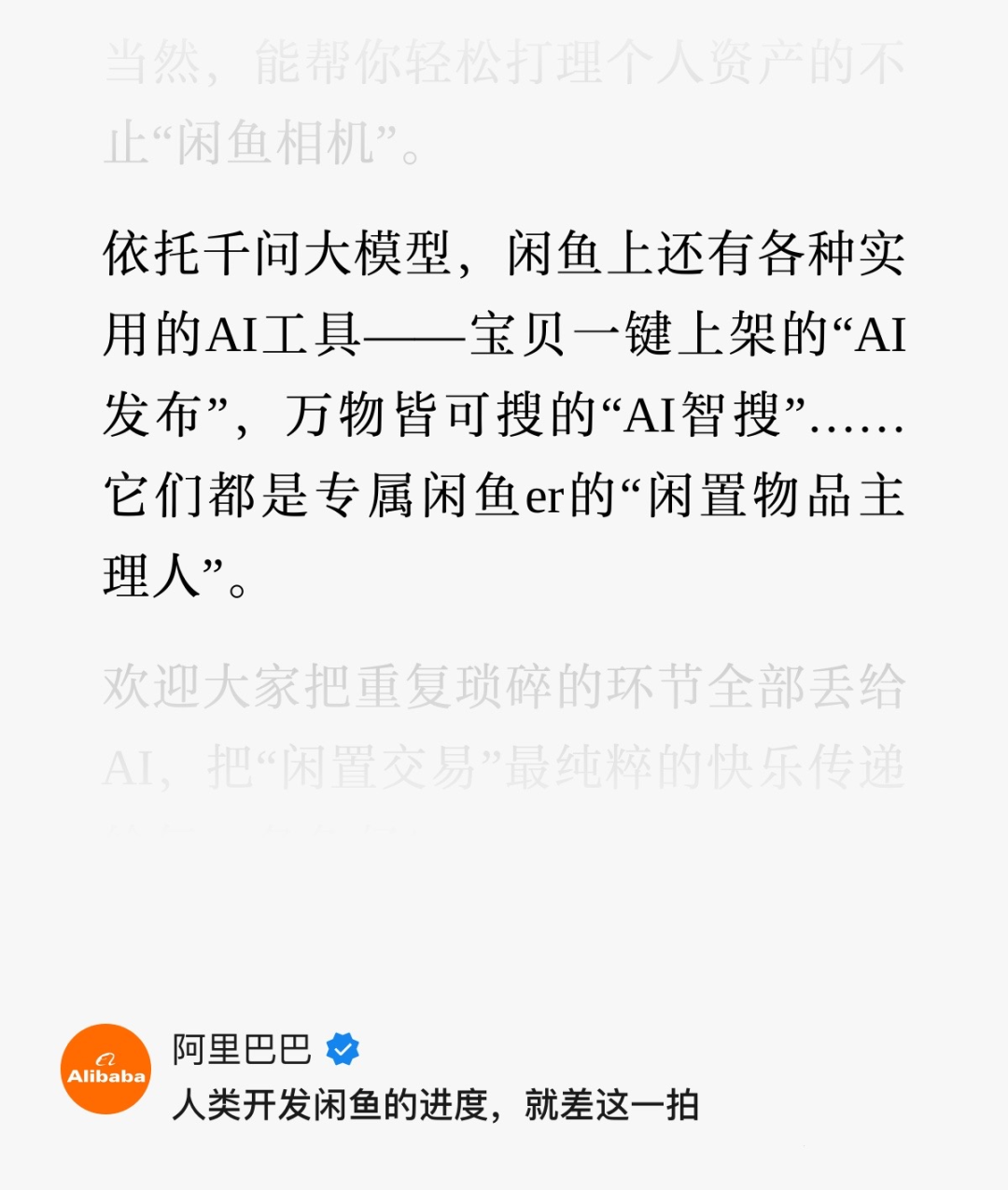
In this condensed process, AI serves as a stock clerk, copywriter, and pricing specialist, providing an excellent assistance experience. However, the moment the system presses the "list" button on behalf of the user, the nature changes.
Listing is essentially a commercial publishing act with contractual implications.
Xianyu's product logic assumes that as long as a user's photo enters a specific space, the system infers a selling intention and completes subsequent actions on behalf of the user in the most efficient manner, even without informed consent.
This overstepping is not convenience but a loss of control for the user.
This extreme greed for efficiency stems from the business pressure on Xianyu, as a two-sided market, to activate individual sellers and enrich long-tail supply. The traditional process of taking photos, writing descriptions, and checking prices is too cumbersome, hindering the circulation of idle items.
Xianyu uses AI to eliminate friction. For professional sellers who need to list dozens of SKUs daily, the ability to list items immediately after taking photos is a cost-saving and efficiency-enhancing tool. For the Xianyu platform, the transaction commission for Fish Shop sellers increased from 0.6% to 1.6% starting April 18th. Helping sellers facilitate more transactions naturally also brings greater benefits.

However, for ordinary users who simply want to save a photo or check a price, this is undoubtedly an invasion of privacy and a deprivation of decision-making. Attempting to apply a funnel model that pursues extreme conversion rates to two vastly different types of users is bound to backfire.
Looking back at Alibaba's overall actions in the AI field recently, Xianyu is merely the outpost of Alibaba's AI strategy.
This year, Alibaba has been vigorously promoting "AI for Business." Starting January 15th, Qianwen has been fully integrated into Taobao, Alipay, Flash Sale, Fliggy, Amap, and other platforms, adding over 400 new AI business functions. In the past two days, Qianwen announced its full opening to third-party Agents and Skills, with initial access granted to heavyweight consumer and travel brands such as KFC, Luckin Coffee, and China Eastern Airlines.
Qianwen is eager to move AI capabilities beyond the information layer and penetrate the service and transaction layers.

This is Qianwen's true hidden agenda. When users interact with AI, they expose a large amount of real decision-making logic—which suggestions they accept, which plans they reject, and which scripts they ultimately use to complete transactions. Once these signals flow back into Qianwen's training pipeline, the model acquires not just language capabilities but transactional capabilities.
However, AI intervention in transactions essentially means replacing humans in executing commercial contracts. On Xianyu, if AI lists an item the user didn't intend to sell, it can simply be withdrawn. But in the complex transaction ecosystem Qianwen is building, if Agents make default decisions on behalf of users in pursuit of conversion rates, it could result in actual financial deductions or non-refundable airline tickets.
It lacks complete compliance boundaries yet has already begun exercising power. This poses a far greater risk than AI falsely selling national treasures.
Part 2: The Isomorphism of Oppression
If Qianwen, as a key C-end entry point for Alibaba's AI strategy, manifests as overstepping authority on Xianyu, then DingTalk, as a key B-end entry point under this strategy, stages an isomorphic form of oppression through its AI project "ONE."
The only difference is that the object of oppression has shifted from users' listing intentions to employees' autonomy in message handling.
The recent 75,000-word essay "Being Inside the Nails" that sparked widespread discussion on Alibaba's internal network accurately dissected this absurdity. The vision of ONE is to enable "things to find people," acting as users' dedicated work secretaries, using AI to proactively organize and push messages, schedules, and to-dos.
This is similar to Xianyu's "photo-to-listing" feature, using AI to complete the next step for users and assuming users are willing to be helped.
However, as the author of "Being Inside the Nails" pointed out, DingTalk's DNA determines that this proactivity will inevitably lead to oppression. DingTalk's history is one of standing on the side of managers, the "senders," and striving for certainty for the organization. Features like "read/unread" and "DING" address bosses' anxieties.
In the latest version of DingTalk, when AI becomes the super agent for senders, employees merely browsing message summaries in the homepage card flow will automatically trigger a "read" marker in the original conversation.
In this process, employees feel not convenience but intensified surveillance, losing the precious psychological buffer zone before handling messages—the last line of defense in deciding when and how to enter a work state.
As mentioned in the long essay, a structural contradiction exists between proactive services and the sender's standpoint. The more proactive and accurate the AI, the deeper the oppression on recipients.
This is identical to Qianwen's misstep on Xianyu. The question for DingTalk is whether AI should mark messages as "read" on behalf of users. The question for Xianyu is whether AI should press the "list" button on behalf of users.
More fundamentally, both sacrifice real user value for reportable metrics.
To ensure stable delivery of important unread messages, ONE limits its judgment scope to direct superior messages. While this makes the metrics look good, the scenario becomes narrower. Messages from cross-departmental collaborations or customer groups, which users are more likely to miss, are filtered out instead.
This is similar to Qianwen's overfitting to specific categories in pursuit of recognition accuracy. Both approaches reflect a product mindset focused on exam-like thinking, chasing high scores on narrow topics rather than solving complex real-world problems.
Part 3: Organizational Distortion
From Xianyu to DingTalk, Qianwen serves as the shared brain, while Xianyu and DingTalk act as limbs eager for action. Both adhere to efficiency-first radicalism, attempting to let large models directly take over transaction or work processes, assuming they can make decisions on behalf of users and then hold users accountable for the results.
This isomorphism stems from Alibaba's underlying DNA and strategic anxieties.
"Being Inside the Nails" describes DingTalk as a "diligent industry." In the project room on the fourth floor of C6, over forty people crowd together, surrounded by the smells of coffee, takeout, and cold medicine. Requirements raised by the boss in the morning must be implemented and verified by evening—a mechanism known as "daily delivery."
This mechanism creates a strong wartime atmosphere but also leads to side effects of overexertion, sacrificing real user value for reportable metrics and filling managers' insecurities at the expense of executors' breathing room.
Both Qianwen and DingTalk are under immense pressure to prove themselves.
The entire AI industry recognizes that standalone chatbots have shallow moats, high computational costs, and unfavorable ROI. As competitors like ByteDance and Baidu launch price wars, the cost per million tokens for Qianwen's API has plummeted to single digits, nearing the cost line. The MaaS model, which charges based on usage volume, is rapidly becoming a low-margin labor-intensive business.
At the same time, Alibaba's nature compels them toward commercial restructuring. Baidu's core is search, Tencent's is social, and Alibaba's is transactions. It possesses the most complete fulfillment and payment systems across the internet, along with a network of millions of merchants.
Qianwen's destiny is not to be a poetry-writing assistant but to prove it can drive incremental value for Alibaba's massive e-commerce ecosystem, directly stimulating consumption, facilitating transactions, and improving organizational efficiency. If it fails to do so, its strategic value within Alibaba will be significantly diminished.
The same applies to DingTalk, which operates within an organizational context and real work scenarios. Under Wu Yongming's "e-commerce + AI" strategic vision, this is simply unacceptable.
Therefore, whether it's "AI for Business" on the C-end or "AI Work Secretaries" on the B-end, the underlying logic is to have AI directly intervene in transaction and service processes to achieve value closure.
"Being Inside the Nails" mentions that DingTalk initially overemphasized "big entrances" and "new forms" because it served not just users but also Wu Zhao's self-value proof and his position within Alibaba's new power structure.
The same pressure inevitably transmits to the leader of the Qianwen model, possibly including the suddenly departed Lin Junyang. Although Zhou Jingren, who temporarily oversees the Qianwen model, became an Alibaba partner last year and no longer needs to prove his value like Wu Zhao, he represents organizational will itself.
This organizational pressure manifests through agile mechanisms like "daily delivery" and "rapid reporting" as product managers' all-nighters and designers' revisions, ultimately translating into the "list" button on Xianyu that requires no user confirmation and the proactive "read" marking service on DingTalk.
Whether it's Xianyu's accident or DingTalk's dilemma, the essence is that AI, still immature, has been granted commercial contract agency rights that do not belong to it. It begins participating in commodity decisions without sufficiently stable judgment capabilities, assumes users are willing to sell or have read messages without truly understanding their intentions, and exercises power without being able to bear responsibility.
Technology advances relentlessly, but no matter how fast it evolves, it should not—and cannot—outpace human confirmation of intentions, boundaries, and rules.
"Being Inside the Nails" laments at the end that what DingTalk lacks most is "the art of letting go." This verdict applies equally to Qianwen today.
Precisely because Alibaba operates in such close proximity to financial resources and boasts such seamless conversion channels, it requires a heightened sense of prudence more than any other entity when advancing its AI strategy. For vendors of large AI models, they cannot simply revel in the valuation premium associated with being labeled as the 'new water, electricity, and coal' without also shouldering joint and several liability for any engine runaway incidents (where multiple parties are held responsible for the full extent of damages).
Zhang Yiming once famously remarked, 'Algorithms have no values.' Subsequently, ByteDance found itself repeatedly having to demonstrate that platforms must indeed uphold certain values. Today, AI large model companies are traversing a similar trajectory.
Qianwen's dual mirrors on the consumer (C-end) and business (B-end) fronts unveil a more profound risk: when a company bases its AI strategy on transactions, its initial instinct is invariably to leverage technology to eradicate all friction impeding deals.
This instinct is so potent that it systematically obscures the lines between assistance and agency, interpreting users' silence, inertia, or lack of attention as readily convertible business prospects.
This serves as a crucial reminder to the entire industry: before fully relinquishing control to AI Agents, it is imperative to install the brakes first. Otherwise, the cyber reselling incidents and DingTalk dilemmas witnessed today will merely serve as minor preludes to more extensive AI crises in the future.
END
-
![]()
Qianwen’s Version of ‘Being Inside the Nails’
-
![]()
Unbelievable! Chery’s Rumor Refutation Disappears—Who’s Behind the Chaos?
-
![]()
Force Robotics Acquires Atomix: Empowering Robots to Develop Data Flywheels in Real-World Business Environments
-
![]()
Is India Acquiring Electric Vehicle Tech from China? Chery Responds
-
![]()
Struggling to Compete? Japanese Automakers Shift Focus to India, a Market Even Musk Avoids
-
![]()
Why Haven’t We Seen Any Automakers Go Bankrupt Yet, Even as 2026 Reaches Its Midpoint?
-
![]()
Saido Is in Need of a 'Primary Responsible Entity'
-
![]()
Shanghai Robot Brain’s Debut Share: Second Bid for HKEX Listing