Apple Shareholders Paid a $230 Billion 'Makeup Exam Fee' for Apple's AI
 06/09 2026
 456
456

PART01 A Makeup Exam Costing $230 Billion
Apple CEO Tim Cook took the stage at Apple Park for the last time as CEO, delivering the keynote at WWDC 2026. Three months later, hardware engineering chief John Ternus will succeed him, leading Apple into a more challenging AI era.
The farewell show on June 8 was supposed to be a coronation. Instead, it looked more like a 'makeup exam.' The 'brand-new AI' promised at WWDC 2024 did arrive, now called 'Siri AI,' but from the live demo, it could answer questions, search for information, send messages, and set reminders—nothing surprising for users accustomed to AI tools. As for Agent capabilities, they were even further out of reach.
After the event, Apple's stock price plummeted, shedding over $230 billion in market value by the close.
On a business level, this was a barely passing 'makeup exam.'
Let's rewind the clock two years.
In June 2024, Apple announced 'Apple Intelligence' at WWDC, promising Siri would have screen-awareness, cross-app operations, and natural language understanding. It was Apple's first direct response to the AI wave sparked by ChatGPT, briefly exciting capital markets. Apple's stock hit new highs that summer.
But promises soon turned into delays.
In fall 2024, the new Siri failed to launch with iOS 18. In 2025, Apple postponed it again, citing 'internal technical issues.' Meanwhile, OpenAI released GPT-4o, Google launched Gemini 1.5 Pro, and Anthropic's Claude 3 surpassed them all in coding and reasoning. Apple's assistant, however, often struggled to set alarms correctly.
More embarrassing were internal metrics. In March 2025, Apple executives admitted during an internal meeting that Siri's new features succeeded only 60-80% of the time. That meant one failure every five interactions. When this figure leaked within the tech industry, it was dubbed 'ugly and embarrassing.'
In January 2026, Apple struck a deal with Google to integrate Gemini into Siri—akin to a top student borrowing notes from a deskmate.
When Apple Senior Vice President Craig Federighi said at WWDC 2026, 'We believe privacy in AI is non-negotiable,' he had to simultaneously explain why your Siri queries would be processed on Google's servers. Apple gave this compromise a polished name: Private Cloud Compute. Essentially, Apple admitted its in-house AI model couldn't independently support a modern smart assistant.
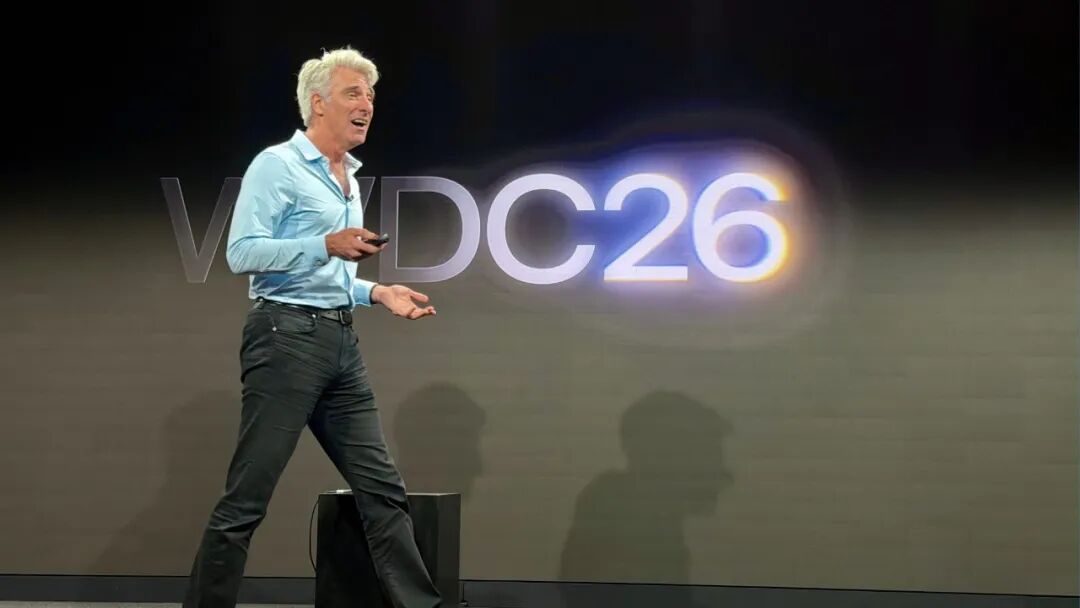
Moreover, the new features showcased at WWDC 2026 were hardly novel for many users.
Siri now has a standalone app, supporting both text and voice interactions while retaining conversation history. ChatGPT achieved this in 2022. 'Visual Intelligence' integrates with the camera to recognize objects, scan business cards, and read nutrition labels. Google Lens debuted in 2017.
Image Playground has been upgraded to support higher-quality image generation and 'description modification' features, which Midjourney and Stable Diffusion users have enjoyed for three years.
As for Safari's AI-powered tab management, Messages' AI reply suggestions, and the Phone app's ability to read email context during calls, these have existed on Android and third-party apps for years. Additionally, Apple admitted that some Apple Intelligence features (like image generation) have usage restrictions. Due to regulatory requirements, EU and Chinese users are excluded from this 'AI upgrade.'
PART02 The Price of Closed Philosophy
After WWDC 2026, tech media evaluations were surprisingly consistent.
Mashable captured a telling detail during its livestream: when Apple Senior Vice President of Software Engineering Craig Federighi announced Siri AI would launch later that year as a 'public beta,' the top comment in the chat was: So... that's it? (So... that's all?) Sharper criticism came from Bloomberg's Mark Gurman. Before the event, he posted on X predicting Apple would focus on 'privacy and security features'—implying not to expect genuine AI breakthroughs.
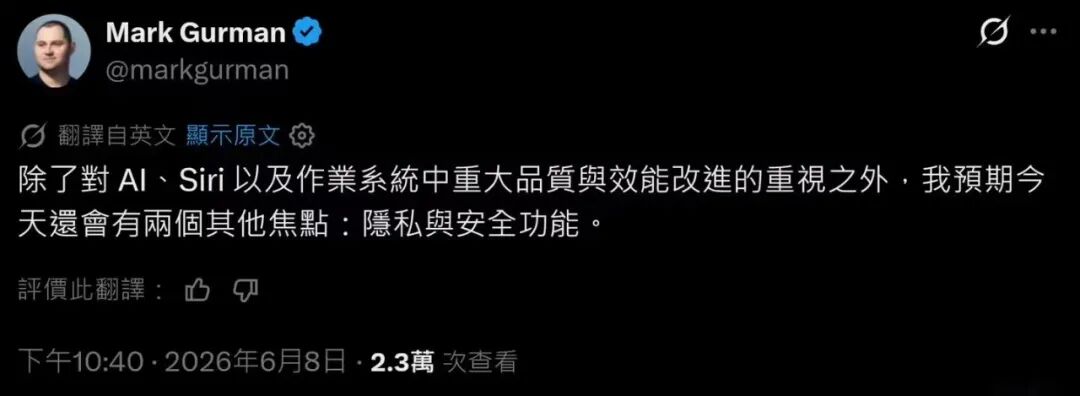
These reactions point to a core issue: Apple has lost its ability to 'define standards' in the AI era.
That was its competitive edge in the smartphone era. Over the past two decades, Apple defined what smartphones (iPhone), tablets (iPad), and smartwatches (Apple Watch) should be. It didn't need to be first to market but always redefined industry standards.
Yet in AI, it has played catch-up. In capital markets, despite strong performance in its core businesses (iPhone, Mac, services), its stock price underperformed in 2025. Entering 2026, as investor enthusiasm shifted toward companies with clear AI revenue streams, Apple's crisis became starker.
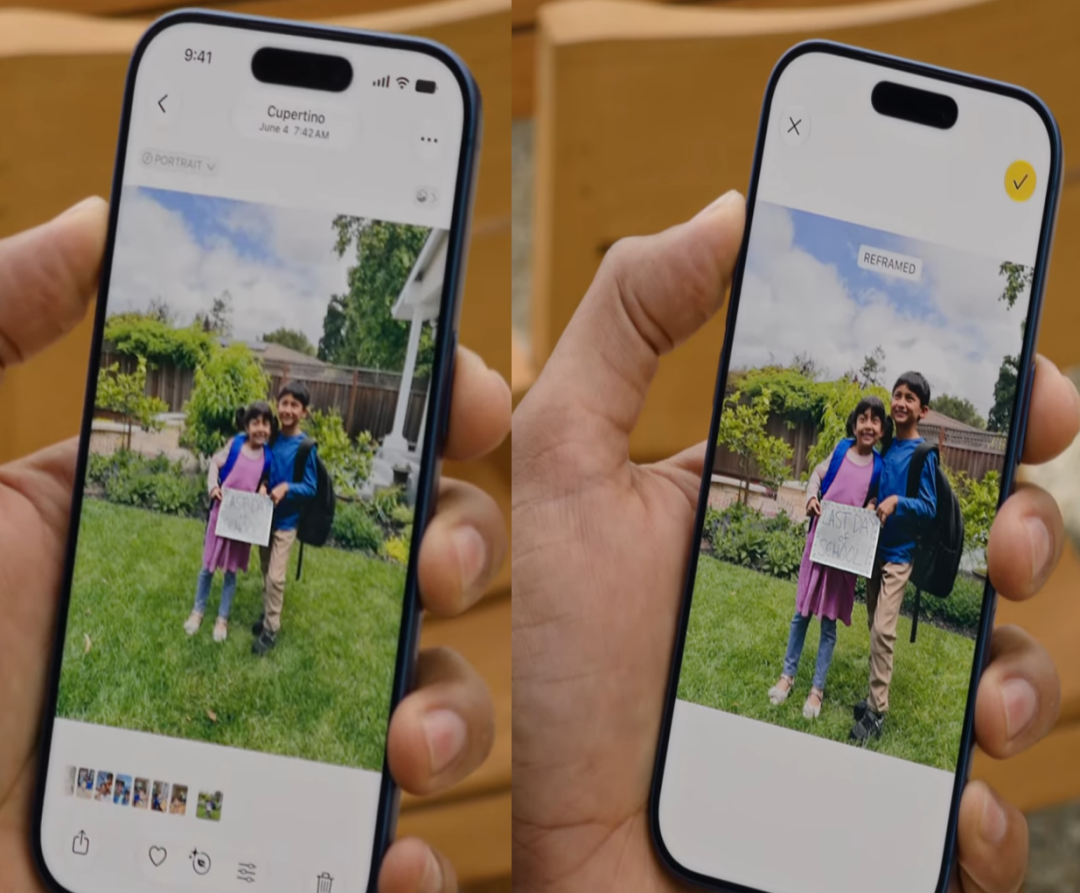
An Apple engineer demonstrates AI-powered photo adjustment live
Apple's foundations are undeniably strong. Beyond technical prowess and cash reserves, its most competitive asset is the world's largest device ecosystem—no AI company directly reaches 2.35 billion active devices globally. Additionally, Apple's privacy commitments are well-recognized among users, effectively alleviating concerns about AI safety.
Yet this is a double-edged sword.
The elegant product logic of closed systems was Apple's secret weapon in the smartphone era. From Macintosh to iPhone, from iOS to App Store, Apple created unparalleled user experiences by controlling every aspect of hardware, software, and services.
This closed nature was a moat in the mobile internet era but became a cage in the AI era. AI model competitiveness is directly tied to data scale, yet Apple's strict privacy policies limit internal teams' access to user data. Researchers must train models on third-party authorized datasets and synthetic data—akin to feeding a teenager only water and bread, inevitably stunting growth.
When OpenAI released ChatGPT in 2022, it didn't need to worry about device compatibility, regional privacy policy differences, or maintaining a local computing architecture across billions of devices. It only needed a browser to let the world experience cutting-edge AI. Apple? An insider described it this way: Doing AI at Apple means every move faces hundreds of vetoes. You have to fight the 'privacy police' to make progress.
Under such conditions, speed becomes an inevitable casualty.
While competitors iterate models weekly, Apple advances features annually. The term 'AI Agent' has been trending for a year, yet Apple continued to 'tease' it at WWDC 2026. It allows users to book restaurants, manage schedules, and control smart homes via Siri, but most Agent functions remain 'coming soon.'
PART03 Changes at the Crossroads
But change is happening. The keyword is openness.
First, Apple has humbled itself to forge alliances.
The latest iOS lets users freely switch to third-party AI models vetted by Apple, from Google Gemini and Anthropic Claude to DeepSeek, replacing Apple's in-house models for Siri, writing tools, and image generation.
Apple's partnership with Google is even tighter. At WWDC 2026, Apple announced: 'To enable Siri to handle the most complex requests, we're collaborating with industry-leading AI models. Today, we're thrilled to announce that Google Gemini will be deeply integrated into Apple Intelligence.'
These two companies, mortal enemies in smartphones and litigants in search and advertising, are now forced allies in AI. It resembles Microsoft's $150 million investment in Apple in the 2000s to sustain Office for Mac.
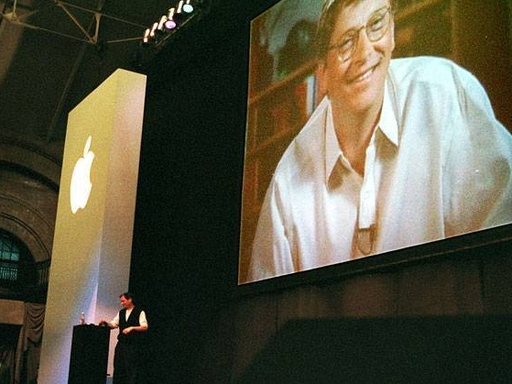
Macworld 1997: Jobs on stage, Gates announcing investment + Office 98 for Mac via video
Dignity counts for nothing against the tide.
Second, Apple is attempting to build a more open developer ecosystem.
This includes: Siri Extensions API letting third-party AI models access system-level experiences, Core AI framework replacing the outdated Core ML, Foundation Models v2 enabling side-loaded large models with three lines of Swift code, and a dedicated App Store AI section.
Clearly, Apple aims to replicate its 2008 playbook. Back then, in the smartphone blue ocean, developers who learned Objective-C and Apple's Human Interface Guidelines could reach the world's most affluent user base. In its first year, the App Store paid developers over $1 billion; by 2017, that figure reached $70 billion.
By opening its ecosystem to compensate for its innovation shortfalls, Apple lets developers explore scenarios it hasn't yet envisioned. This was its path in the last era, and now it hopes to replicate it in AI.
But the challenges are immense. By every measure, this move reeks more of forced compromise than proactive innovation.
For instance, Apple seeks to control AI's entry layer. According to WWDC 2026, App Intents becomes the sole interface for third-party apps to be invoked by Siri, while SiriKit is officially retired. Apps that don't migrate will become invisible to AI. Yet AI's core competitiveness lies not in entry points but in model capabilities, data flywheels, and iteration speed. When developers can directly invoke Google Gemini or OpenAI via Siri Extensions, Apple controls only the switch, not the power grid.
Once users perceive third-party AI experiences as superior to Apple's in-house offerings, they'll bypass Siri for native apps—rendering Apple's entry-point 'promise' obsolete, reducing it to a costly middleman.
Apple's reliance on Google Gemini carries similar risks: If Siri's core intelligence comes from Google, why wouldn't users just use Google Assistant or the Gemini App?
As Cook steps down, these questions will fall to incoming CEO John Ternus to answer. A hardware engineering veteran, he led the development of the M-series chips and Vision Pro. His appointment signals Apple's continued belief that AI's ultimate competitive edge lies in integrating 'chips + devices + ecosystem.'
Cook concluded his tenure with an 'AI makeup exam,' and Apple has shed its arrogance of developing everything in-house, adopting a more pragmatic approach to AI competition. Partnerships with Google, openness to third-party AI models, and embracing Agent concepts—these shifts, though late, at least point in the right direction.
John Ternus still has a chance to craft a new version of Apple's signature 'late-mover advantage'—of course, all while maintaining Apple's hardware edge.
-
![]()
62.9%! New Energy Penetration Rate Surges to All-Time High
-
![]()
Apple Shareholders Paid a $230 Billion 'Makeup Exam Fee' for Apple's AI
-
![]()
Qianwen’s Version of ‘Being Inside the Nails’
-
![]()
Unbelievable! Chery’s Rumor Refutation Disappears—Who’s Behind the Chaos?
-
![]()
Force Robotics Acquires Atomix: Empowering Robots to Develop Data Flywheels in Real-World Business Environments
-
![]()
Is India Acquiring Electric Vehicle Tech from China? Chery Responds
-
![]()
Struggling to Compete? Japanese Automakers Shift Focus to India, a Market Even Musk Avoids
-
![]()
Why Haven’t We Seen Any Automakers Go Bankrupt Yet, Even as 2026 Reaches Its Midpoint?