On June 3, the Indian IT Sector Faced a Major Upheaval
 06/09 2026
 470
470
Over the past year, global attention has been fixated on the United States and China, with OpenAI, Anthropic, and DeepSeek轮流成为焦点(taking turns to dominate the headlines). However, the first major blow from AI was directed at India.
If AI can indeed write code, conduct testing, create documentation, and handle customer service, what will become of the country that relies most heavily on "exporting programmers"?
India is about to find out.
Multiple industry insiders told Pencil News that this seismic shift accelerated dramatically in the second half of 2025, marked by the rise of Agentic AI. AI can now autonomously complete 70% to 80% of the work involved in developing SaaS software.
Kouding Intelligence, an AI programming company that has secured three rounds of funding, told Pencil News: "The impact of AI programming on the IT outsourcing economy is not just significant—it could be catastrophic."
- 01 - Three Decades of Prosperity, Built on a Codebase
One industry has underpinned India's economic rise for 30 years.
Many are unaware that India's most profitable sector is neither manufacturing nor the internet, but IT outsourcing.
According to data from the National Association of Software and Service Companies (NASSCOM), in the 2025 fiscal year, the total revenue of India's technology industry reached approximately $282.6 billion (around 2 trillion yuan), with IT services contributing about $137 billion—nearly half of the total.
More critically, exports. In the 2025 fiscal year, India's technology industry export revenue hit $224 billion, accounting for nearly 80% of total revenue.
What does this signify? Simply put, one of India's most lucrative businesses has been serving American and European companies.
Luan Tianyi, CEO of Kedichuhai, succinctly captured the essence: "Software outsourcing is essentially 'selling people.' Billing by headcount and man-hours is very similar to the construction industry." Over the past 30 years, India has nearly rewritten its national destiny through this industry. American companies needed software development, European banks required system maintenance, and Fortune 500 companies sought digital transformation. The solution? Outsource the work to India, which then mobilized tens of thousands of engineers to fulfill the orders.
This has led to a classic model: More clients lead to more projects, more engineers, and higher revenue.
Today, India's leading IT service companies epitomize this model. In the 2025 fiscal year, TCS's annual revenue exceeded $30 billion, with a workforce of nearly 600,000; Infosys's annual revenue was about $19.3 billion, employing over 320,000 people; Wipro's annual revenue was about $10.5 billion, with over 230,000 employees.
These three companies alone employ over 1.15 million people.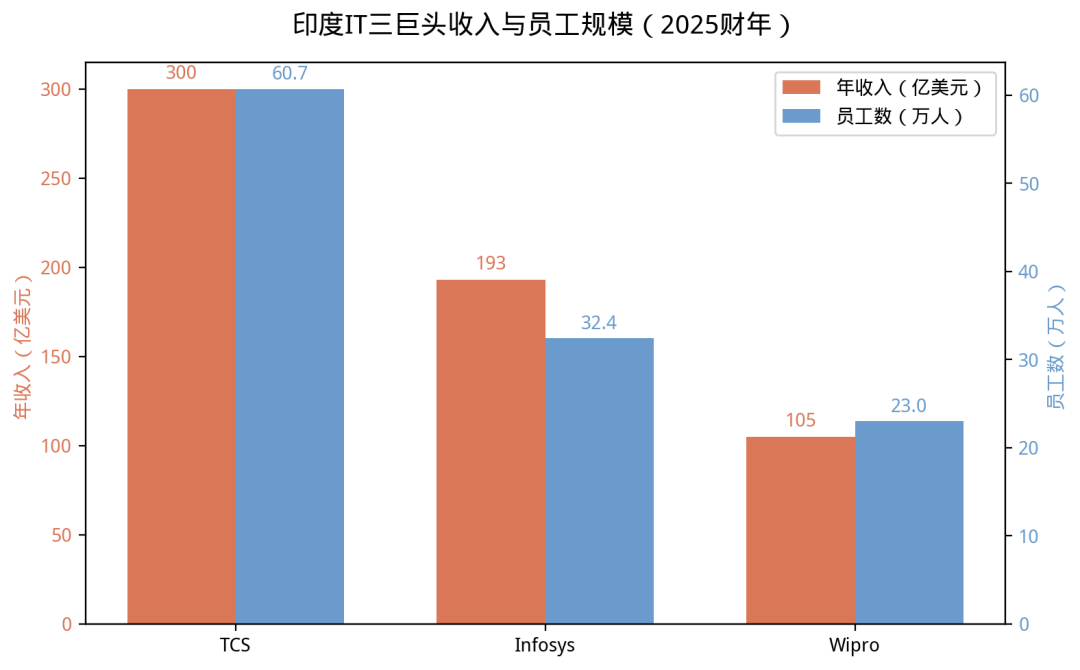
Revenue and Workforce Scale of India's IT Giants (2025 Fiscal Year) Source: NASSCOM
More importantly, these companies' growth logic has long been highly consistent: Hire more engineers, take on more projects, and earn more revenue. For decades, a key metric for capital markets to evaluate Indian IT companies was not even AI capabilities but the number of employees.
According to Reuters data, the scale of India's IT industry has reached approximately $283 billion. Many international investors even refer to India as the "world's back office."
But this logic is now being upended. A key factor is AI: The IT outsourcing business is being dismantled by AI programming.
Su Wen said, "New technologies rarely directly kill existing markets. Their more common approach is to completely disqualify you from participating in new markets. It's like having someone specialized in catching balls under the basketball hoop—does that position still exist now? No matter how well you catch, it's meaningless."
- 02 - A 5.8% Daily Plunge: Capital Markets Sound the Alarm
As a result, capital markets have begun to worry.
In February this year, the Indian IT sector lost $22.5 billion (about 160 billion yuan) in market value in a week. At the time, the market thought this was an overreaction. But by June, panic resurfaced.
On June 3, the Indian IT index plummeted by 5.8% in a single day, marking the largest drop in four months; TCS, India's largest software exporter, fell by 9%, Infosys by 4.3%, and Wipro by 3.7%. TCS headquarters building Source: Forbes India
More notably, this was not an isolated incident. By early June, the Indian IT index had fallen by 22% since the beginning of 2026; it had already dropped by 26% throughout 2025. In other words, this star sector that once supported India's economic growth has become one of the worst-performing industries in the market for two consecutive years.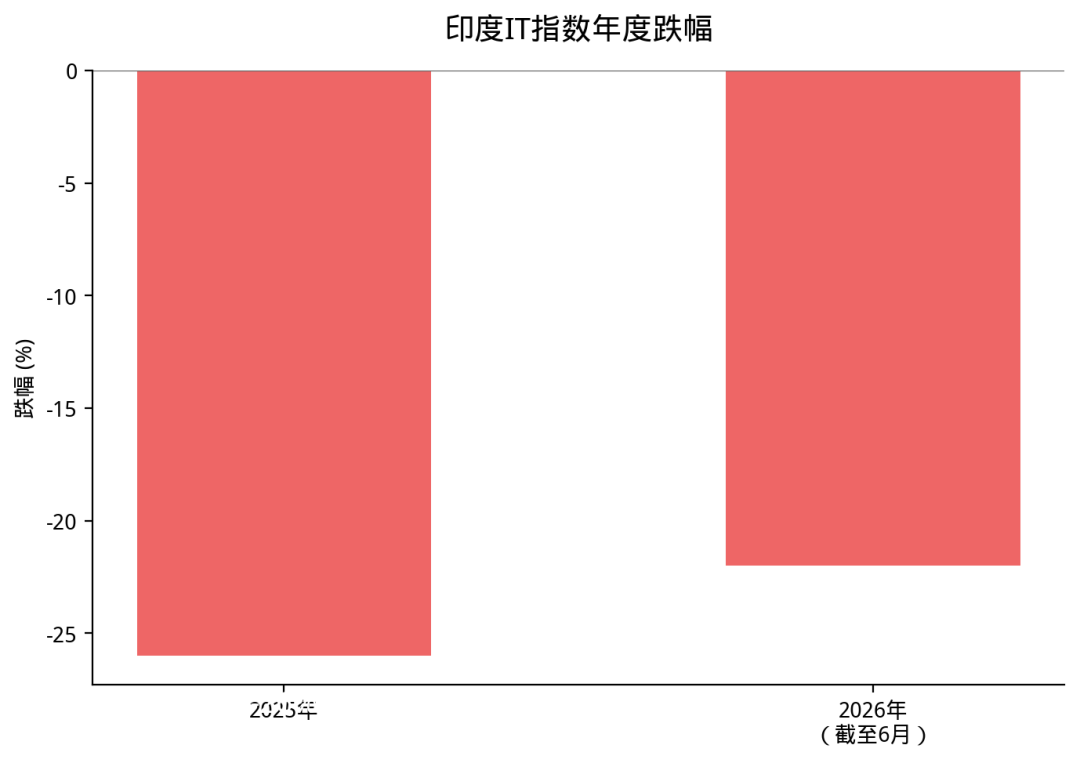 Indian IT index plummets for two consecutive years Source: Economic Times
The reason is straightforward. More and more investment institutions are realizing that AI is replacing India's core business—writing code, testing software, operational support, documentation, and customer service. These tasks once required a large number of engineers, but now more and more companies are trying to use AI to complete them.
What's even more alarming is that capital markets are not worried about "all programmers losing their jobs" but rather that India's most profitable business model will become obsolete.
The old logic was: A client wants a project, an Indian company sends 100 people, and earns money from 100 people. In the future, it may become: A client wants a project, AI completes 80% of the work, and only 20 people are needed.
Kouding Intelligence, an AI programming company that has raised three rounds of funding, provided Pencil News with a set of data: A development team that once required 100 people can now be completed by 2-3 people; an e-commerce website that might have cost hundreds of thousands or even millions to develop can now be built for $6-8.
Even more frightening is the per-customer price. "The per-customer price for software development companies may face a 70%-90% decline," Su Wen told Pencil News.
Brokerage research reports show that the overall net profit margin of the software outsourcing industry has dropped from nearly 10% to about 0.1% (not specific to India). This means that the profit margins of Indian IT companies are being squeezed by AI.
The global perspective is even more daunting.
Mordor Intelligence data shows that the global IT outsourcing market size was about $618 billion in 2025. Among this, about 40%-60% relies on labor-intensive delivery, meaning approximately $250 billion to $450 billion (about 3 trillion yuan) is at risk of being directly replaced or significantly repriced by AI.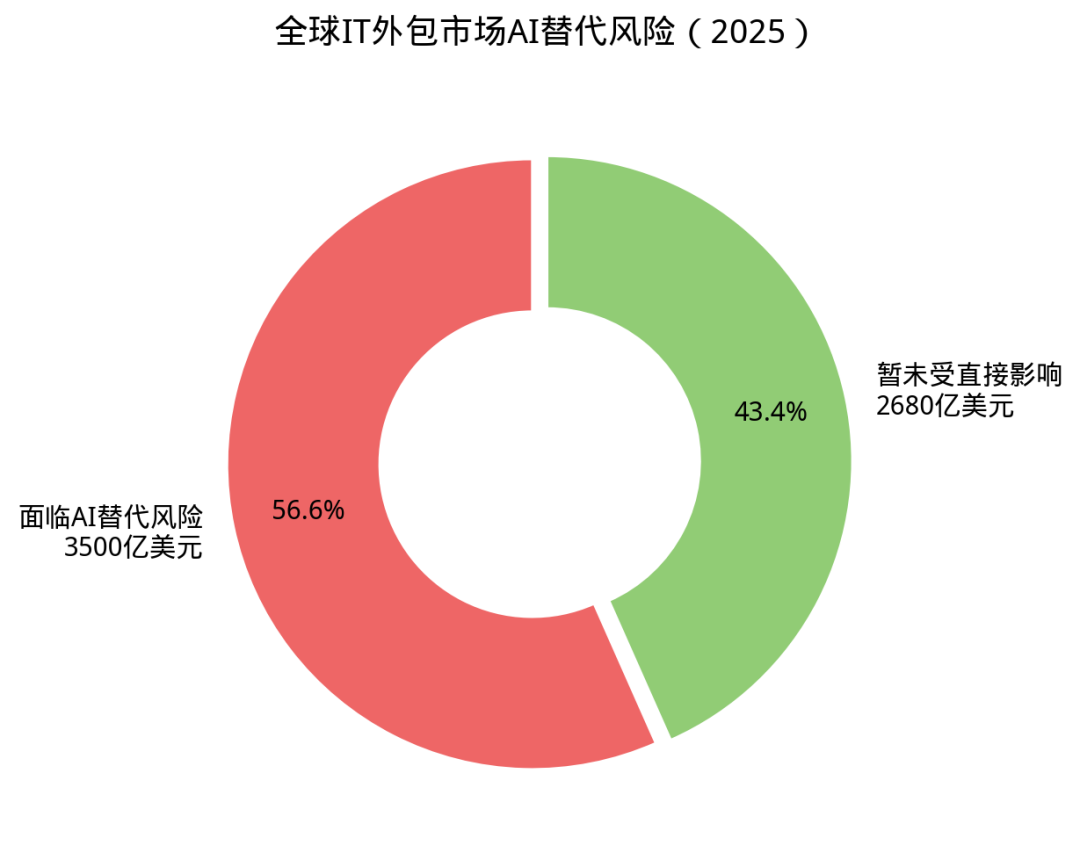 Global IT Outsourcing Market AI Replacement Risk (2025) Source: Mordor Intelligence
For a $280 billion industry, this is a nuclear-level alert.
- 03 - Leading Companies Begin Layoffs
A more dangerous signal has emerged.
If it were just a stock price decline, it would not be a big deal. What truly deserves attention is recruitment. More direct changes are already visible in the headcounts of leading companies.
Su Wen's judgment is even more radical: "A 20-fold reduction in engineering staff is the minimum." Mei Si, a senior programmer with over a decade of experience at major firms, shares a similar view: "The future trend is a 10:1 compression. An engineering team of two to three thousand people may eventually only need two to three hundred."
India's largest IT service company, TCS, had about 607,000 employees in the 2025 fiscal year, a decrease of about 13,000 from the previous fiscal year.
Infosys had about 324,000 employees, a year-on-year decrease of about 15,000. This is a rare phenomenon in India's IT industry over the past few decades. For 30 years, these companies' headcounts almost only increased. Growth was the norm; contraction was the exception. Today, this 30-year growth curve is turning downward.
Lalit Ahuja, founder and CEO of ANSR, bluntly stated, "There is a cautious mood in the market, and companies are reducing hiring."
The recruitment market across India's tech industry is sharply shrinking. In June 2026, active tech job vacancies in India had dropped to 93,000, the lowest point in 28 months. Job vacancies for technical positions requiring less than two years of experience plummeted by 44% year-on-year—nearly half of entry-level positions have disappeared.
Su Wen explained the underlying logic: "Development tasks with a complexity level of 4 or below can be completely replaced. A team that once required 100 people now only needs 2-3."
In past growth cycles, an increase in projects often meant an increase in hiring; now, revenue growth is gradually decoupling from employee growth.
The biggest headache for Indian tech companies used to be a shortage of people. Today, they are beginning to wonder if they have too many.
When leading companies like TCS and Infosys simultaneously start "downsizing," the direction of an era has changed.
- 04 - AI Strikes at India's Economic Heart
Why is India more at risk than others?
Because what AI is disrupting in India is not a peripheral industry but a core one.
For example, if AI impacts an e-commerce company, the effect is limited. If AI impacts the advertising industry, the effect is limited. But India is different—IT services are one of India's most important export industries. India's total IT industry revenue has exceeded $315 billion, accounting for over 7% of India's GDP and employing more than 6 million people. Behind these 6 million people are 6 million families and tens of millions of livelihoods.
More importantly, this is not an isolated industry. IT outsourcing supports India's training industry, real estate (office buildings and residences in Bangalore and Hyderabad), services, and education sectors. One IT job drives at least 3-5 peripheral jobs. This means AI's impact on the IT industry could ultimately affect the employment ecosystem of 20-30 million people in India.
Moreover, India faces an even harsher reality. Reuters data shows that India's urban youth unemployment rate remains as high as 13.6%.
Many young people are already struggling to find jobs. The unemployment rate among Indian university graduates has surged to 29.1%, with 40% of young graduates under 25 unable to find work. Every year, over 1.5 million computer science graduates enter the job market, but only 42.6% meet corporate employability standards.
Now AI is further squeezing employment rates. Employment pressure + skills mismatch + AI replacement are not three independent issues but an interlocking death spiral.
Su Wen put it bluntly: "The new market has bypassed you. You're not losing to competitors; this segment is being erased by technology."
Analysts at Everest Group bluntly stated, "AI will no longer need L1 and L2 engineers." And these L1 and L2 engineers are precisely the foundation of India's IT industry, the first stop for 1.5 million computer science graduates each year, and the entry point for millions of families to change their fortunes.
- 05 - India's Potential: 80% of Employees Use AI, Leading Globally
Of course, India could also become the biggest winner.
The story does not end here because India has another set of data.
According to Boston Consulting Group's (BCG) latest "AI at Work 2026" report, India has become one of the most proactive countries globally in AI adoption, ranking first in AI usage among employees and managers.
Another survey, "People at Work 2026," conducted by ADP across 34 countries, shows that 80% of Indian employees use AI tools multiple times a week; 41% use AI daily. The global averages are only 50% and 20%, respectively.
In other words, about 1 in 5 people globally use AI daily; in India, about 2 in 5 people do.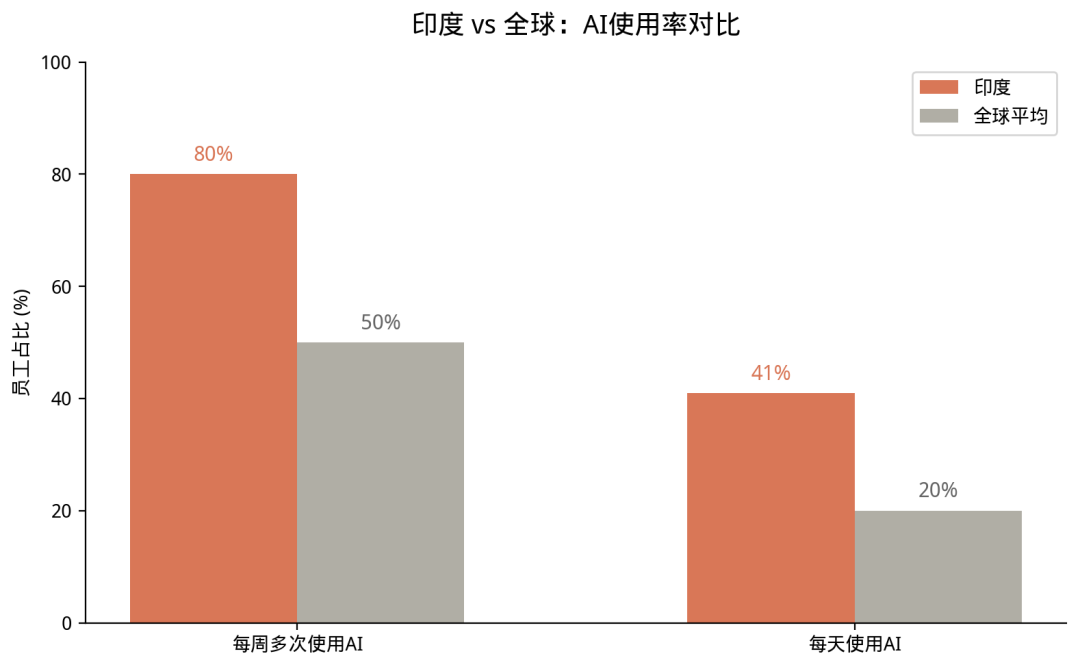
India vs. Global AI Usage Comparison Source: BCG/ADP 2026
Not only are employees using AI, but companies are also deploying it on a large scale. In late May, Microsoft disclosed that TCS, Infosys, and Wipro had each deployed over 100,000 Microsoft 365 Copilot licenses, with a combined total of over 300,000 seats. Microsoft called this one of the largest enterprise-level AI implementations globally.
In other words, two things are happening simultaneously in India: On one side, AI is impacting traditional outsourcing jobs; on the other, AI is penetrating enterprises at an unprecedented speed. This is why Microsoft India's head recently publicly stated that India has become one of the fastest-growing global markets for AI.
- 06 - A New Paradigm Emerges
What might the new paradigm for IT outsourcing in India be?
In fact, while capital markets are still worried about the Indian IT outsourcing model being dismantled by AI, India's largest tech companies have already begun searching for new ways to make money: no longer selling engineers but selling AI productivity.
The most typical example is TCS. In the first quarter of 2026, TCS disclosed that its annualized AI-related business order volume had reached $2.3 billion, up from $1.8 billion in the previous quarter—a 28% increase in just one quarter.
At the same time, TCS's single-quarter new orders reached $12 billion, remaining at a historical high. This indicates an interesting phenomenon: Clients have not stopped spending money; they are just spending it differently.
In the past, clients bought 100 programmers. Today, clients buy AI solutions, agent systems, and automation capabilities.
Many people believe that India's greatest future opportunity lies in following the U.S. model and creating a product like Cursor. However, a prevailing viewpoint is that India's true opportunity lies in becoming the world's largest AI implementation hub. In the realm of large models, the U.S. has already produced a number of monopolistic companies such as OpenAI, Anthropic, Google, and Meta. But models are just the beginning; the real complexity lies in implementation.
By 2026, India is projected to have set up more than 2,100 Global Capability Centers (GCCs). These centers will provide services to multinational giants like Microsoft, JPMorgan Chase, Goldman Sachs, Walmart, and Pfizer. They are expected to generate revenues of approximately $100 billion and directly create employment opportunities for over 2.36 million individuals. The main activities of these GCCs encompass software development, system integration, enterprise digitalization, data management, as well as IT operations and maintenance. These tasks call for significant engineering implementation capabilities, an area where India has built up its most formidable strengths over the past three decades.
Based on IDC's forecasts, global enterprise spending on AI is set to surpass $630 billion by 2028. India's biggest opportunity may not be in contending for the model market but rather in competing for the deployment market. Over the past 30 years, India has been exporting engineers to the world. Looking ahead to the next decade, it may well shift to exporting Agent deployment capabilities, AI operations and maintenance capabilities, and AI productivity.
Perhaps this truly represents a new paradigm for India.
-
![]()
Storage Price Increases Weigh on Industry! Global Smartphone Production Set to Decline by 16.2% by 2026
-
![]()
Large Models Reignite Big Tech's 'Healthcare Dreams'
-
![]()
Siri AI Takes Center Stage, VisionOS Steps Back: Can Cook Secure Victory in the AI Showdown?
-
![]()
Tencent and JD.com Forge Alliance: AI Agent Achieves Transaction Breakthrough
-
![]()
Auto Market Sees Increasing Polarization amid 'Moderate Recovery,' SAIC Volkswagen Leads Transformation with Five New Energy Models
-
![]()
Automotive-Grade Chip Prices Skyrocket by 180% in Three Months, Prompting NEVs to Stealthily Hike Prices Again
-
![]()
Kuaishou’s Kling Reaches 100 Million Users Worldwide: What’s the IPO Valuation in Hong Kong?
-
![]()
Li Feifei's Manifesto on World Models