Large Models Reignite Big Tech's 'Healthcare Dreams'
 06/09 2026
 412
412
Source | Bohu Finance (bohuFN)
How much does it cost to build a top-tier hospital? ByteDance's answer is 6 billion yuan.
Some time ago, the Chaoyang Branch of the Beijing Municipal Commission of Planning and Natural Resources publicly displayed the planning scheme for the 'Beijing Airui International Medical Complex,' a tertiary general hospital with a total investment of 6 billion yuan, held by a ByteDance subsidiary.
To outsiders, tech giants and top-tier hospitals may seem like unrelated entities. However, ByteDance is not alone; in recent years, internet giants have quietly extended their layout (layout) into offline healthcare.
In 2021, ByteDance opened its first Xiaohe Clinic in Beijing; in April this year, JD Health's comprehensive outpatient clinic in Wangjing officially opened. Alibaba, Tencent, Baidu, and others have also been active, such as Ant Group's previous acquisition of Haodf Online.
However, healthcare is a 'slow business' with high barriers, low tolerance for errors, and long return cycles. Over the years, these companies have remained restrained in their layout (layout). It wasn't until AI healthcare became a trend that these 'far from healthcare, close to AI' giants finally saw a breakthrough.
Can these giants finally crack the 'tough nut' of healthcare in this round?
01 Big Tech Has Long Coveted Healthcare
More than a decade ago, big tech companies had already set their sights on the healthcare business.
In 2015, Alibaba Health took over Tmall's pharmaceutical business and launched services like cloud hospital platforms; that same year, JD began selling medicines as an online pharmacy; in 2017, JD Internet Hospital officially went live.
Baidu started layout (laying out) the healthcare sector even earlier, in 2010, developing services like medical search and registration; Tencent, since 2012, has relied on WeChat to offer services like appointment registration, payment, and waiting.
Over the years, big tech's layout (layout) in healthcare has shared a common trait: a focus on superficial 'connection' services.
Whether opening internet hospitals to provide registration and light consultation services or layout (laying out) pharmaceutical e-commerce to cover more medication purchase scenarios, these efforts essentially remain traffic matching businesses without touching the core diagnostic and treatment processes or the vast healthcare ecosystem.
For big tech companies, their primary consideration is not 'can we do it' but 'is it worth doing and how to do it.'
First, healthcare is a business with public welfare attributes; it cannot be overly commercialized, as this could easily provoke public resistance.
This means big tech companies must carefully balance 'commercial profitability' and 'social responsibility,' forcing them to maintain a high degree of strategic restraint.
Second, over the past decade, the monetization models in healthcare have been relatively limited. Online consultations, traffic matching, and pharmaceutical e-commerce are the three most common business models, all of which have been extensively explored by big tech.
However, each of these monetization models has its shortcomings:
Online consultations are low-frequency; users ask their questions and leave, making it difficult to retain them. Pharmaceutical e-commerce may seem like a high-frequency necessity, but it is essentially an e-commerce business, only tangentially related to 'healthcare.'
Traffic matching, while high in frequency, operates at two extremes. Ordinary registration and payment services are low-margin businesses; if higher-margin medical advertising is pursued, it places significant demands on the platform's compliance control capabilities.
Haodf Online is a typical example. Its founder, Wang Hang, set 'three no' principles for the platform: no profit from medications, no self-built offline hospitals, and no medical advertising business.
Wang Hang's intentions are respectable, but in the business world, excessive restraint means self-limitation. Once external conditions change, it is easy to fall into operational difficulties.
Another mobile healthcare platform, Chunyu Doctor, is also facing this issue. According to its disclosed data, the company incurred losses of 9.572 million yuan, 22.949 million yuan, and 2.918 million yuan in the first 10 months of 2023, 2024, and 2025, respectively.
Today, leading platforms like Haodf and Chunyu Doctor have been successively acquired. The internet healthcare business may seem easy, but without sufficient resources and financial strength, platforms find it difficult to persist.
More importantly, healthcare is inherently a high-investment, high-barrier business. If big tech companies are unwilling to settle for mere traffic matching, they must acquire or build professional medical teams to gain entry, but the cost of this 'tuition' is destined (destined) to be high.
In 2022, ByteDance fully acquired the high-end women's and children's hospital Amcare for 10 billion yuan, setting a record for the highest transaction in China's private hospital history.

Therefore, against an uncertain backdrop, big tech companies have maintained a delicate balance in this 'arduous but unrewarding' healthcare business: they want to secure a position but dare not move too quickly.
02 Large Models Change Everything
However, the emergence of AI large models has quietly changed everything.
The scarcity of medical resources is a global challenge, and AI large models can amplify limited medical resources, creating replicable knowledge modules to serve more users.
This change is not limited to the consumer (C) end but also covers different levels of the entire healthcare ecosystem.
At the consumer (C) end, the diagnostic and treatment experience of top experts can be empowered to more grassroots patients through AI. Some basic diseases can also be 'triaged first, then treated' through AI product endpoints, alleviating the strain on medical resources to a certain extent.
This is also the current hot direction for big tech companies, such as Ant Group's 'Ant Afu,' ByteDance's 'Xiaohe AI Doctor,' Baidu's 'Wenxin Health Manager,' and JD's 'AI Jingyi.'
In addition to basic functions like health Q&A and health management, 'Ant Afu' also offers real doctor consultations, forming a closed loop from online consultations to medication purchases.

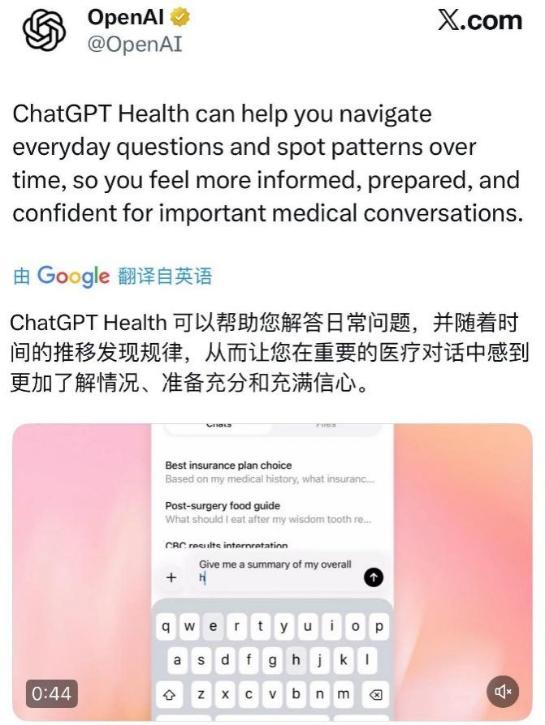
Overseas large model vendors are also accelerating their layout (layout). Earlier this year, OpenAI launched OpenAI Health, allowing users to ask health and wellness-related questions; Claude, with user authorization, can access personal health and diagnostic data, connecting to health insurance and claims.
At the doctor (D) end, AI products can integrate cutting-edge medical research, complex cases, and expert diagnostic experience to provide clinical decision support for grassroots and trainee doctors.
For example, North America's AI healthcare unicorn OpenEvidence aims to 'JPEG compress' medicine, claiming that one in four U.S. doctors already uses its platform.
Alibaba Health's medical AI assistant 'Hydrogen Ion,' JD Health's AI tool 'Zhiyi,' and Baichuan Intelligence's 'Baixiaoying,' powered by its self-developed medical large model Baichuan-M3 Plus, are all medical AI tools targeting this direction.
The imagination space at the business (B) and government (G) ends is even greater. AI can be deployed in hospitals, medical institutions, and public healthcare service platforms. These scenarios not only have rigid demand but also represent long-term service projects that can generate sustained revenue.
With more footholds, AI healthcare has become a must-win battleground for big tech companies.
The first thing noticed is the 'money-making potential' of AI healthcare. Frost & Sullivan predicts that China's AI healthcare market will grow rapidly from 8.8 billion yuan in 2023 to 315.7 billion yuan in 2033, with a compound annual growth rate of 43.1%.
In addition, big tech companies value the strategic importance of healthcare as a gateway to a trillion-dollar health ecosystem, as AI healthcare is one of the few vertical fields that can simultaneously serve the consumer (C), business (B), and government (G) ends.
AI healthcare products at the consumer (C) end are transforming into AI health managers, capable of integrating users' health data, lifestyle habits, and connecting to services like medical care, social security, and insurance, forming highly sticky AI application scenarios.
The business (B) end handles diagnostic and treatment needs; the government (G) end acts as infrastructure, providing underlying credit endorsement and resource allocation guarantees. Once this comprehensive service chain is established and solidified, it becomes difficult to replicate.
Such 'AI + personal service' products are also closer to people's vision of the ultimate form of AI assistants—where the model itself is the product, capable of binding with different types of intelligent terminals to provide deeply personalized services, forming long-term, stable, and scenario-based service models.
03 AI Healthcare Accelerates Implementation
As a result, big tech companies have begun increasing their investments in AI healthcare.
Late last year, Ant Group's 'Ant Afu' entered the market with saturated investment. Ant Group CEO Han Xinyi stated that the marketing spend for Afu's rebranding alone amounted to 'several hundred million yuan.'
ByteDance's investment of 6 billion yuan to build a hospital in Beijing essentially demonstrates a resolve—big tech companies are no longer testing the waters or waiting on the sidelines in AI healthcare but are now vying for market share.
Interestingly, while all big tech companies are betting on AI healthcare, they have chosen different developmental paths.
ByteDance is betting on a heavy-asset model, expanding its healthcare footprint from online to offline through Holdings acquisition (holding acquisitions), deep integration, and self-built ecosystems.
Opening hospitals holds significant importance for the implementation of AI healthcare, as it can bridge the data gap between online and offline services, helping big tech companies establish a closed loop for diagnostic and treatment services. It also allows user consultation data to feed back into large models, improving their efficiency and accuracy.
JD, which has always emphasized supply chain business, is pursuing a strategy of 'using medicine to drive healthcare.' While JD also operates hospitals, it has not taken overly large strides. Instead, it has chosen mature sectors like physical examinations, dentistry, and medical aesthetics, which offer high margins and repeat purchases, to first establish a profitable model.

In contrast, Alibaba, Tencent, and Baidu have opted for a light-asset model, using digital capabilities to connect upstream and downstream players in the healthcare industry and serve as AI healthcare infrastructure.
Among them, Alibaba and Ant Group are undoubtedly the most formidable competitors. Their core value lies not in their user scale but in their ability to provide electronic infrastructure with universal coverage.
Patient care is not an isolated scenario; medical consultation is just the first step. Subsequent steps involve registration, payment, insurance claims, and more, requiring a complete fulfillment system. Alibaba and Tencent are the most advantageous players in this regard.

Currently, while vertical players like iFLYTEK and Baichuan Intelligence are also active in the AI healthcare track , the players most likely to simultaneously succeed in in-hospital medical care, off-site health management, and AI healthcare products are still the big tech companies.
However, the key for big tech companies to gain a foothold is not the choice of business pathway but returning to the first principles of the healthcare industry—patients are the most important.
The core issue remains reliability. Healthcare is not an ordinary consumer product; its tolerance for errors is extremely low. However, current AI healthcare products cannot yet guarantee 100% accuracy.
On social media, many users complain about several mainstream AI large models, citing issues like data hallucinations and inaccurate analyses.
Additionally, regulatory and legal frameworks for AI healthcare are not yet complete, with no clear boundaries for rights and responsibilities. This has also made some healthcare institutions and consumers hesitant to adopt AI healthcare.
Ultimately, AI healthcare is not a breakthrough of a single technology but a systematic project that reconstructs the healthcare field from aspects like technology, scenarios, compliance, and trust.
Within the safe and controllable boundaries of healthcare, truly helping users solve health problems is the essence of AI healthcare implementation.
Of course, there is still a long way to go. AI healthcare will not transform the world overnight, but if big tech companies fail to secure their place now, they may miss out forever.
The cover image and illustrations in this article are owned by their respective copyright holders. If the copyright owners believe their works are unsuitable for public browsing or should not be used without compensation, please contact us promptly, and our platform will make immediate corrections.
-
![]()
Cook’s ‘Curtain Call’: Has Apple AI Finally ‘Set Sail’? | Apple WWDC 2026 Highlights
-
![]()
Cook's 'Curtain Call': Apple AI 'Sets Sail'? | Apple 2026 WWDC Highlights
-
![]()
Storage Price Increases Weigh on Industry! Global Smartphone Production Set to Decline by 16.2% by 2026
-
![]()
Large Models Reignite Big Tech's 'Healthcare Dreams'
-
![]()
Siri AI Takes Center Stage, VisionOS Steps Back: Can Cook Secure Victory in the AI Showdown?
-
![]()
Tencent and JD.com Forge Alliance: AI Agent Achieves Transaction Breakthrough
-
![]()
Auto Market Sees Increasing Polarization amid 'Moderate Recovery,' SAIC Volkswagen Leads Transformation with Five New Energy Models
-
![]()
Automotive-Grade Chip Prices Skyrocket by 180% in Three Months, Prompting NEVs to Stealthily Hike Prices Again