Cook's 'Curtain Call': Apple AI 'Sets Sail'? | Apple 2026 WWDC Highlights
 06/09 2026
 367
367
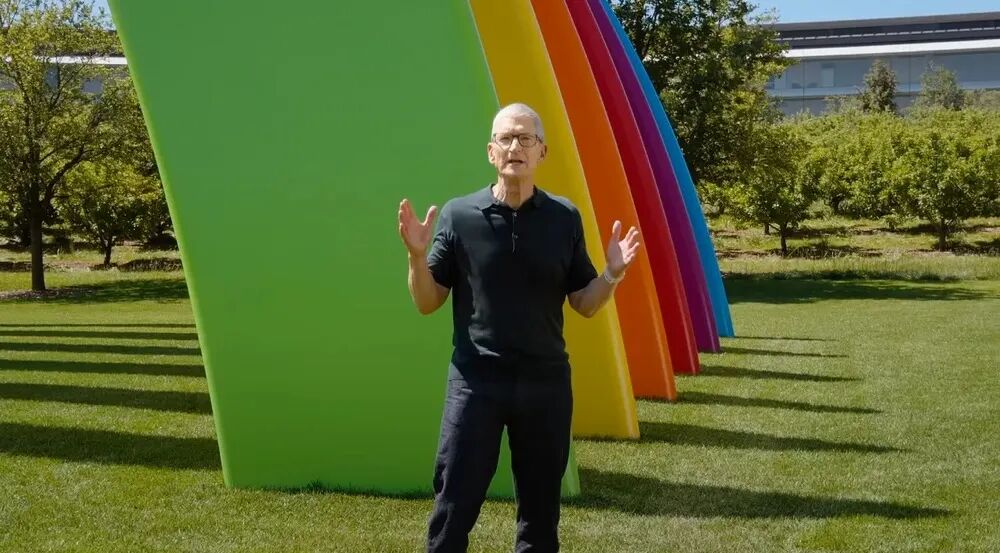
The much-anticipated Siri AI has finally made its debut.
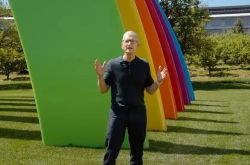
In a 75-minute keynote, with 70% of the content dedicated to AI, Cook seemed somewhat 'eager' in his final WWDC appearance as the host.
WWDC stands as one of Apple's most pivotal annual events, unveiling the latest advancements in software systems such as iOS, iPadOS, and macOS. Over the past three years, AI has emerged as the central theme of WWDC, shaping the future of operating systems.
Two years prior, Apple proudly unveiled Apple Intelligence, aiming to redefine intelligent assistants amidst the AI surge. However, the system's progress fell short of expectations, and the new Siri failed to materialize as initially promised.
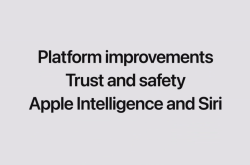
This year's WWDC 2026 carries the weight of restoring Apple's credibility in the AI domain. From Cook's opening remarks, the message was clear: the long-awaited Siri is finally here.
The highlight of this year's WWDC is undoubtedly the arrival of the revamped Siri.
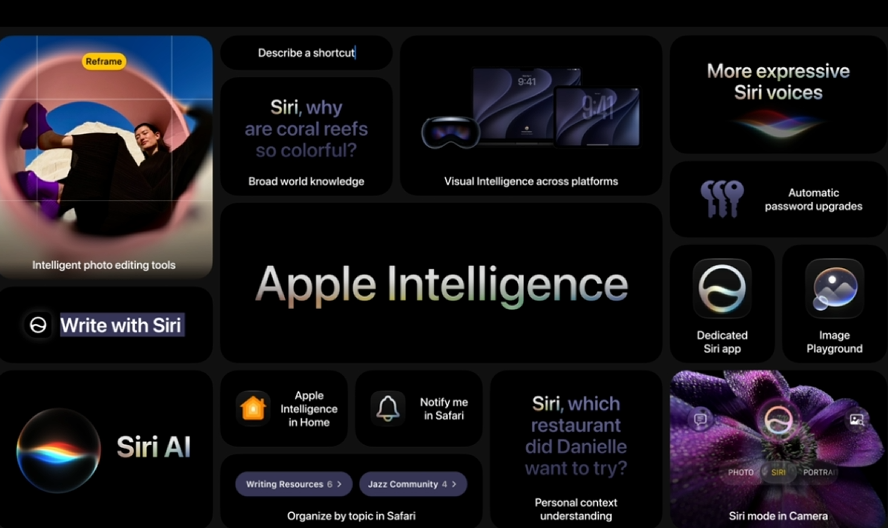
Apple has rebranded the upgraded Siri as Siri AI. No longer just a 'voice remote' for playing music, making calls, or checking the weather, it has evolved into a true system-integrated Agent.
In essence, the new Siri AI is far from underwhelming. Like last year's revolutionary Doubao phone, Apple's mobile AI now boasts ubiquitous system-level capabilities.
The new Siri boasts five key capabilities: personal context understanding, image comprehension, world knowledge, screen awareness, and APP invocation. Almost all daily tasks can be accomplished through Siri, such as replying to emails, scheduling appointments, and composing articles based on chat history.
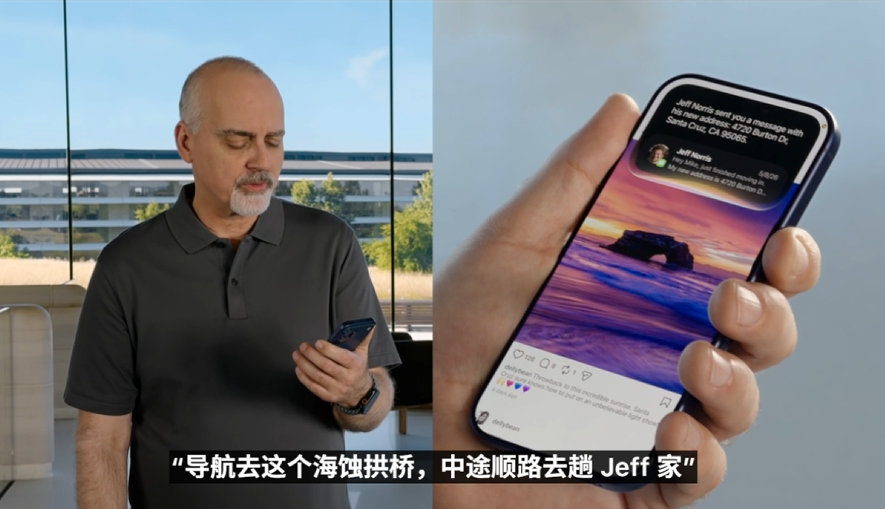
In a demo, the presenter casually opened a photo, and Siri instantly identified the location on the screen, navigated to it on the map, and then cross-referenced a friend's address from a social APP to plan a route with a stopover at their house—completing tasks involving screen information viewing, data extraction, and relevant APP invocation. Clearly, the new Siri has become a higher-level gateway above apps.
Another demonstrator utilized Siri to check the World Cup's first-week schedule, proposed hosting a Brazil vs. Morocco viewing party, and asked Siri to recommend classic dishes from both countries. Siri then searched global knowledge, retrieved coconut cookies mentioned by friend Maria in a chat, and ultimately compiled a menu blending both cuisines, drafting a group invitation with the menu attached and sending it with one click—all without manual intervention.
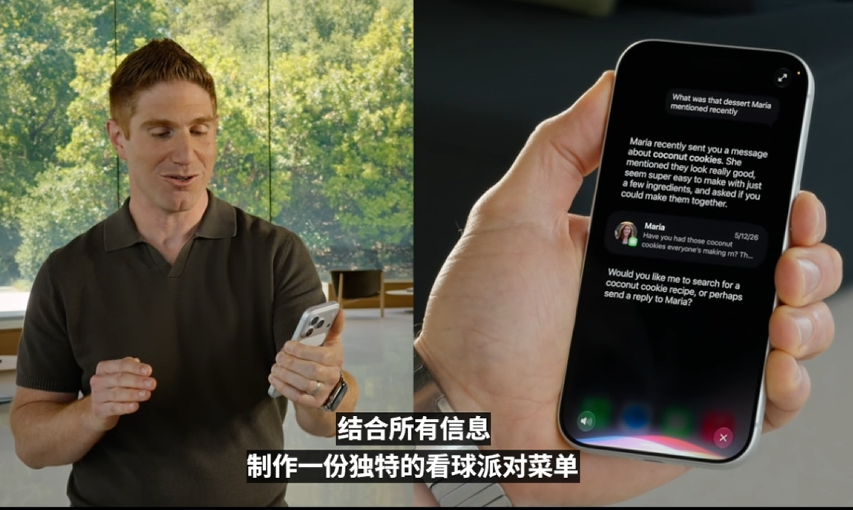
From Apple's official demos, Siri AI is no longer a mere assistant. With Agent capabilities and multimodal functions, it can now 'see' the phone screen and 'act' on behalf of users. While these tasks primarily rely on Apple's native APPs and haven't yet reached the level of coordinating third-party APPs—or even matching the freedom of domestic AI phones to order coffee with a single phrase—this nonetheless represents a significant upgrade for Apple, which has 'acknowledged its tardiness in AI.'
Additionally, Apple showcased a series of AI-powered 'modular' application capabilities, emphasizing AI's omnipresence.
Siri can also assist in organizing photo albums. A simple command like 'Put photos with [name] into the family shared album' allows Siri to handle recognition, filtering, and operations without opening the APP.
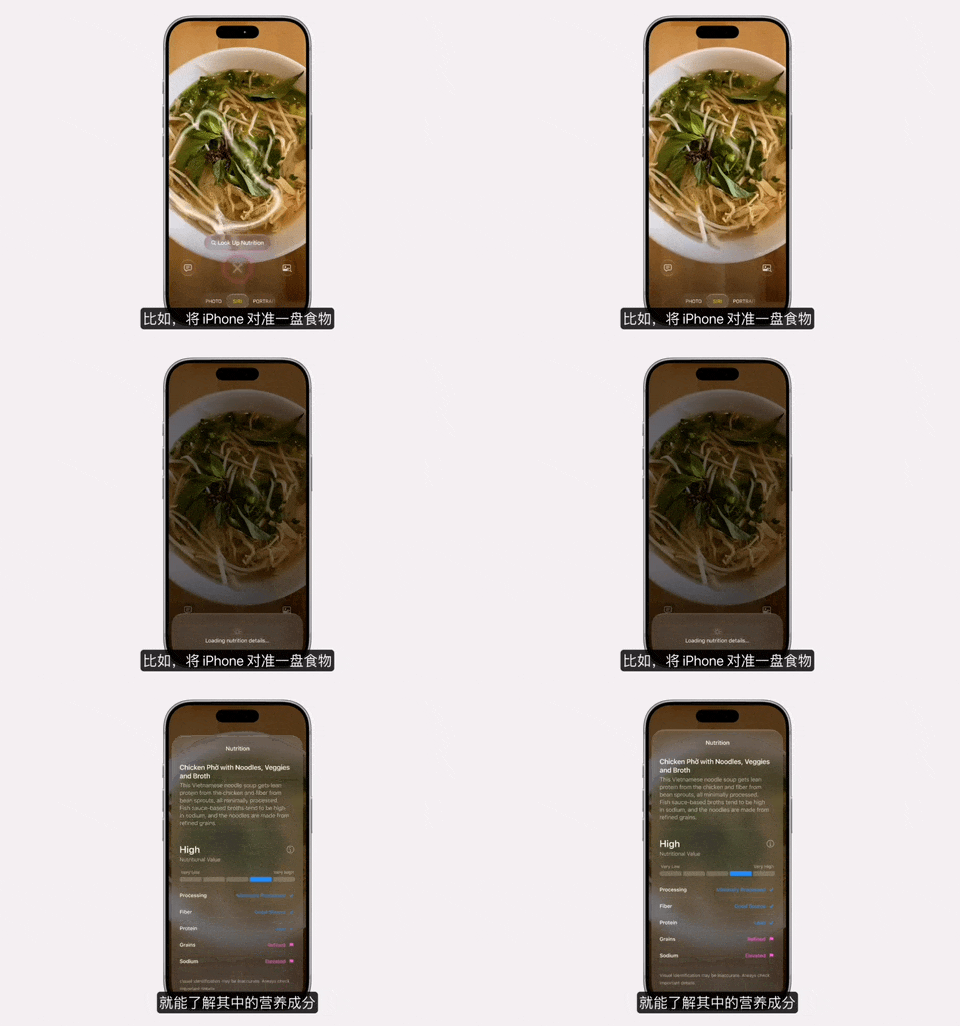
Siri is also integrated into the camera. Pointing the lens at an object enables users to ask Siri questions, such as the calorie count of a dish or how much each person owes on a bill.
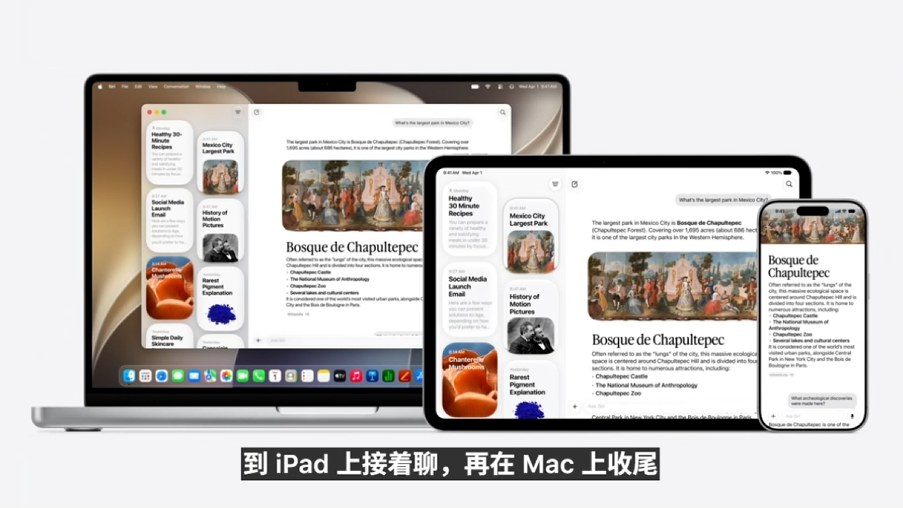
In terms of activation methods and multi-device experiences, Siri AI retains both 'Hey Siri' and side-button wake-up options, while also being embedded in the Dynamic Island. A downward swipe enables multi-round voice or text conversations. Furthermore, Apple has launched a dedicated Siri APP, with all conversation records privately synced via iCloud. Conversations initiated on an iPhone can continue on an iPad and conclude on a Mac.
Siri's form varies across platforms. On Mac, Siri is integrated into Spotlight, accessible from any interface, with right-click menus allowing questions about selected content. On Apple Watch, Siri AI operates with minimalist interactions directly on the wrist. Vision Pro takes it further, requiring only a glance at Siri to speak—no wake word needed.

These capabilities are driven by Apple Intelligence. The system operates on-device and in private clouds, with simple tasks running locally and complex ones sent to Private Cloud Compute.
Built on the Apple Intelligence foundation, native APPs like Safari, Messages, Mail, and Calendar are now empowered with AI capabilities.
Behind Siri AI's impressive performance lies Apple's complete rebuild of its AI architecture, finally unveiling the long-delayed Apple Intelligence.
Recall that at WWDC 2024, Apple's high-profile launch of Apple Intelligence generated significant anticipation. The promise of the most 'Apple-like' experience, seamless AI large model collaboration (ChatGPT), and flawless edge-cloud synergy was Apple's commitment to consumers—and a reference point for AI smartphone manufacturers in deploying intelligent agents. Some analysts and consumers even believed Apple might still develop its own AI.
However, at WWDC 2026, all doubts were dispelled. Apple Intelligence is built on Google Gemini.
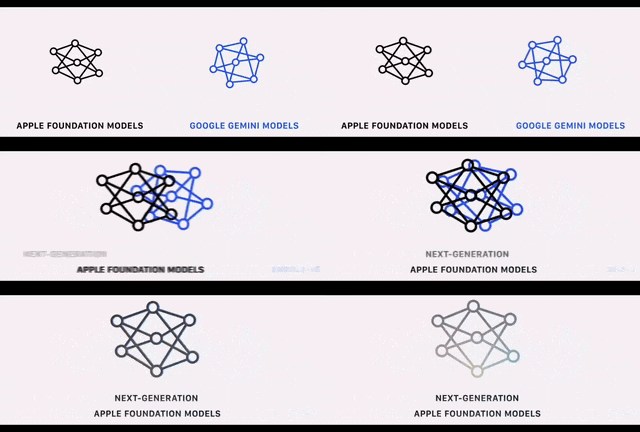
While details remain scarce, we can still examine Apple's new AI architecture. Logically, Apple AI adopts the industry-consensus hybrid edge-cloud architecture. Apple's foundational models—Apple Foundation Models—are a series co-developed with Google based on Gemini, deployed on-device and in the cloud (Private Cloud Compute).
On the cloud side, Apple has built dedicated AI infrastructure. According to Apple, the cloud processes user requests and then 'deletes' the data, ensuring Apple neither stores nor accesses user information.
This design defies convention, as AI large model companies highly value interaction data with users to iteratively improve model capabilities. For Apple, however, it resembles a 'one-and-done' approach to handling complex user demands (image generation, complex reasoning, etc.). This may suggest Apple lacks a mature data loop or even independent model training capabilities.
On the edge side, Apple categorizes models into high- and low-capability tiers this year. First, all Apple Intelligence-compatible devices come with a ~3B-parameter foundational model.
On higher-performing devices (e.g., latest phones, PCs), Apple adds a larger model capable of higher-quality outputs and longer contexts. Apple also includes a dedicated speech model for natural conversations and personalized voice synthesis in the new Siri.
For edge-side foundational models, Apple's solution is noteworthy. It introduced a System Orchestrator architecture to manage Apple Intelligence.
To clarify, an Orchestrator in AI (especially in the era of intelligent agents) no longer relies on a single large model for all tasks but instead coordinates multiple small models with varying capabilities, tools (search, APP invocation), edge-cloud tasks, and contextual (multi-step) memory. The Orchestrator's role is to break down overall tasks into suitable sizes and assign them to the most appropriate components.
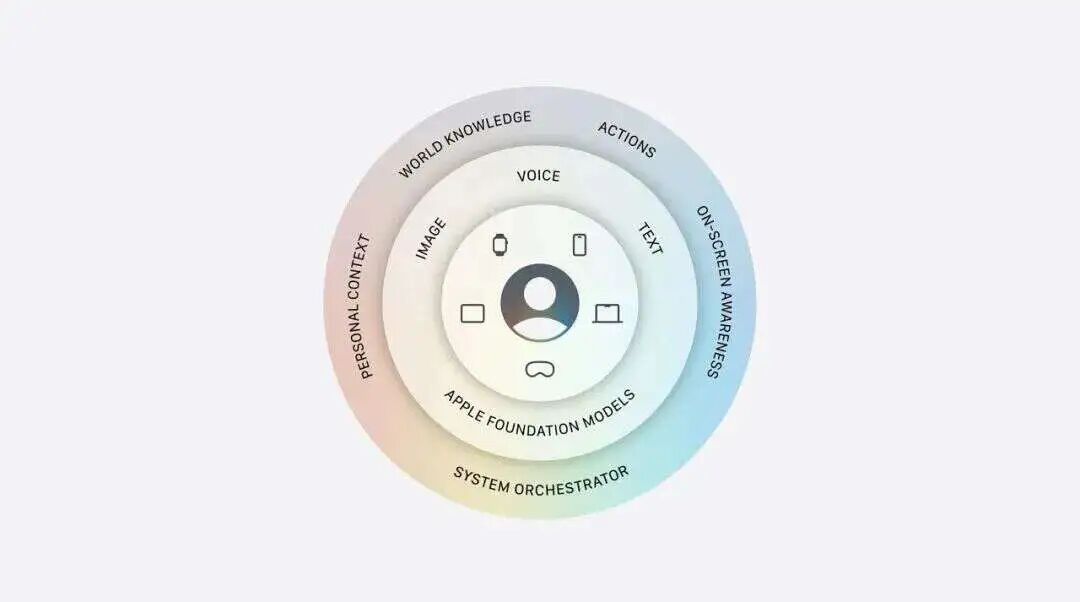
Apple's System Orchestrator manages four functional modules responsible for personal information understanding, world knowledge, Actions, and screen awareness.
Specifically, contextual understanding refers to on-device information—text, images, emails—which the phone AI comprehends fully to invoke correct data.
World knowledge represents a degree of common sense. Apple offers an online world knowledge service, enabling the AI to access appropriate information when local model knowledge is insufficient or outdated.
Actions empower Siri AI to perform operations rather than just chat, acting as users' 'hands' to manipulate the phone.
Screen awareness serves as users' 'eyes,' reading on-screen information for AI model input.
Overall, the four modules form two paired structures, handling internal/external information acquisition and execution/output roles. According to Apple, this is AI centered around you.
After two years, Apple has finally delivered Apple Intelligence. However, its AI still feels somewhat 'conflicted,' from application effectiveness to strategic layout.
On one hand, Apple Intelligence retains traces of 'old-school' AI assistants. For example, the world knowledge component is a knowledge graph Apple has operated for years, initially intended to address Siri's outdated or fabricated information. Today, with AI large models capable of internet access, this seems redundant. On the other hand, partnering with Google for AI models marks a departure from Apple's obsession with in-house development.
Nevertheless, any AI deployment is a positive step. Especially in 2026, as Chinese smartphone manufacturers continuously showcase innovations, Apple has finally grasped the importance of delivery over perfection.
Finally, the update roadmap: Apple AI supports devices as old as the iPhone 11, but PCs must use Apple chips. China and the EU are excluded for now.
However, Chinese users may gain access soon. Previously, Apple planned to partner with Baidu, using ERNIE Bot 4.0 as the foundation for generative AI on Chinese iPhones to comply with domestic data regulations. Later, it simultaneously collaborated with Alibaba for AI compliance reviews in China.
Without direct access to Google services, Apple will likely seek a new local AI partner, with QianWen being the most probable candidate.
The success and speed of this partnership will directly determine whether Chinese users can access the new Siri.
Beyond regional restrictions, what truly matters at this WWDC is Apple's completion of an AI-era restructuring, embedding Agents into the operating system.
-
![]()
Cook’s ‘Curtain Call’: Has Apple AI Finally ‘Set Sail’? | Apple WWDC 2026 Highlights
-
![]()
Cook's 'Curtain Call': Apple AI 'Sets Sail'? | Apple 2026 WWDC Highlights
-
![]()
Storage Price Increases Weigh on Industry! Global Smartphone Production Set to Decline by 16.2% by 2026
-
![]()
Large Models Reignite Big Tech's 'Healthcare Dreams'
-
![]()
Siri AI Takes Center Stage, VisionOS Steps Back: Can Cook Secure Victory in the AI Showdown?
-
![]()
Tencent and JD.com Forge Alliance: AI Agent Achieves Transaction Breakthrough
-
![]()
Auto Market Sees Increasing Polarization amid 'Moderate Recovery,' SAIC Volkswagen Leads Transformation with Five New Energy Models
-
![]()
Automotive-Grade Chip Prices Skyrocket by 180% in Three Months, Prompting NEVs to Stealthily Hike Prices Again