The 2026 618 Shopping Festival: A Revolution! AI-Powered Shopping Takes the Lead, Is the Price War Finally Over?
 06/09 2026
 335
335
Introduction: Bridging the Gap Between Algorithms and Human Touch: How 618 Leverages AI to Reignite the Joy of Shopping
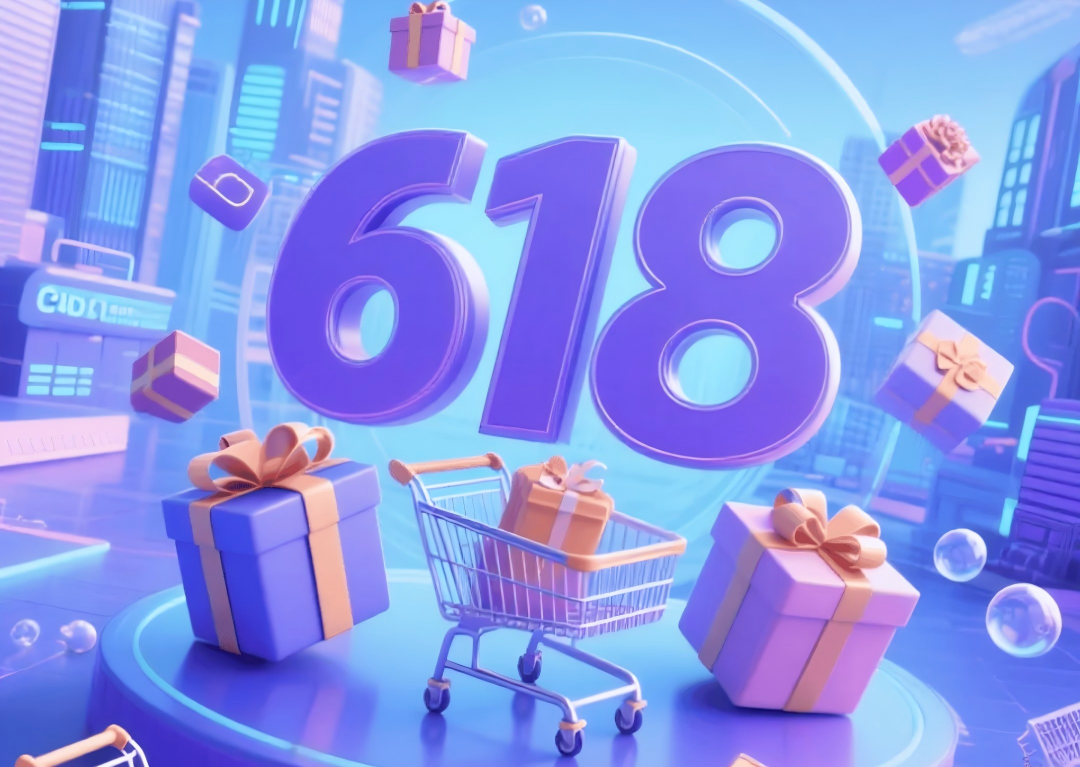
This year's 618 Shopping Festival is a game-changer.
Gone are the days of complex discount calculations and midnight payment deadlines. Leading e-commerce platforms have unanimously embraced the power of AI.
2026 marks what the industry is calling the 'dawn of AI-native mega promotions.'
From Taobao's 'AI Shopping Assistant' to JD.com's seamless AI integration across all scenarios, from Douyin's 'Ask Doubao Before Buying' to Pinduoduo's stealthily tested AI product curation tools, a silent revolution in shopping is underway.
Elon Musk once emphasized the importance of first principles—stripping away the superfluous to uncover the essence. So, what lies at the heart of this year's AI + e-commerce approach to the 618 Shopping Festival?
I. The Core of AI + E-commerce: Simplification
The fusion of AI and e-commerce is not a novel concept. AI has been a part of previous shopping festivals, primarily operating behind the scenes in areas like AI analytics, intelligent customer service, and traffic management.
Whether it's Taobao's unified dialog box addressing all shopping dilemmas or JD.com's all-encompassing AI integration, the AI + 618 models of major platforms are essentially an extension of the simplification trend seen in recent years.
In recent times, 618 has shifted its focus towards 'simplification,' moving away from complex tactics aimed at boosting retention and short-term GMV growth through discounts. They've eliminated combined discounts, freeing users from the burden of 'math' to save money.
This year, AI tools are empowering consumers to derive greater pleasure and satisfaction from shopping, reconnecting them with its true essence.
The new AI + e-commerce ecosystem transforms 'searching' into 'conversing' and 'filtering' into 'recommending.'
This shift is fundamentally about simplification: transitioning from the overwhelming burden of information overload to merely bearing the decision-making cost of selection.
It's akin to the impact of Tesla's direct sales model.
Traditional 4S stores often require consumers to outsmart salespeople, compare prices, negotiate discounts, and navigate mandatory insurance and loan rebates. Buying a car typically entails visiting at least three stores.
Tesla's direct sales model, with fixed pricing, online orders, no middlemen, and no negotiations, offers a stark contrast. Musk stated, 'Consumers don't want a game; they want certainty.'
Many consumers are willing to pay a premium for this streamlined convenience.
Similarly, Japan's 7-Eleven convenience stores may not always offer the cheapest prices compared to supermarkets, but they excel in 'convenience'—being located downstairs, open 24/7, and providing services like money withdrawal and bill payment. Consumers are willing to pay for 'fewer steps and minutes.'
Of course, this year's 618 AI shopping experiment is also a test of AI's practicality for consumers.
After all, many shopping needs are not initially clear but are gradually shaped while 'browsing.'
Like weekend mall visits, we may not intend to buy anything but are captivated by a certain atmosphere amidst the dazzling display windows and enticing aromas, leading to impulse purchases.
Whether browsing online on Taobao or offline in malls, we often start with a vague need rather than a specific product, which becomes clearer during the browsing process.
This is the advantage of traditional search-based e-commerce and offline shopping. In contrast, AI shopping relies on AI's 'superior performance' for precise recommendations or completing purchases with a single sentence, lacking this immersive ambiance.
This 618 is also a platform to encourage more users to truly 'embrace' AI. Through the shopping festival, it assesses the application level of AI, challenging not only the accuracy of algorithms but also whether AI can truly comprehend human needs that are 'felt but not easily articulated.'
Take QianWen as an example: I mentioned a need for a Father's Day gift and sought QianWen's recommendations. It provided a framework of product options, allowing me to swipe left or right to indicate interest before further refining specific product recommendations.
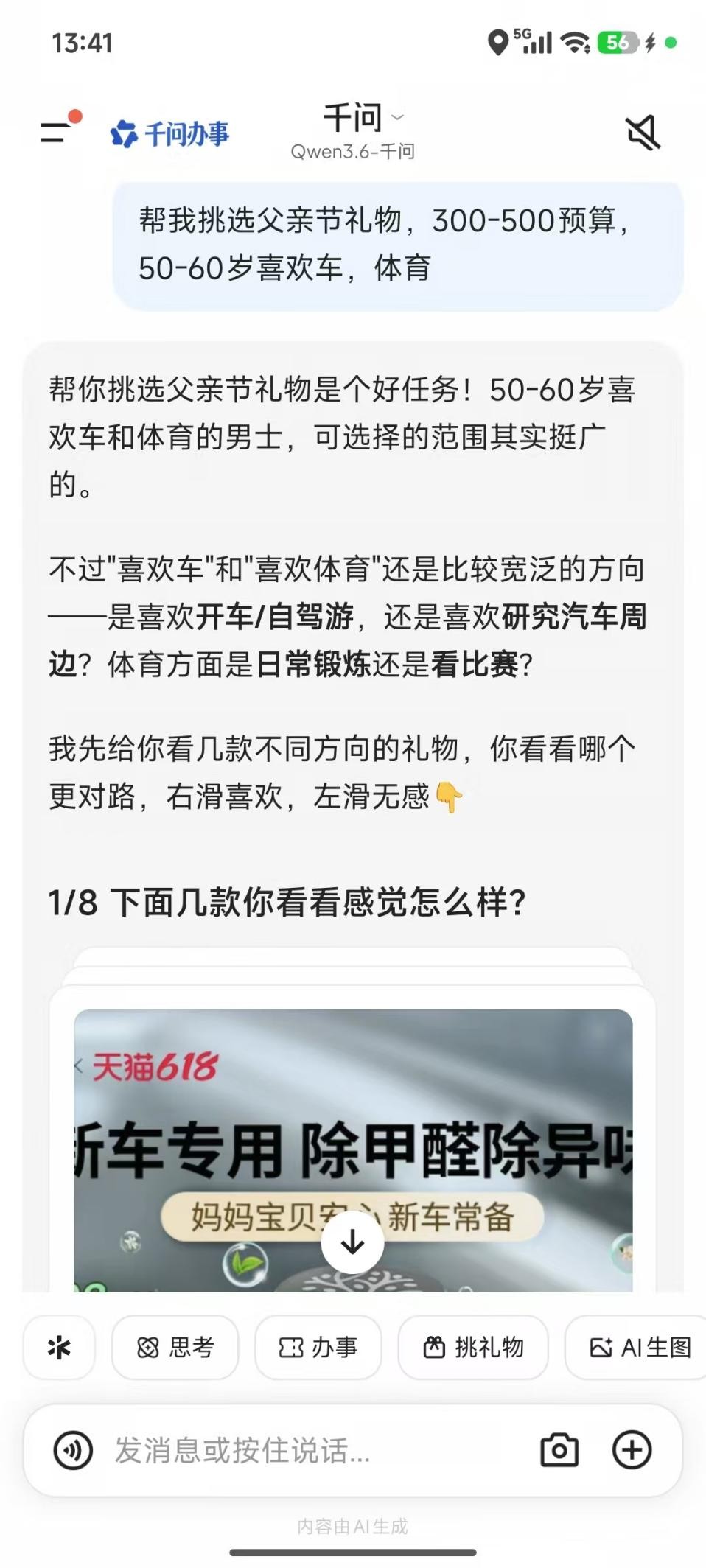
While current AI shopping may lack some of the 'browsing' ambiance, it undoubtedly breaks down the barriers between 'people finding goods' and 'goods finding people.'
This reminds me of how Dianping evolved from a mere 'restaurant search' tool into a 'local recommendations' platform during the mobile internet boom.
When technology reaches a certain maturity, tools transcend their initial positioning and evolve to meet the demands of a new era.
This 618 also signifies a comprehensive popularization of AI applications.
Although AI transformations have been accelerating monthly since last year, many users' AI applications are still limited to interacting with QianWen and Doubao, akin to the initial 'search' phase of internet adoption.
The 618 Shopping Festival provides a scenario for AI to transition from a 'novelty' to a 'utility.'
You don't need to understand large models, Tokens, or Transformers; you just need to know: a simple conversation can save you half an hour of price comparisons.
Technological progress always unfolds in this manner.
When scan-to-pay first emerged, the elderly deemed it 'unsafe' until every stall in the market had a code, and they got accustomed to going wallet-free. When short videos first became popular, many dismissed them as 'a waste of time' until they learned to cook and fix pipes from them, realizing their practical value.
AI is no different. After 618, more people will realize: AI is not just for chatting; it's for getting things done efficiently.
II. This Year's 618: Beyond Just Shopping
While consumers perceive 'simplification,' brands and capital markets see a deeper layer of logic.
Personally, what I hope to witness from this 618 is not just the evolution in pricing or gameplay after AI integration but rather the value AI brings to brands and e-commerce platforms during this period.
During the 618 warm-up phase, a statement from Qingbei Daoyuan added an extra layer of significance to the shopping festival.
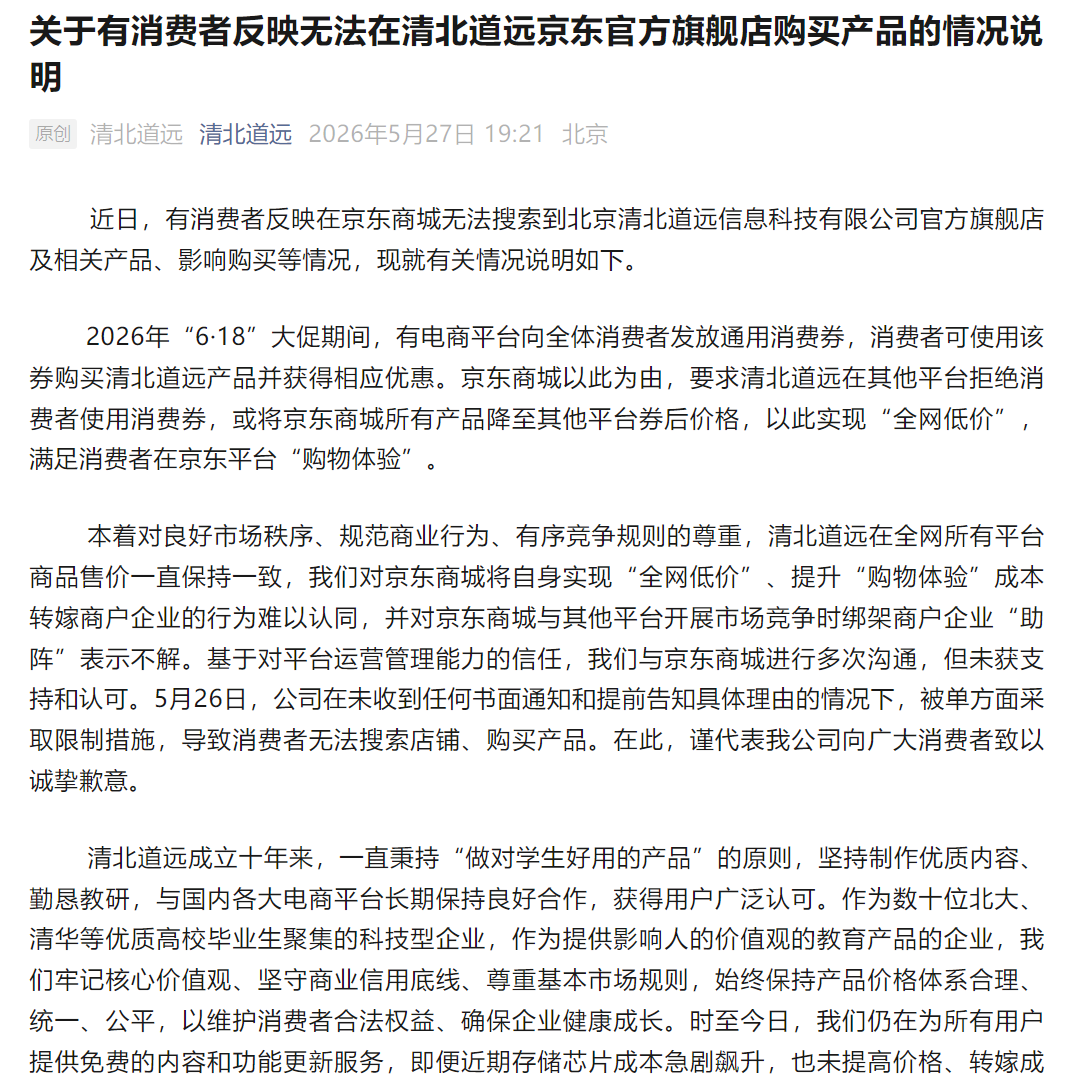
Qingbei Daoyuan stated that JD.com demanded either refusing consumer coupons on other platforms or lowering all JD products to the post-coupon prices on other platforms to achieve 'lowest prices across the net.'
Price comparisons during shopping festivals are not new, nor exclusive to JD.com. However, with everyone embracing AI and entering a new business era, AI + e-commerce has also reconstructed a new traffic distribution mechanism.
In AI mode, consumers gain convenience, and platforms offer enhanced experiences, but merchants also require new traffic acquisition strategies.
The test of AI applications for merchants during this 618 lies in how brands can thrive under the new traffic distribution mechanism.
This growth, I believe, hinges on 'repurchase rates.'
This year, a key metric for merchants is 'repurchase rate.' For instance, in the first-stage battle report of Tmall's 618, it was highlighted that repurchase rates in industries like beauty and apparel exceeded 40%.
AI recommendations are not devoid of context; they are essentially a summary and induction of past data. Once past data is involved, brands that have consistently maintained quality have a significant advantage, possibly fostering a new business ecosystem facilitated only in the first year of AI-native mega promotions.
Of course, this is not solely attributable to AI but also reflects a trend in brand evolution during recent shopping festivals.
In recent years, e-commerce platforms have been advocating for 'simplification' and 'navigating cycles,' essentially aiming to return shopping festivals to their consumer essence, creating a shopping experience that delights both consumers and brands.
We can observe that major e-commerce platforms like Taobao, Tmall, and Pinduoduo have been focusing on brand building in recent years. Even Pinduoduo launched a hundred-billion support program last year, essentially helping unbranded products become recognized brands.
Previously, under many platforms' traffic mechanisms, merchants were like 'wild fishers,' needing constant traffic investment to yield results, with no guarantee of success with each cast.
Now, under the AI + e-commerce mechanism, high-quality brands can 'chum' in the AI recommendation circle based on past quality and reputation, while platforms can build 'fishing ponds' of traffic for quality merchants, enabling low-cost, repeated access to target consumers, establishing stronger emotional connections, and boosting repurchases.
Establishing such a matching space between merchants and consumers allows genuinely needy consumers to meet quality brands, breaking the unhealthy ecosystem of brutal price competition, and guiding brand merchants' long-term operations from 'price correctness' to 'value correctness.'
Besides consumers and brands, this 618 is also a significant test for the e-commerce ecosystem.
Recently, news emerged that WeChat's embedded AI Agent has entered prototype testing and may commence compliance declarations as early as June, causing Tencent's stock to close up 10.46%, with a single-day market value increase of approximately HK$410 billion.
The market's attention to big tech's AI ecosystems is palpable.
But as Joe Tsai previously mentioned, 'It's hard to talk about ROI for the current massive AI investments.'
Investors are optimistic about big tech's AI ventures, like the direction but unclear about the returns. Hundreds of billions of dollars are poured into large models, but what else can be done besides making chatbots more 'human-like'?
This 618, the AI application results of Alibaba, Pinduoduo, Douyin, and JD.com will also demonstrate to the market the practical value of AI, i.e., the ROI of AI investments led by e-commerce.
Take Alibaba as an example. Previously, we discussed how the AI ecosystem integrates Alibaba's core businesses, allowing users to meet all needs—food, housing, transportation, travel, shopping, and entertainment—in a single dialog box.
But this is more of a strategic value, reflecting recognition of Alibaba's AI ecosystem.
Now, the progress of this 618 Shopping Festival has given QianWen more DAUs, provided new takeout order sources for Taobao Deals, and opened new channels for Alibaba's large model Token consumption.
The application value of AI is evident, and the ecosystem's cycle continues, showcasing both strategic and practical value.
Of course, this is not exclusive to Alibaba. Douyin utilized AIGC to generate 40 million words of copy, covering over 1 million merchants; JD.com embedded AI in over 3,000 scenarios, and Meituan's 'Wen Xiaotuan' AI search assistant is also popular during 618.
This 618 has not concluded yet, but we are bidding farewell to the pioneer era of brutal growth relying on information gaps and price wars, stepping into an era of intensive cultivation relying on algorithmic recommendations, quality repurchases, and ecological symbiosis.
When 'low prices' are no longer the sole competitive edge, 'value' becomes the anchor for brands to navigate cycles.
Disclaimer: This article is based on legally disclosed company information and publicly available data, offering commentary. However, the author does not guarantee the completeness or timeliness of this information.
Additionally: Stock markets involve risks; enter cautiously. This article does not constitute investment advice; investment decisions should be made independently.
-
![]()
Zhang Xiaolong Predicted the Rise of Agents a Decade Ago: Will WeChat AI Revolutionize Everything?
-
![]()
In-depth | Subsidy Decline and Restructuring: The 'Scale-up' Challenge for New Energy Heavy Trucks
-
![]()
The 2026 618 Shopping Festival: A Revolution! AI-Powered Shopping Takes the Lead, Is the Price War Finally Over?
-
![]()
Cook’s ‘Curtain Call’: Has Apple AI Finally ‘Set Sail’? | Apple WWDC 2026 Highlights
-
![]()
Cook's 'Curtain Call': Apple AI 'Sets Sail'? | Apple 2026 WWDC Highlights
-
![]()
Storage Price Increases Weigh on Industry! Global Smartphone Production Set to Decline by 16.2% by 2026
-
![]()
Large Models Reignite Big Tech's 'Healthcare Dreams'
-
![]()
Siri AI Takes Center Stage, VisionOS Steps Back: Can Cook Secure Victory in the AI Showdown?