Zhang Xiaolong Predicted the Rise of Agents a Decade Ago: Will WeChat AI Revolutionize Everything?
 06/09 2026
 521
521
Recently, there has been a flurry of rumors and discussions surrounding WeChat AI, creating a sense of anticipation and excitement within the self-media sphere. Newcomers to the industry may not be aware that, a few years back, self-media outlets would extensively cover any WeChat update, as content related to this national-level app was guaranteed to generate traffic. However, since the release of version 8.0 in 2021 (which introduced features like Video Accounts and dynamic emojis), WeChat has shifted its focus from major functional updates to optimizing Video Accounts, Official Accounts, AI search, WeChat Pay, and the Mini Program ecosystem. Today, the version number still begins with 8.0.
This time, WeChat AI is poised to make a significant impact. Here's a summary of the latest developments regarding WeChat AI:
The WeChat Agent project has been unveiled, allowing users to activate AI with a simple right swipe and directly utilize Mini Programs for various operations. WeChat has notified Mini Program developers to integrate AI capabilities, with companies like Didi quickly expressing their intent to follow suit. Brands such as JD.com, Meituan, KFC, Didi, Ctrip, Tongcheng Travel, and Dewu are actively participating in internal testing, covering scenarios like shopping, food delivery, logistics, ride-hailing, flight and hotel bookings, and itinerary planning. WeChat is also collaborating with Huawei, Honor, and Xiaomi on A2A (Agent-to-Agent) capabilities, enabling AI-powered voice assistants on smartphones to directly invoke WeChat's functionalities with a single command. Honor, the most aggressive in the AI smartphone direction, has already completed A2A integration. Additionally, there is an internal testing image, likely generated by AI. 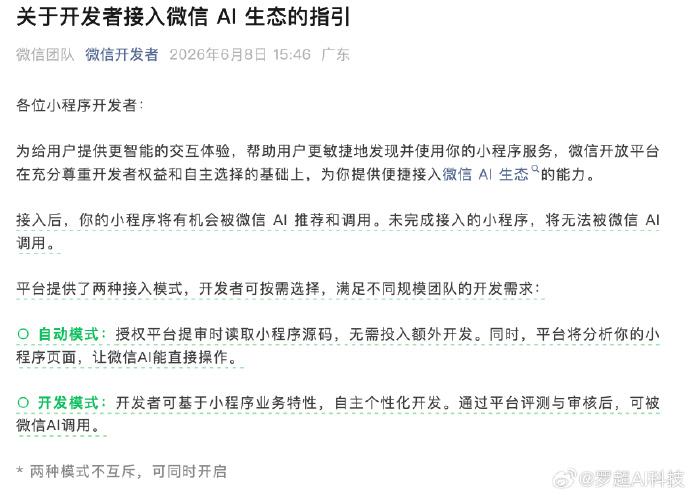
Some have recently claimed that Tencent's AI efforts are lagging behind. Indeed, when it comes to chatbots comparable to ChatGPT, text-to-image, and video generation, Tencent has been slow to respond. As everyone waited to see what Tencent AI would do, WeChat AI made a bold move by directly developing the ultimate AI product—Agent. It's not just about chatting, Q&A, searching, or drawing; it's about 'completing any task.' Whatever Mini Programs can do, WeChat AI can do as well.
What exactly can WeChat AI accomplish? Ride-hailing, ticket booking, restaurant reservations, food ordering—these are the most common use cases, and there are already mature service providers for them within the WeChat ecosystem. However, the potential of Mini Programs extends far beyond that. While writing this article, I took a look at the Mini Programs I recently used in WeChat: coffee ordering, highway toll payment, parking fee payment, vending machines—some were used passively via QR codes, while others were actively searched for.
Theoretically, the number of services that WeChat Agent can access is in the millions (since there are millions of Mini Programs), covering almost any scenario: life, work, study, entertainment, commerce—now, all of them can directly become atomic capabilities that WeChat AI can invoke. Therefore, the Mini Program service ecosystem is WeChat AI's ultimate trump card, enabling it to complete various tasks in one go.
As technology becomes increasingly standardized, service gaps will widen. Companies like DeepSeek are closing the technology gap, and open-sourcing will make foundational models as accessible as utilities. In the later stages, the Agent service system or commercial ecosystem will become increasingly important.
Looking at Western counterparts, Google launched Project Astra, an Agent, in 2024. However, the services it can invoke are too limited—Gmail, Calendar, Maps, plus a bunch of third-party Extensions. This ecosystem has been two years in the making, but how many active developers does it have? Hundreds. OpenAI launched the GPT Store, but it was ridiculed as a 'dumping ground' half a year after launch because it lacked a closed-loop service system and an audit system. If you ask ChatGPT to order food, it gives you an OpenTable link, and you still have to order it yourself. That's not an Agent. Apple's Siri AI, demonstrated at WWDC last night, has similar issues. There are only a few recurring use cases. Even if AI has Agent capabilities, with App data silos and service walls, the amount of actual work it can do is limited.
What do Mini Programs offer? Payment, WeChat ID (account system), unified UI/UE interface, location information—basically covering all the infrastructure for services. Take Didi ride-hailing as an example: users can hail a ride, pay, share their itinerary with friends, and receive an invoice via the Official Account, all without leaving WeChat. When an Agent invokes a Mini Program, this closed loop is automatically inherited. Why is Didi so eager to integrate? Because the super Agent is the future's new service entry point. Users are developing the habit of 'obtaining services with their voice,' and this trend is irreversible. In the future, all service providers will be like Didi: exploring in-app AIs like 'AI Didi' while also integrating with entry-level Agents like WeChat.
The most absurd part is that everything is within Zhang Xiaolong's predictions. Mini Programs were launched in 2016. At the end of that year, during a WeChat Open Class speech, Zhang Xiaolong systematically predicted today's Agent era. He didn't use the term 'Agent,' but the vision he described is exactly what's happening today.
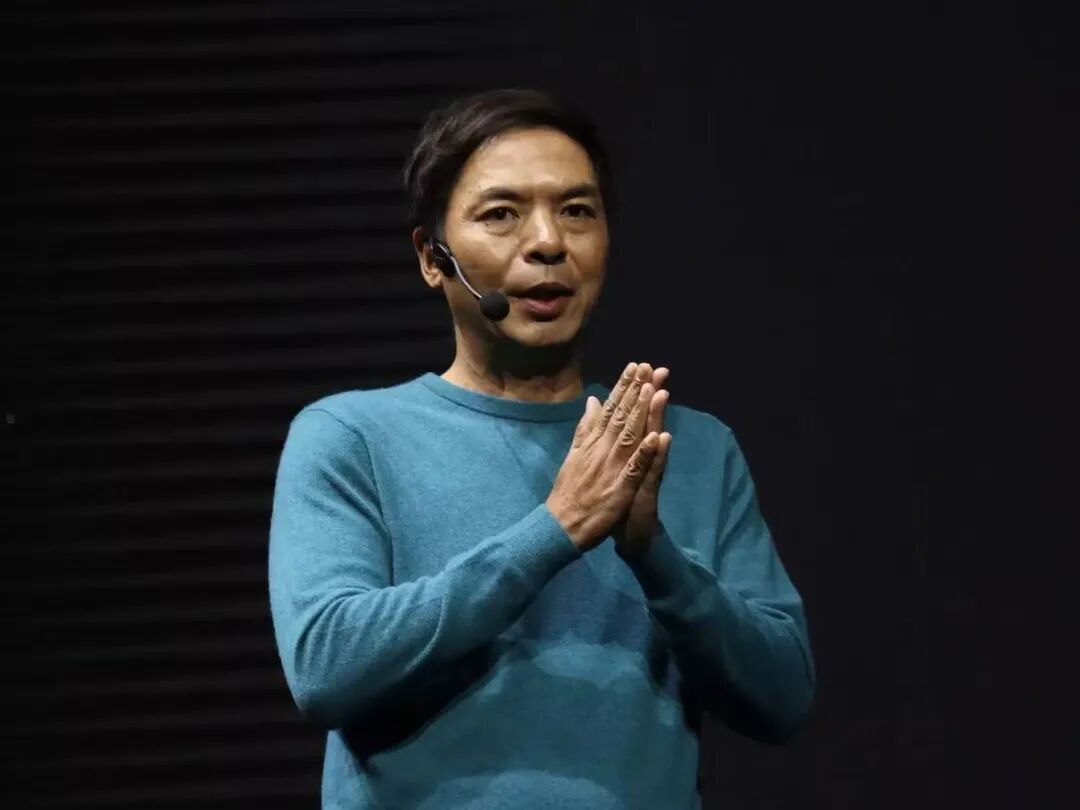
He said that in the next 10 years, technology would project screens onto the retina, and we would wear smart glasses everywhere. The operating system in the glasses shouldn't require you to install applications. 'I hope that wherever I look, the corresponding application appears.' See a lamp, and the switch application appears automatically. Walk to the park entrance, and the ticket application appears automatically.
This is true 'what you see is what you get'—also the core concept of Agents: services follow the scenario, not people going to Apps to find services. He also mentioned Bill Gates' book 'Information at Your Fingertips' (the book title should be 'The Road Ahead'). 'I admire him for writing such a book at that time. Whenever I think of this book, I feel proud that we've achieved this vision in another way (through Mini Programs).'
The concept of Agents originated from Bill Gates. In his book published in 1995, Bill Gates first proposed the concept of Software Agents. He envisioned a future where everyone would have a digital assistant capable of:
Understanding users' interests and preferences; helping filter information; automatically scheduling appointments; shopping and booking tickets on behalf of users; handling emails; proactively finding information users need on the internet.
From today's perspective, this description is exactly the prototype of Agents, except that today's Agents are empowered by large models with stronger capabilities: they can plan, have memory, use tools, and even engage in multi-Agent collaboration.
Mini Programs are not Agents, but they are the most ideal service form that Agents can invoke: no installation required, within reach, use-and-go, no uninstallation needed. For example, if you say, 'Help me book a flight to Shanghai tomorrow,' the Agent invokes the Ctrip Mini Program, completes the booking, and exits. You won't receive any further push notifications from Ctrip. Another example: if you tell the AI, 'Show me the same shoes and buy the cheapest size 40 black pair,' the Agent invokes the camera for recognition + Mini Program for price comparison and places the order directly.
Zhang Xiaolong emphasized 'services' repeatedly ten years ago, not 'applications' or 'content.' Today, the first item in the 'Me' section of the WeChat menu is Services because the nature of services is to complete tasks and end, without the need for subscriptions, daily active user metrics, or user engagement time.
Bill Gates predicted in 1995 that 'information will become increasingly cheap, while what will truly be scarce are tools that help people process information.' WeChat AI may focus more on the latter. From this logic, WeChat AI's focus may be the opposite of leading consumer-grade AIs on the market. ChatGPT and others are still concerned with DAU/MAU, hoping to gain more active users and engagement time. However, WeChat AI aims to satisfy users' needs through Mini Programs, focusing more on the breadth, frequency, and completion of services.
The most amazing part is Zhang Xiaolong's judgment about AI glasses ten years ago. Today, Rokid, Thunderbird, Qianwen, iFlytek—are all striving to popularize AI glasses. Meanwhile, smartphones are becoming AI phones, and computers are upgrading to AI PCs. All hardware is becoming AI-powered and can invoke services from WeChat and other Agents in the future.
Ten years ago, when Mini Programs were first launched, I wrote an article titled 'WeChat Mini Programs Are Here: Don't Overestimate Them in the Short Term, Don't Underestimate Them in the Long Term.' I didn't expect that 'long term' to be ten years. WeChat has integrated its internal super ecosystem through Mini Programs and Official Accounts, providing a unified Agent interface externally. It has upgraded into a super Agent where users can 'obtain any service with their voice' and also serve various Agents. Clearly, WeChat AI is not just adding AI features or an AI chat assistant to WeChat; it's rebuilding a more enormous WeChat with AI. No wonder Tencent made users wait so long—it's truly a grand strategy.
I've always said that Tencent AI didn't need to rush. The first half of the AI race is about technology, and the second half is about applications. As foundational model technologies gradually level off, Tencent will leverage its product capabilities and resources like WeChat's entry point and Mini Program ecosystem to quickly drive the commercialization of technology and products.
Many large model companies have powerful technologies but have yet to launch any memorable star products. When WeChat enters the scene, as long as it gives WeChat AI services a prominent position (such as the negative first screen) and ensures they are user-friendly, it can drive the widespread adoption of AI, turning Agents from toys for a few into daily tools for everyone. Users don't need to worry about technical topics like 'What is OpenClaw, how to deploy it, or what is shrimp farming.' They can simply swipe or use their voice to access Agents, and through this process, users and AI continuously learn from each other.
Product commercialization means that product creators can still make money. Currently, all large model products are struggling to answer the question of how to generate revenue. Claude adopts a subscription model, but this focuses on productivity scenarios. Enterprises and office workers are willing to pay because AI can improve efficiency, save effort, and save time. ChatGPT explores an advertising model, but inserting ads into AI responses is ten times harder than in search engines. If an Agent recommends a restaurant that paid the most but the food is terrible, will users still use it next time? Therefore, AI advertising can easily ruin the user experience and destroy trust. Doubao explores e-commerce, and Qianwen integrates with Taobao. AI-driven sales seem to be another monetization method, but how far this path can go is unknown. AI can be a bonus for e-commerce platforms, but users' habit of shopping in general-purpose AIs has not yet been established.
The answer to WeChat AI's commercialization may lie in Mini Programs. Few people discuss what the business model of Mini Programs is, but that doesn't prevent them from making money: payment commissions, ad revenue sharing, e-commerce revenue sharing, cloud service bundling, and developer value-added services are already well-established. The essence of this business model is that Tencent, as the platform provider, controls the flow distribution of Mini Programs and, consequently, the service distribution rights. Just look at the 'Nine-Grid' model, which has attracted leading players like JD.com, Meituan, Didi, Pinduoduo, and Tongcheng to partner with Tencent.
Now, with Agent integration, AI will further amplify this distribution power, and users' frequency and demand for services will increase tenfold or even a hundredfold. The WeChat Mini Program pie will become even larger, and new business models will emerge alongside the old ones, such as Agent subscription services. A developer creates an 'Business Trip Assistant Agent' that invokes Tongcheng for ticket booking, Didi for ride-hailing, Meituan for food ordering, and WeChat Work for reimbursement. Users pay for the Agent itself, and WeChat and the developer share the revenue.
Ten years ago, Zhang Xiaolong said, 'The entry point of the PC internet is the search box, and the entry point of the mobile internet is the QR code.' Many people didn't understand that at the time. Looking back now, QR codes brought offline services online, giving birth to the Mini Program ecosystem. Today, WeChat AI will make online services Agent-based. How important is this?
The mobile internet exploded rapidly because of WeChat back then. Then, through WeChat Pay, Red Packets, Official Accounts, Mini Programs, Video Accounts, and more, WeChat connected people, content, services, and commerce, continuously driving the prosperity of the WeChat ecosystem and the mobile internet. In the past two years, the AI industry has been waiting for the 'WeChat moment for AI.' Now, it seems that this moment will be when the legendary WeChat super AI officially launches. It feels like it's coming soon.
-
![]()
Zhang Xiaolong Predicted the Rise of Agents a Decade Ago: Will WeChat AI Revolutionize Everything?
-
![]()
In-depth | Subsidy Decline and Restructuring: The 'Scale-up' Challenge for New Energy Heavy Trucks
-
![]()
The 2026 618 Shopping Festival: A Revolution! AI-Powered Shopping Takes the Lead, Is the Price War Finally Over?
-
![]()
Cook’s ‘Curtain Call’: Has Apple AI Finally ‘Set Sail’? | Apple WWDC 2026 Highlights
-
![]()
Cook's 'Curtain Call': Apple AI 'Sets Sail'? | Apple 2026 WWDC Highlights
-
![]()
Storage Price Increases Weigh on Industry! Global Smartphone Production Set to Decline by 16.2% by 2026
-
![]()
Large Models Reignite Big Tech's 'Healthcare Dreams'
-
![]()
Siri AI Takes Center Stage, VisionOS Steps Back: Can Cook Secure Victory in the AI Showdown?