From 'Comrades-in-Arms' to Rivals: The Intensifying 'Feud' Between NIO and Li Auto
 06/09 2026
 329
329
Produced by Leida Finance, Written by Zhou Hui, Edited by Meng Shuai
The competitive landscape between Li Auto and NIO, two titans among China's new energy vehicle (NEV) startups, continues to evolve with intensity.
Recently, Li Auto released a comparison video showcasing the real-world performance of the Li L9 Livis and NIO ES9 on undulating terrain. The video claimed that, under identical test conditions, the Li L9 Livis outperformed its NIO counterpart.
Although the video was swiftly removed, it still managed to capture NIO's attention. NIO Vice President Ma Lin took to social media, expressing concerns that the performance of NIO's vehicle in the video did not align with its actual product specifications and urged Li Auto to verify the authenticity of the video.
In response, Tang Jing, head of Li Auto's product line, questioned NIO CEO Li Bin's earlier assertion that NIO's 48V integrated fully active suspension outperforms Li Auto's 800V split-type solution.
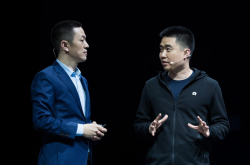
It's worth noting that NIO and Li Auto, now fierce competitors, once shared a brief period of camaraderie. During the nascent and challenging days of NEV startups, Li Xiang and Li Bin supported each other's product launches.
Li Xiang even stated that if only three new NEV makers were to survive, he hoped NIO and XPeng would be his 'comrades-in-arms.' However, as industry competition intensified, the two automakers inevitably transitioned from 'comrades' to rivals.
Nevertheless, Li Auto and NIO are currently navigating different trajectories. In Q1 2026, Li Auto reported a decline in both revenue and profit: revenue reached RMB 22.983 billion, down 11.35% year-over-year (YoY), while net profit attributable to the parent company shifted from a profit of RMB 650 million in the same period last year to a loss of RMB 2.29 billion.
During the same period, NIO achieved revenue of RMB 25.533 billion, up 112.16% YoY, with a net loss attributable to the parent company of RMB 496 million, representing a significant narrowing of 92.8% YoY. Additionally, NIO's automotive gross margin for the quarter reached a four-year high of 18.8%, far exceeding Li Auto's 6.1%.
Notably, in the 2026 Hurun Global Rich List released in March, Li Auto founder Li Xiang and NIO founder Li Bin made the list with fortunes of RMB 27.5 billion and RMB 8.5 billion, respectively.
Road Test Video Sparks Controversy: Executives from Li Auto and NIO Engage in Verbal Sparring
According to media reports, Li Auto recently released a comparison video showcasing the real-world performance of the Li L9 Livis and NIO ES9 on undulating roads.
The comparison video depicted the test being conducted in two rounds, with testers adjusting the suspension comfort modes of the Li L9 Livis and NIO ES9 to the hardest and softest settings, respectively, and driving them on a wavy paved road under uniform conditions.
According to the video's test results, under identical conditions, the Li L9 Livis maintained a more stable body posture with less sway, while the NIO ES9 exhibited more pronounced bouncing and oscillation.
Although the video was deleted shortly after its release, it still managed to catch NIO's attention.
On June 5, NIO Vice President Ma Lin posted on Weibo, stating that in the video, the NIO ES9's oscillation speed in standard mode was the same as or even faster than in ultra-soft mode with minimal fully active suspension engagement, which did not align with the product's specifications.
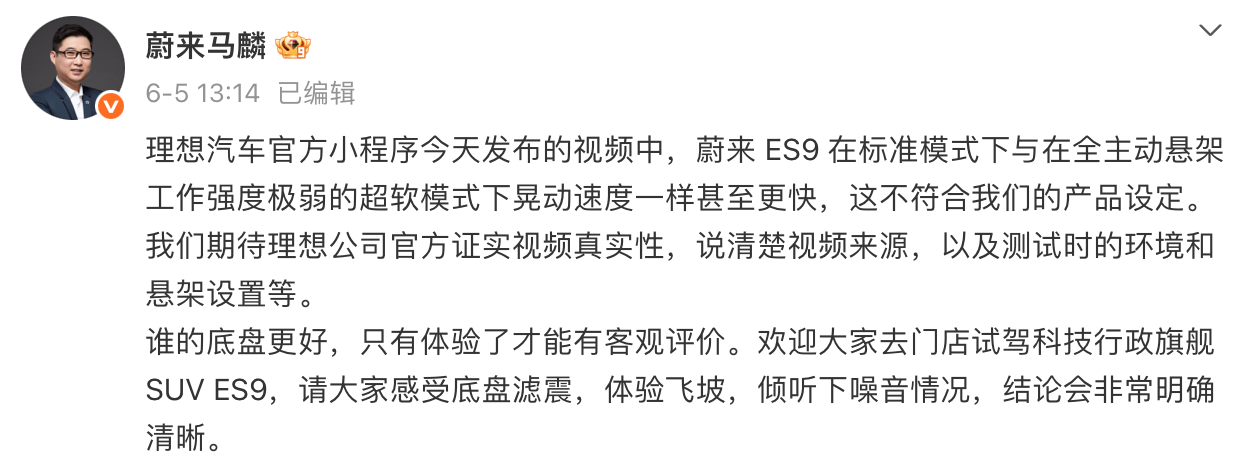
Ma Lin urged Li Auto to verify the video's authenticity, clarify its source, and provide details about the testing environment and suspension settings.
Ma Lin emphasized, 'Only through firsthand experience can one objectively evaluate which chassis is superior.' He also invited netizens to visit NIO stores to test drive the ES9, experience its chassis filtering, tackle speed bumps, and assess noise levels, stating that 'the conclusion will be self-evident.'
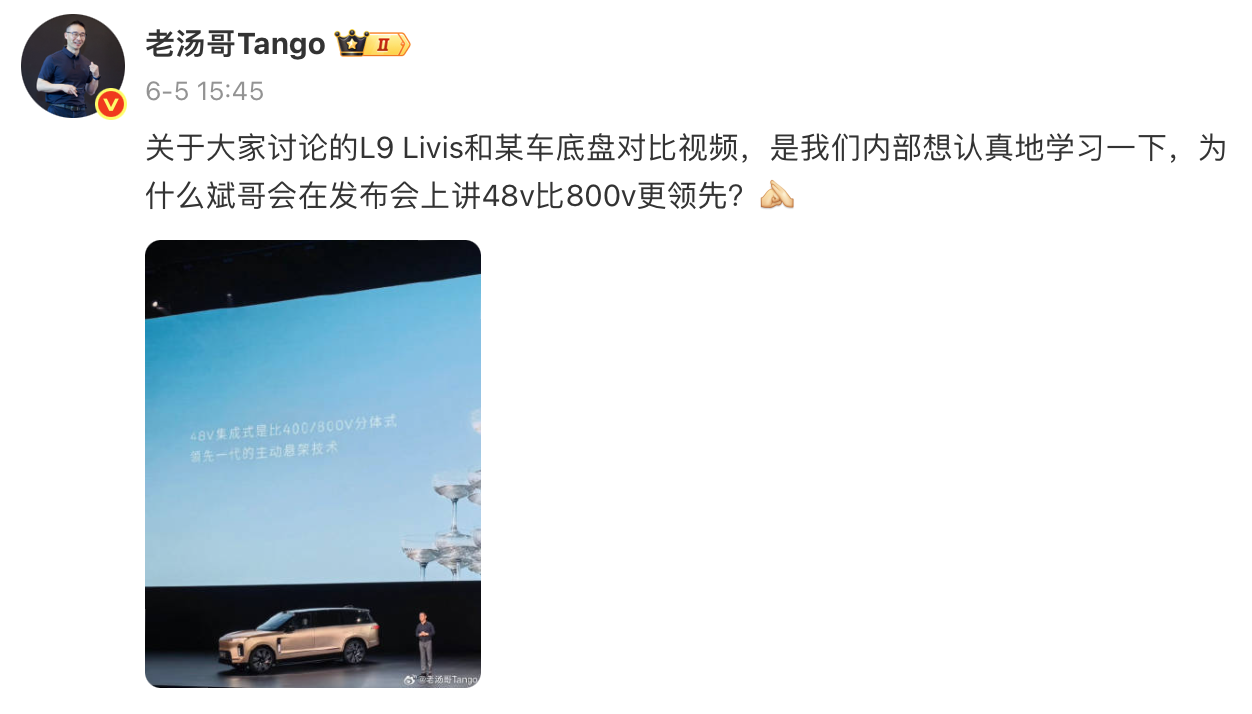
Subsequently, Tang Jing, head of Li Auto's product line, posted on Weibo, 'Regarding the comparison video of the L9 Livis and another vehicle's chassis that everyone is discussing, we internally wanted to seriously understand why Brother Bin stated at the press conference that 48V is more advanced than 800V.'
It is reported that the Li L9 Livis and NIO ES9 are new flagship SUVs launched by the two automakers, positioning them as direct competitors.
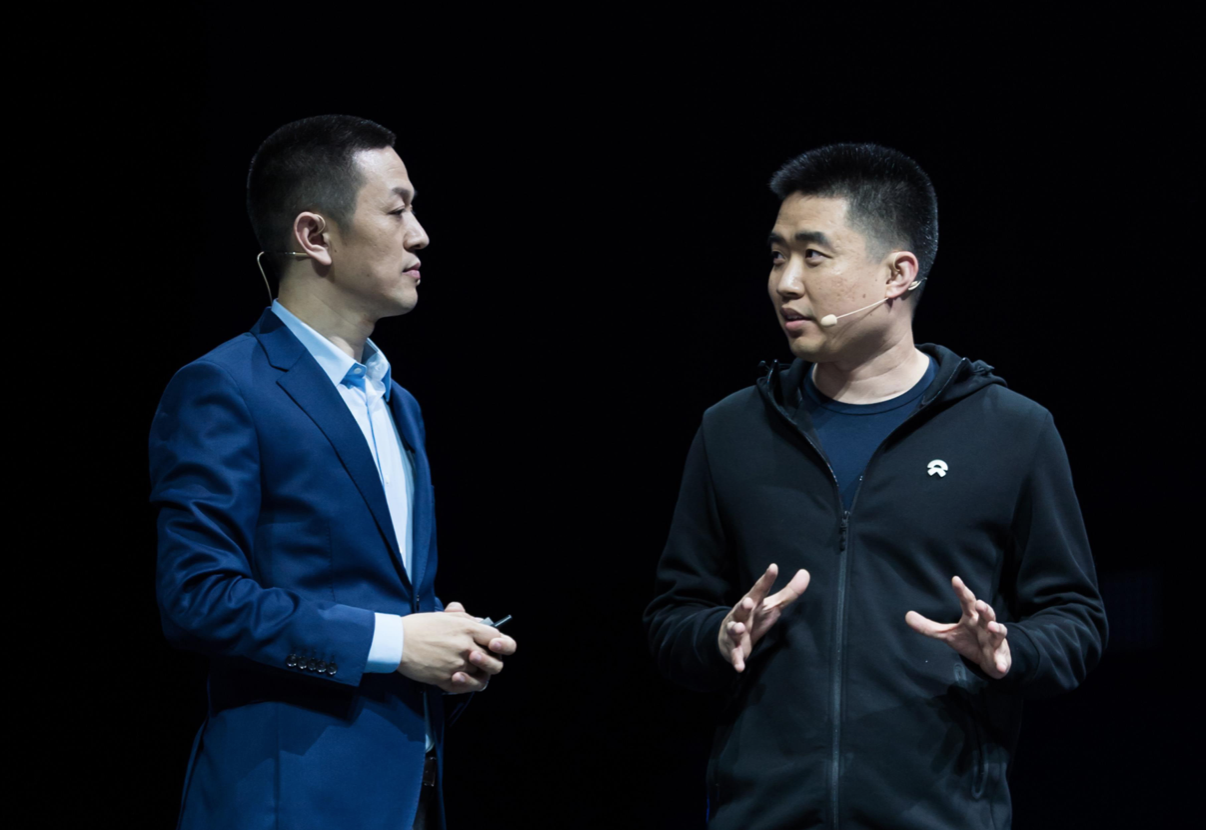
At the NIO ES9 launch event on May 27, NIO CEO Li Bin highlighted the Tianxing 48V integrated fully active suspension equipped in the ES9, stating that compared to 400V/800V split-type solutions, the 48V integrated technology is a 'generation ahead.'
At that time, Tang Jing responded, 'The debate over which active suspension is the next generation or more advanced has been particularly heated recently, especially with third-party tests getting involved, but controversies are also significant. Everyone feels it's unfair; some argue that testing modes should be aligned, while others demand more testing opportunities if a competitor is given five or six lane changes.'
Tang Jing also suggested that instead of arguing over who is a 'generation ahead' or debating true self-research versus 'word research,' or questioning the fairness of third-party evaluations, 'Why not organize a championship for active suspensions?'
Regarding the suspension technology controversy between Li Auto and NIO, industry insiders pointed out that the fully active suspension technology route is still in a 'diversified' state. NIO's 48V integrated and Li Auto's 800V split-type solutions do not have a clear superiority hierarchy; they merely represent different engineering trade-offs tailored to their respective product positioning.
From 'Comrades' to Rivals
Prior to this recent 'clash,' Li Auto and NIO actually shared a brief period of camaraderie.
According to Tianyancha, in 2014, Li Bin, founder of Bitauto, established NIO, officially entering the NEV sector. The following year, Li Xiang, founder of Autohome, also ventured into car manufacturing, founding Li Auto. Thus began their years-long rivalry.
During the challenging early days of the industry, Li Auto and NIO were kindred spirits. In 2017, NIO invested RMB 80 million to launch its first new car, the ES8. At the event, Li Xiang provided strong support, attending the launch and even purchasing a NIO ES8 with his own money to show solidarity.
A year later, Li Auto held a launch event for the Li ONE, and Li Bin reciprocated the support by attending alongside NIO President Qin Lihong.
According to 36Kr, Li Xiang once stated that if only three new NEV makers were to survive, he hoped NIO and XPeng would be his 'comrades-in-arms.'
Over the years, Li Auto and NIO have grown into leading players among NEV startups. However, as industry competition intensified, they have had to continuously expand their product lineups to vie for the same pool of potential consumers, straining their relationship.
In 2021, NIO launched the new ET5 model. When introducing its panoramic digital cockpit based on VR/AR technology, Li Bin remarked, 'Actually, cars don't need so many large screens,' a comment perceived by some as a subtle jab at Li Auto's numerous large screens.
Li Xiang promptly countered on Weibo, listing various issues with VR video interaction and stating, 'Don't easily define products you haven't even used.'
In 2024, the 'rivalry' between the two companies further escalated. In July of that year, after Li Auto released its 30th-week NEV brand sales rankings, NIO Vice President Ma Lin publicly called out Li Xiang on Weibo, saying, 'High-level directive: Avoid low-level internal competition. Ranking by weekly sales is somewhat low-level internal competition. Brother Xiang, stop it.'
During the same period, senior executives from Geely Holding Group and XPeng Motors, among others, also expressed their opposition to weekly sales rankings.
In response to the industry's 'challenge,' Li Xiang posted a 'shush' emoji on Weibo, accompanied by an image depicting the story of 'plugging one's ears while stealing a bell.'
Diverging Q1 Performances: Li Auto and NIO Face Different Challenges
Beyond the disputes, Li Auto and NIO are currently navigating different challenges.
In Q1 2026, Li Auto delivered a less-than-stellar financial report: revenue reached RMB 22.983 billion, down 11.35% YoY, while net profit attributable to the parent company shifted from a profit of RMB 650 million in the same period last year to a loss of RMB 2.29 billion.
Specifically, automotive sales revenue was RMB 21.5 billion, a 12.7% decrease from RMB 24.7 billion in Q1 2025 and a 21% decrease from RMB 27.3 billion in Q4 2025.
Li Auto explained that the YoY decline in automotive sales revenue was primarily due to a lower average selling price resulting from a different product mix, while the QoQ decline was attributed to seasonal factors related to the Spring Festival holiday, which affected delivery volumes, and a lower average selling price due to a different product mix.
In Q1 2026, Li Auto delivered 95,100 vehicles, a slight 2.5% YoY increase, but its automotive gross margin plummeted to 6.1%, a staggering 13.7 percentage point YoY drop.
The simultaneous decline in automotive business revenue scale and profitability significantly increased Li Auto's cash flow pressure. In Q1, the company's net cash flow from operating activities was -RMB 6.1 billion, compared to -RMB 1.7 billion in the same period last year.
In contrast, NIO fared better in Q1. Revenue reached RMB 25.533 billion, a substantial 112.16% YoY increase, while the net loss attributable to the parent company was RMB 496 million, narrowing by 92.8% YoY.
In terms of deliveries, NIO handed over 83,500 vehicles in Q1, a 98.3% YoY increase, though still falling short of Li Auto's 95,100 units.
With increased deliveries, NIO's automotive sales revenue also surged, rising 129.2% YoY to RMB 22.784 billion.
Meanwhile, benefiting from an improved product mix, NIO's automotive gross margin for the quarter rose to 18.8%, a four-year high.
Notably, according to Li Bin, the average transaction price of the NIO brand in Q1 reached RMB 390,000, surpassing BMW by RMB 50,000 and being 1.5 times that of Audi. In Shanghai, the Yangtze River Delta, and first-tier cities, the NIO brand has overtaken traditional luxury brands in market share.
However, with the phasing out of policy incentives and the continuous rise in raw material prices for memory chips and batteries, many automakers, including Li Auto and NIO, face severe challenges.
Data from the China Passenger Car Association showed that in Q1 2026, retail sales of passenger cars in China totaled 4.226 million units, down 17.4% YoY. Among them, domestic retail sales of NEVs were 1.908 million units, a 21.1% YoY decline. The automotive industry's sales profit margin dropped to 3.2%, below the average of 6% for downstream industrial enterprises.
On January 26, UBS released a research report titled 'China's Auto Industry: Estimating the Cost Impact of Rising Metal and DRAM Prices on Electric Vehicles.' The report estimated that the manufacturing cost of a typical mid-size intelligent electric vehicle would surge by RMB 4,000 to RMB 7,000 in the short term.
Against the backdrop of increasingly fierce competition in the NEV market, what market performances will Li Auto and NIO deliver next? Leida Finance will continue to monitor the situation.
-
Hot Topic | NVIDIA, Samsung, and Microsoft Simultaneously Release Chips, Securing Dominant Positions in Key Growth Sectors
-
Spears and Shields, But Not for Sale: When an AI Private Company Holds the Lifeline of Other Nations
-
![]()
From 'Comrades-in-Arms' to Rivals: The Intensifying 'Feud' Between NIO and Li Auto
-
![]()
Smartphone Prices Surge Amid Manufacturer Anxiety
-
![]()
Orbbec Soars to Record Heights, Eyes Further Capital Influx of 980 Million!
-
![]()
Tongding Interconnect Sets Up Shop in Shaoguan with 800 Million Yuan in Registered Capital
-
![]()
Before Kimi’s A-Share Debut, Zhipu Aims to Secure More 'Strategic Funding'
-
![]()
Innovative Leap | Fiber-Pluggable 1470nm Laser Source: Revolutionizing Precision Laser Weeding