62.9%! New Energy Penetration Rate Surges to All-Time High
 06/09 2026
 392
392
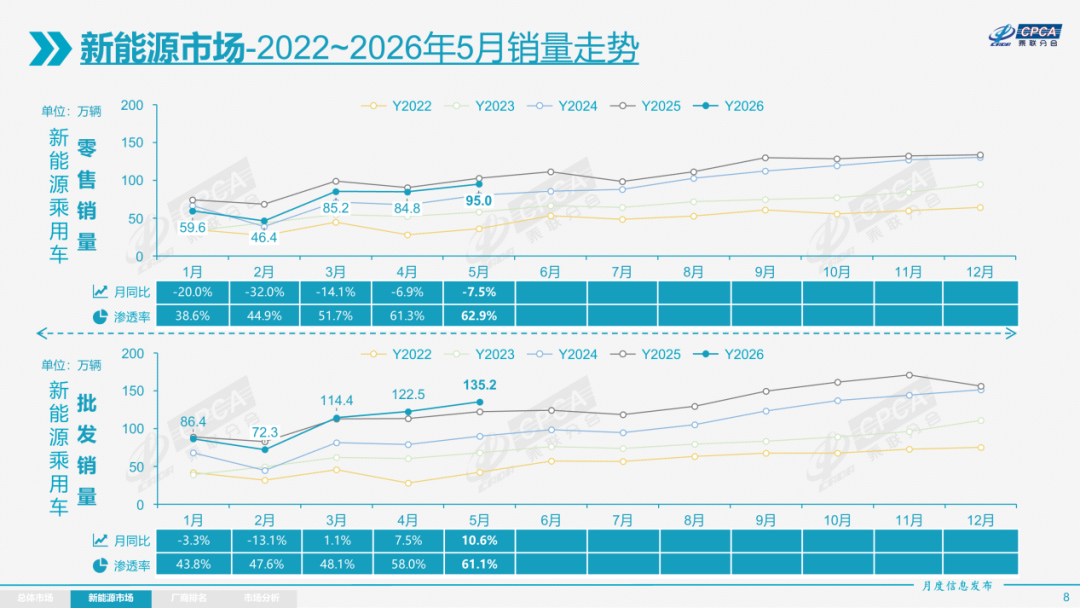
In May 2026, the domestic market for new energy passenger vehicles displayed a mixed trend, with retail sales rebounding on a month-on-month basis and wholesale sales achieving positive growth year-on-year. Data reveals that retail sales of new energy passenger vehicles hit 950,000 units in May, marking a 7.5% decrease year-on-year but a 12.4% increase month-on-month. Wholesale sales reached 1.352 million units, climbing 10.6% year-on-year and 10.3% month-on-month, underscoring a more optimistic sentiment on the production side compared to the retail market. From January to May, cumulative retail sales of new energy passenger vehicles amounted to 3.697 million units, down 15.1% year-on-year. However, cumulative wholesale sales totaled 5.306 million units, up a modest 1.7% year-on-year, marking a positive growth turnaround since the beginning of the year.
Retail Sales Rebound Sharply, Penetration Rate Surpasses 62.9%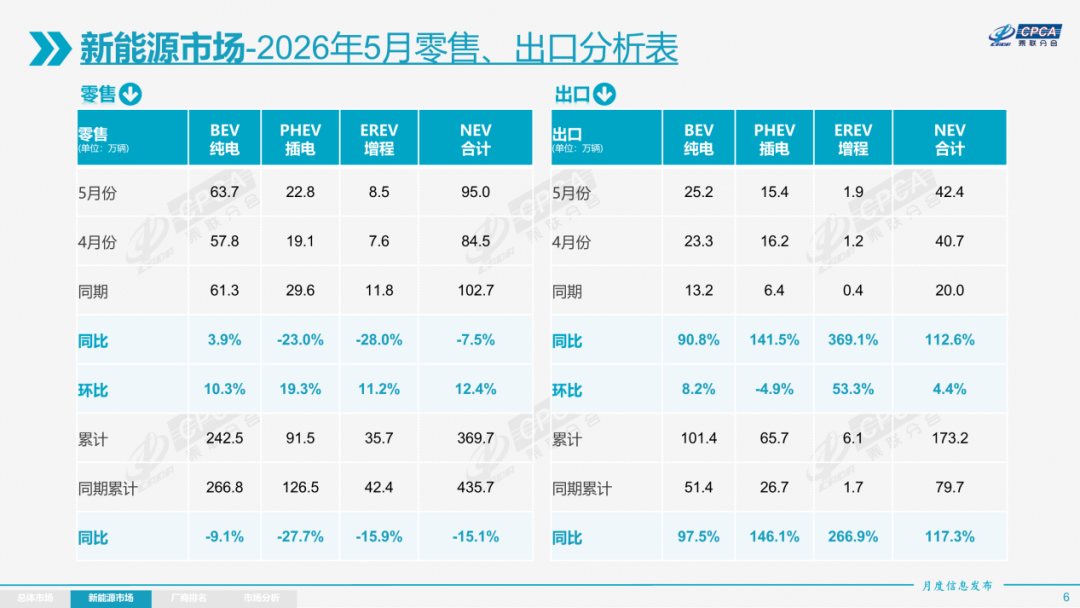
In May 2026, domestic retail sales of new energy passenger vehicles amounted to 950,000 units, showing a 7.5% decrease year-on-year but a significant 12.4% increase month-on-month. The notable month-on-month rebound was primarily due to the stabilization of automaker promotions, reduced consumer wait-and-see sentiment amid price cuts, and the release of pent-up demand following the Beijing Auto Show, leading to a steady recovery in new energy vehicle purchasing power.
From January to May, cumulative retail sales of new energy passenger vehicles reached 3.697 million units, down 15.1% year-on-year. Affected by sluggish market conditions at the start of the year, cumulative sales remained in a year-on-year decline, but the rate of decline gradually narrowed.
Driven by changes in the sales structure, the new energy retail penetration rate reached 62.9%, up 1.6 percentage points month-on-month and 9.9 percentage points year-on-year. This rate has maintained a stable position above the 60% threshold for several consecutive months, continuously setting new historical highs. In contrast, retail sales of fuel vehicles stood at 560,000 units in May, plunging 39% year-on-year and growing only 5% month-on-month. Fuel vehicle sales declines accounted for 82% of the total decline in passenger vehicle sales, solidifying the market trend of fuel vehicle contraction and new energy dominance.
Wholesale Sales Achieve Year-on-Year and Month-on-Month Growth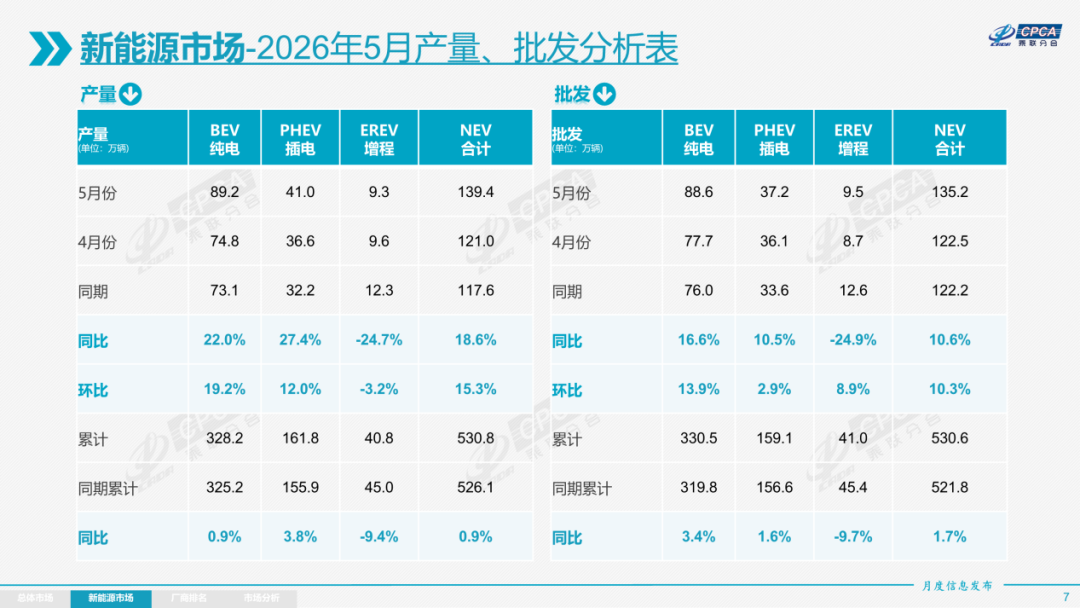
The wholesale market more accurately reflects the true situation of automaker production and supply. In May, wholesale sales of new energy passenger vehicles reached 1.352 million units, up 10.6% year-on-year and 10.3% month-on-month, demonstrating a "dual growth" trend and significantly outperforming the retail market. The wholesale penetration rate of new energy manufacturers reached 61.1%, up 8 percentage points year-on-year, indicating a comprehensive shift in automaker production focus towards new energy vehicles.
From January to May, cumulative wholesale sales of new energy passenger vehicles reached 5.306 million units, up 1.7% year-on-year, achieving a positive growth turnaround. During the same period, production of new energy passenger vehicles reached 1.394 million units, up 18.6% year-on-year and 15.3% month-on-month, with accelerated capacity release laying a solid foundation for subsequent sales growth.
Pure Electric Vehicles Remain Dominant, Extended-Range Sales Decline
Breaking down the wholesale sales structure of new energy vehicles in May by the three major technical routes—battery electric vehicles (BEVs), plug-in hybrid electric vehicles (PHEVs), and extended-range electric vehicles (EREVs)—reveals significant differentiation, with distinct trends for each route:
Wholesale sales of pure electric vehicles reached 886,000 units, up 16.6% year-on-year and 13.9% month-on-month, accounting for 65.7% of total new energy wholesale sales. Pure electric vehicles remained the undisputed market leader, with the highest growth rate across all categories and continuously rising market acceptance.
Wholesale sales of plug-in hybrid vehicles reached 372,000 units, up 10.5% year-on-year and 2.9% month-on-month, showing steady growth and steadily improving competitiveness in family and long-distance travel scenarios, accounting for 27.5% of the market.
Wholesale sales of extended-range vehicles reached 95,000 units, down 24.9% year-on-year but up 8.9% month-on-month, becoming the only technical route with a year-on-year decline. Its market share shrank to 7.0%, with significantly insufficient growth momentum.
From the perspective of sales characteristics by price segment, the polarization of the new energy market, with strength at the high end and pressure at the low end, further intensified.
High-end B-segment electric vehicles performed outstandingly, with wholesale sales of 273,000 units in May, up 42% year-on-year and 9% month-on-month, accounting for 31% of total pure electric sales. The mid-to-high-end market became the core growth engine for pure electric vehicles.
Entry-level economical electric vehicles continued to struggle. Wholesale sales of A00-segment pure electric vehicles reached 87,000 units, plummeting 44% year-on-year, with their share of the pure electric market dropping to 10%. Affected by factors such as subsidy reductions and consumption downgrades, sales in the entry-level market continued to decline. A0-segment and A-segment electric vehicles performed relatively stably, becoming the backbone of the mid-end market.
New Energy Vehicle Exports Continue to Soar
Amid domestic demand pressure, overseas exports have emerged as the core growth driver for new energy vehicles. In May, new energy export sales reached a new high, helping automakers offset domestic market pressure. Total passenger vehicle exports reached 784,000 units in May, up 75.1% year-on-year and 2.3% month-on-month. Among them, exports of new energy passenger vehicles reached 424,000 units, soaring 112.6% year-on-year and 4.4% month-on-month, far outpacing the industry average growth rate.
New energy vehicles accounted for 54.0% of total passenger vehicle exports, up 9 percentage points year-on-year, firmly maintaining a position above the 54% threshold for the first time in history. China's automobile exports have officially entered the "new energy-dominated" era. During the same period, exports of fuel passenger vehicles reached 361,000 units, up 46% year-on-year, achieving "dual-line overseas growth for both new energy and fuel vehicles."
Judging from recent sales trends, domestic new energy sales will continue in a phase of "month-on-month recovery and year-on-year weakness," but the long-term growth logic remains intact.
-
![]()
62.9%! New Energy Penetration Rate Surges to All-Time High
-
![]()
Apple Shareholders Paid a $230 Billion 'Makeup Exam Fee' for Apple's AI
-
![]()
Qianwen’s Version of ‘Being Inside the Nails’
-
![]()
Unbelievable! Chery’s Rumor Refutation Disappears—Who’s Behind the Chaos?
-
![]()
Force Robotics Acquires Atomix: Empowering Robots to Develop Data Flywheels in Real-World Business Environments
-
![]()
Is India Acquiring Electric Vehicle Tech from China? Chery Responds
-
![]()
Struggling to Compete? Japanese Automakers Shift Focus to India, a Market Even Musk Avoids
-
![]()
Why Haven’t We Seen Any Automakers Go Bankrupt Yet, Even as 2026 Reaches Its Midpoint?