Thirst for Computing Might! Tencent Secures $7 Billion Worth of Computing Resources from Oracle
 10/08 2026
 560
560
According to reports, Tencent and Oracle have inked a five-year cloud computing lease pact, encompassing approximately 100,000 high-end AI chips across multiple data centers in Southeast Asia. The deal is valued at around $7 billion, with an initial payment covering 30% of the total.
This transaction represents Tencent's largest-ever overseas computing power lease and stands as one of the most emblematic strategic moves by a Chinese tech behemoth to secure advanced computing capabilities amidst tightening U.S. export restrictions.
Xingkong Jun posits that the underlying rationale for this deal extends far beyond merely "renting abroad due to domestic constraints."
It underscores China's AI industry's path to breakthrough amidst computing power bottlenecks, the intricate interplay between commercial interests and security concerns in the U.S.-China tech rivalry, and the emerging nuanced "dual-track" system in the global AI computing power supply chain.
1. Thirst for Computing Might: The 'Chokepoint' Dilemma in Tencent's AI Strategy
To grasp the urgency of this transaction, one must view it within the broader context of Tencent's strategic trajectory for 2026.
In early 2026, Tencent significantly ramped up its AI endeavors. The recruitment of Yao Shunyu, a former OpenAI researcher, signaled Tencent's foray into a new phase of foundational model R&D investment.

In April, Tencent unveiled Hunyuan Hy3 preview, a mixture of experts model boasting 295 billion total parameters and 21 billion activated parameters, marking a "qualitative leap" in Agent capabilities compared to its predecessors.
By the time the full version of Hy3 was released in July, its daily token consumption had surged 20-fold compared to the preview version, while user autonomous selection rates on WorkBuddy soared sixfold.
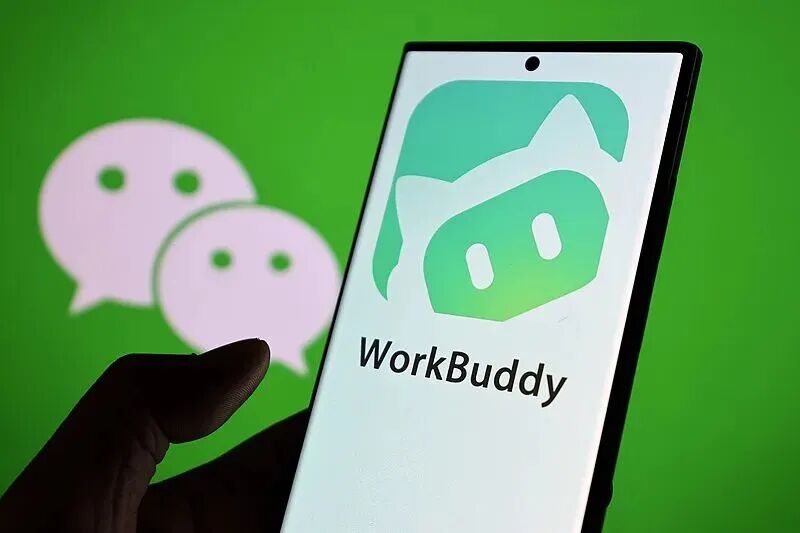
The explosive growth of WorkBuddy was a pivotal factor. Launched in March 2026, the AI agent platform immediately crashed due to overwhelming traffic, compelling Tencent to urgently scale capacity tenfold and compensate users with bonus points.
By September, the WorkBuddy open platform officially launched, introducing over 100 initial ecological partners across three tiers: smart hardware, industry applications, and developers. Liu Yi, Vice President of Tencent Cloud, envisioned it as an "operating system for the Agent era."
The computing power demands of Agent products differ fundamentally from traditional conversational AI. A complex Agent workflow may entail dozens or even hundreds of reasoning steps, tool invocations, and file operations. Hy3 preview has been verified to support intelligent agent workflows of up to 495 steps.
This implies that each user request may necessitate tens of times the computing power of traditional conversational models. When WorkBuddy offers free bonus points to a vast user base and distributes 5,000 points monthly to public welfare institutions, these "free" services are underpinned by substantial GPU consumption.
Tencent's financial data already reflects this strain.
In the second quarter of 2026, Tencent's capital expenditures soared to 52.78 billion yuan, up 176% year-on-year and 65% quarter-on-quarter, far surpassing market expectations of 32.1 billion yuan. Free cash flow was -13.8 billion yuan, turning positive to 37.6 billion yuan only after excluding AI computing power procurement prepayments.
Tencent President Martin Lau acknowledged during the earnings call that capital expenditures fell short of expectations due to "obstructions in the supply of advanced GPUs in China," and the company "hopes to purchase more cards, ultimately compensating for some computing power needs through leasing."
This is the core backdrop to the $7 billion overseas computing card leasing deal. Tencent's AI strategy is in full swing, with model iteration, Agent product expansion, and ecosystem construction accelerating. However, the computing power foundation supporting all this faces structural supply bottlenecks domestically.
2. The Imperative of Overseas Leasing: The Structural Deficit in Domestic Computing Power Supply
Since 2022, the U.S. has progressively tightened export controls on advanced AI chips to China. In January 2026, the U.S. Department of Commerce's Bureau of Industry and Security (BIS) revised its licensing review policy, subjecting exports of NVIDIA H200 and similarly performing chips to China to "case-by-case review" with stringent conditions: exports must not diminish global capacity available to U.S. customers, Chinese purchasers must establish export compliance procedures, and products must undergo independent third-party testing in the U.S.
However, for re-exports or transfers of similar items from overseas to China, the policy maintains a "presumption of denial" stance.
This means that even if NVIDIA H200 can theoretically be exported to China, actual approval processes and volumes are severely constrained. For more advanced chips, export channels to China are largely shut.
The situation with domestic alternatives is equally discouraging.
Huawei's Ascend series still grapples with production capacity and ecological maturity challenges, with supply barely meeting the needs of top clients like DeepSeek. Other domestic AI chip manufacturers still trail NVIDIA products by generations in performance, software stack maturity, and mass production capabilities.
Rumors suggest that one company has already fully paid Huawei but will not receive cards until 2027.
Under these constraints, Chinese tech companies have forged two response paths: increasing procurement and adaptation of domestic chips, or seeking compliant computing power acquisition channels overseas. Tencent is pursuing both tracks concurrently, but overseas leasing is clearly a faster, more direct solution to current computing power shortages.
The selection of Southeast Asian data centers is highly strategic. Oracle's cloud infrastructure in Southeast Asia is not directly subject to U.S. export controls to China since the computing power is physically located outside China. Such overseas cloud leasing transactions are permitted under U.S. export rules. Tencent is leasing Oracle's data center services rather than directly purchasing chips, partially circumventing direct export control restrictions.
3. Why Tencent 'Probably Won't Face Blockade'
A natural query arises: will Tencent's large-scale acquisition of U.S. tech infrastructure invite sanctions from U.S. regulators?
Based on current information, Xingkong Jun believes this risk exists but is relatively manageable. Several factors come into play.
First, the transaction's structure itself offers compliance flexibility. Tencent is leasing Oracle's cloud services in Southeast Asia rather than importing chips into China. As a U.S. publicly traded company, Oracle would have undergone rigorous legal review before signing such a substantial contract. The deal legally complies with current U.S. export control frameworks; otherwise, Oracle would not assume the risk.
Second, Tencent's ecological niche in global AI competition differs from ByteDance and Alibaba. In June 2026, the U.S. Department of Defense updated its 1260H 'Chinese Military Companies' list, adding Alibaba and Baidu for the first time but excluding Tencent from the new entries.
While this list differs from the export control Entity List, it reflects U.S. regulators' differentiated positioning of Chinese tech companies.
Third, Tencent's product strategy in overseas markets also diminishes political sensitivity. WorkBuddy's global layout, with separate operations for domestic and international versions, allows overseas businesses to operate under a structure less constrained by geopolitics. This "dual-version" strategy, previously employed by TikTok and Douyin, isolates overseas operations from domestic entities in terms of compliance.
More crucially, this transaction holds commercial allure for the U.S. side. Oracle has been aggressively pursuing Amazon AWS and Microsoft Azure in cloud infrastructure and urgently needs major clients to bolster returns on its data center investments. Tencent's $7 billion five-year contract represents substantial long-term revenue, with upfront payments reaching approximately $2.1 billion. Oracle's stock price fluctuations following the deal news also indicate market assessment of its significance for Oracle's cloud business.
4. The Dual Faces of the U.S. AI Ecosystem: Open Source, Closed Source, and the Triangular Dynamic with Chipmakers
The feasibility of Tencent's transaction is inextricably linked to structural contradictions within the U.S. AI ecosystem.
A rarely discussed tension exists in the U.S. AI industry: the interests of leading large model firms and chip/cloud infrastructure providers are not fully aligned.
The four frontier model firms—OpenAI, Anthropic, Google DeepMind, and Meta—exhibit divergence in model strategies. OpenAI and Anthropic are highly closed-source, repeatedly expressing public concerns about the security risks of open-source large models and advocating for stronger regulation. While Meta has open-sourced its Llama series, the openness of its latest-generation models has contracted.
This closed-source trend implies that if global AI computing power demand were entirely driven by a few closed-source model firms, NVIDIA's customer base would be highly concentrated, and data center demand growth would be limited by these companies' capital expenditure rhythms.
NVIDIA and Oracle have distinct interest considerations. NVIDIA CEO Jensen Huang has publicly endorsed open-source models multiple times, arguing that an open-source ecosystem can expand total AI computing power demand.
As a cloud service provider, Oracle's business model essentially entails "selling computing power." Who the clients are or what models they run is not its core concern. A thriving open-source model ecosystem means more enterprises can participate in AI application development, generating broader and more sustained computing power demand.
Tencent happens to benefit from this tension structure. Hunyuan Hy3 adopts the Apache 2.0 open-source license, allowing global developers free commercial use. Hy3 is temporarily freely available on OpenRouter with highly competitive API pricing, as low as 1.2 yuan per million tokens for input.
This open-source, low-cost strategy positions Tencent as a significant participant in the global open-source AI ecosystem. For Oracle and NVIDIA, supporting Tencent—an open-source model player—in acquiring computing power effectively expands the total AI computing power market rather than merely serving the needs of a few closed-source giants.
This "both sides" dynamic provides Tencent with certain political buffers for its overseas computing power acquisition. If the U.S. severely cracks down on Chinese companies' use of overseas compliant cloud computing power, the losses would extend beyond Tencent to encompass Oracle's data center revenue and NVIDIA's chip shipments.
-
Moonshot AI Launches Pre-IPO Funding Round, Eyes HKEX Listing in Q1 2027
-
Leapmotor's World Model Hasn't Yet Broken Free from Dahua's Shadow
-
![]()
Data Centers Can No Longer Keep Up with AI’s Ambitions
-
Vanishing 340 Billion! MiniMax’s Market Value Plummets by 80%, Signaling End of Capital Splurge in Large Model Sector
-
What Exactly is Holding Back the 'Last Mile' of Enterprise AI Implementation?
-
![]()
When World Models Become the 'Intermediary'
-
![]()
Is Apple Exerting Ecological Dominance? Forcing Developers to Comply with iPhone Duo Standards
-
![]()
Which Competitor's Market Share Does the Yijing X9 Target with Its Full-Huawei-Tech Stack at the 300,000 Yuan Price Point?