SpaceX: From 'Rocket Bro' to 'Landlord,' Who Will Fund Musk's New Trillion-Dollar Vision?
 10/21 2026
 337
In the early hours of October 21 Beijing Time (after market close on October 20 U.S. Eastern Time), SpaceX released its second financial report since going public: performance fully exceeded expectations, with even more explosive guidance. Key details include:
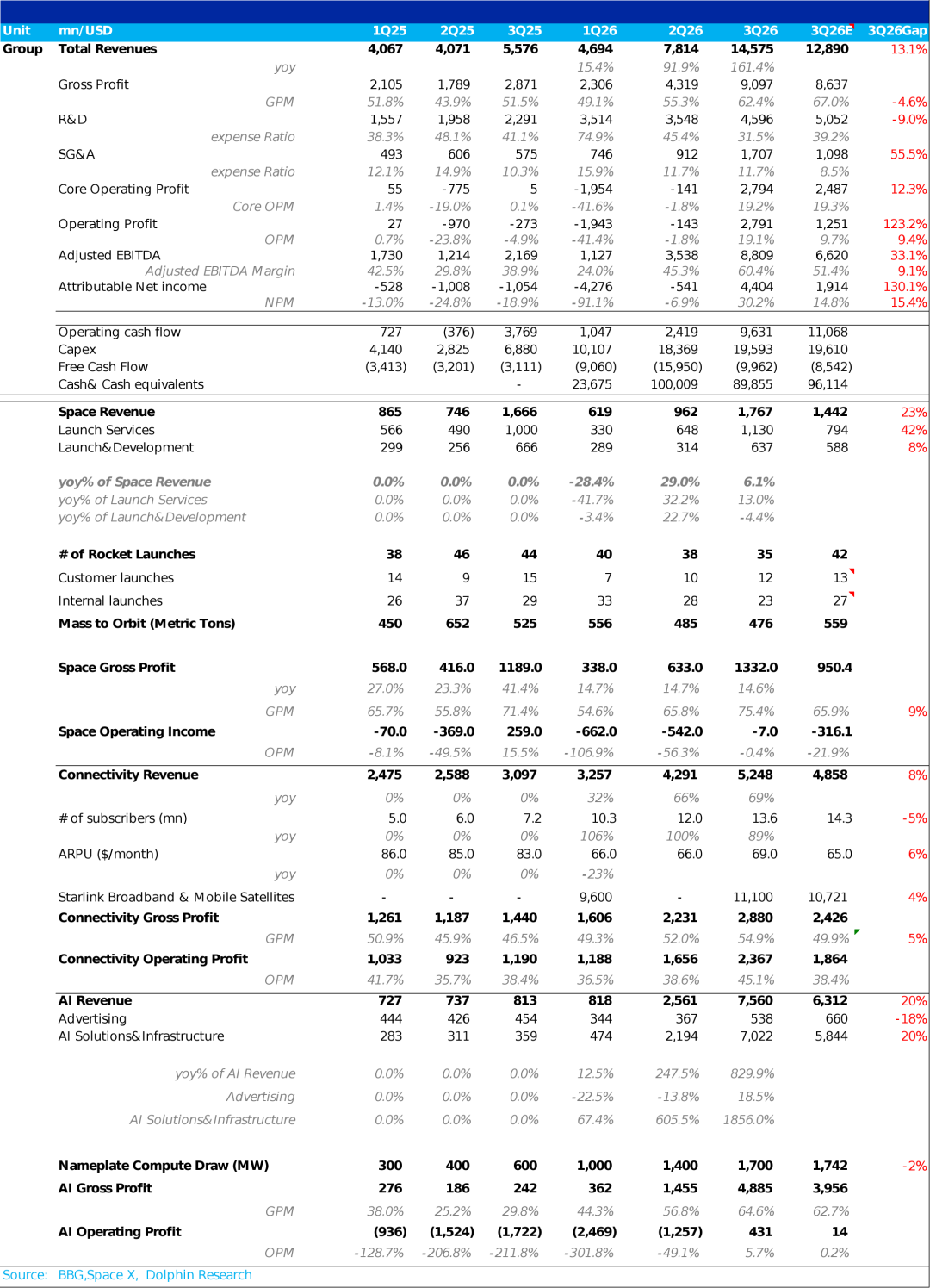
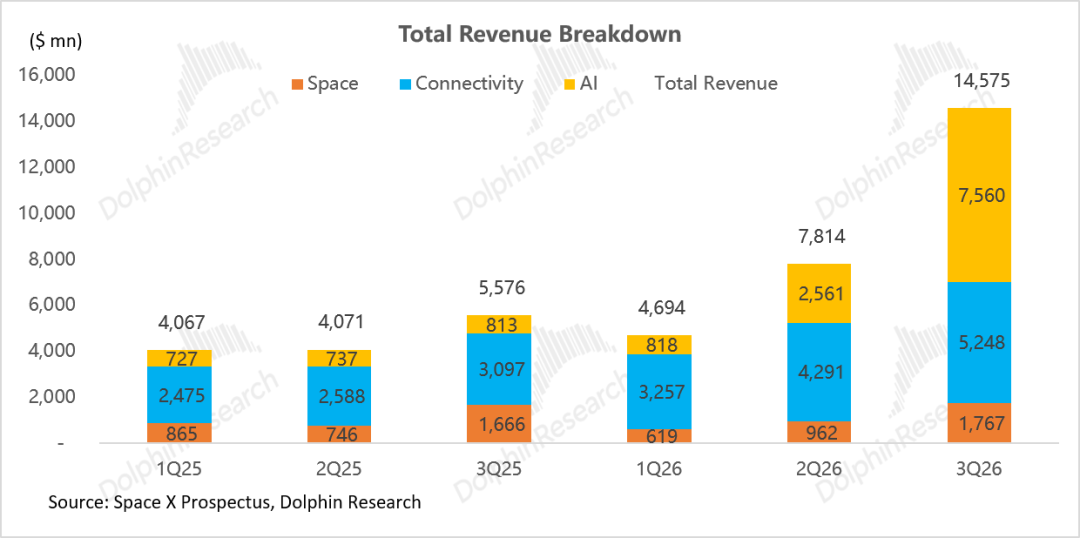
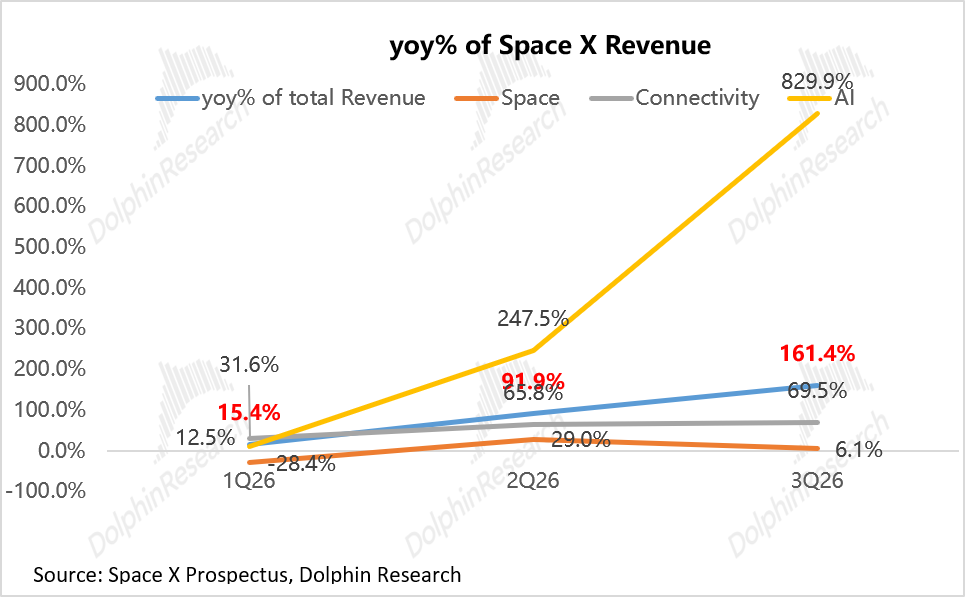
① Total revenue significantly surpassed expectations, with AI computing power leasing driving nearly double quarter-over-quarter revenue: Q3 total revenue reached $14.58 billion, exceeding market expectations (~$12.9 billion) by 13%, up 161% YoY and accelerating from Q2 (+92%).
Revenue from all three major segments—aerospace, Starlink, and AI—exceeded expectations. AI revenue hit $7.56 billion (52% of total), surpassing 50% for the first time, primarily driven by full-quarter contributions from computing power leasing and increased Grok revenue.
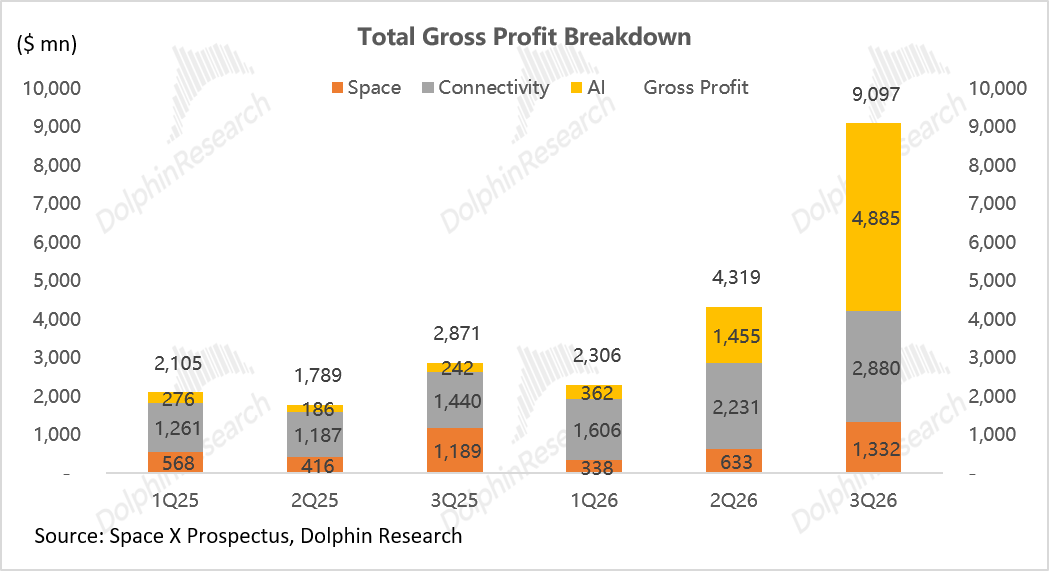
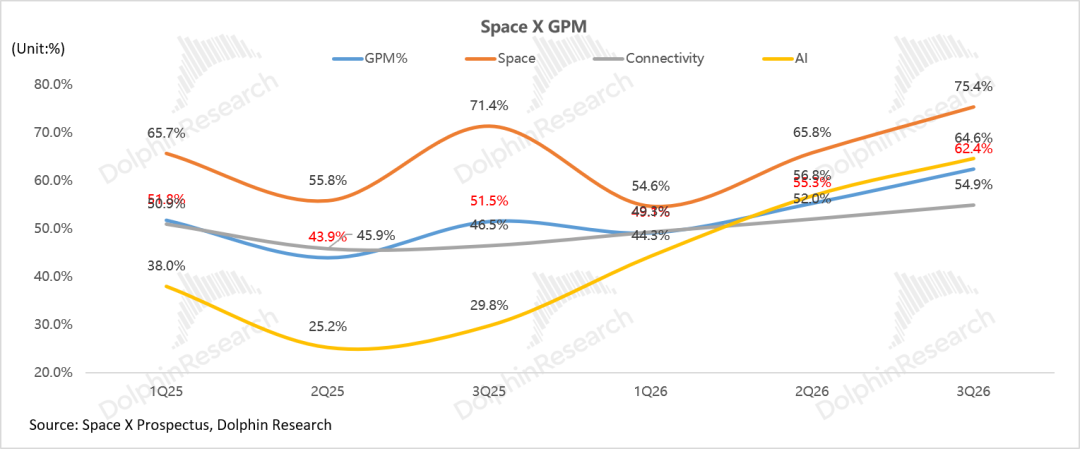
② Gross margin improved significantly but includes one-time factors, expected to retreat in Q4: Gross profit reached $9.1 billion, exceeding market expectations (~$8.64 billion); gross margin rose 7.1 percentage points QoQ to 62.4% (Q2: 55.3%).
Improvements came from three main areas: 1) A sharp increase in high-margin computing power hosting, with AI gross margin rising from 56.8% to 64.6%; 2) Concentration of high-value aerospace missions, with gross margin increasing from 65.8% to 75.4%; 3) A one-time tariff refund of approximately 3 percentage points for Starlink.
However, management guided for Q4 gross margin to return to Q2 levels (~55%), as Q3 included one-time benefits and a favorable customer mix, making the Q3 high point unsustainable.
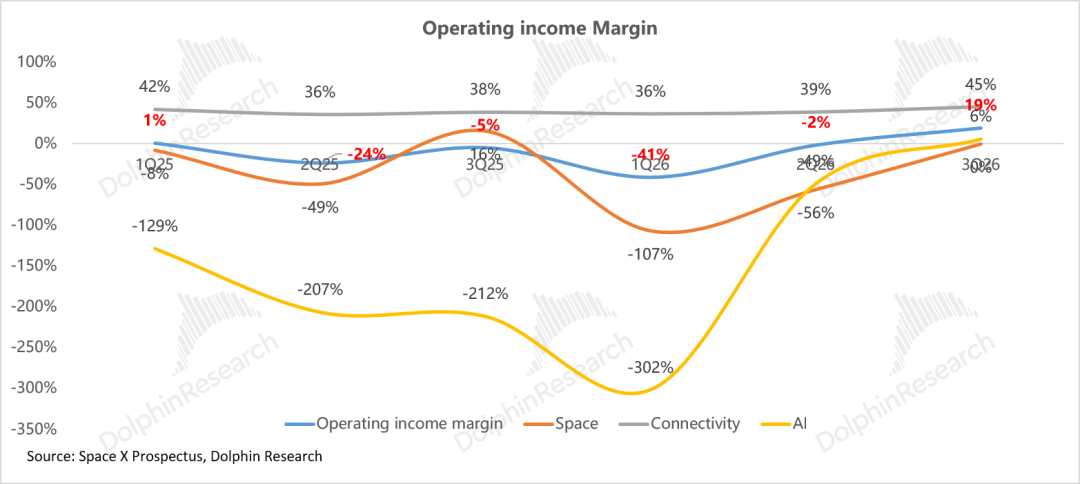
③ Significant operating leverage release, with GAAP operating profit turning positive for the first time and far exceeding expectations: Operating profit reached $2.8 billion, more than double market expectations ($1.25 billion) (Q2: -$140 million), with operating margin improving ~21 percentage points QoQ to 19%.
④ Detailed business performance:
a. Aerospace business: High-value customer missions drove revenue far exceeding expectations, increased R&D investment in Starship, but the segment neared break-even.
Revenue: Aerospace revenue reached $1.77 billion, exceeding market expectations (~$1.44 billion), up 6% YoY.
Launch services: Revenue hit $1.13 billion, surpassing market expectations ($800 million), primarily due to a higher proportion of high-value customers and better-than-expected pricing.
In terms of launch volume, customer launches reached 12 (Q2: 10), slightly below expectations of 13, including Falcon Heavy's launch of the Roman Space Telescope for NASA and six national security missions.
Total launches reached 35 (Q2: 38), including 23 internal launches (21 Falcon 9 Starlink launches + 2 Starship test flights). After the last Falcon 9 Starlink launch in Florida on August 26, Starlink deployments in Florida gradually shifted to Starship, with internal launch frequency continuing to decline.
Regarding launch pricing, revenue per customer launch reached ~$94 million, up significantly from ~$65 million in Q2, primarily due to the concentration of high-value missions like Falcon Heavy and national security launches.
New orders remained strong: 3 Dragon crew missions (scheduled through 2028), 18 national security launches, 3 Starfall missions, an Artemis 3 Starlink communications contract, and a Starship lunar payload contract.
With its near-monopoly on launch capacity (accounting for ~90% of global orbital mass), SpaceX maintains firm pricing power.
Launch and R&D services: Recognized $640 million, doubling QoQ (Q2: $310 million).
This business is recognized based on milestones/completion progress, with Q3 improvements driven by Starship progress: Flight 13 deployed real V3 satellites for the first time, while Flight 14 achieved orbit, deployed 26 V3 satellites, and completed controlled deorbit burns, corresponding to milestone nodes for contracts like NASA's HLS lunar lander.
Profitability: Aerospace gross margin improved ~10 percentage points QoQ to 75.4%, benefiting from high-value missions and increased Falcon 9 reuse.
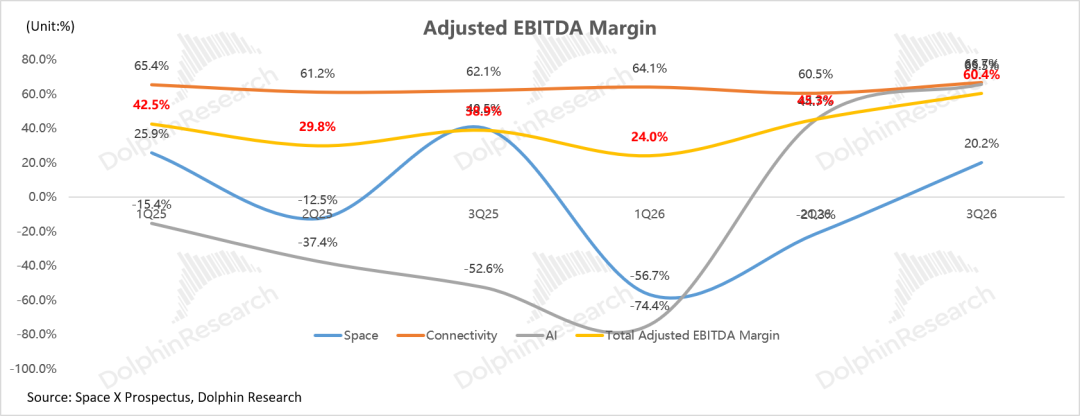
Operating loss narrowed to just $7 million, far better than market expectations of -$320 million. The primary reason for the slight aerospace loss was that the costs of two Starship test flights were mainly include, count, enter into R&D expenses (aerospace R&D reached $1.23 billion, up 14% QoQ); adjusted EBITDA reached $360 million, turning positive again.
b. Starlink business: ARPU unexpectedly rebounded, with B2B/G driving growth, but consumer user numbers fell short of expectations.
Revenue: Starlink revenue reached $5.25 billion, up 69% YoY, exceeding market expectations (~$4.86 billion).
Enterprise and government business: Revenue hit $2.13 billion (expectations: ~$1.96 billion), up 91% YoY, driven by Starshield and aviation: Two new U.S. Space Force Starshield contracts signed in Q2 (Space Data Network Backbone: ~$2.29 billion, Space-Based AMTI: ~$4.16 billion) entered execution;
Aviation has signed contracts for ~12,000 aircraft (~25% of available fleet, covering three of the four major U.S. airlines), with over 3,800 installations by late September. Aviation terminal production capacity has quadrupled this year and will double again by year-end. Management expects enterprise and government revenue to eventually surpass consumer revenue.
Consumer business: Revenue reached $3.12 billion (expectations: ~$2.84 billion), up 57% YoY.
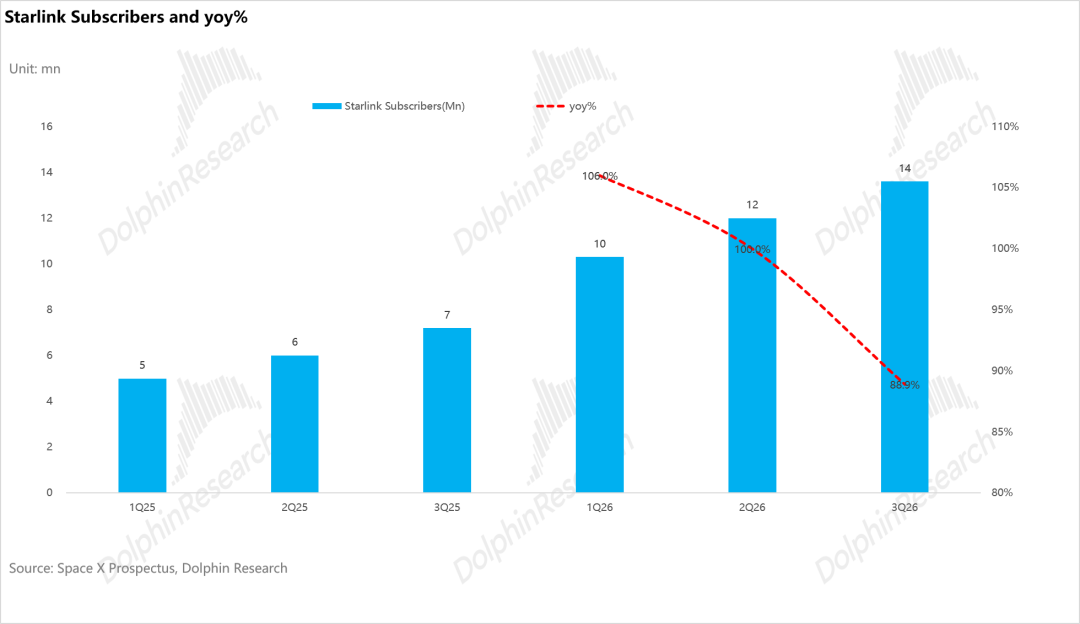
User numbers: Consumer users grew to 13.6 million, a net increase of 1.6 million QoQ (Q2: ~1.7 million), falling short of expectations of ~14.25 million.
The primary reason was that the new-generation home terminal V5 (antenna "dish") only began volume production, with prior capacity constraints leading to preferential stocking for retail channels before the holiday season, leaving many units inactive. Activation is expected to increase significantly in Q4.
Additionally, starting this quarter, "Starlink users" have been renamed "Starlink consumer users," excluding hundreds of thousands of enterprise and government users.
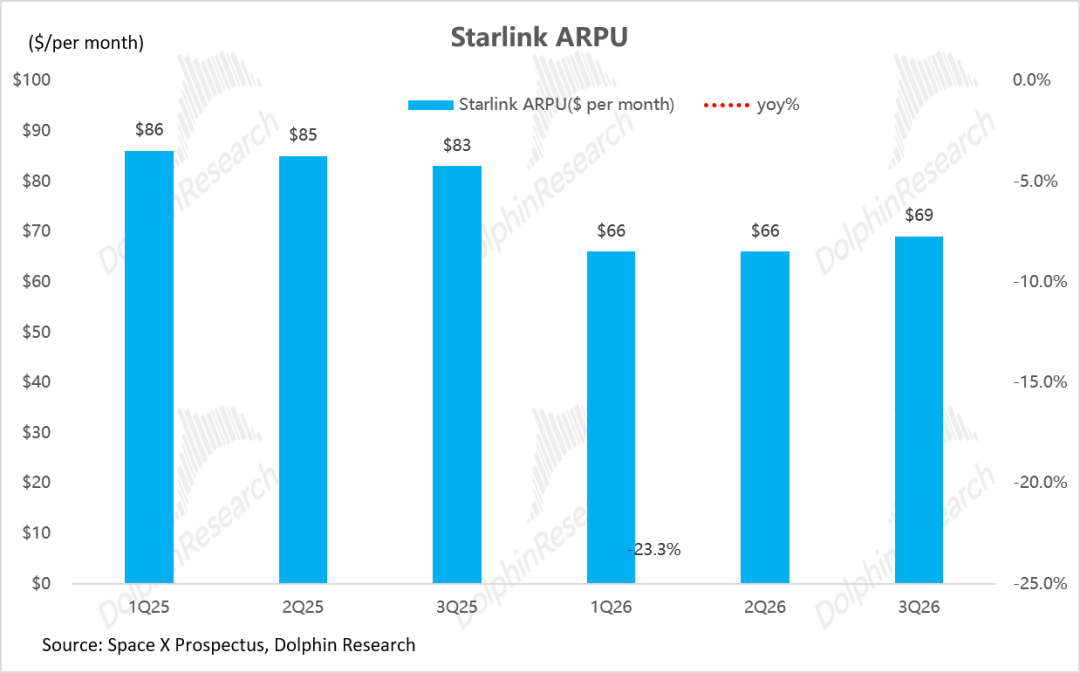
ARPU: Monthly consumer ARPU reached $69, up 5% QoQ (Q2: $66), higher than expectations of ~$65, marking the first rebound in several quarters, primarily due to new users being concentrated in developed markets. Note that ARPU only includes subscription revenue; based on quarterly average users, ~$400–$500 million of consumer revenue came from non-subscription sources like terminal hardware.
Mobile communications business: Currently focuses on wholesaling satellite direct-to-device capacity to operators worldwide, with over 22 million monthly active users, up 37% QoQ.
The next step is to build its own operator: On October 8, SpaceX announced the acquisition of Grain's 800MHz low-band spectrum (expected to close in H1 2027), adding to its previously acquired EchoStar 2GHz mid-band spectrum; the FCC has approved ~15,000 mobile V2 satellites (launching from 2027). Management plans to launch services using its own spectrum in early 2028, aiming to become a major U.S. mobile operator.
As of the end of Q3 2026, ~11,100 satellites were in orbit (this quarter's count includes ~400 approved deorbit satellites, with the previous count at ~10,700; Q2 2026: 10,200). Flight 14 deployed ~26Tbps of downlink bandwidth with only about half its payload, equivalent to 10 Falcon 9 Starlink launches.
Profitability: Starlink gross margin reached 54.9%, up ~3 percentage points QoQ, primarily due to the one-time tariff refund, remaining largely flat otherwise;
Operating profit reached $2.37 billion, with an operating margin of 45%, up 6.5 percentage points QoQ, significantly higher than expectations of ~38.4%. Starlink's SaaS-like economies of scale continue to unfold, and the ARPU rebound has alleviated previous concerns.
c. AI business: Full-quarter hosting confirmation + Cursor consolidation drove revenue to triple, with operating profit turning positive for the first time.
Revenue: AI revenue reached $7.56 billion, far exceeding expectations (~$6.31 billion), up 195% QoQ and 830% YoY.
AI solutions and infrastructure: Revenue hit $7.02 billion (expectations: ~$5.84 billion), primarily driven by:
① Computing power hosting: The Anthropic contract (~325,000 GPUs, 480MW, ~$1.25 billion/month) contributed a full quarter for the first time, totaling ~$3.75 billion (Q2: ~$1.6 billion); the Google contract (110,000 GB300s, 220MW, $920 million/month) ramped up from September and reached full capacity in October; Reflection AI ($150 million/month) began leasing in July.
Excluding Cursor, revenue reached $6.41 billion, up 192% QoQ, with hosting revenue estimated at ~$4.5 billion by Dolphin Research.
② Cursor consolidated for the first time: Closed on August 14, consolidated for ~1.5 months, contributing $608 million in revenue (~$4.7 billion annualized).
③ Grok model: Grok revenue is estimated to have risen from ~$600 million last quarter to ~$1.9 billion, driven by the releases of Grok 4.6 (8/12) and 4.7 (9/21), as well as the launch of the resident intelligent agent Grok Bot: Paid weekly active users reached 800,000 in early October, more than doubling in nearly a month, with full enterprise deployment expected within weeks.
X platform advertising revenue: Reached $540 million, up 47% QoQ but falling short of expectations of ~$660 million.
After completing the AI advertising infrastructure overhaul in Q1 (automated delivery, AI attribution, Grok-driven brand safety controls), ad revenue has rebounded for two consecutive quarters, but whether it can Continuous recovery (chíxù huánwǎn, continuously recover) lost advertisers remains to be seen.
Profitability: AI gross margin reached 64.6%, up 8 percentage points QoQ (expectations: ~62.7%); operating profit reached $430 million, improving by $1.7 billion QoQ and turning positive for the first time (expectations: ~break-even), primarily due to leasing premiums amid strong demand for computing power.
⑤ Capital expenditures and cash flow: Q3 met expectations, Q4 guidance nearly doubled, free cash flow remains deeply negative.
Q3 capital expenditures reached $19.6 billion, largely in line with expectations, including $16.4 billion for AI, $1.6 billion for aerospace, and $1.5 billion for Starlink, with AI remaining the dominant driver.
In terms of computing power, nominal capacity reached 1.7GW by the end of Q3 2026 (Q2 2026: 1.4GW), slightly below expectations of 1.74GW; however, it reached nearly 2.2GW by late October and is expected to reach 2.5–3GW by year-end (higher than the original 2GW guidance). Currently, ~200,000–220,000 GB300 units are coming online monthly, with Vera Rubin becoming the primary focus in 2027.
Due to new capacity added this quarter, management guided for Q4 capital expenditures to rise to $35–40 billion, nearly double Q3's level, corresponding to full-year spending of ~$83–88 billion, significantly higher than previous market expectations of $65–70 billion.
Operating cash flow improved to $9.6 billion this quarter due to profit growth, but capital expenditures remained high at $19.6 billion, resulting in free cash flow of ~-$10 billion.
Overall view from Dolphin Research:
Overall, SpaceX delivered a financial report that fully exceeded expectations: revenue up 161% YoY, net margin improving 37 percentage points QoQ to 30.2% (net profit of $4.4 billion exceeded operating profit, primarily due to ~$1 billion in other income, ~$900 million in interest income, and ~$400 million in tax benefits).
In terms of revenue mix, SpaceX has shifted from "rockets + satellite broadband" to "AI computing power as the largest growth driver": AI revenue accounted for more than half (52%, Q2: ~33%) for the first time.
The operating profit turnaround was also primarily driven by the AI business shifting from "burning cash for growth" to contributing profits, backed by high-margin computing power leasing.
More critically, the guidance fully exceeded expectations: Q1 2027 revenue guidance far surpassed expectations, with 2027 targeting 13GW of computing power and $500 billion–$1 trillion in ARR:
Q1 2027 revenue guidance of $33–37 billion, 40–60% higher than market expectations (~$23.4 billion);
The 2026 year-end ARR target of $100 billion remains unchanged (annualized based on December revenue), with the company's total ARR expected to reach $500 billion–$1 trillion by the end of 2027.
Supporting this guidance is an even more aggressive computing power plan: Nearly 3GW will be secured this year, with 10GW "highly certain" for 2027 and the probability of exceeding 20GW rising rapidly. Power and cooling capacity for an additional 20GW has already been planned by the end of 2027 (totaling ~23GW).
This confidence comes from strong demand for computing power: Pricing slightly exceeds the $30–50/Watt range, with new deployments achieving payback periods of less than one year, potentially shortening to six months next year; demand is several times supply, with rental rates for older H100 cards now higher than when they were new.
As a result, management favors short-term spot leasing and bets on continued per-watt value appreciation; hosting contracts can also be terminated early (e.g., Google's contract can be terminated by either party with 90 days' notice after the end of 2026). This is the optimal strategy during a supply shortage, but low revenue visibility and short contract durations remain the largest discount factors for AI business valuation.
With cash and marketable securities totaling just $89.9 billion at quarter-end, SpaceX cannot sustain this investment pace and expects to start raising funds in H1 2027.
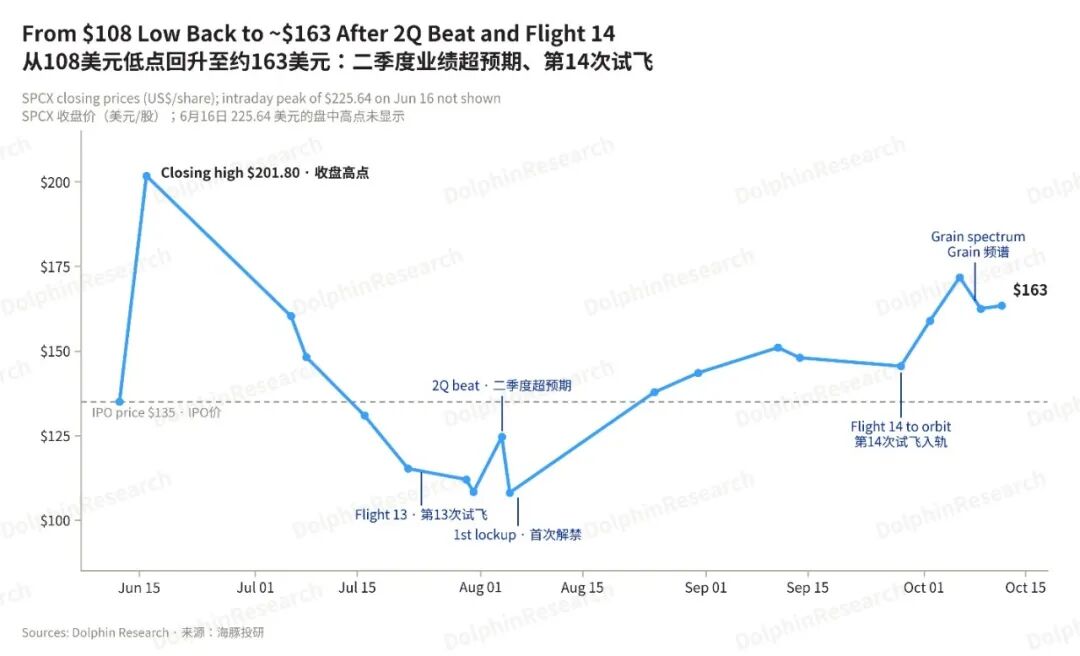
More than four months after its IPO, SpaceX's stock price has nearly halved and then recovered: from a closing high of ~$202 (~$225.6 intraday) to ~$108 in early August, rebounding to ~$163 by mid-October.
This confirms Dolphin Research's judgment after the Q2 financial report: Like Tesla, SpaceX is priced based on "event catalysts" rather than short-term performance. Long-term businesses like space-based computing power and the 10GW AI expansion account for most of its market cap, yet contribute little profit today. The stock price is essentially a "probability-weighted option," with each catalyst increasing the exercise probability. Over the past two months, catalysts across all segments have nearly simultaneously materialized:
① Starship Flight 14's first successful orbit insertion (9.28): This was the 14th Starship launch and third flight of the V3 configuration, with the spacecraft entering a ~275km orbit for the first time, deploying all 26 operational Starlink V3 satellites. Each satellite offers 1Tbps downlink and 160Gbps uplink, roughly 10x and 22x V2's capacity, respectively.",
This quarter, the company signed new cloud service agreements. Management stated that the unit price of computing power is slightly higher than the upper limit of the $30–50/W range, with the payback period for new computing power being less than one year, reflecting the continued supply-demand imbalance in computing power.

③ Cursor Deal Closed, Grok Intensifies Iteration:
On August 14, SpaceX completed the acquisition of Cursor for $60 billion in an all-stock deal: Cursor became its wholly-owned subsidiary, with only about 1.5 months of consolidation in Q3, contributing $608 million in revenue, and full consolidation starting in Q4.
This acquisition brings an AI programming gateway with an ARR of approximately $4 billion (about 75% from enterprises, with over 64% of Fortune 500 companies using it). Its interaction data has been used for supplementary training of Grok, enhancing model performance.
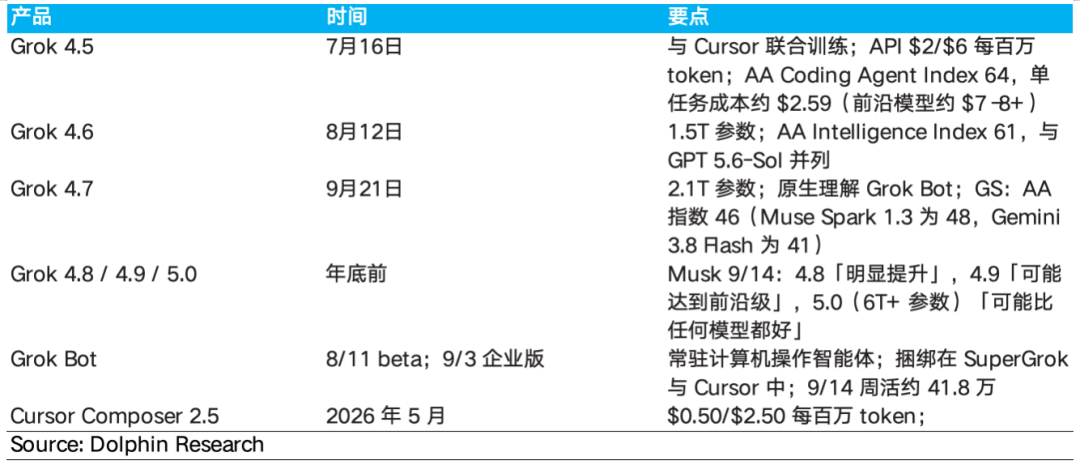
Meanwhile, Grok has entered monthly-level iteration: On August 12, Grok 4.6 was released (1.5T parameters, 500K context, $2/$6 per million tokens), scoring 61 on the Artificial Analysis Intelligence Index, tying with GPT-5.6 Sol and entering the first tier.
In August, Grok Bot was launched, entering the computer use agent category in the form of cloud virtual machines. By early October, its paid weekly active users had reached 800,000, more than doubling in the past month, with sustained narrative momentum.
On September 21, Grok 4.7 was released, with parameters increased to 2.1T (about 40% more than 4.6), maintaining cost-effective pricing.
On September 14, Musk previewed that Grok 4.8, 4.9, and 5.0 would be released before the end of the year, stating that 4.9 "might reach the frontier level" and 5.0 "might be better than any model." Grok 5 (6T+ parameters, trained on Colossus 2) is expected to be released in December.
Thus, SpaceX's AI business has begun to extend from "selling computing power" to "selling models + applications": Short-term revenue still relies on premium computing power contracts, but Grok monetization (especially on the enterprise side) will become increasingly important. The long-term goal is to close the loop of "computing power—data—model—agent products."
④ Low-Frequency Spectrum + FCC Approval Clarify Mobile Business Roadmap:
On October 8, SpaceX announced plans to spend approximately $6–8 billion to acquire Grain Management's nationwide 800MHz low-frequency spectrum (up to 14MHz paired, for broad coverage and indoor penetration). Combined with EchoStar's previous ~65MHz of 2GHz mid-band spectrum (for high-speed capacity), Starlink has now secured both "low-band + mid-band" terrestrial spectrum for the first time. With the FCC's recent approval of 15,000 direct-to-phone satellites, its positioning has shifted from "satellite gap-filling" to the "fourth largest facility-based operator."
However, short-term revenue contributions will be limited: Satellites alone cannot solve urban high-concurrency and indoor penetration issues, and the total spectrum is only ~80MHz, about two-fifths of the three major carriers. The three major carriers also refuse to provide MVNO (network leasing), so ground networks must be self-built (see Starlink section below for plans).
Nevertheless, holding spectrum itself is an "option": The more credible the threat of self-building networks, the greater the bargaining power to force traditional carriers to open MVNOs.
Overall, SpaceX's financial performance was impressive: Revenue and profit exceeded expectations, with operating profit turning positive for the first time, and guidance significantly surpassing expectations. However, the post-earnings stock price trend will depend on short-term selling pressure from lock-up expirations and medium-term progress on key milestones: Full reuse of Starship (Flight 15 dual-stage capture), V3 deployment pace and mobile business ground network plans, whether 2027 computing power expansion orders and financing can match, and whether the $500 billion–$1 trillion ARR target by the end of 2027 can be achieved.
Specifically:
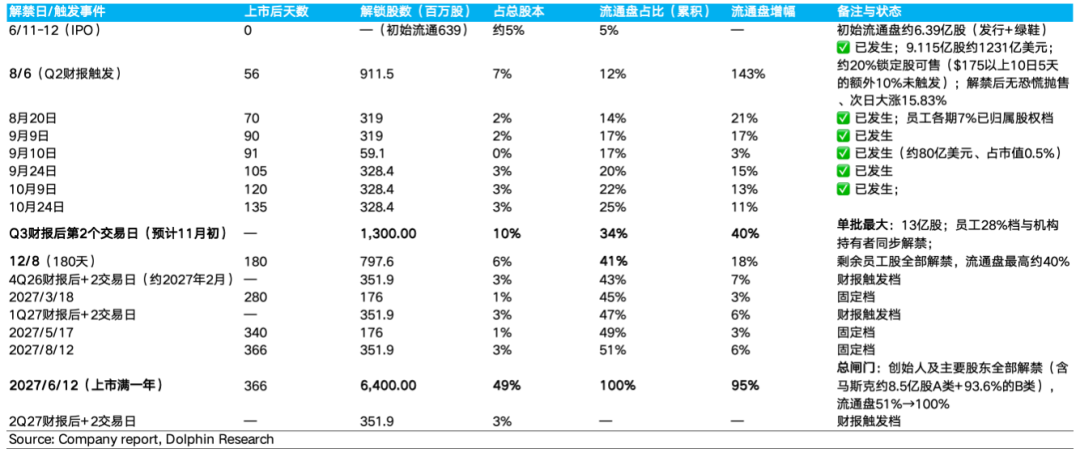
a. Short-term: ~1.3 billion shares unlock right after earnings, the most concentrated window for technical selling pressure
On August 6, the first batch of 911.5 million shares (~7% of market value) unlocked after Q2 earnings, resulting in "much ado about nothing": The prior sell-off had already digested marginal selling, and no panic selling occurred post-unlock, with the stock surging 16% the next day (August 7).
According to lock-up terms, the peak unlock will occur on the second trading day after Q3 earnings (~October 22): 28% of vested employee equity and institutional holders will unlock simultaneously, totaling ~1.3 billion shares (~10% of total shares), the largest batch since listing. On December 8 (180 days post-listing), the remaining employee shares will fully unlock, with the float potentially reaching ~40% of total shares.
The stock price had rebounded ~50% from its lows to above $160 before earnings (corresponding to a market value of ~$2.2 trillion), with profit-taking intentions clearly stronger than in August. However, the guidance significantly surpassed expectations, providing strong reasons for buyers to step in.
b. Launch Business: Flight 15 Dual-Stage Capture, the Largest Positive Catalyst Since IPO
Significant cost reductions for Starship are fundamental for large-scale V3 networking and space data centers. Musk stated that Flight 15 is expected in November, attempting to recover both the booster and spacecraft simultaneously using the launch tower. FAA approval is expected to cover return and tower recovery, with Musk stating "success is more likely than failure" (previously self-rated at 50%–60%). If successful, it would be the first complete recovery of an orbital vehicle.
Subsequently, the second stage will be reused in early 2027 with attempts at in-orbit refueling, targeting one launch per week in the first half and two or more per week in the second half, beginning to launch mobile V2 and Starmine satellites. The new launch site in Louisiana has an internal goal of a maiden flight in 2028 and scaling (scaled) operations in 2029.
This is a cost inflection point: Without reuse, V3 launch costs are ~$600–900/kg; after 5–6 reuses, costs can drop below $200/kg. Once "full reuse" is achieved, market confidence in long-term prospects will significantly improve. Conversely, failure combined with unlocks could amplify short-term pullback risks.

c. Starlink Business: Short-term focus on V3 deployment pace, medium-term focus on mobile business "ground network" solution
Broadband business: Management stated that hundreds of V3 satellites are needed for users to notice significant capacity improvements, expected by mid-2027, requiring Starship to enter high-frequency deployments from Flight 15/16. A fully loaded V3 launch will add more than 20x the capacity of a Falcon 9 launch, with Musk estimating that constellation bandwidth could reach 100x current levels in ~3 years.
Mobile business: With Grain's low-band and EchoStar's mid-band spectrum, the spectrum puzzle is nearly complete. The next step is whether to participate in the Upper C-band auction in April 2027 (~160MHz, the largest mid-band block in the U.S. in the coming years).
For ground networks, management's plan is: Satellite S-band will carry the majority of traffic, with 800MHz for indoor penetration. Small base stations will be added to residences, businesses, and towers already equipped with Starlink, reusing sites, with services targeted to launch in early 2028. This may be lighter than the market's previous assumption of a "nationwide self-build costing over $100 billion," but the investment scale has not been disclosed. Dolphin you believes scaled commercial rollout may not occur until after 2029.
Short-term key tracking points include V3 deployment nodes, mobile V2 launch progress, and the ground network plan to be disclosed at the special event.
d. AI Business: $100 billion ARR largely assured, 2027 focus on orders, financing, and pricing
In the Q2 review, Dolphin you estimated that without major new orders, AI business ARR would reach ~$50 billion by year-end, still short of the $100 billion target. New hosting contracts in Q3 largely closed the gap, with management reaffirming the target.
The updated December 2026 ARR breakdown is as follows:
① Computing power hosting: Annualized ~$54.5 billion from five disclosed clients, plus new agreements signed this quarter and revenue from new capacity after year-end computing power expands to 2.5–3GW.
② Cursor: Annualized ~$4.7 billion during consolidation, projecting ~$6–8 billion by year-end at 8%–12% monthly growth.
③ Grok: ~$8 billion by year-end, with Grok 5 expected in December.
④ Advertising: Annualized ~$2–2.5 billion.
⑤ Starlink + Aerospace: ~$30 billion by year-end.
Total: ~$100.5–103 billion, with the $100 billion target largely assured when including new agreements and capacity.
Looking at 2027: 1Q27 revenue guidance annualized at $132–148 billion, with $100 billion ARR just the starting point. Musk even stated that ARR could reach $500 billion–$1 trillion by the end of 2027. To achieve this, four questions must be answered:
1. What does $500 billion–$1 trillion ARR mean?
In scale, this is 5–10x the $100 billion target by the end of 2026.
Lower bound: Based on 13GW computing power, 60% leased (~8GW), at $50/W, computing power leasing ARR would be ~$390 billion, plus ~$80 billion from applications, ~$45 billion from connectivity and aerospace, totaling ~$515 billion.
Upper bound: Relying solely on computing power leasing would require leasing 17–18GW externally, exceeding the leasing capacity under optimistic 20GW scenarios. This would require massive scaling of Grok Bot and Cursor, representing a "long-term option."
2. Where will the money come from?
Q4 guidance has pushed this year's Capex to $83–88 billion. Adding 10GW in 2027 would require $300–350 billion per GW, totaling $300–350 billion, while cash and marketable securities were under $90 billion at the end of Q3.
Management prioritizes operating cash flow, supplemented by debt financing (in talks with multiple parties) and industry chain partnerships, maintaining investment-grade ratings without mentioning equity financing. New capacity will generate cash from the first half of 2027 but will still be insufficient relative to investment.
Dolphin you roughly estimates that without new financing, cash could run out by Q1 2027, with large-scale debt financing likely in Q4 this year to H1 next year.
3. Can orders keep up?
1Q27 guidance is based on contract visibility for the next six months, covering only H1 next year. At 60% external leasing, ~8GW needs to be signed externally by year-end, while Dolphin you estimates ~1.2–1.4GW has already been signed, leaving a gap of over 5GW.
However, this gap is partly intentional: Management prefers spot short-term leases and does not lock in long-term capacity, and demand is several times supply. Dolphin you believes match rates will improve quarterly but actual lease signings are needed to confirm.
4. How long can high pricing be sustained?
The unit price is slightly above the upper limit of the $30–50/W range, with a payback period of less than one year, 3–5x faster than peers, reflecting premium pricing under computing power shortages. Management's logic is that model improvements increase "useful intelligence" per watt, with H100 old card rents now higher than when new cards launched. Thus, they choose spot short-term leases and raise prices upon renewal, holding a "call option" on pricing increases while supply is tight.
The core tracking metric is new contract and renewal pricing. The risk is that once supply-demand inflects in 2027 with new computing power like Vera Rubin coming online, high premiums could collapse.
Thus, Dolphin you believes this is an earnings report that surpassed expectations, with guidance exceeding even those expectations. In the short term, the unlocking of ~1.3 billion shares may cause technical disruptions. In the medium term, the stock price narrative has shifted to "whether the addition of over 10GW of data centers can land as scheduled and whether leasing orders can match investments." As long as new capacity can be leased at current prices, the sub-1-year payback period will make large Capex a growth accelerator rather than a burden.
At the current market value of ~$1.95 trillion, this equates to less than 4x the lower bound and less than 2x the upper bound of 2027 year-end ARR, making valuations seem "cheap"—but only if ARR targets are fully met.
If unlocks drive a stock price pullback in the short term, Dolphin you sees it as an opportunity for medium- to long-term bottom fishing. Successful Flight 15 dual-stage capture, $100 billion ARR achievement in December, Grok 5 exceeding expectations, 2027 debt-focused financing plans landing, and new computing power contracts with "unchanged pricing and longer terms" would all be positive catalysts.
Additionally, Musk responded positively for the first time to a merger with Tesla: Personally, he thinks it's a good idea, but the special committees of independent directors at both companies have not agreed on any terms, and Tesla would need 50% approval from all outstanding shares—a high threshold. The market's assumption that a merger is "certain" clearly overestimates the likelihood.
Financial charts:
- END -
// Reprint with Authorization
This article is an original work of Dolphin Research. Reprinting is permitted only with authorization.
// Disclaimer and General Disclosure Notice
This report is intended solely for general comprehensive data purposes, designed for general viewing and data reference by users of Dolphin Research and its affiliated entities. It does not take into account the specific investment objectives, investment product preferences, risk tolerance, financial condition, or particular needs of any individual receiving this report. Investors must consult with an independent professional advisor before making any investment decisions based on this report. Any person making investment decisions using or referring to the content or information mentioned in this report does so at their own risk. Dolphin Research shall not be liable for any direct or indirect responsibility or loss that may arise from the use of the data contained in this report. The information and data contained in this report are based on publicly available sources and are provided for reference purposes only. Dolphin Research strives to ensure, but does not guarantee, the reliability, accuracy, and completeness of the relevant information and data.
The information mentioned or the views expressed in this report shall not, in any jurisdiction, be regarded or construed as an offer to sell or an invitation to buy securities, nor shall they constitute advice, solicitations, or recommendations regarding securities or related financial instruments. The information, tools, and materials contained in this report are not intended for distribution to, or use by, any person or resident in any jurisdiction where such distribution, publication, provision, or use would be contrary to applicable laws or regulations or would subject Dolphin Research and/or its affiliates or associated companies to any registration or licensing requirements in such jurisdiction.
This report solely reflects the personal views, insights, and analytical methods of the relevant contributors and does not represent the stance of Dolphin Research and/or its affiliated entities.
This report is produced by Dolphin Research, and the copyright is solely owned by Dolphin Research. Without the prior written consent of Dolphin Research, no institution or individual may (i) produce, copy, reproduce, duplicate, forward, or create any form of copies or reproductions in any manner, and/or (ii) directly or indirectly redistribute or transfer them to any other unauthorized persons. Dolphin Research reserves all relevant rights.
-
New Chips Frequently Emerge, RISC-V Fuels the AI Era
-
Raccoon Carries SenseTime to the Top of the AI Wave
-
Huaqiangbei-Based Company Replicates Huawei’s Popular Wide Straight Slab Phone
-
![]()
Optical Manufacturing Drives Life and Health Forward! Goertek Optics and Nearview Technology Forge Strategic Alliance
-
RMB 37.49 Billion Long-Term Contract: What Is Xiechuang Data Wagering On?
-
![]()
Why, After 34 Years, Has the Former Color TV Leader Reached the Point of Delisting? "Konka, Delisting, Color TV, Price War, China Resources"
-
![]()
Xiaomi Restructures Business, Eyes AI as Next Growth Engine
-
![]()
Amid Business Reorganization, Xiaomi Sets Sights on AI for Future Growth