When AI Starts to Impose a 'Tax' on Everyone
 09/11 2026
 352
352
Under AI Expansion, Major Companies Are Brewing an 'AI Tax'
Image Source | Internet (Please contact us for removal if infringement occurs)
Have you noticed that smartphones and computers suddenly became unaffordable this autumn?
September is typically the promotional window for back-to-school tech 'three-piece sets,' but the 2026 autumn new product season kicked off with a series of record-high prices.
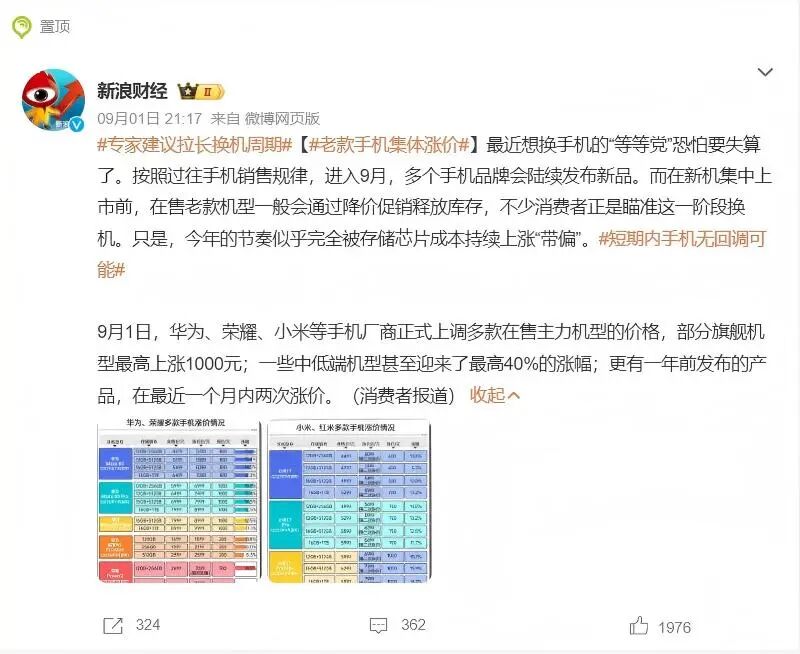
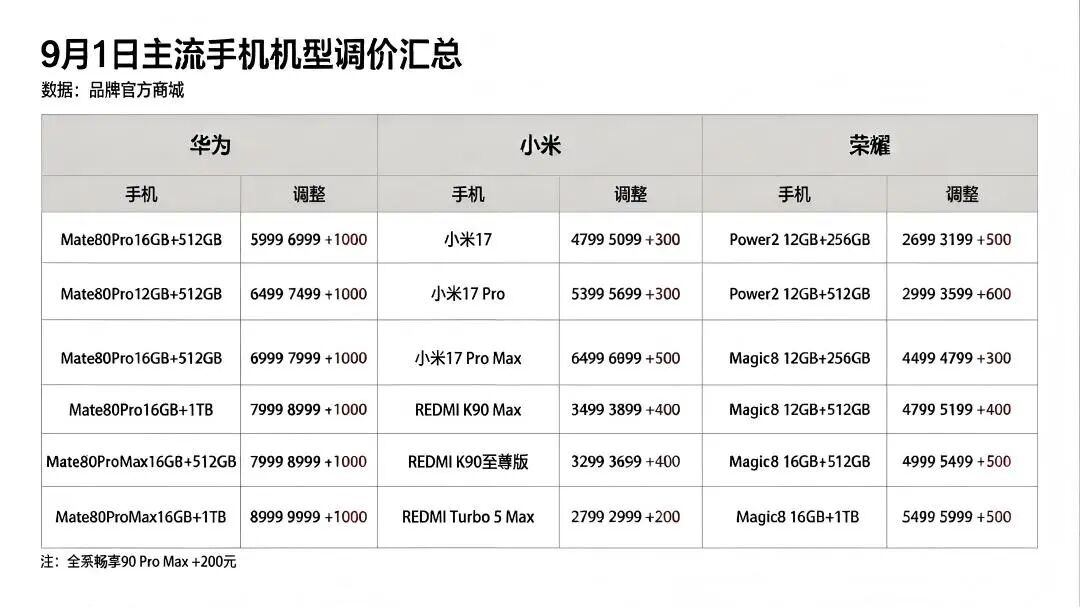
Starting September 1, multiple smartphone brands, including Huawei, Xiaomi, and Honor, collectively raised prices for their in-sale models, with increases ranging from 100 to 1,000 yuan; the PC side followed suit, with brands like HP and ASUS adjusting prices, and some products seeing cumulative increases of nearly 30% this year.
The Xiaomi 17 series saw cumulative price increases of 600-1,000 yuan from its initial launch price, the Huawei Mate 80 Pro Max top-tier model rose from 8,999 yuan to 9,999 yuan, and the Lenovo Xiaoxin Pro 16 Ryzen Edition increased by about 1,500 yuan in three months. Even the secondhand market wasn't spared, with some popular electronics seeing secondhand price increases of 100 to 500 yuan.
This is not an isolated case for a single brand but a collective price adjustment covering all price segments. From budget phones to flagship models costing tens of thousands of yuan, from smartphones to computers, the price hike wave is sweeping through the wallets of every digital consumer.
And the mastermind behind all this is not inflation or exchange rates but a concept you might hear about every day yet may not truly understand.

Who Is 'Snatching' the Chips?
Recently, I often see bloggers saying that the recent price hikes in smartphones, computers, and other devices are primarily blamed on AI, and upon closer inspection, this seems to hold some truth.
The direct driver of this round of price hikes is memory chips. In the first quarter of 2026, global DRAM contract prices surged by 93% to 98% quarter-over-quarter, with some automotive-grade memory spot prices rising by over 180%.
According to CFM China Flash Market estimates, global DRAM and NAND spot prices saw annual increases of 386% and 207%, respectively, in 2025.
The memory industry is experiencing its most intense upswing cycle in history.
But this is not an ordinary cyclical fluctuation. Over the past 20-plus years, the price cycles of memory chips have been driven by the inventory rhythms of smartphones and PCs, recurring roughly every 2 to 3 years. The fundamental driver of this round of price hikes is the explosive growth of AI computing power.
Data best proves everything: A single AI server's DRAM capacity is 8 to 10 times that of traditional servers, and its NAND usage is about 3 times higher.
Global AI server shipments increased by about 180% year-over-year in 2026, and AI servers now account for 53% of the total global memory demand, meaning that over half of the world's memory chips are now consumed by AI servers.
The demand surge is only one side of the story. More critically, there is a structural shift on the supply side, with Samsung, SK Hynix, and Micron—the three major memory giants—reallocating 70% to 90% of their advanced production capacity to higher-margin HBM (High Bandwidth Memory) and server-grade DRAM.
HBM is the 'standard memory' for AI chips, with a gross profit margin far exceeding that of ordinary consumer-grade DRAM. Cloud providers and AI companies further squeeze the supply space for consumer-grade memory by locking in long-term agreements and snapping up production capacity at high prices.
A report by KB Securities in South Korea points out that Samsung Electronics and SK Hynix's memory chip inventories have dropped to less than 10 days' supply.
According to institutional estimates, global PC manufacturers may face a 15% memory chip shortage in 2027, equivalent to a production loss of 58 million PCs; smartphone manufacturers will also see a 12% shortage, equivalent to 134 million fewer phones produced.
This is not just a price hike; it's a 'snatching' of production capacity.

When 'Moore's Law' Meets the 'AI Law'
For more than a decade, the consumer electronics industry has adhered to an iron law: With the same amount of money, consumers could buy devices with larger memory, greater storage, and stronger chips every year. Performance upgrades and stable prices were the dividends 'Moore's Law' brought to consumers.
But in 2026, this iron law was shattered.
The proportion of memory chips in the total cost of devices surged. The memory cost for an 8GB+256GB smartphone rose by nearly 200% year-over-year in the first quarter of 2026, with its share increasing from 10%-15% to 30%-40%, and some models approaching 50%.
On the PC side, memory components now account for 40%-60% of the total material cost.
Faced with soaring costs, smartphone manufacturers' hardware gross profit margins were severely compressed, with most dropping below 5%, and low-end products even facing losses.
Manufacturers were forced to make a choice: either reduce configurations to cut costs or directly raise terminal prices.
In reality, they chose 'both.'
On one hand, prices went up. On the other hand, configurations shrank.
Since 2026, the number of smartphones priced below $400 in the market is expected to decrease by 22%. Budget phones are no longer the 'lite versions' of flagship models. The Honor X80i 8GB+128GB version is priced at 1,999 yuan, a 600 yuan increase from the X70i's 1,399 yuan, representing a 42.89% hike.
Some industry observers bluntly stated, 'Not only are new flagship models getting more expensive, but their configurations are also being reduced.'
You're paying more for less.
More subtly, manufacturers have found a perfect 'price hike packaging'—AI itself.
This has created an absurd logic: AI caused the price hikes, and AI also became the reason for the hikes.
When soaring memory chip costs pushed manufacturers' profits to the brink, they discovered a brilliant narrative—packaging the price hikes as 'AI upgrades.'
Global smartphone manufacturers are almost all readjusting their brand and product strategies, with Agent phones becoming the new selling point. IDC predicts that China's new-generation AI smartphone shipments will reach 147 million units in 2026, accounting for more than half (53%) for the first time.
Manufacturers are also promoting the so-called 'AI PC' concept, using local AI computing power, dedicated acceleration units, and higher hardware specifications as justification for price increases.
HP's PC business revenue increased by 18% year-over-year, but shipments declined by 16%; Dell and Lenovo's PC business revenues also grew by about 20% and 30%, respectively, selling fewer units but earning more.
The logic behind this is clear: When consumers ask, 'Why the price hike?' 'It now has stronger AI and smarter Agents' is a far more acceptable answer than 'Memory chips are being snatched up by AI.'
The former sounds like paying for a new experience, while the latter exposes an awkward truth: You're getting nothing but are forced to foot the bill for someone else's AI dreams.
Some smartphone manufacturers have even started experimenting with physical form factors. Samsung introduced a 'passport-style' wide folding screen phone with a 4:3 screen ratio.
Phones are getting wider, and folding screens are becoming more common. Behind these design changes, besides product innovation, lies an undeniable motive: to support higher pricing amid soaring core component costs.
Amid the AI smartphone frenzy, manufacturers have found another reason to raise prices.
But for ordinary consumers, they don't care about the new AI or Agent prefix added to their phones; what matters more is whether they're being forced to pay for the so-called 'AI tax' on top of expensive memory chips.

Altered Consumption Logic
The 'AI tax' is, of course, not a new tax levied by the government but a vivid metaphor.
What is its essence?
The benefits of AI are highly concentrated in the hands of a few tech giants, but the costs of AI expansion are passed down through the supply chain and ultimately borne by ordinary consumers in the form of terminal price hikes. This is essentially a 'computing power tax,' meaning that everyone who buys a new phone is unknowingly paying for the computing power consumed by large models.
The logic is not complicated. Just as rising oil prices increase logistics costs for all goods, AI computing power consumption drives up memory prices, and memory is a core component of almost all electronic products.
When AI servers voraciously consume memory production capacity, consumer electronics manufacturers can only compete for the remaining limited capacity, driving up procurement costs that are ultimately passed on to terminal consumers.
The difference is: When oil prices rise, at least everyone is using energy, whereas the productivity gains brought by AI are far from benefiting every consumer.
This is worth pondering. An ordinary user who only uses their phone to browse short videos and chat on WeChat bears the exact same cost in the 'AI tax' as a heavy AI user who uses large models to write code and design—or possibly even more, since the latter at least enjoys the efficiency gains from AI.
When the benefits of technological progress are concentrated upstream in the supply chain while the costs are dispersed across society, is this model sustainable?
This is a question worthy of deep reflection for the entire industry.
The 'AI tax' is fundamentally altering ordinary people's consumption behavior.
National Bureau of Statistics data shows that in July 2026, prices for computers, tablets, and mobile phones rose by 17.4%, 17.2%, and 8.5% year-over-year, respectively.
Faced with persistently high prices, consumers are responding by—not buying.
IDC data shows that global smartphone shipments declined by 16.7% year-over-year in 2026, with the domestic market seeing sales declines for five consecutive quarters. The PC market is equally bleak, with IDC predicting a year-over-year decline of about 9% in global PC shipments in 2026.
The 'wait-and-see' crowd isn't waiting for price drops but facing even higher prices. A recent graduate calculated that their desired MacBook Air had already increased by 1,500 yuan and ultimately decided to keep using their old computer.
High school graduates were forced to downsize their 'back-to-school three-piece sets,' skipping tablets, opting for entry-level laptops, and using their parents' old phones.
A large number of consumers are shifting from 'frequent device upgrades' to 'durable consumption,' with secondhand markets and a wait-and-see approach becoming the primary coping strategies.
But ironically, even if you don't upgrade your phone or buy a new computer, the 'AI tax' is still being levied on you.
The price of a laptop already implicitly includes the costs of the AI boom. Even if you've never purchased any AI subscriptions, buying a computer means you've already paid for AI's 'prosperity.'
On secondhand trading platforms like Zhuanzhuan, prices for some used smartphones have risen by 100 to 200 yuan, while used computers have seen increases of over 300 yuan.
Platform staff noted that after new device price hikes, some budget-constrained consumers turned to the secondhand market, temporarily boosting demand.
Price hikes, reduced configurations, shifts to secondhand markets, and delayed upgrades form a complete transmission chain. And the starting point of this chain lies in AI data centers operating day and night thousands of kilometers away.

Gartner, an IT research and advisory firm, predicts that by the end of 2026, combined DRAM and SSD prices will rise by 130%, driving up PC prices by 17% and smartphone prices by 13%.
IDC forecasts that the average selling price of PCs will rise by about 20% in 2026 and may continue to climb slightly in 2027.
TrendForce offers even starker short-term increases: In the second quarter of 2026, traditional DRAM contract prices are expected to rise by 58% to 63% quarter-over-quarter, while NAND Flash contract prices are projected to increase by 70% to 75%.
With semiconductor factory construction cycles lasting two to three years, the supply-demand imbalance is unlikely to be resolved in the short term.
Global cloud providers and AI companies continue to secure long-term HBM supplies, further preempt (this Chinese word means 'snapping up' or 'seizing') general-purpose memory resources in the spot market.
'High terminal prices may become a temporary norm,' a Xinhua Net report concluded.
And as chips enter the 2nm era, with memory prices continuing to rise and AI driving ever-higher memory and computing power demands, this round of price hikes is unlikely to be a short-lived phenomenon.
The 2026 tech world is marked by a significant feature of 'hidden inflation.'
Tens of billions of dollars are being poured into AI servers, with tech giants racing ahead on the large model track. OpenAI's Altman brought large models into the public eye, and three years later, this 'AI shockwave' has swept through data centers, memory factories, and terminal supply chains, engulfing the entire consumer hardware industry.
The bill for this frenzy has ultimately been sent to every ordinary consumer.
Many people haven't even figured out what large models can actually do for them—even sideloaded AI on phones is mostly useless beyond basic image editing and generating trivial text—yet their wallets have already been emptied by AI in advance.
The few hundred to over a thousand yuan extra you pay for a smartphone is essentially funding the AI race of global tech giants.
This is not to say that AI should not develop. Investments in AI infrastructure may ultimately boost total factor productivity. The issue is that when benefits are seized by a few while costs are shared by all, this development model itself warrants scrutiny.
From a macro perspective on technological development, this AI-driven cost restructuring may be merely a necessary phase of industrial transformation. But during this phase, everyone opening an e-commerce platform to buy a new phone is feeling the weight of the 'AI tax' in cold, hard cash.
And when manufacturers package price hikes as 'AI upgrades' while quietly reducing configurations, consumers need to ask themselves: Do I really need to pay an extra thousand yuan for AI features I'll never use?
The answer may be simpler than you think.
-
![]()
Mother and Son with a 7-Year Age Gap, Labor Remuneration Soars Over 2 Trillion: Xingyu Shares Faces Information Disclosure 'Mishaps' Amid Layoff Controversy
-
If You're a Disruptor, Let's Ride the Wave of CALB's Business Success Together
-
![]()
Foldable Smartphone Showdown: A Prelude to the 'Tech Spring Festival Gala'
-
![]()
China’s Wealthiest Individual Could Change! DeepSeek Aims for STAR Market IPO—Could Liang Wenfeng’s Net Worth Hit Trillions?
-
![]()
Porsche Sells Bugatti for €7.8 Billion to Cover Pension Obligations
-
Does Changsha Still Inspire Optimism?
-
![]()
Riding Tesla’s Wheel-less Cybercab: An Hour of Comfort, Marred by Perplexing Drop-offs
-
![]()
The iPhone Duo, Arriving 7 Years Late, Aims to 'Dominate' the Market from the Start