After Reading Xiaomi's Q3 Earnings Report: Is the Stock Price Still Going to Fall?!
 11/25 2026
 391
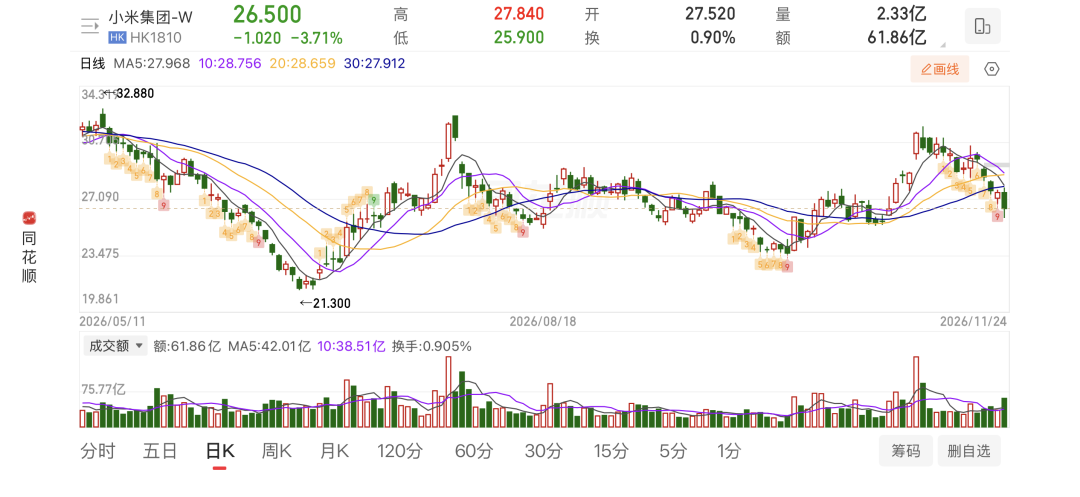
On November 24 Beijing time, Xiaomi released its Q3 2026 financial report. Xiaomi's shares closed down 3.72% that day, marking the fifth consecutive trading day of declines, with a cumulative drop of 10.77%. The latest closing price stood at HK$26.5.
Here are the key takeaways from Xiaomi Group's Q3 2026 financial report:
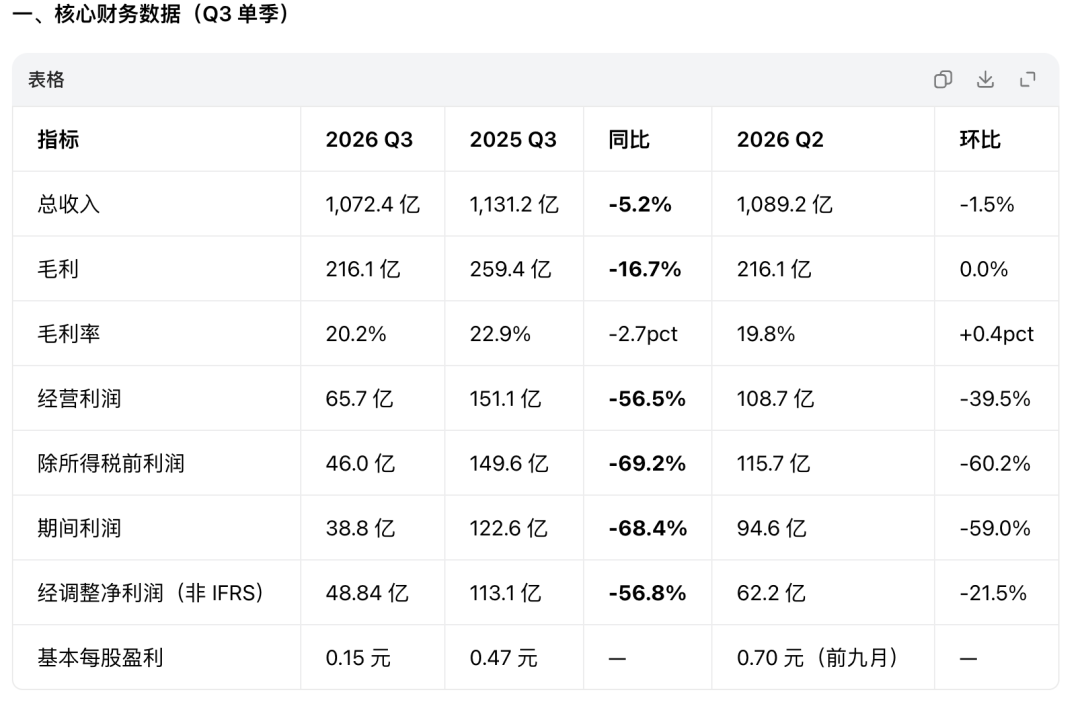
Total revenue: In Q3 2026, Xiaomi's total revenue came in at 107.24 billion yuan, down 5.2% from 113.12 billion yuan in the same period last year and down 1.5% from 108.92 billion yuan in Q2 2026.
Gross profit: Q3 2026 gross profit was 21.61 billion yuan, down 16.7% from 25.94 billion yuan a year earlier. Compared with 21.61 billion yuan in Q2 2026, it was essentially flat.
Gross margin: The gross margin in Q3 2026 was 20.2%, down 2.7 percentage points from 22.9% a year earlier, but up 0.4 percentage points from 19.8% in Q2 2026.
Operating profit: Xiaomi's operating profit in Q3 2026 was 6.57 billion yuan, down 56.5% from 15.11 billion yuan in the same period last year and down 39.5% from 10.87 billion yuan in Q2 2026.
Adjusted net profit (non-IFRS): Adjusted net profit in Q3 2026 was 4.884 billion yuan, down 56.8% from 11.31 billion yuan a year earlier and down 21.5% from 6.22 billion yuan in Q2 2026.
For the first three quarters combined, Xiaomi's revenue totaled 315.30 billion yuan, down 7.4% year-on-year; gross profit was 65.03 billion yuan, down 16.0% year-on-year; operating profit was 22.75 billion yuan, down 45.4% year-on-year; and adjusted profit was 17.18 billion yuan, down 47.7% year-on-year.
Clearly, Xiaomi's gross profit, operating profit, and adjusted profit in Q3 all declined faster than the average pace across the first three quarters, indicating an accelerating downward trend.
A breakdown by business segment:
Xiaomi's smartphone business generated 45.58 billion yuan in revenue in Q3 2026, down 0.8% year-on-year, with a gross margin of 9.2%, down 1.9 percentage points from 11.1% a year earlier.
IoT and lifestyle consumer products brought in 27.15 billion yuan in Q3 2026, down 1.4% year-on-year, with a gross margin of 21.7%, down 2.2 percentage points from 23.9% in the same period last year.
Revenue from new energy vehicles and innovative businesses such as AI reached 23.88 billion yuan, down 17.7% year-on-year, with a gross margin of 19.2%, down 6.3 percentage points from 25.5% a year earlier.
(Within this segment, automotive revenue was 22.7 billion yuan, down 19.9% year-on-year; other revenue including after-sales and AI business was 1.2 billion yuan, up 68.9% year-on-year; new energy vehicles and innovative businesses such as AI posted a loss of 3.4 billion yuan.)
The internet business was the only segment to achieve year-on-year growth. Revenue in Q3 2026 was 9.45 billion yuan, up 0.7% year-on-year, with a gross margin of 73.8%, down 3.1 percentage points from 76.9% in the same period last year.
Gross margins declined year-on-year across all of Xiaomi's business segments.
Xiaomi attributed this mainly to continuous price increases in core components such as memory, which squeezed margins in both smartphones and IoT. Automotive gross margin was pressured by a lower proportion of Ultra models, rising component prices, and higher AI costs.
On the R&D front, Xiaomi's R&D expenditure in Q3 2026 was 9.2 billion yuan. R&D spending for the first three quarters totaled 27.4 billion yuan, up 16.5% year-on-year.
Capital expenditure in Q3 2026 was 3.58 billion yuan, of which 1.31 billion yuan went to smartphones x AIoT and 2.28 billion yuan to automobiles and AI.
It is worth noting that Xiaomi's net cash flow from operating activities in Q3 2026 was -23.03 billion yuan, or about -27.7 billion yuan after excluding changes related to financial factoring and fintech. This was mainly due to a 25.4 billion yuan increase in inventory. Net cash flow from investing activities was +21.05 billion yuan, and financing activities contributed +3.26 billion yuan.
Lei Jun is known as Beijing's "cash king." Xiaomi's cash and cash equivalents stood at 38.4 billion yuan, cash reserves at 196.9 billion yuan, and total borrowings at 45.5 billion yuan.
It is also worth noting that since the start of 2026, Xiaomi has repurchased approximately HK$13.1 billion worth of shares, totaling 431.5 million shares — already exceeding the full-year total for last year.
Another point deserving attention: Jensen Huang returned to Nvidia yesterday to serve as CEO again, reinforcing expectations that AI will continue to devour memory production capacity. The anticipated decline in memory prices will likely be postponed — another blow to Xiaomi.
Faced with rising memory prices, Xiaomi's strategy has been to proactively cut low-end models and prioritize high-end products and ASP. This pushed ASP in Q3 2026 to 1,486.1 yuan, up 39.8% year-on-year. Yet the gross margin remained at 9.2%, still down 1.9 percentage points from 11.1% a year earlier — meaning Xiaomi's smartphone business is still struggling to make money.
What also warrants vigilance: abandoning the low-end phone market does not mean that market will simply come back if Xiaomi relaunches low-end phones in the future. It will still require a fierce battle. Honor has already begun trading price for volume.
As for the automotive business, Xiaomi expects to enter overseas markets in 2027, which brings incremental expectations for the segment.
As existing orders for the Pengcheng series are consumed, Xiaomi Auto's deliveries will also face challenges. Entering overseas markets will give Xiaomi Auto a new growth driver for sales in 2027.
That said, Xiaomi's stock price is expected to hold steady in 2027. After all, by then the financial report may show year-on-year growth simply because the 2026 base is low. If it still declines year-on-year, then Xiaomi will be in real trouble.
-
![]()
Data Analysis, Information Research, and Content Creation Emerge as the Most Commonly Assigned Tasks for Office Agent Users — Part I of the "China Office Agent Market User Research Report 2026"
-
![]()
Dell: The New Cloud "Brake" Didn't Hit Orders — But Did It Hit Valuations?
-
![]()
Former Apple and Meta Employee, Columbia PhD Founder Secures $18 Million Seed Round
-
![]()
WorkBuddy, Qwen Office, and Doubao Work Lead Office Agent Usage, Report Finds — Part II of the China Office Agent Market User Research Report 2026
-
Jensen Huang Is Back, but AI Hardware Will Struggle to Rally Again
-
Chinese Industrial Tycoons Are Collectively Betting on DeepSeek
-
Lei Jun: Xiaomi Sold 12.6 Million Fewer Phones in Q3, Yet Revenue Held Steady
-
2027 Smartphone Manufacturers' Shipment Targets Revealed: vivo Down 29% Year-over-Year, Xiaomi Shrinks 25%