When the iPhone Finally 'Folds,' Who Will Seize the Right to Define the Next Generation of Smartphones?
 09/10 2026
 415
415
High-Priced Foldables Flood the Market: Some Complain About Cost, Others Are Eager to Buy
Written by/ Li Jinlin
Edited by/ Chen Dengxin
Formatted by/ Annalee
From September 7 to September 9, within just 72 hours, Huawei, Xiaomi, and Apple engaged in a head-on clash over the foldable form factor.
On September 7, autumn had yet to fully arrive in Shenzhen, but the heat at Huawei's launch event was off the charts. When Yu Chengdong announced the starting price of the Mate XT 2 Extraordinary Master at 19,999 yuan, online comments began to circulate, saying, 'This isn't a phone; it's a financial product.'
That same evening in Beijing, Lei Jun stood in front of a presentation slide for the Xiaomi 18 Fold, lamenting with a hint of resignation that memory was simply too expensive. Nevertheless, he announced a starting price of 10,999 yuan, marking the birth of Xiaomi's most expensive phone ever.
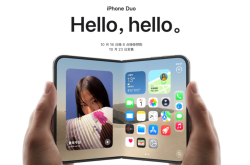
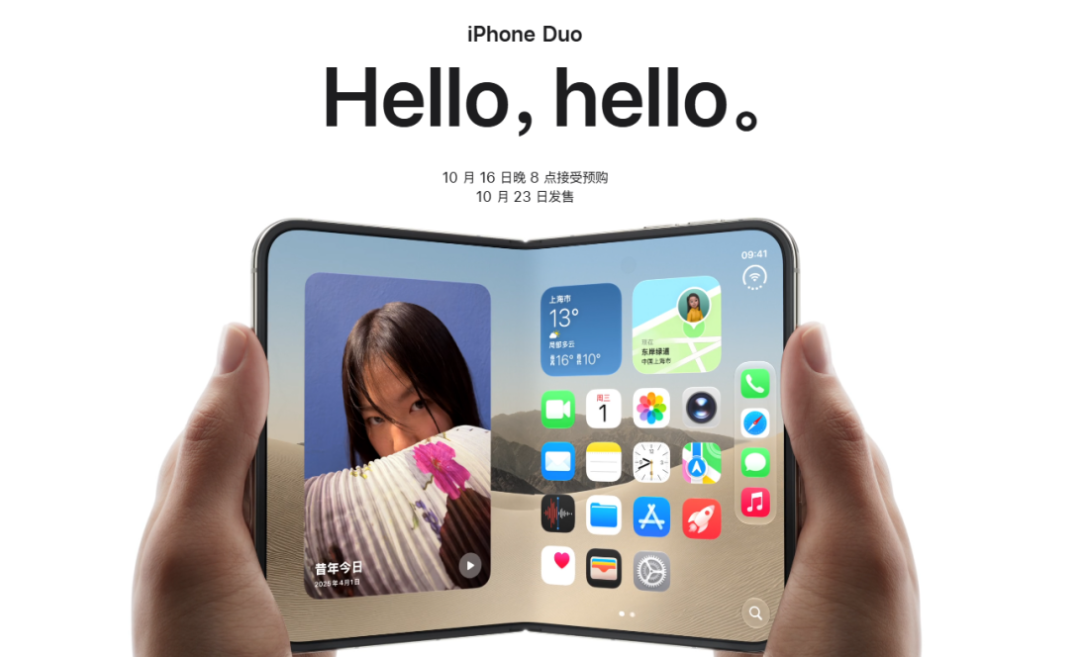
Two days later, in California, Apple's new CEO, Ternus, unveiled the iPhone Duo at the Steve Jobs Theater. With a starting price of 15,999 yuan, the 'three-way showdown' reached its climax, and discussions about the 'outrageously priced iPhone' spread far and wide.
Three products, three price tiers, and three distinct folding philosophies all made their debut within just three days. This marked the first time since the birth of foldable phones that the top players had clashed head-on within the same time window. It was a product war, but more importantly, a battle for the right to define the next generation of smartphone form factors amid anxiety over the stagnating growth of traditional bar-shaped phones.
A Necessity for Productivity or a Symbol of Luxury?
Inside an accounting firm in Chengdu, Sichuan, data analyst Zhang Wei is organizing materials for a meeting. Instead of carrying a heavy laptop and iPad in her bag, she has a Huawei Mate XT.
After using a triple-fold phone for nearly two years, Zhang has grown accustomed to handling various aspects of her life and work with a single device in most scenarios. When unfolded, the inner screen displays the Wind data terminal on the left, a WeChat chat window on the right, and a floating AI summary window in the middle—a workflow that previously required three separate screens.
'In the past, during security checks while traveling, I had to take out my laptop, which was a hassle. Now, I just unfold my phone into a tablet and fold it back into a phone when done.' Zhang, whose usage habits have been profoundly transformed, is currently looking for a new device, with the long-anticipated Apple foldable phone at the top of her list.
Zhang is not alone. According to Counterpoint Research's forecast, global foldable smartphone shipments are expected to grow by 21% year-over-year in 2026, driven primarily by high-end users' urgent demand for device convergence.
Over the past two years, the integration of large AI models on end-user devices has fundamentally changed human-computer interaction. As AI can now replace a significant amount of manual input, users' reliance on physical keyboards has plummeted, while their desire for larger screens has surged.
This means that foldable phones are no longer just a flashy differentiated product but are becoming a must-have for productivity in the AI era.

Huawei's Triple-Fold Phone Has Become the Top Choice for Many Business Professionals
The qualitative shift in demand is directly reflected in the product strategies of the three giants. Huawei's Mate XT 2 adopts a 'G'-shaped dual inward-folding design, with the main screen fully enclosed within the body. When unfolded, it forms a 10.2-inch wing-like display, almost equivalent to a lightweight tablet.
Xiaomi's 18 Fold takes a 'wide-folding' approach, featuring a 5.38-inch outer screen and a 7.58-inch inner screen, with the entire device weighing just 219 grams. It attempts to strike a new balance between portability and a large display.
Apple's iPhone Duo, with its 4:3 inner screen ratio, unfolds to a size close to that of an iPad mini and is powered by a 2nm A20 Pro chip, clearly aiming to break down the barriers between phone and tablet ecosystems.
However, this scenario revolution has also brought new anxieties. As phone prices surpass the 10,000-yuan threshold and even approach 20,000 yuan, consumers' decision-making logic is changing.
A mobile phone dealer in Chongqing told Zinc Scale, 'In the past, when selling foldable phones, customers asked most often, 'Are the creases noticeable?' Now, they ask, 'Can it replace a tablet?' Behind these questions lies the survival pressure for foldable phones to evolve from secondary devices to primary ones.'
Consumer reactions have also become polarized.
After the iPhone Duo's release, social media quickly split into two camps. Some users scoffed at its high price: 'An outrageous price, sky-high,' 'An iPhone and an iPad together wouldn't cost that much, and they're more convenient to use,' 'I thought it was made of pure gold.'
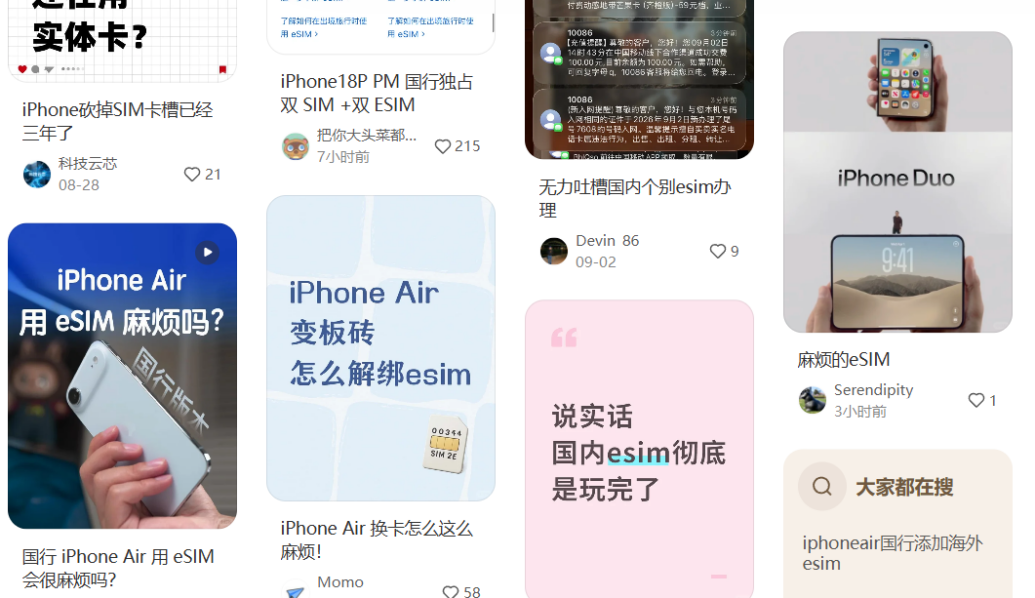
Many Users Complain About the Inconvenience of eSIM
Zhao Zexiang, a die-hard Apple ecosystem user, had been eagerly anticipating Apple's foldable phone since earlier in the year. However, once the price was announced, he abandoned the idea: 'It's just too expensive. At this price, it can only be used as a primary device, but for a primary device, I'd need large memory, bringing the total cost close to 20,000 yuan. I have to pass. Plus, eSIM is still a major hassle to use, so I'm not willing to try it lightly.'
Zhao also mentioned that before Apple, manufacturers like Huawei, Samsung, Xiaomi, OPPO, and Vivo had all launched foldable phones. However, many Apple ecosystem users like him were waiting for Apple's foldable device, hoping to continue enjoying the seamless Apple ecosystem. But with the price announcement, many might now hesitate.
On the other hand, some consumers have shown a completely different attitude. One netizen commented, 'Those who like it don't seem to mind the price.' This divide precisely reflects the awkward position of 10,000-yuan foldable phones: they are both a symbol of status and taste and face the existential question of whether they are truly worth it.
The Battle for Definition: Who Will Have the Last Laugh?
If this 'three-way showdown' is understood merely as product-level competition, its strategic significance is underestimated. Against the backdrop of stagnating global smartphone shipments, foldable phones represent one of the few remaining high-end segments still experiencing growth.
On September 7, according to Counterpoint Research's latest global foldable smartphone market forecast, cumulative global foldable phone shipments are expected to surpass 100 million units by the end of 2026.
Counterpoint Research predicts that Apple's foldable iPhone shipments could reach up to 6 million units in 2026, helping it capture 25% of the global market share and rise to second place, just behind Samsung's 38% and ahead of Huawei's 22%. Given the relatively short sales window expected this year, Apple's rapid ascent in this category after entry is particularly significant.
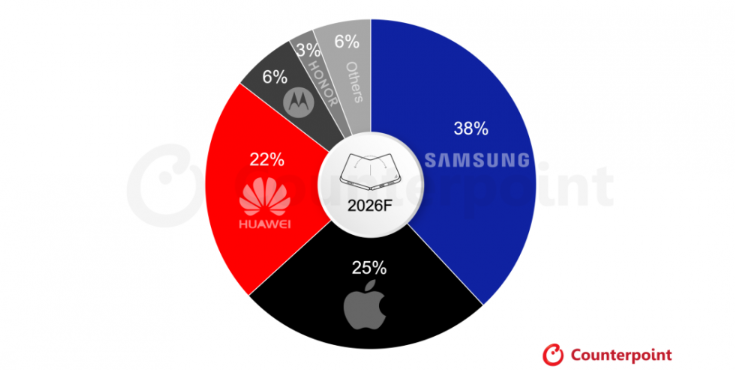
Counterpoint Research's Forecast of Foldable Phone Market Share
Looking ahead at the foldable phone market, the real battle lies in defining the 'next generation of smartphone form factors.' Huawei is betting on triple-fold phones to explore the physical limits of smartphone form factors, attempting to redefine the boundaries of mobile work with its 'wing-like' design. Xiaomi's 'wide-folding' approach seeks the greatest common ground between portability and a large display, aiming to expand its user base with a more affordable price. Apple, meanwhile, continues its ecosystem integration strategy, using a 4:3 inner screen ratio to bridge phone and tablet usage scenarios, attempting to win users through ecosystem stickiness rather than hardware specifications.
These three approaches have no absolute superiority or inferiority; they represent different visions for the future.
The first vision is that high-end users are willing to pay a premium for extreme form factor innovation. The second is that foldable phones need to transition from luxury items to high-end consumer products, with price reductions being essential. The third is that the ultimate form of foldable phones is not to replace phones but to merge phones and tablets into a personal computing center for the AI era.
Based on current market feedback, Huawei's dominant position in China's foldable phone market remains solid. IDC data shows that in the first quarter of 2026, Huawei held a 60% market share in foldable phones, with Honor at 21% in second place, and OPPO, Vivo, and Xiaomi accounting for 6%, 5%, and 4%, respectively. However, with Apple's official entry, this landscape may face reshaping. Apple's brand appeal and ecosystem integration capabilities will directly challenge Huawei's high-end market.
Nevertheless, even Apple cannot rely solely on its brand halo to mask the inexperience of its first-generation product. A deeper variable may lie in AI.
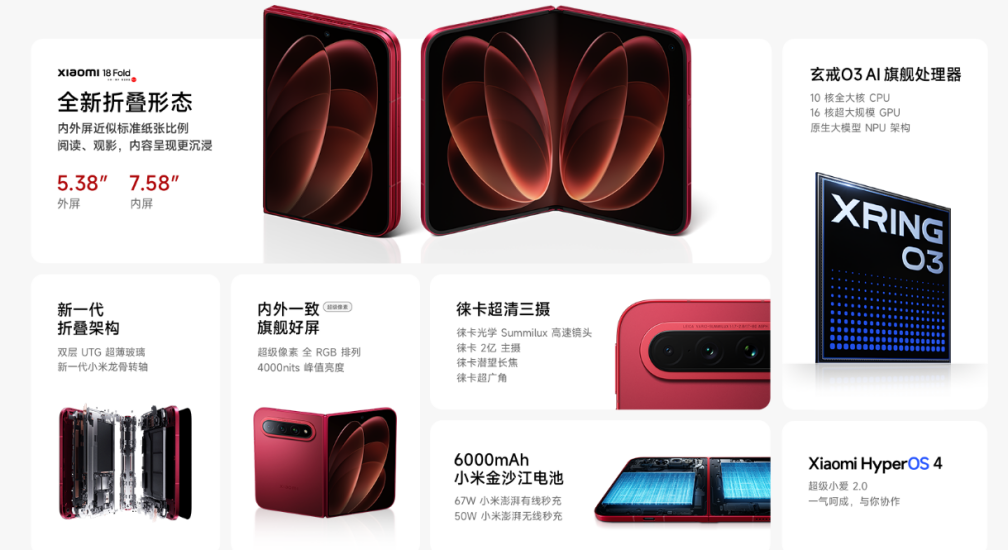
Enhancing AI Computing Power Is a Key Competitive Factor
As on-device large AI models become standard, the large-screen advantage of foldable phones will be further amplified. Whether it's Huawei's HarmonyOS 7, Xiaomi's Xuanjie O3, or Apple's A20 Pro, all emphasize improvements in AI computing power. This means that competition in the foldable phone market is shifting from hardware specifications to AI experience. Whoever can leverage AI to deliver greater value on large screens will gain the upper hand in the battle to define the next generation of smartphone form factors.
The 72 hours from September 7 to 9, 2026, may be remembered as the watershed moment when foldable phones transitioned from a niche novelty to a mainstream choice. Huawei explored the boundaries of form factors with its triple-fold phone, Xiaomi tested market tastes with its wide-folding design, and Apple redefined the rules of the game with ecosystem integration. Three products, three philosophies, all converging at the same time window.
For consumers, this may be the most confusing era. 10,000-yuan foldable phones are no longer unattainable tech luxuries but accessible productivity tools. However, opinions remain divided on whether they are worth the cost.
When the three giants clash head-on in the same arena, any strategic misstep could mean elimination. For the entire industry, the ultimate winner of this 'three-way showdown' may not be a single company but the 'foldable' form factor itself. When foldable phones truly become mainstream, the battle for the right to define the next generation of smartphones will also be settled.
-
When Genuine Elderly-Friendly Home Appliances Meet Pseudo-Smart Features: Bridging the Intergenerational Gap in Appliance Consumption
-
![]()
When the iPhone Finally 'Folds,' Who Will Seize the Right to Define the Next Generation of Smartphones?
-
![]()
Seven Years After Foldable Phones Emerged, Why Has Apple Just Launched the iPhone Duo?
-
![]()
July’s Online Speaker Market: Harman Kardon Adjusts Strategy, Philips Breaks Through, and Outdoor and Home KTV Trends Reshape the Landscape
-
The Awkwardness of AI Long Series: Cost Reduction is Easy, but Profitability is Hard
-
What is the Real Issue with Foldable Screens? iPhone Duo Didn't Provide a Complete Answer
-
What if Jobs Were to Depart One Day: The Future of Apple?
-
Benchmarked Against Anker, Roborock, and Ecovacs: Has the Overhang from Lock-up Expiry Been Fully Released? Is Insta360 Still Overvalued?