Base Station Flying in the Stratosphere! SoftBank Completes World's First HAPS Edge Computing Technology Verification, Commercialization Expected by 2027
 09/14 2026
 354
354
A new star may be rising in the field of communications.
In early September, SoftBank and U.S.-based Sceye announced that they had successfully conducted trial services for HAPS commercialization in Japan using Sceye's LTA (Lighter Than Air) high-altitude platform station (HAPS). This marks Japan's first successful stratosphere-based communication test utilizing HAPS within its own airspace.

The so-called HAPS (High-Altitude Platform Station) can be understood as a 'mobile base station flying in the stratosphere': it typically consists of communication equipment carried by lightweight aerial platforms such as solar-powered aircraft, airships, or balloons, which remain in the stratosphere for extended periods and provide communication services to ground-based mobile phones, IoT devices, and drones via wireless signals. The International Telecommunication Union (ITU) Radio Regulations (RR) define HAPS as radio stations located on objects at altitudes of 20-50 kilometers, maintaining specific, nominal, fixed positions relative to the Earth.
If existing communication networks are imagined as a global 'web,' HAPS occupies a rather unique position.
Compared to traditional ground-based base stations that require fixed installation, HAPS 'stands taller' and can therefore cover larger areas. It can also quickly provide networks in areas where ground communication infrastructure is difficult to deploy or has been disrupted by disasters;
Compared to satellites, it is much closer to the ground, resulting in lower communication latency and easier integration with existing mobile communication networks.
In fact, HAPS is not a new concept. The ITU began researching HAPS as early as the mid-1990s. In recent years, technological advancements in solar panel efficiency, battery energy density, lightweight composite materials, autonomous avionics, and antennas have made HAPS more feasible. Now, SoftBank and Sceye's latest tests represent a crucial step forward in transitioning this technology from vision to commercialization.
Successful Completion of Stratosphere-Based Communication Testing Using HAPS
Let's first examine the notable progress made in this test—
According to an official press release, the Sceye HAPS used in this trial took off from New Mexico, USA, at 10:00 PM (Japan Standard Time, JST) on August 9, 2026. The platform flew across the Pacific Ocean in the stratosphere for approximately 13 days, covering a distance of over 15,000 kilometers, and entered Japanese airspace at 7:11 AM (JST) on August 23.
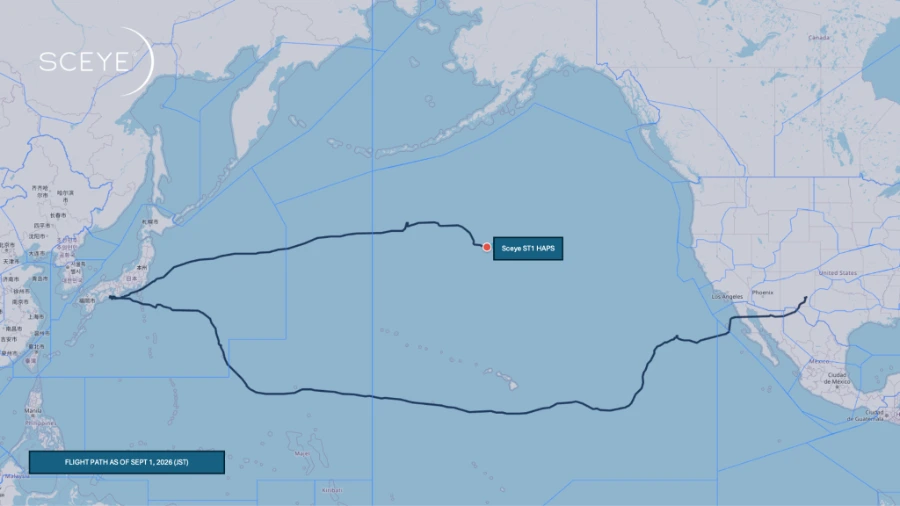
Upon arriving in Japan, the HAPS operated over the sea near Muroto Cape in Muroto City, Kochi Prefecture. Considering meteorological conditions such as stratospheric wind direction and speed, Sceye successfully maintained the platform over the target operating area for extended periods, with the station-keeping range controllable to within a 5-kilometer radius. This achievement verified the HAPS platform's long-distance, long-duration flight capabilities while demonstrating its ability to remain operational over designated target areas under actual Japanese operating conditions.
During the platform's station-keeping period, the testing covered—
Verification of Ground-Based Smartphone Communication Performance via HAPS
The two parties conducted bidirectional communication tests between stratospheric HAPS and ground-based smartphones near Muroto City, Kochi Prefecture. During the tests, a 4G LTE equivalent base station installed on the Sceye HAPS connected to SoftBank's core network via a ground gateway.
Test results showed that HAPS could stably support voice calls and text messaging while enabling normal use of social media applications and high-capacity data communication, including video calls and video streaming. SoftBank and Sceye also verified the operation of emergency warning systems for earthquakes and tsunamis and collaborated with the Japan Coast Guard to test making 118 maritime emergency rescue calls via HAPS.
In data communication tests, both parties confirmed that HAPS could achieve communication performance comparable to ground networks while reducing wireless interference with ground-based base stations.
Successful Communication Between HAPS and Drones
Additionally, SoftBank plans to build a three-dimensional communication network enabling HAPS to provide communication services not only to ground personnel during emergencies like large-scale disasters but also to stable network connections for aerial mobile systems such as drones. As part of this plan, the two parties conducted communication tests between HAPS and drones.
During the tests, they utilized the communication link provided by HAPS to achieve automatic drone flight via remote control. Test results showed stable completion of drone flight control, position data feedback, and video transmission.
In the future, HAPS is expected to expand drone applications, including post-disaster damage assessment and supply transportation, monitoring remote islands and offshore areas, supporting logistics in mountainous regions, and conducting infrastructure inspections for transmission lines, roads, and forest monitoring.
After completing relevant trials within Japan, the HAPS began flying across the Pacific Ocean again to return to the United States. As of September 2, 2026, Sceye continues to verify platform performance through sustained long-duration flights. SoftBank and Sceye will further advance preparations for HAPS commercial deployment in Japan based on data and experience gained from this trial service, planning to roll out related services starting in 2027, including establishing an operational framework and further improving communication quality.
Regarding the World's First HAPS Edge Computing Technology Verification
In this event, what deserves greater attention is not SoftBank's so-called 'first achievement of smartphone/drone communication via HAPS' but rather the 'world's first' test of HAPS edge computing.
To explore the application potential of stratospheric edge computing, SoftBank and Sceye deployed a processing server on the HAPS platform, enabling data processing directly within the platform. Test results showed that the server hosted on the HAPS platform achieved an average round-trip processing response time of 68 milliseconds, reducing communication latency by over 40% compared to cloud-based processing via the internet. This marks the world's first deployment of both a mobile core network and a web server for data processing on an HAPS platform, enabling complete response processing within the HAPS platform and returning results to smartphones. By combining HAPS's extensive communication coverage capabilities with edge computing technology, SoftBank aims to further expand new application scenarios requiring both wide-area coverage and low latency, including physical AI and real-time video analysis.
This can be viewed as a capability test for 'aerial edge computing.' 'Aerial edge computing' is not a single technology but rather a collective term for deploying edge computing capabilities on aerial platforms (such as satellites, high-altitude airships/drones, or low-altitude drones), with the core idea of processing data 'in the sky' nearby rather than transmitting everything back to ground-based clouds. Currently, it primarily has three implementation paths: 'orbital edge computing' on satellites, 'HAPS edge computing' on stratospheric airships, and 'onboard edge computing' on industrial drones.
SoftBank's decision to validate HAPS in actual communication trials suggests its role may be evolving. Moreover, this represents a significant leap compared to just a few weeks ago when SoftBank still emphasized the 'milestone' of building Japan's autonomously controllable HAPS project. Now, its technological positioning seems to have suddenly advanced to a third stage: from 'flying base stations' to 'flying network nodes' and further to 'flying edge computing stations.'
The 68-millisecond round-trip latency data naturally intersects with dedicated 5G and physical AI (Physical AI). In fact, using HAPS for dedicated 5G is not a new concept. As early as 2022, Airbus and Saudi operator Salam discussed developing dedicated 5G and IoT networks for disaster management services using the Zephyr platform. At the time, Salam's CEO referred to Zephyr as a 'key asset for providing dedicated network services.' This architecture is easy to understand: if 5G network coverage needs to extend beyond factories or warehouses to broader geographical areas such as wind farms, oil fields, open-pit mines, and large construction sites, HAPS could become a highly attractive network infrastructure.
Machines and sensors may be scattered across tens or even hundreds of square kilometers. Traditional ground-based 5G networks operate more like individual base station sites connected by backhaul links; in contrast, HAPS solutions have the potential to cover entire operational areas. Consequently, the drone demonstration in this test becomes more than just an incidental experiment—it can be further utilized for scenarios like remote equipment inspection. For example, video data captured by drones no longer needs to be transmitted through distant ground core networks and clouds; some processing tasks can be completed directly on the HAPS platform or near it. In fact, the HAPS Alliance already describes similar network models. Its 2026 work on coexistence among ground, aerial, and satellite networks explicitly includes HAPS connections for dedicated networks and discusses shared network and Neutral Host models: HAPS operators provide infrastructure 'as-a-service' while serving multiple different users simultaneously.
This Neutral Host service model warrants particular attention. Theoretically, a single HAPS platform can simultaneously undertake multiple tasks: providing public cellular network coverage for contractors and non-work scenarios; offering dedicated network connections for industrial production processes; and supplying independent communication channels or network slices for drones, industrial equipment, and emergency communications. In Europe, a ground-based version of this architecture already exists. For example, the CROFT project, supported by the European Space Agency (ESA), integrates dedicated 5G, satellite backhaul, 'multi-access' edge computing, and wide-area 5G supported by HAPS within a drone delivery architecture. The project's goal is to establish resilient communication networks for remote areas and island communities while enabling this architecture to be further reused for medical supply delivery and emergency response scenarios.
That said, 68 milliseconds of latency still cannot compete with fiber optics and is even difficult to compare with highly controlled local dedicated 5G networks. However, this result at least indicates that HAPS does not necessarily have to serve merely as an access link between devices and ground networks. It could become part of a future 'grid compute' architecture—which may well represent a crucial direction for distributed network construction in the physical AI era.
If future AI-driven drones, robots, vehicles, and industrial equipment need to make autonomous decisions based on real-time video and sensor data, computing and networking must move even closer to where actions occur. Currently, this typically means deploying edge servers within factories, edge nodes at network sites, or computer racks in local data centers. However, for certain applications, edge computing nodes might one day be located 20 kilometers above the ground.
Conclusion
From a market size perspective, HAPS has clearly evolved beyond being merely a communication concept confined to laboratories. According to Grand View Research, the global HAPS market size was approximately $1.54 billion in 2023 and is expected to grow to $2.66 billion by 2030, with a compound annual growth rate (CAGR) of about 8.4% from 2023 to 2030. Recent forecasts from 360iResearch suggest that the global HAPS market could expand from $1.82 billion in 2026 to $3.03 billion in 2032. Although different institutions vary in their definitions of market boundaries and statistical scopes, these predictions at least demonstrate one point: communication, networking, and computing capabilities centered around high-altitude platforms are forming an emerging market worthy of attention.
More importantly, HAPS is gradually shedding its single-dimensional positioning as an 'aerial base station.' ABI Research previously noted that HAPS could cover various scenarios in the future, including fixed broadband, direct cellular terminal connections, network backhaul, disaster recovery, and inter-HAPS interconnections, with the potential to synergize with GEO, LEO satellites, and edge computing systems. For regions where ground networks are difficult to cover, construction costs are prohibitively high, or continuous connections to aerial mobile terminals such as drones and robots are required, HAPS offers a new type of infrastructure choice Between ground network and satellite network (between ground networks and satellite networks).
However, this does not mean HAPS has found definitive commercial answers. High-altitude platforms involve a series of complex issues such as aviation safety, airspace management, spectrum licensing, environmental impact, and varying regulatory frameworks across countries and regions. Stringent approval and licensing processes may delay commercial deployment while increasing operational, maintenance, and compliance costs for platforms. Additionally, platform endurance, station-keeping, communication capacity, launch and recovery, equipment maintenance, and synergy with existing ground and satellite networks will all directly impact HAPS's final business model.
In short, the HAPS story may have just begun. Whether it ultimately becomes an indispensable 'third layer' between ground and satellite networks or remains confined to a few specialized scenarios due to cost, regulatory, and business model factors depends not on how high it can fly but on whether it can create sufficiently high and sustained value in the real world.
References:
HAPS – High-altitude platform systems——ITU
SoftBank Corp. Achieves Japan's First HAPS Trial Service in Preparation for Commercialization——SoftBank
New Star in the Communications Firmament – SoftBank Positions HAPS Between Terrestrial and Satellite——rcr wireless
Sceye and SoftBank Test HAPS Connectivity and Edge Processing Over Japan——iot business news
Communication Base Station in the Stratosphere: SoftBank's HAPS High-Altitude Platform Station Approaches Commercialization!——ChinaAET (Applied Electronic Technique)
High-Altitude Aerial Platform Station (HAAPS) Market Size, Share, and Industry Analysis by Platform Type (Drones, Airships, Balloons, etc.), Altitude Range (Lower Stratosphere, Middle Stratosphere, and Upper Stratosphere), Application (Telecommunications, Earth Observation and Remote Sensing, Surveillance and Security, Environmental and Atmospheric Monitoring, and Disaster Management), End-User (Commercial, Defense, Homeland Security, Government Agencies, and Research Institutions), and Regional Forecast, 2026-2034——fortune business
Moving the Core Network to 16.5 Kilometers High: SoftBank Validates HAPS Edge Computing for the First Time——Aerostats
An Article to Help You Understand HAPS——Pipi Learning
-
![]()
Rescuing Neta Auto: Even Taiyi Zhenren Steps In, and Associated Company’s Value Soars by 2.5 Billion Yuan
-
Why Does 'Taiyi Shenglian' Step In to Save Neta?
-
![]()
Registered Capital Sees Slight Reduction to 110.7291 Million Yuan! Yongxin Optics Finalizes Industrial and Commercial Registration Amendments
-
![]()
Renaming Marks the Start: Conant Optics’ Smart Glasses Business Gets a Full-Throttle Boost
-
Amazon’s Shift to Passkey Compels Home Furnishing Brands to Overhaul Backend Access Controls
-
![]()
Doubao Mobile Phones: Opting for the Path of Maximum Public Discourse
-
![]()
OpenAI Hits Pause on the AI Race: The Hype Around Large Models Cools Down, and Enterprise AI Enters the Era of Results-Based Adoption
-
![]()
Li Feifei's Atlas Opens the Door to a New World for Embodied AI