Comparison of Industrial Strength Among Beijing, Shanghai, Shenzhen, and Nanjing in China's 6G First Tier
 09/21 2026
 353
353
Introduction
Recently, the Ministry of Industry and Information Technology issued the '15th Five-Year Plan for the Development of the Information and Communications Industry,' which proposes to strengthen innovation-driven development, accelerate research and development of core 6G technologies, and continuously conduct 6G technology trials. It also mentions the timely launch of 6G commercialization.
China has completed the first-phase key technology trials for 6G and is advancing to the second phase. The MIIT has organized special department-province collaborative pilot initiatives for 6G innovation and development, aiming to develop a series of independently innovative 6G technical solutions, application scenarios, and terminal products by 2029. 6G is expected to start commercialization around 2030.
In terms of regional 6G development levels, Beijing, Shanghai, Shenzhen, and Nanjing are currently the first-tier cities in the 6G landscape. Let's take a look at the industrial benchmarking analysis of these four cities formed by the Huoshi Xinglan Industrial Intelligence Agent.
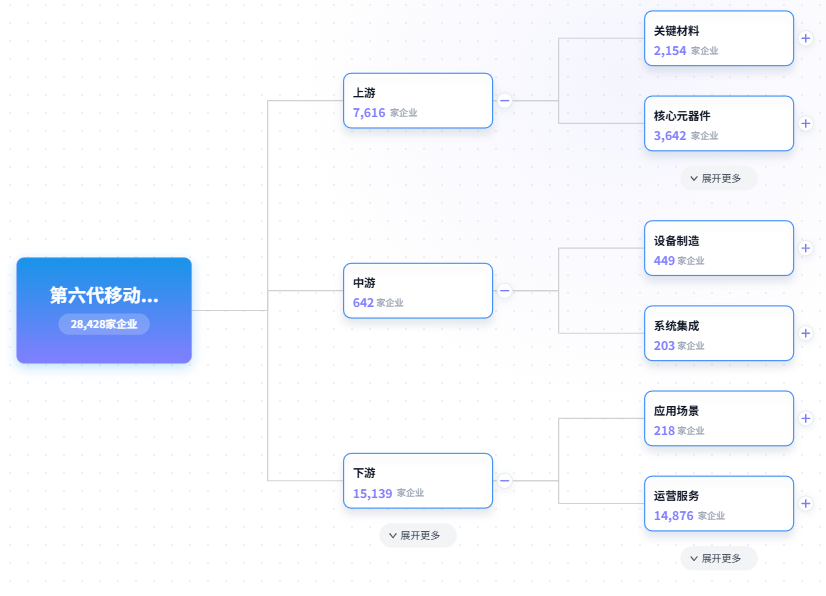
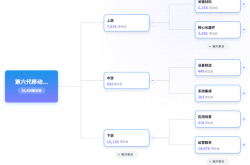
Figure: 6G Industrial Chain Map
Source: Huoshi Xinglan Industrial Intelligence Agent
01
Policy
Beijing: 'Earliest and Most Practical,' Nanjing: 'Most Complete at the Top Level,' Shanghai: 'Most Specific in Implementation,' Shenzhen: 'High Hierarchical Level but Weak in Special Initiatives'
Beijing uses 'standard proposal rewards + patent pools' to directly target international standard discourse, a unique approach nationwide. Nanjing is the only city systematically building a 'G City' through top-level urban design. Shanghai's policy highlights lie in the rapid implementation of 'carrier + fund matrix.' Shenzhen's shortcoming is not its strength but the lack of policy tools—it lacks special funding policies comparable to Beijing's Economic and Technological Development Zone, relying mostly on provincial-level alliances and planning coordination. Table: Key Policies of the Four Cities 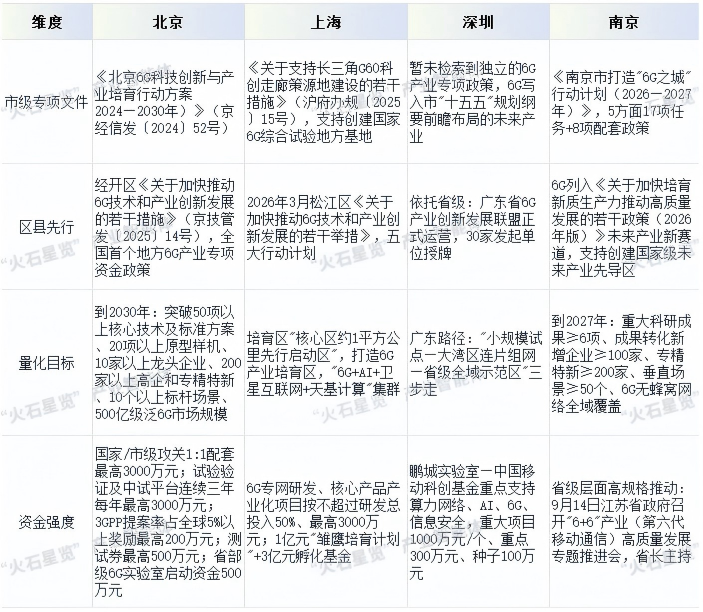
Huoshi Xinglan Industrial Intelligence Agent: Key Policies
02
Energy Level
Shanghai and Beijing Lead in Total Scale, Shenzhen Excels in Industrial Density and Externalities, Nanjing Compensates with National-Level Platforms
From the perspective of 'comprehensive urban strength + scale of the information and communications industry,' Beijing, Shanghai, and Shenzhen lead. Nanjing has a lower total energy level but possesses a significant structural advantage in 6G-specific energy level (density of national-level platforms) that does not match its overall scale.
Table: Urban Energy Levels 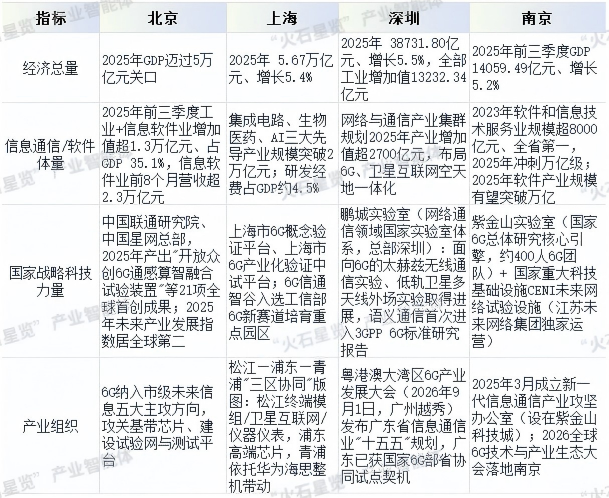
Huoshi Xinglan Industrial Intelligence Agent: Urban Energy Levels
03
Development Stage
Nanjing Leads in Trial Networks, Shanghai Excels in Industrialization Closure, Beijing Leads in 'Platform + Standards,' Shenzhen Leads in Node Deployment but Lacks Carriers
Currently, the national 6G industry is in the window period of 'pre-standard freeze (around 2029) + system integration and field trials,' with commercialization expected around 2030. All four cities have surpassed the pure vision research stage: Nanjing leads in technical verification (Pre-6G real networks); Beijing leads in platform and standard verification; Shanghai leads in engineering/pilot testing and incubation; Shenzhen leads in network node deployment and industrialization support but lacks iconic carriers like the first trial network/first cultivation zone.
Table: Development Trajectories of Each City 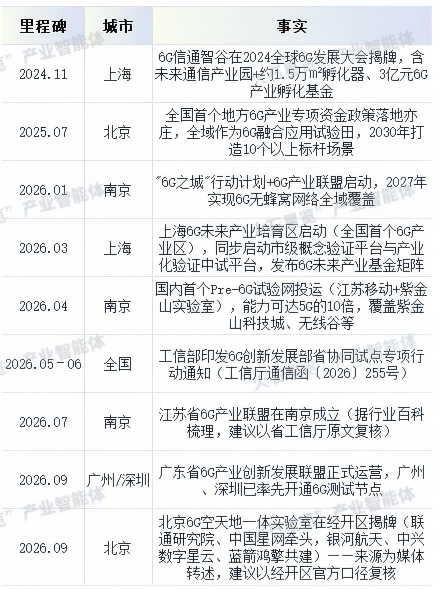
Huoshi Xinglan Industrial Intelligence Agent: Development Trajectories
04
Industrial Structure
The Four Cities Are Positioned at Different Links in the Chain
Shenzhen has the most complete 'complete machine + components + manufacturing' hard industrial structure; Beijing has a high-end element structure of 'standards + R&D + scenario governance'; Shanghai has a transformational structure of 'platform + funds + parks' and uniquely enjoys a satellite internet space-based foundation; Nanjing has a source-verification structure of 'scientific research devices + verification scenarios,' with obvious gaps in the midstream (equipment manufacturing) and downstream scale links of the chain.
Table: Development of Each Link in the Industrial Chains of the Four Cities 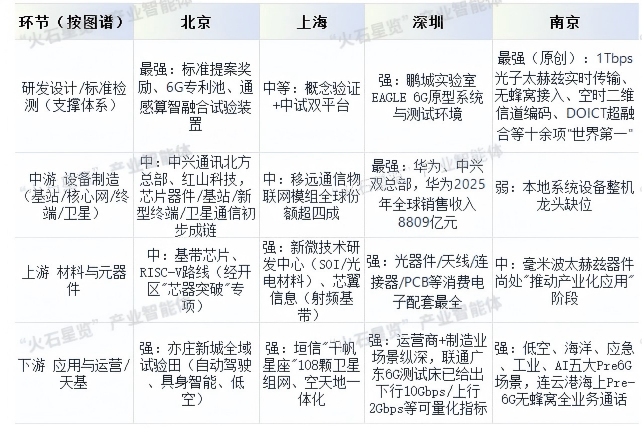
Huoshi Xinglan Industrial Intelligence Agent: Industrial Chain Diagnosis
From the perspective of enterprise agglomeration, Shenzhen has the highest density of leading enterprises, Shanghai has the most solid 'chain leader + park' structure, Beijing has advantages in central SOE R&D headquarters and newly established platforms, and Nanjing has strong research institutions but weak enterprise entities.
Table: Enterprise Agglomeration Development in the Four Cities 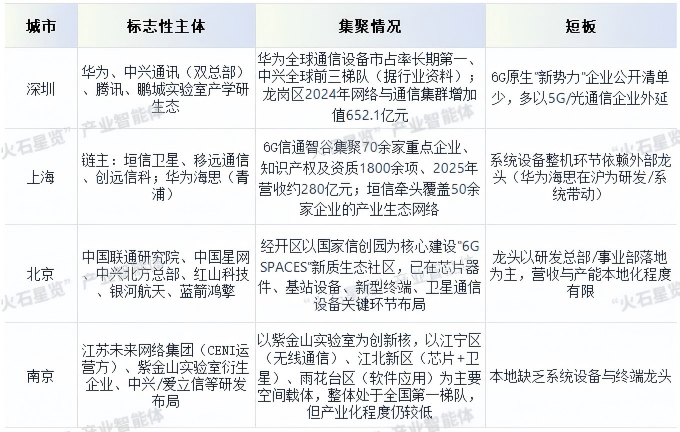
Huoshi Xinglan Industrial Intelligence Agent: Enterprise Agglomeration
Overall, Beijing serves as the source of standards and capital, being the only city with both national 6G technical solution sourcing (China Unicom Research Institute, China StarNet), the first local 6G special fund nationwide, and incorporating 3GPP proposal rates into reward clauses. However, its local manufacturing and capacity implementation are weak, and its 500 billion yuan pan-6G goal heavily relies on 'spillover headquarters economy.'
Shanghai has advantages in industrialization closure. It has cultivation zones, concept verification platforms, pilot testing platforms, fund matrices, and parks (Xintong Zhigu) all in place, along with a unique 'constellation in the sky, terminals on the ground, and instruments in hand' chain leader combination nationwide. However, it lags behind Nanjing and the Pengcheng system in original underlying technologies. Shenzhen has the strongest industrialization foundation. Huawei and ZTE as dual leaders, along with the Pengcheng Laboratory (semantic communications already included in the 3GPP 6G standard research report, breakthroughs in terahertz and low-orbit satellite field experiments), form the strongest technical industrialization closure foundation nationwide. However, public carriers such as trial networks/pilot testing platforms have not yet formed a 'national first' label, making it prone to being in a position of 'strong strength but weak visibility' in department-province collaborative pilots.
Nanjing has strong technical and trial network advantages but weaker industrial entities. With more than ten 'world firsts' + the nation's first city-level Pre-6G trial network + the first systematic '6G City' top-level design, but lacking leading enterprises in the midstream and having a lower GDP and industrial energy level than the other three cities, it faces the risk of 'blooming inside the wall but smelling fragrant outside.' It needs to strengthen itself through the '6G Future Industry Cluster + Financial Empowerment + Chain Leader Cultivation.'
-
![]()
"China Speed" from an Overseas Perspective: The Coordination Revolution of Manufacturers and Suppliers
-
![]()
Founders Fund Allocates SpaceX Shares to Investors: Commercial Space Industry Hits Trillion-Dollar Valuation, Unlocks Liquidity Avenue
-
![]()
Revealed: Tesla’s Robot Team Conducts Factory Inspections, with Top Group, Sanhua Intelligent Controls, and Others Securing Major Orders!
-
![]()
After Data Security Controversy, Zhipu’s AI Coding Tool ZCode Goes Open-Source, Commits to Monthly Security Audits
-
![]()
Comparison of Industrial Strength Among Beijing, Shanghai, Shenzhen, and Nanjing in China's 6G First Tier
-
![]()
Lei Jun’s 200 Billion: Why Does He Always Make Bold Moves After Trends Emerge, Rather Than Before?
-
![]()
Has Geely Made a Strategic Shift: From Brand-Specific to Group-Wide Charging Networks?
-
![]()
Guangxi Automobile Group Unveils 'Capacity Matrix' at CAEXPO: Autonomous Vehicles with Volumes from 0.1m³ to 20m³ Initiate 'Tiered Deployment'