The Deeper Automakers Venture into Self-Developed Batteries, the More Apparent the Greatest Challenge Becomes
 09/17 2026
 547
547
The dynamic between automakers and power batteries is undergoing a transformation.
Power batteries, a pivotal component requiring procurement and matching, are subject to diverse demands from automakers concerning range, cost, and rapid charging capabilities. Battery firms, in turn, strive to provide tailored products to meet these specifications.
By 2026, this distinction is becoming increasingly indistinct.
◎ Xiaomi approaches battery design from a holistic vehicle perspective.
It defines the electrochemical system, voltage platform, capacity, and cell specifications, and spearheads the development of the battery pack structure, thermal management, and BMS. Subsequently, it entrusts partners like CALB and Sunwoda with cell development and mass production.
Following the collaborative model of Sunwoda and CALB, Xiaomi extends its quality management to the production lines of its suppliers.
◎ To achieve 5C ultra-fast charging, Li Auto has established its own battery R&D team and is intensifying its focus on batteries.
◎ Geely adopts a distinct strategy, developing and producing batteries in-house while also forming a joint venture battery company with CATL. It continues to procure cells from CATL for certain models.
Some automakers are responsible for defining battery specifications, others for joint development, some for in-house production, and yet others continue to rely on professional battery companies for manufacturing. The paths vary, but the gap between knowing the required battery type and consistently producing it is vast.
Producing small quantities of high-performance batteries is not uncommon; the true challenge lies in manufacturing billions at an industrial scale while maintaining close proximity in capacity, internal resistance, safety, and lifespan. Some are just beginning to grasp this challenge, while others have been navigating it for over two decades.
At CATL's "Global Quality Open Month," Chief Manufacturing Officer Ni Jun shared insights into the complexities of power battery manufacturing: Only with superior consistency can high-quality batteries be produced.
01
Automakers are Venturing into the Battery Realm,
Pursuing "Self-Development" on Multiple Fronts
● No longer content with merely purchasing batteries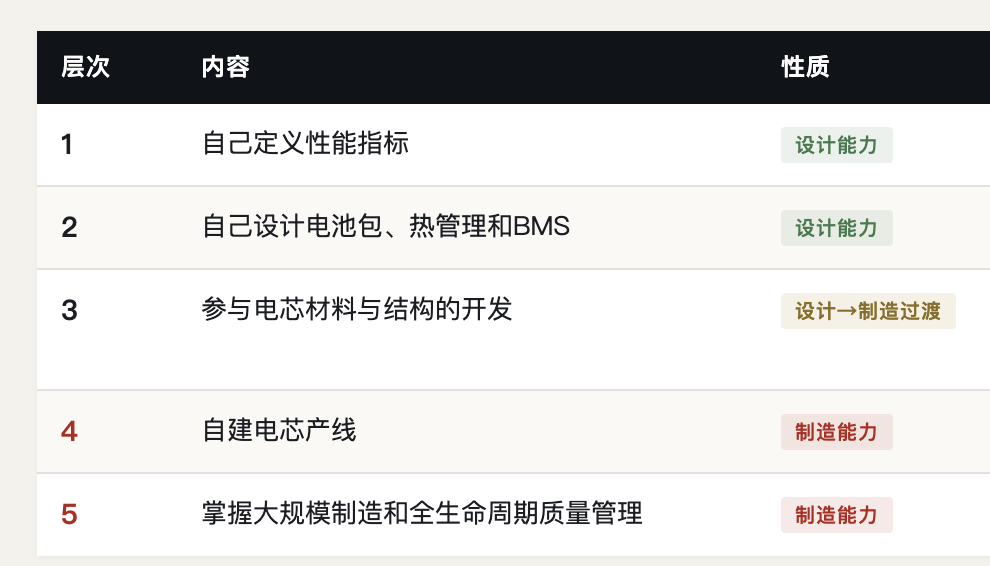
◎ Batteries are increasingly directly shaping the overall vehicle experience.
Consumers previously discussed engines and transmissions; now, they focus on range, charging speed, low-temperature performance, collision safety, and degradation—all influenced by batteries.
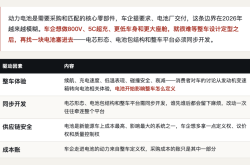
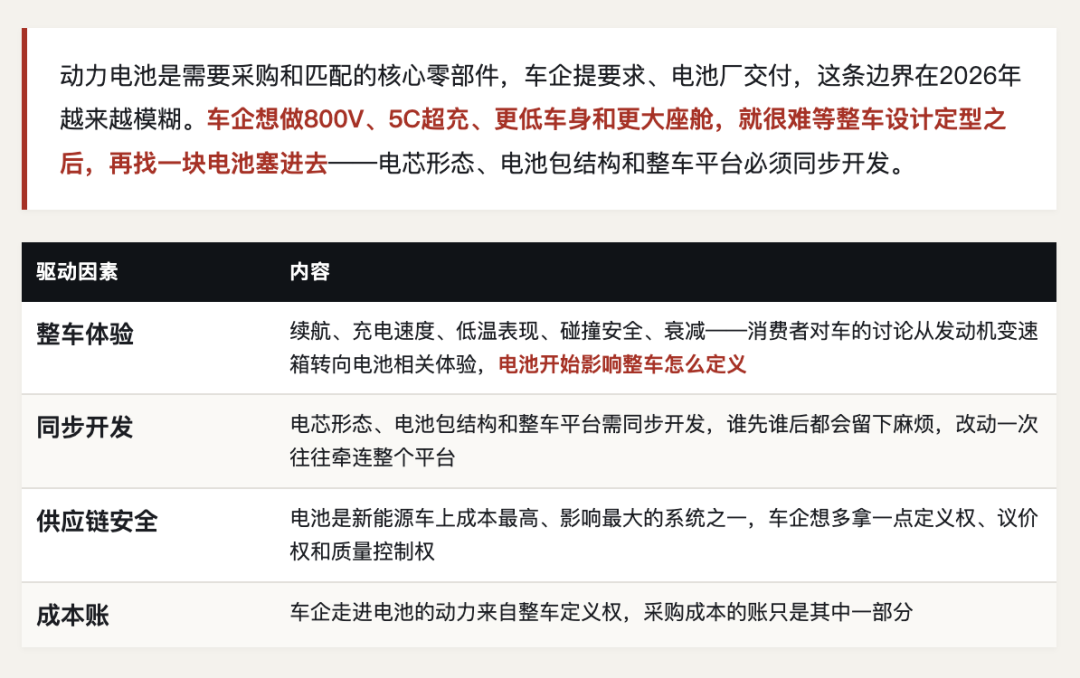
Batteries are beginning to dictate vehicle design. If automakers aim to implement 800V, 5C ultra-fast charging, lower body profiles, and larger cabins, waiting until vehicle design is finalized before fitting a battery is impractical.
Cell morphology, battery pack structure, and the vehicle platform must be developed concurrently; any sequence will introduce complications, and changes often impact the entire platform.
◎ Batteries also relate to supply chain security and cost.
As one of the highest-cost and most influential systems in new energy vehicles, it's natural for automakers to seek greater control over definition, pricing, and quality.
The motivation for automakers to enter the battery arena stems from a desire for vehicle definition rights, with procurement costs being just one aspect.
● There are Five Levels of Automaker Self-Development
The market frequently hears about "so-and-so automaker self-developing batteries," defining performance indicators, designing battery packs, thermal management, and BMS, participating in cell material and structure development, building in-house cell production lines, and mastering large-scale manufacturing and full lifecycle quality management.
Most automakers have reached the second or third level. At the fourth and fifth levels, the difficulty escalates, requiring significantly more investment in capital, personnel, and time.
The first two levels rely on design capabilities, while the latter three hinge on manufacturing prowess, with no straightforward transition between them.
● Challenges Only Become Apparent After Diving In
◎ Xiaomi's approach involves automaker definition, supplier development and manufacturing, and automaker oversight.
◎ Li Auto meets vehicle requirements down to the cell level through joint development.
◎ Geely adopts a three-pronged strategy, combining in-house production, joint ventures, and procurement.
These routes are not about superiority or inferiority but reflect each company's trade-offs among scale, cost, technical accumulation, and supply chain security.
The difficulty with batteries lies in consistently producing stable products amidst multiple changing variables. Pushing individual performance indicators to the limit is merely the first step.
Fast charging, energy density, and range figures take a backseat here, with another term coming to the fore: consistency.
02
Producing One High-Quality Battery is Not Difficult;
The Challenge Lies in Achieving Consistency Across Billions
● Compliance is Just the Baseline
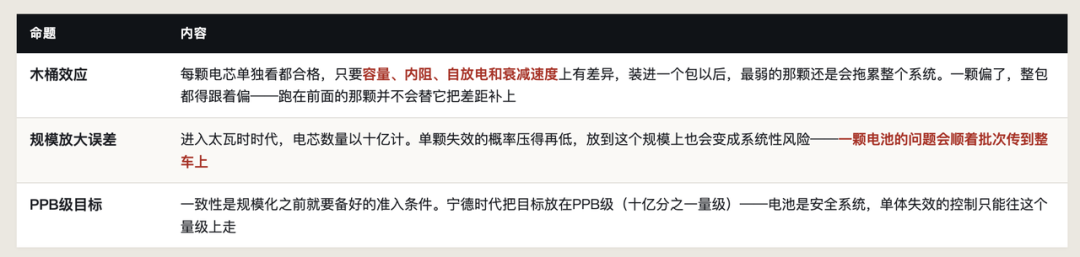
There's a bucket effect among cells. Each cell may be compliant individually, but differences in capacity, internal resistance, self-discharge, and degradation rates will cause the weakest cell to drag down the entire system once assembled into a pack.
The key in a battery pack is for each cell to be sufficiently similar; if one deviates, the entire pack must follow suit, and the leading cell won't compensate for the gap.
● Scale Amplifies Errors
Entering the terawatt-hour era, the number of cells reaches the billions. No matter how low the probability of individual cell failure, at this scale, it becomes a systemic risk, with battery issues propagating through batches to entire vehicles.
Consistency is a prerequisite for scaling up. CATL aims for PPB-level (parts per billion) consistency, as batteries are a safety system, and single-cell failure control must operate at this scale.
● Precision and Speed Are Both Essential
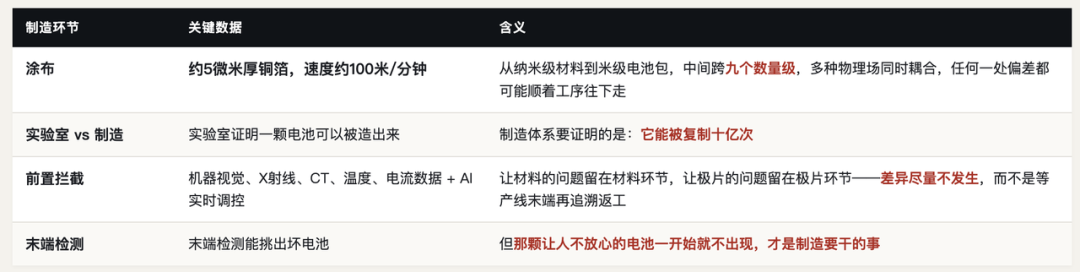
Manufacturing here demands extreme precision.
Coating is done on copper foil about 5 microns thick at speeds around 100 meters per minute. From nanoscale materials to meter-scale battery packs, spanning nine orders of magnitude, multiple physical fields couple simultaneously, and any deviation can propagate through the process.
Laboratory tests prove a battery can be made. The manufacturing system must prove it can be replicated a billion times.
● Preventing Differences Before They Occur
If problems are only detected at the end of the production line, minor deviations will have passed through multiple processes, making traceability and rework costly.
CATL's approach is to keep material issues at the material stage and electrode issues at the electrode stage. Machine vision, X-rays, CT scans, temperature, current data, and AI real-time adjustments all work toward minimizing differences.
While end-of-line testing can weed out bad batteries, preventing the problematic battery from appearing in the first place is what manufacturing must achieve.
● The Real Test Is on the Road a Decade Later
Consistency at cell assembly doesn't guarantee consistency after thousands of cycles.
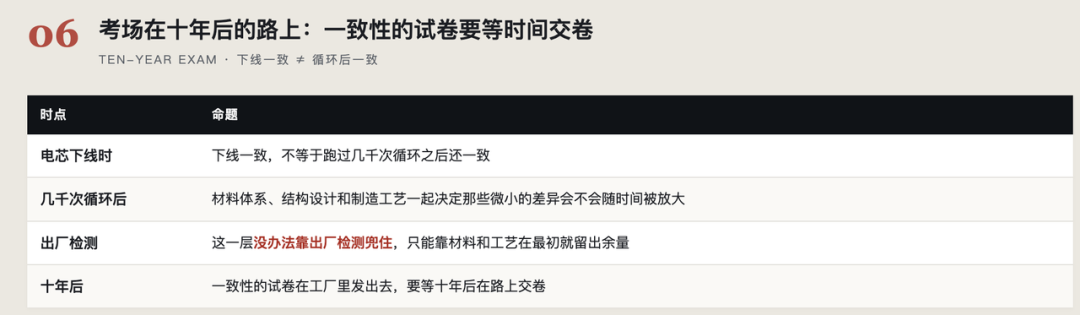
The material system, structural design, and manufacturing process together determine whether minor differences will amplify over time. This layer cannot be ensured by factory testing alone; it must be accounted for in the material and process design from the outset.
The consistency exam begins in the factory but is only graded a decade later on the road.
Summary
More and more automakers are defining, developing, and even manufacturing batteries in-house, underscoring the importance of batteries in the industry. As they delve deeper into manufacturing, difficulties gradually surface. Performance can be enhanced with a technological breakthrough, but consistency can only be achieved through materials, equipment, processes, algorithms, and manufacturing experience—a process with no shortcuts.
Some are just venturing into these deep waters, while others have been navigating them for years.
CATL's "CATL Quality" ensures that, regardless of when or where a battery is produced or which vehicle it's installed in, safety, reliability, and longevity remain consistent. As more companies enter battery manufacturing, transforming individual excellence into billion-cell consistency is the ultimate challenge in this field.
Only with superior consistency can high-quality batteries be produced.
-
![]()
Beauty Joins In, ByteDance Ramps Up Investment Game
-
![]()
Jensen Huang Hits Back at Ray Dalio: Is AI the Next Big Financial Bubble?
-
![]()
Battle for the Gateway to the World Model: ByteDance Leans Left, JD.com Leans Right
-
![]()
The Deeper Automakers Venture into Self-Developed Batteries, the More Apparent the Greatest Challenge Becomes
-
![]()
Seres No Longer Relies on Huawei for Growth
-
![]()
Good Stocks to Follow | AI Giant Calls for Slowdown, Goldman Sachs Bullish on SK Hynix Amid HBM Super Cycle Speculation
-
![]()
【Electric Equipment】Lingong's New Energy Mining Truck Project in Inner Mongolia Goes into Operation
-
![]()
Seres Steps into the Spotlight with AITO, Facing Its Own Set of Challenges