Research on the Quality Performance of Chinese Automobile Products in 2026: The Main Battlefield of Quality is Shifting from Hardware to Software, and Intelligent Experience Becomes a New Weakness
 09/18 2026
 506
506
Recently, CheZhi.com and CnRRC jointly released the
The overall quality performance of the industry declined in 2026, primarily driven by an increase in the number of issues.
The quality performance of traditional hardware modules such as engines and transmissions continued to improve, while software-intensive modules like intelligent cockpits and intelligent driving systems experienced a significant decline. Vehicle computer issues are a common pain point for both fuel vehicles and new energy vehicles.
The average time for new vehicles to experience quality issues shortened to 7.4 months, with new energy vehicles experiencing issues even sooner.
The overall quality performance of domestic brands in the new energy vehicle market outperformed that of overseas brands, but their fuel vehicles lagged behind the latter.
▍Significant Improvement in Hardware, Noticeable Decline in Software and Intelligent Function Performance
The research measures market quality performance using the formula 'market quality performance = number of issues × degree of complaints,' with lower values indicating better quality. This year's research covered 28 market segments with a total of 128 models, including 52 fuel vehicles and 76 new energy vehicles.
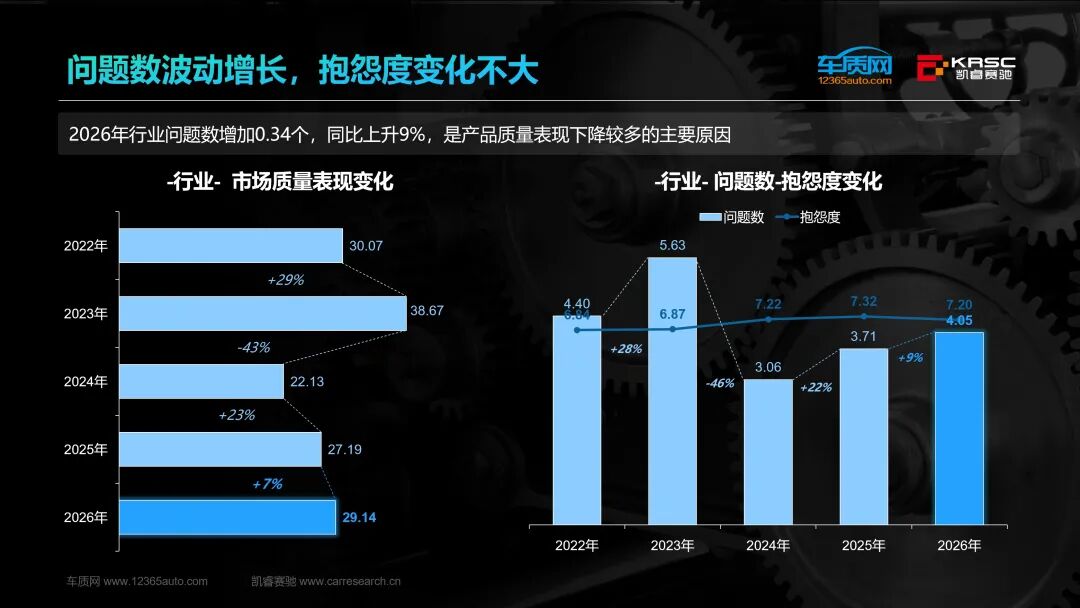
The industry's quality performance score increased by 7% year-on-year in 2026, indicating an overall decline in quality, primarily driven by an increase in the number of issues. The number of industry issues increased by 9% year-on-year, while user complaints slightly decreased, maintaining a score of 7.2. By module, traditional powertrain modules such as engines and transmissions showed the most significant improvement in quality performance; three categories of software-intensive modules—functional configurations, intelligent cockpits, and driving assistance—experienced the most significant declines, becoming the industry's main weaknesses.
From a specific issue perspective, excessive wind noise, vehicle computer crashes/black screens, and excessive tire/road noise ranked as the top three issues in terms of quantity. The number of the first two issues increased year-on-year, indicating that user focus is shifting from mechanical failures to usage experience.
▍Shared 'Vehicle Computer Pain Points' for Fuel Vehicles and New Energy Vehicles, with Different Structural Weaknesses
In terms of energy types, the quality performance of both fuel vehicles and new energy vehicles declined. The number of issues for fuel vehicles increased by 20% year-on-year, with complaints slightly decreasing. Issues exhibited both 'static + dynamic' characteristics: vehicle computer crashes/black screens, lag, and long-term OTA non-updates were the most concentrated problems, with tire noise and wind noise also being key concerns.
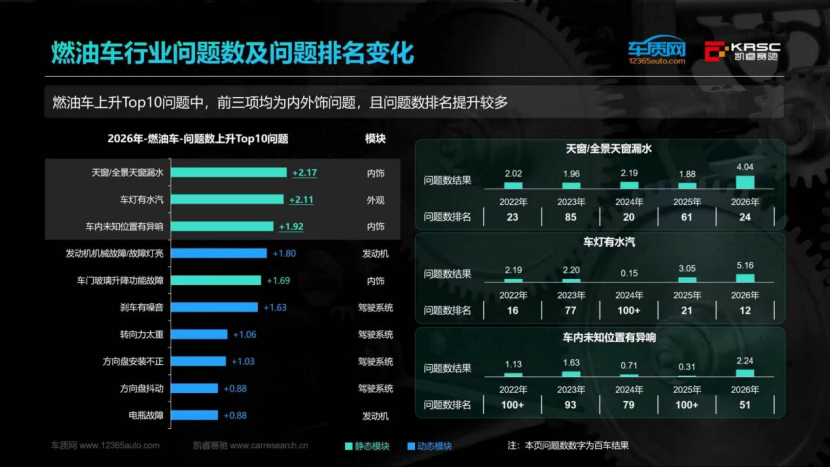
Among the top ten issues with the fastest increase in fuel vehicles in 2026, the first three were traditional interior and exterior trim issues. Domestic brand fuel vehicles underperformed overseas brands in modules such as appearance, intelligent cockpits, engines, and transmissions, with the largest gap in intelligent cockpits. The main issues were long-term OTA non-updates, vehicle computer system lag, and long vehicle computer startup times.
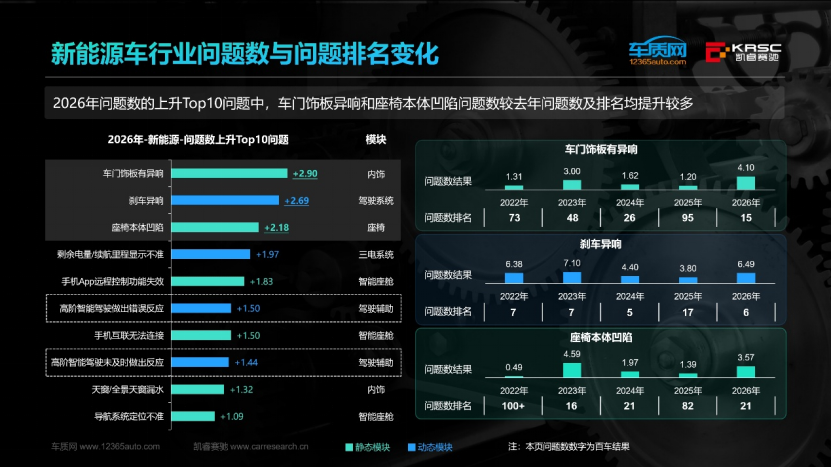
The number of issues for new energy vehicles increased by 9% year-on-year, with complaints remaining the same as the previous year. Their core issues in common with fuel vehicles were vehicle computer crashes and lag. Additionally, issues such as OTA non-updates and abnormal door opening/closing sounds decreased significantly, while issues like excessive chassis vibration and abnormal brake sounds became more prominent. Among the issues with a significant increase, abnormal door trim panel sounds, seat body depressions, and inaccurate remaining range displays grew rapidly. In contrast to fuel vehicles, domestic new energy vehicles outperformed overseas brands in multiple modules, with the most significant advantages in intelligent cockpits and three-electric systems.
Furthermore, new energy vehicles underperformed fuel vehicles in the driving assistance module, with more prominent issues such as misjudgments and delayed reactions in high-level intelligent driving. This difference reflects the technological routes and configuration priorities of the two types of vehicles.
▍Three Types of Verification Blind Spots and 'Launching with Defects'
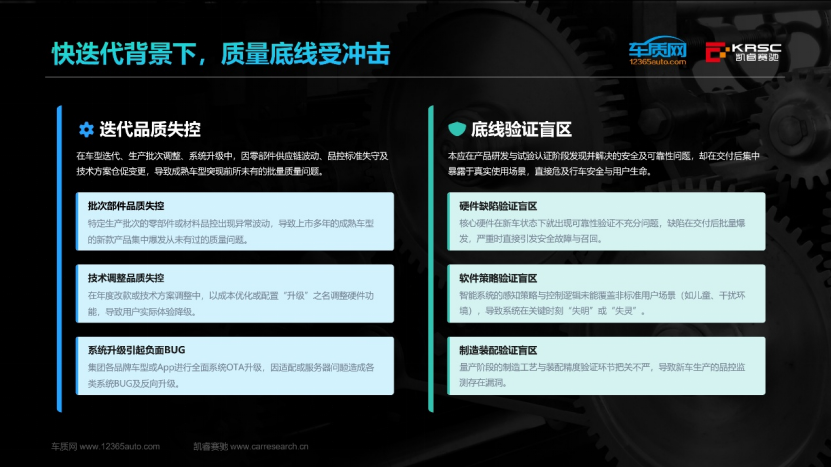
The research shows that the number of industry issues has continuously increased over the past three years, with the average time for new vehicles to experience issues shortening to 7.4 months, and new energy vehicles experiencing issues even sooner. The research attributes this to insufficient verification following compressed research and development cycles.
The research further identifies three types of verification blind spots: hardware defect verification blind spots, evident in insufficient reliability verification of core hardware, such as blurry and glaring front cameras; software strategy verification blind spots, where control logic fails to cover non-standard scenarios, such as zero-gravity seats causing injuries; and manufacturing assembly verification blind spots, where lax quality control in mass production leads to issues like paint bubbling on the inner side of doors.
▍Research Recommendations: Shifting from Hardware Quality Control to a Full-Link Quality System
The research believes that the
The research also proposes governance directions covering the entire lifecycle:
First, in the design and development phase, establish a vehicle model quality database and issue Early warning (early warning) mechanisms to proactively avoid common issues.
Second, in supplier management, strengthen control over the secondary supply chain and establish a dynamic monitoring mechanism for component batches.
Third, in vehicle testing, update verification standards in response to the increase in extreme weather, covering scenarios such as high temperatures, heavy rain, and severe convection.
Fourth, in software testing, introduce user scenario-centric software experience evaluations to complete full-scenario functional verification.
Fifth, in pilot production and mass production, involve users and engineers in joint evaluations and surveys to bridge the gap between engineering and user perspectives, and establish a rapid market quality feedback mechanism.
Sixth, in benchmarking evaluation, form an independent evaluation team to continuously conduct rolling benchmarking evaluations of competitor models to adapt to the fast-paced update environment of vehicle models.
Additionally, the research mentions the public opinion aspect, suggesting the use of third-party professional testing results to objectively clarify negative quality public opinion.
-
![]()
Smartphones Might Be About to Change Forever
-
![]()
Research on the Quality Performance of Chinese Automobile Products in 2026: The Main Battlefield of Quality is Shifting from Hardware to Software, and Intelligent Experience Becomes a New Weakness
-
![]()
The Race for AI Data Infrastructure Behind the Trillion-Dollar Market
-
![]()
Can 3 Billion Yuan in Funding Revive Nezha Auto?
-
![]()
A DeepSeek Engineer’s Midnight Reflection: What Kept the Tech World Wide Awake?
-
![]()
Insta360 H1 Revenue Soars 50%, Yet Net Profit Plummets 90%; Nearly 2 Billion Yuan Spent on Memory Chip Procurement; Inventory Surges to 6.2 Billion Yuan Amid Negative Operating Cash Flow; Stock Price
-
![]()
Second-Generation Doubao Phone Hits the Shelves: The Moment of Truth for AI Agent Smartphones
-
![]()
Second-Gen Doubao Phone Hits Shelves: Can AI Agent Phones Step Up?