Quality Performance of China’s New Energy Vehicle Tri-Electric Systems in 2026: Experience-Centric Issues Take Center Stage, Range Remains Top Challenge
 09/20 2026
 344
344
Recently, CheZhi.com and CnRData Consulting jointly released the "2026 Study on the Quality Performance of China’s New Energy Vehicle Tri-Electric Systems." The study’s key findings reveal:
The overall quality performance of the tri-electric systems has declined compared to 2025, with an increase in the number of issues reported, albeit with a slight decrease in user complaints.
Range remains the most critical weakness of the tri-electric systems, with inaccurate remaining battery level and range displays being the most prominent issue.
Domestic brands continue to outperform overseas brands overall, but the quality gap has narrowed year-on-year.
Extended-range models exhibit the best quality performance, followed by plug-in hybrids. Pure electric vehicles still have room for improvement, though the trend is positive, with user experience regarding range and charging efficiency receiving the most attention.
▍Range Remains the Biggest Challenge, Experience-Related Issues Overtake Hardware Failures
Initiated in 2023, this specialized study covers 76 mainstream new energy vehicle models this year, spanning 37 vehicle brands, 36 powertrain suppliers, and 18 battery system suppliers.
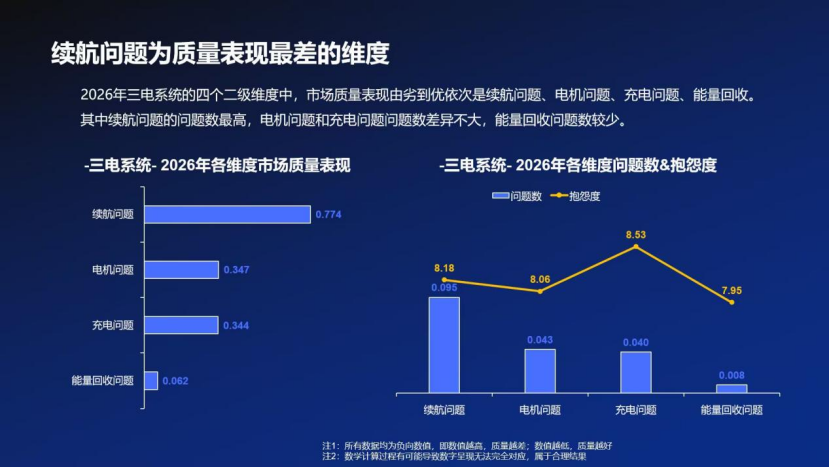
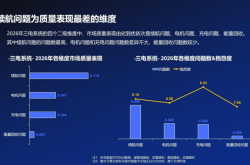
The study reveals that the overall quality performance of the tri-electric systems in 2026 is inferior to that in 2025, primarily due to an increase in the number of issues, despite a slight decrease in user complaints. Among the four sub-dimensions—range, motor, charging, and energy recovery—range issues are currently the most critical weakness; motor and charging issues are secondary, while energy recovery performs relatively well.
Compared to the previous year, only the quality performance in the charging dimension has improved, while the other three dimensions have declined. Among the top 10 issues, inaccurate remaining battery level and range displays are the most problematic, primarily due to the highest number of occurrences; sudden drops in remaining range display generate the highest level of user complaints. Battery failures mostly occur in vehicles purchased over 12 months ago and with mileage exceeding 50,000 kilometers.
▍Domestic Brands’ Lead Narrows, Extended-Range Models Showcase Stability
Domestic brands still outperform overseas brands in terms of the overall quality performance of the tri-electric systems, but the gap has narrowed compared to the previous year. In specific dimensions, domestic brands excel in motor and charging performance, while overseas brands have advantages in range and energy recovery.
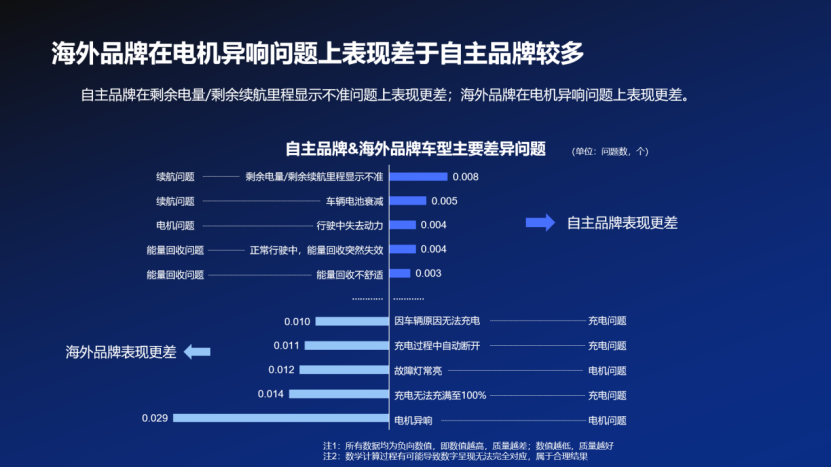
In terms of specific issues, domestic brands primarily face inaccurate remaining battery level and range displays; overseas brands’ most significant issue is motor noise. From a temporal perspective, issues with overseas brands tend to emerge earlier, with nearly 80% occurring within six months of purchase, primarily concentrated in failure and charging duration scenarios.
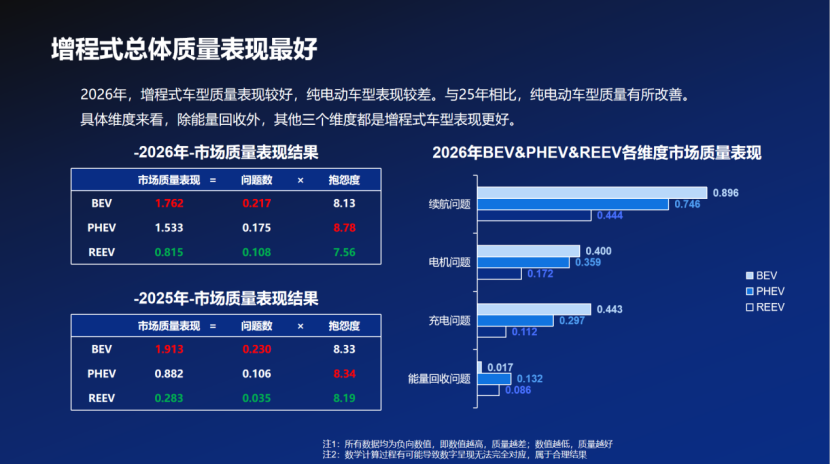
Regarding technology routes, extended-range models demonstrate the best quality performance in the tri-electric systems, followed by plug-in hybrids, with pure electric vehicles ranking last but showing improvement compared to the previous year. Except for energy recovery, extended-range models perform the best in range, motor, and charging dimensions. Compared to pure electric and plug-in hybrid models, extended-range models have more prominent issues with motor noise, battery failures, and battery degradation, while plug-in hybrids primarily experience inaccurate charging times and constant fault light illumination, with over half of the issues occurring within six months of purchase for both.
Furthermore, the average range completion rate for pure electric vehicles in summer is 71.46%, showing a fluctuating downward trend, with user overall satisfaction at a moderate level; the winter completion rate is approximately 11 percentage points lower than in summer. Notably, several new energy vehicle manufacturers demonstrate higher summer and winter range completion rates and satisfaction levels than the industry average. Regarding motors, noise issues occur relatively frequently within one year of purchase, particularly noticeable within the first 3,000 kilometers, mostly involving acceleration scenarios.
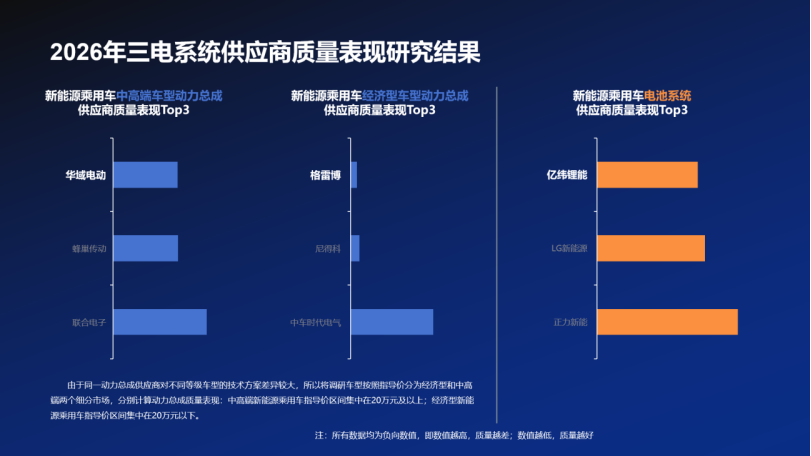
According to the "2026 Study on the Quality Performance of China’s New Energy Vehicle Tri-Electric Systems," despite overall industry quality pressures, some brands still gain user recognition through technological accumulation and refined management and control. In the field of powertrains for mid-to-high-end new energy passenger vehicles, Huayu Auto Electric ranks first in quality performance, followed by Honeycomb Transmission (Fengchao Transmission) and United Automotive Electronics in second and third places, respectively. In the economic model powertrain segment, Grabon ranks first, followed by Nidec and CRRC Times Electric. In the battery system dimension, EVE Energy ranks first, followed by LG New Energy and Zhengli New Energy.
-
![]()
From Netizens' Perspective, the XPENG G9L Still Seems Pricey
-
![]()
10 Questions I Care Most About Regarding Doubao Mobile Phone II
-
![]()
Quality Performance of China’s New Energy Vehicle Tri-Electric Systems in 2026: Experience-Centric Issues Take Center Stage, Range Remains Top Challenge
-
![]()
AIDrive’s Cooperation Model Undergoes Change: Is Xiaomi Pengcheng the Unexpected Winner?
-
![]()
FAW and GAC Make Moves: Will the "Greater Anhui Automobile" Dream Become Reality?
-
![]()
Why FAW Can Successfully Integrate with GAC While Dongfeng and Changan Fail
-
![]()
Beauty Board Secretary ‘Dilraba’ Joins O-Film Tech, Capturing Renewed Attention
-
![]()
Huawei Steps Back, Seres Faces the Music