In September, Not a Single BBA Model Surpassed 10,000 Retail Units! Netizens: The Pricing Power of Traditional Luxury Cars Has Been Relinquished…
 10/21 2026
 427
The automotive market’s evolution has left many astounded. The Japanese Big Three, once dominant players on the global stage, are now witnessing a steady erosion of their market share in China. Data reveals that in September, Nissan sold 23,658 vehicles in China, marking a staggering 61.6% year-on-year decline—the sixth consecutive month of contraction, with the rate of decline widening each month. Honda, too, saw a significant slump, selling 25,564 vehicles in September, down 53.1% year-on-year, marking its 32nd consecutive month of decline, hampered by delayed new model launches. Toyota, though relatively more resilient, still experienced an approximate 18% year-on-year sales drop in September.
Amid this sales freefall, the financial health of the Japanese Big Three has begun to deteriorate. Honda reported its first annual loss in nearly 70 years since going public, posting a net loss of ¥423.9 billion for the 2025 fiscal year. Nissan has sustained massive losses for two consecutive years, totaling over ¥1.2 trillion. In response, Honda plans to shut down some production lines at GAC Honda and Dongfeng Honda, halting production in June 2026 and 2027, respectively, and slashing its fuel vehicle production capacity in China by about 40% from 2026 to 2027. Meanwhile, the struggles of BBA (BMW, Mercedes-Benz, and Audi) are becoming increasingly apparent, as underscored by a trending topic today: not a single BBA model achieved retail sales exceeding 10,000 units in September. 
Data indicates that the BMW 3 Series led the pack with 9,975 units sold, just 25 units short of the 10,000-unit milestone. Mainstream sedans like the BMW 5 Series, Mercedes-Benz C-Class/E-Class, and Audi A6L all fell short of 9,000 retail units. Even in the SUV segment, mainstream models such as the BMW X3, Mercedes-Benz GLC, and Audi Q5L failed to reach the 10,000-unit mark, with no model across BBA’s entire lineup surpassing monthly sales of 10,000 units. 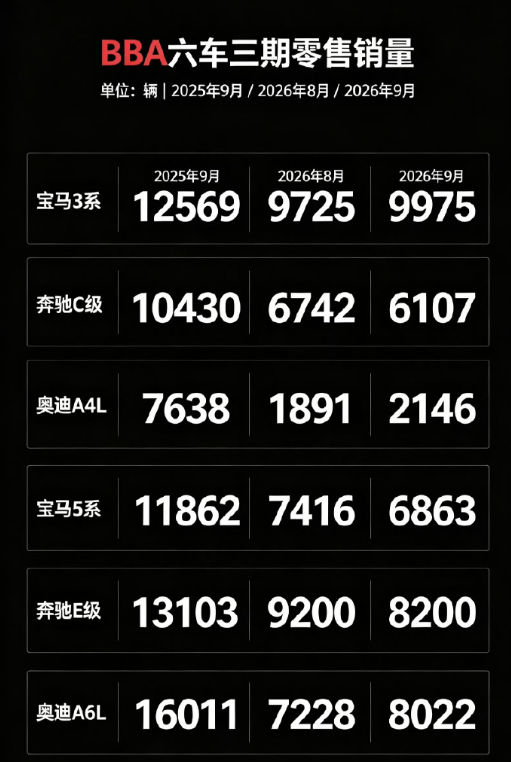
However, these figures mask an even starker reality: they were achieved amid relentless price cuts by BBA. Data shows that terminal discounts for BBA’s main models ranged from 23% to 28%, with the BMW 5 Series’ base model dropping to ¥280,000 and models like the Audi A6L seeing price reductions exceeding ¥100,000, triggering a comprehensive downward shift in price bands. Even with prices plummeting into the ¥200,000-¥300,000 range, sales continued to slide. Specifically, BMW sold 114,000 vehicles in China in the third quarter, down 24.8% year-on-year; Mercedes-Benz sold 87,000 vehicles, down 31%; and Audi sold 94,600 vehicles, down 24.5%. The situation at the dealer level is even more dire.
In 2025, the average gross profit margin for new luxury brand vehicles turned negative at -25%, with a ¥300,000 car experiencing a price inversion of ¥75,000—meaning dealers lost money on every sale. The proportion of loss-making Mercedes-Benz dealers once peaked at 58%, BMW at 51%, and Audi at 49%. BBA dealerships in Hangzhou and Dongguan have successively closed, with operators vanishing and leaving customers’ deposits and maintenance packages in limbo. Witnessing these changes, netizens have engaged in heated debates. Some commented: “BBA has slashed prices so drastically, yet not a single model hit 10,000 sales in September. This proves people are losing their fascination with BBA. No wonder many BBA 4S stores across the country have shut down.” 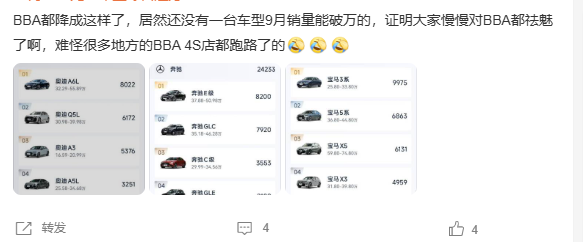
“Brands that once reigned supreme at the pinnacle of fuel vehicle consumption now can’t even reach the 10,000-unit monthly sales baseline for a single model. The premium logic of luxury brands is being rewritten by new market rules.” 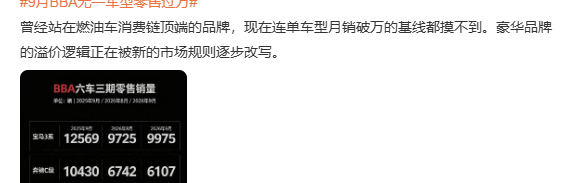
“It’s not that BBA is no longer competitive; it’s that there are too many alternatives at the ¥300,000 price point. With a ¥300,000 budget, customers demand urban NOA (Navigate on Autopilot), 8295 chips, and ‘fridge and TV’ features. No one cares about the engine anymore.” 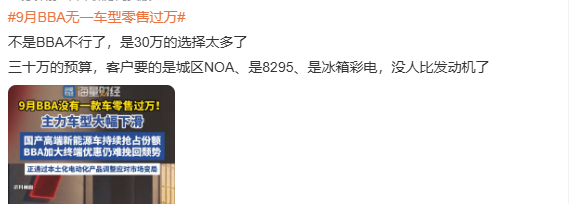
Some netizens also argue that it’s not that cars aren’t selling; it’s that the pricing power of the word “luxury” has been relinquished! 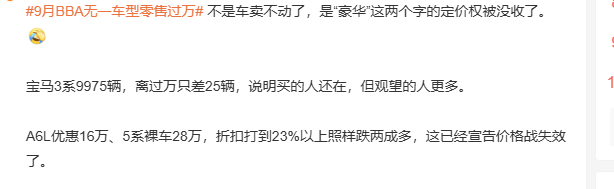
But regardless, numbers don’t lie—they’re both the most honest and the most ruthless indicators. No matter how optimistic one remains about BBA, in the era of intelligence, luxury is being redefined. Traditionally, it revolved around large-displacement engines, historical pedigree, materials, and craftsmanship. However, in the intelligence era, except for the engine, everything else seems to have become standard.
Conversely, today’s luxury in the new energy market, such as digital experiences, is something traditional luxury brands have yet to fully grasp. Therefore, the real reason behind BBA’s inability to sell even with price cuts lies in the shift of product definition rights. Many argue that new entrants have only been around for a few years and lack the technological accumulation of BBA. This isn’t entirely untrue, as BMW’s “Neue Klasse” platform, Audi’s PPE, and Mercedes-Benz’s pure electric platform are all in development.
But the time gap itself comes at a cost. On the path to “new luxury,” BBA is inherently passive. This passivity is reshaping consumer perceptions. Data shows that brand loyalty for traditional luxury cars fell below 18% in 2025. 
Loyalty is the most valuable asset in the consumer market. When BBA’s user loyalty drops below 20%, they lose far more than just orders—they lose their core customer base. Of course, BBA won’t disappear overnight. They remain titans in the global market, and their fuel vehicle profit cows can still be milked for some time.
However, in China—the world’s largest and fastest-evolving automotive market—they are undergoing an identity crisis: from “those who define luxury” to “those who need to reprove they deserve luxury.” Today’s trending topic may well signal the end of an old pricing power era.
END
-
New Chips Frequently Emerge, RISC-V Fuels the AI Era
-
Raccoon Carries SenseTime to the Top of the AI Wave
-
Huaqiangbei-Based Company Replicates Huawei’s Popular Wide Straight Slab Phone
-
![]()
Optical Manufacturing Drives Life and Health Forward! Goertek Optics and Nearview Technology Forge Strategic Alliance
-
RMB 37.49 Billion Long-Term Contract: What Is Xiechuang Data Wagering On?
-
![]()
Why, After 34 Years, Has the Former Color TV Leader Reached the Point of Delisting? "Konka, Delisting, Color TV, Price War, China Resources"
-
![]()
Xiaomi Restructures Business, Eyes AI as Next Growth Engine
-
![]()
Amid Business Reorganization, Xiaomi Sets Sights on AI for Future Growth