Four Leaps in Diffraction Waveguide Technology: From 'Display Capable' to 'Mass Production Ready'
 10/19 2026
 354
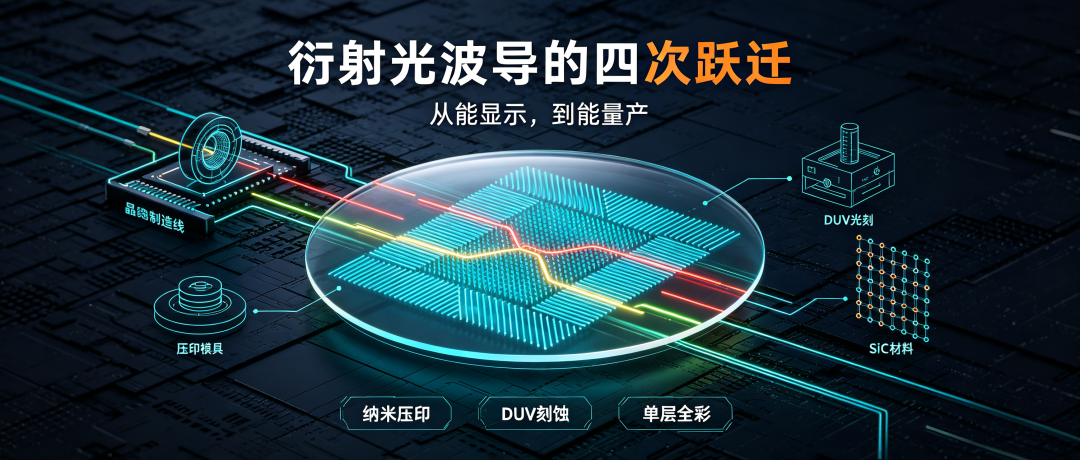
Abstract: 2026 represents a watershed moment for the industrialization of SRG diffraction waveguides. The industry continues to make breakthroughs through four parallel technological pathways, systematically addressing the four core bottlenecks of mass production, precision, FOV, and image quality.
Leading manufacturers are concentrating their efforts on ramping up production capacities, achieving million-unit-scale mass production capabilities. SRG technology is officially transitioning from single-point technical validation to large-scale commercial deployment.
While the concept of optical waveguides has been widely discussed in the industry for years, 2026 truly marks a turning point for industrialization.
ZhiGe Technology is striving to deliver annual shipments of one million SRG waveguides. AAC Technologies has achieved a stable yield rate exceeding 80% for its SRG production line, with a million-unit-scale production capacity plan in place. Goertek Optics has officially launched China's first 12-inch DUV lithography and etching mass production line. Guangna Siwei has achieved large-scale production of full-color silicon carbide (SiC) diffraction waveguides.
From laboratory sample fabrication to production lines capable of million-unit-scale mass production, the industrialization of SRG diffraction waveguides has completed four critical technological leaps.
01 Mass Production Pathway: Nanoimprinting Transforms SRG from Samples to Commodities
The first industrial hurdle for SRG diffraction waveguides lies not in optical design but in engineering mass production: how to stably and batch-produce high-precision nano-grating structures on glass substrates.
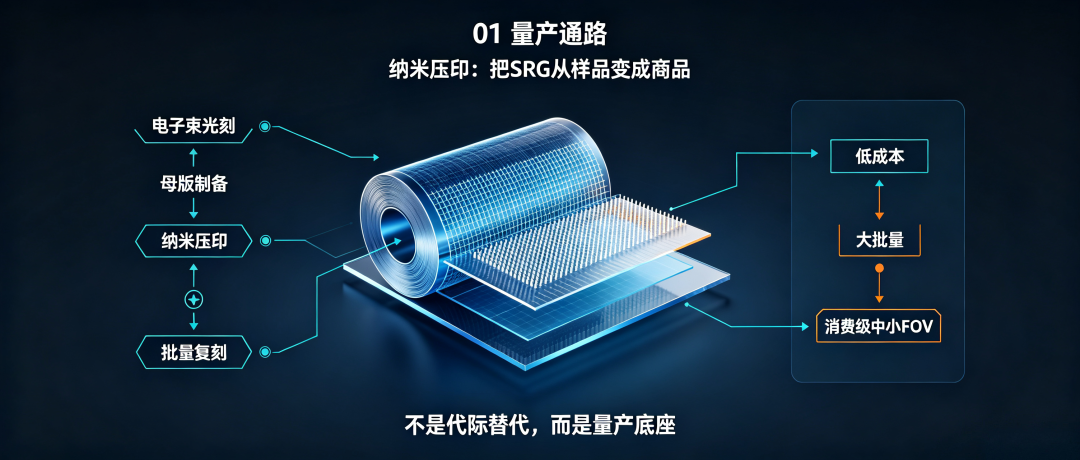
In the early stages, the industry relied on electron beam lithography for piece-by-piece processing, which was highly inefficient and costly, suitable only for laboratory sample validation and entirely unfeasible for commercialization.
The maturation of UV nanoimprinting technology has completely restructured the mass production logic. By utilizing high-precision master molds, nano-grating structures can be batch-replicated on glass substrates, enabling low-cost, standardized, and large-scale production.
Currently, Guangna Siwei has established an annual production capacity of one million fully automated nanoimprinting lines, achieving stable and continuous batch shipments of monochromatic waveguide products. These have been successfully integrated into multiple mass-produced AR glasses models, including Even G1 and G2 from Ewin Technology.
Nanoimprinting has thoroughly (thoroughly) broken through the low-cost mass production pathway for SRG and remains the mainstream process for consumer-grade, small-to-medium FOV waveguides. However, constrained by process principles, it cannot fabricate high-precision grating structures with large aspect ratios and steep angles, imposing inherent performance limitations.
02 Precision Pathway: DUV Etching Transforms SRG from 'Capable of Fabrication' to 'Precise Fabrication'
While nanoimprinting addresses the question of whether SRG can be mass-produced, it fails to break through performance bottlenecks.
The diffraction efficiency, FOV size, and image uniformity of SRG waveguides primarily depend on the precision of grating tooth profiles, groove depths, and duty cycle parameters. High-performance grating structures with steep angles and deep grooves represent a technological blind spot for traditional nanoimprinting processes.
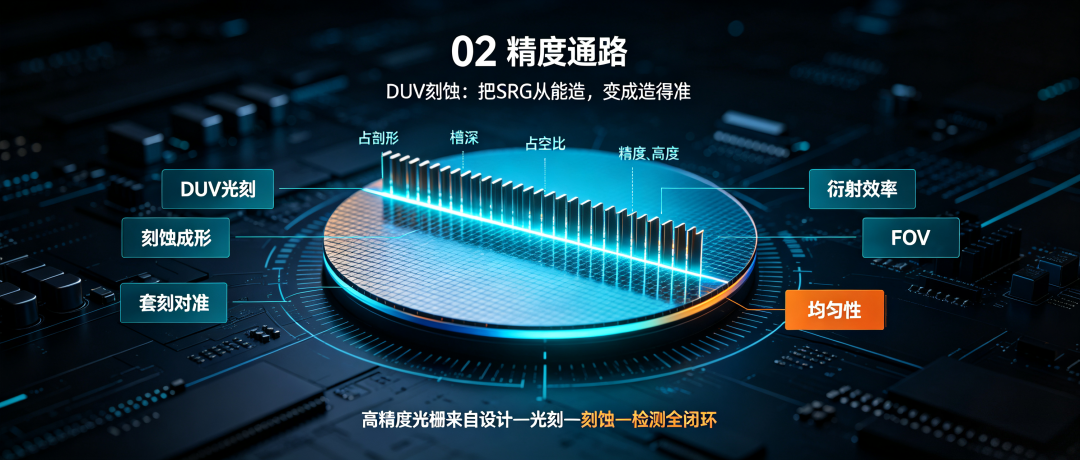
The industrialization of semiconductor-grade DUV lithography and etching technology has filled this gap. Goertek Optics has established China's first 12-inch wafer DUV lithography and etching mass production line, supporting high-precision overlay alignment and integrated processing of multi-layer gratings. The non-contact processing mode effectively avoids lens scratches and surface contamination while simultaneously expanding production capacity and improving yield rates.
Relying on this high-precision process system, AAC Technologies has maintained a stable mass production yield rate exceeding 80% for its self-developed single-layer full-color SRG, significantly outperforming the industry average of 50%.
It is important to clarify that this high yield is the result of closed-loop management across the entire process chain, from optical design to DUV lithography and etching, coating, inspection, and module integration, rather than a natural outcome of simply adopting DUV equipment.
DUV etching and nanoimprinting do not represent an iterative replacement relationship but form a complementary tiered process structure, supporting stable mass production of high-end, high-precision SRG products.
03 Physical Pathway: SiC Pushes the FOV Ceiling of SRG Higher
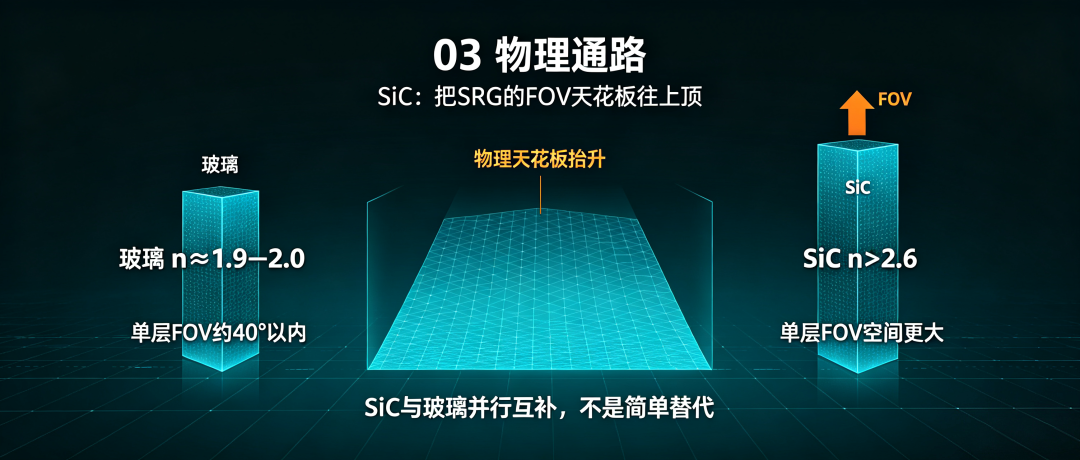
After manufacturing process precision reaches its limits, the performance bottleneck for SRG waveguides shifts from engineering manufacturing to the physical limitations of substrate materials.
Traditional optical glass has a refractive index of only 1.9-2.0. Constrained by the optical K-domain, the FOV of single-layer SRG waveguides is generally locked below 40°, failing to meet user demands for immersive AR experiences.
The large-scale application of silicon carbide (SiC) materials has thoroughly (completely) broken this physical constraint. With a refractive index exceeding 2.6, SiC significantly broadens the optical étendue, unlocking larger FOV ranges.
AAC Technologies' high-end SiC-based SRG solution achieves a 52° FOV, effectively suppressing rainbow artifacts in full-color displays, with a color deviation Δu'v' < 0.02, delivering more balanced and pure color performance.
According to Guangna Siwei's public industry disclosures, it has achieved the world's first large-scale mass production of full-color SiC-etched diffraction waveguides, with product thickness below 0.6mm and single-unit weight under 3g. These have been batch-integrated into Coray Air2 commercial AR glasses.
It is essential to clarify that SiC represents an upgrade in substrate material dimensions rather than a replacement of traditional glass SRG process systems. Instead, it opens up new performance boundaries in scenarios where glass materials cannot achieve large FOV and low dispersion, forming a parallel and complementary pattern (landscape) with glass solutions.
04 Image Quality Pathway: Single-Layer Full-Color Elevates AR from Information Prompts to Immersive Displays
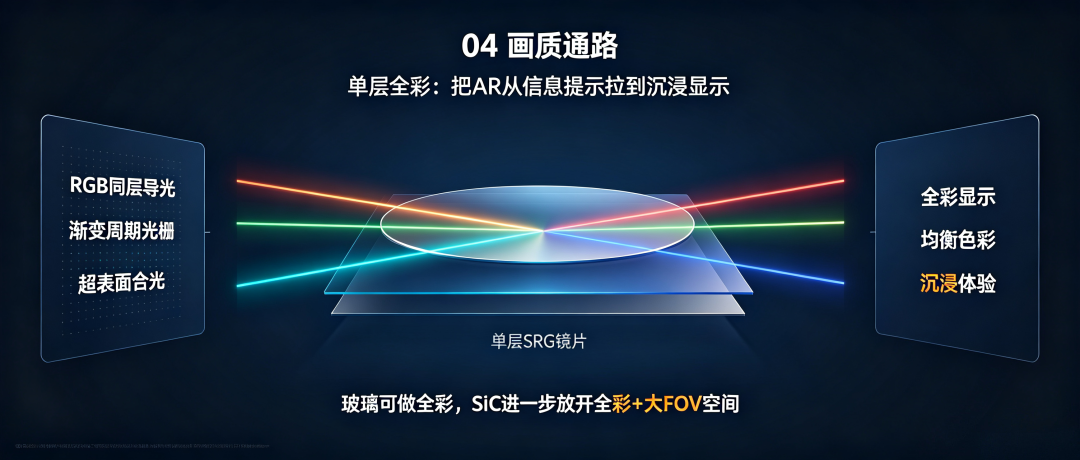
After achieving large FOV, high precision, and mass production capabilities, image quality upgrades become the final core piece of the SRG waveguide puzzle.
Monochromatic waveguides can only support basic information prompt interactions. To elevate AR devices from lightweight tool interactions to immersive visual experiences, full-colorization represents an irreversible industrial trend.
Industry technical solutions are evolving from bulky multi-layer stacked light-combining structures to lightweight single-layer full-color SRG technology routes.
AAC Technologies' self-developed single-layer full-color waveguide measures only 0.7mm in thickness and 4g in weight, reducing weight by over 50% compared to traditional glass waveguides of the same specifications. The lens environmental light transmittance exceeds 90%, balancing ultimate wearing comfort with high-definition display effects.
Guangna Siwei's C25C single-layer full-color waveguide has also achieved stable mass production, meeting the iterative upgrade demands of mainstream consumer-grade AR devices.
The core technical challenge of full-colorization lies in achieving efficient coupling-in, coupling-out, and balanced transmission of RGB trichromatic light within a single waveguide layer. With the continuous maturation of technical solutions such as gradient-period gratings and metasurface light combining, SRG full-color image quality has formal (officially) transitioned from laboratory technology demonstrations to becoming a standard feature in consumer-grade mass production.
05 2026 Industrial Inflection Point: From Single-Point Technical Validation to Full-Chain Capability Formation
The layered empowerment of four differentiated technological pathways has thoroughly (completely) broken through the core bottlenecks of SRG waveguides across the four dimensions of mass production, precision, performance, and image quality.
In 2026, the industry is undergoing a critical qualitative transformation: SRG breakthroughs are no longer isolated technical highlights but represent the holistic formation of large-scale capabilities across the entire chain.
According to Counterpoint Research's Q1 2026 industry data, the AR glasses market structure is rapidly iterating. The market share of traditional Birdbath and planar prism solutions has contracted from 82% to 58%, while the proportion of waveguide-based AR glasses has surged from 18% in the same period last year to 42%.
Multiple industry institutions predict that global AR glasses shipments will reach the million-unit scale in 2026.
Production capacities are simultaneously ramping up: ZhiGe Technology is striving for annual waveguide shipments of one million units. AAC Technologies' million-unit-scale production capacity plan is steadily landing, achieving stable monthly ramp-up shipments. A host of enterprises, including Guangna Siwei, Gudong Intelligence, Mojie Technology, and Lipai Optics, are intensively raising funds for expansion.
This does not represent a technological breakthrough by a single enterprise, nor does it signify that the entire industry has achieved stable million-unit-scale delivery. Instead, it marks the first time the entire waveguide supply chain has completed closed-loop capability formation across all links.
From master mold fabrication and precision machining to specialty material supply and standardized inspection systems, all segments have simultaneously completed large-scale adaptation, thoroughly (completely) bidding farewell to the industry's past dilemma of isolated technical trials without commercial viability.
Epilogue
Reviewing the four core breakthroughs in SRG diffraction waveguides reveals that this is not a chain of generational replacement between old and new technologies but rather four parallel, complementary pathways that continuously elevate industrial ceilings.
Nanoimprinting breaks through the mass production pathway, solving the industry's 'existence problem'; DUV etching elevates manufacturing precision, addressing the 'quality problem'; SiC materials break physical constraints, raising the industry's FOV ceiling; single-layer full-color technology iterates display solutions, upgrading terminal immersive image quality.
These four technological pathways mutually empower each other without substitution, jointly driving the continuous advancement of the AR waveguide industry.
The million-unit-scale production capacity competition initiated in 2026 signifies that the door to SRG waveguides has thoroughly (completely) swung open, transitioning from sample R&D to large-scale mass production.
However, the formation of mass production capabilities does not equate to full-scale consumer market penetration. Beyond this door, challenges such as continuous cost reduction, stable yield management, complete machine adaptation optimization, and killer application landings remain to be overcome. This merely represents a new starting point for the large-scale and popularization of AR waveguides.
Interactive Topic: Among SRG's four technological leaps, which do you believe holds the greatest value for driving industrialization? Is it nanoimprinting's mass production breakthrough, DUV etching's precision upgrade, SiC materials' large FOV breakthrough, or single-layer full-color's image quality innovation? Welcome to share your judgment in the comments.
—— AR Andy | Focusing on the optical waveguide and AR microdisplay sectors, deeply dissecting the underlying logic of the optics industry
[Risk Disclaimer] This article is compiled based on publicly disclosed corporate information and industry data, serving solely as industrial insights and technical popularization. Processes and metrics vary among manufacturers and do not constitute technical selection or investment advice.
-
Smart #2 Sees 3,000 Yuan Price Increase for Order Transfers: Is It the Electric Vehicle Market's Answer to the iPhone Duo?
-
Is 55% of Domestic Computing Power Really Used for Videos and Short Dramas? Doubao Responds
-
![]()
How to Interpret the Data: 61.6% NEV Penetration in September, 24% Retail Decline in Early October
-
![]()
Q3 Report | Hengtong Optoelectronic’s Performance Soars, Achieving Up to 61% Quarter-over-Quarter Net Profit Growth in a Single Quarter
-
![]()
Manus Restarts Independent Operations, Yet Avoids Starting Anew
-
One Photo Suffices for Celebrity Endorsements: Merchants Offer Custom AI Videos from 150 to 1000 Yuan per Minute
-
![]()
Total Investment Reaches 450 Million Yuan! Luke Optical Launches Its First Pilot Production Line for an Annual Output of 20 Million Pairs of Glasses
-
Chery Leads in Auto Exports, But When Will It Dominate the Domestic Market?