Financial Agents Procurement Trends: Large-Scale Orders Rebound, Securities Firms Lead the Charge
 09/10 2026
 408
408

August witnessed a resurgence in the bidding market for financial agents.
According to partial statistics from 01CAI, August saw the announcement of 40 public tenders, marking a month-on-month increase of over 40%[1], roughly reverting to the levels observed in June. A total of 16 bids were awarded or transactions disclosed, with 11 of them revealing the contract amounts, summing up to approximately RMB 103 million—a figure more than five times that of July.
On the one hand, the buyer base continued to diversify: banks maintained a robust demand, securities firms experienced a concentrated surge, and newcomers such as futures exchanges and insurance asset managers joined the fray.
On the other hand, the demand dynamics shifted, with a decline in platform-based projects and a greater emphasis on iterative upgrades of existing systems, deepening business scenarios, and a swift increase in operational control needs, including agent monitoring, security governance, and risk testing.
On the supply side, CLB Information Technology secured the year's largest financial agent project to date, while Ant Group Digital Technology, Volcano Engine, and Hundsun Technologies each clinched two bids within a single month.
Banks Remain Key, Securities Firms Surge, New Entrants Emerge
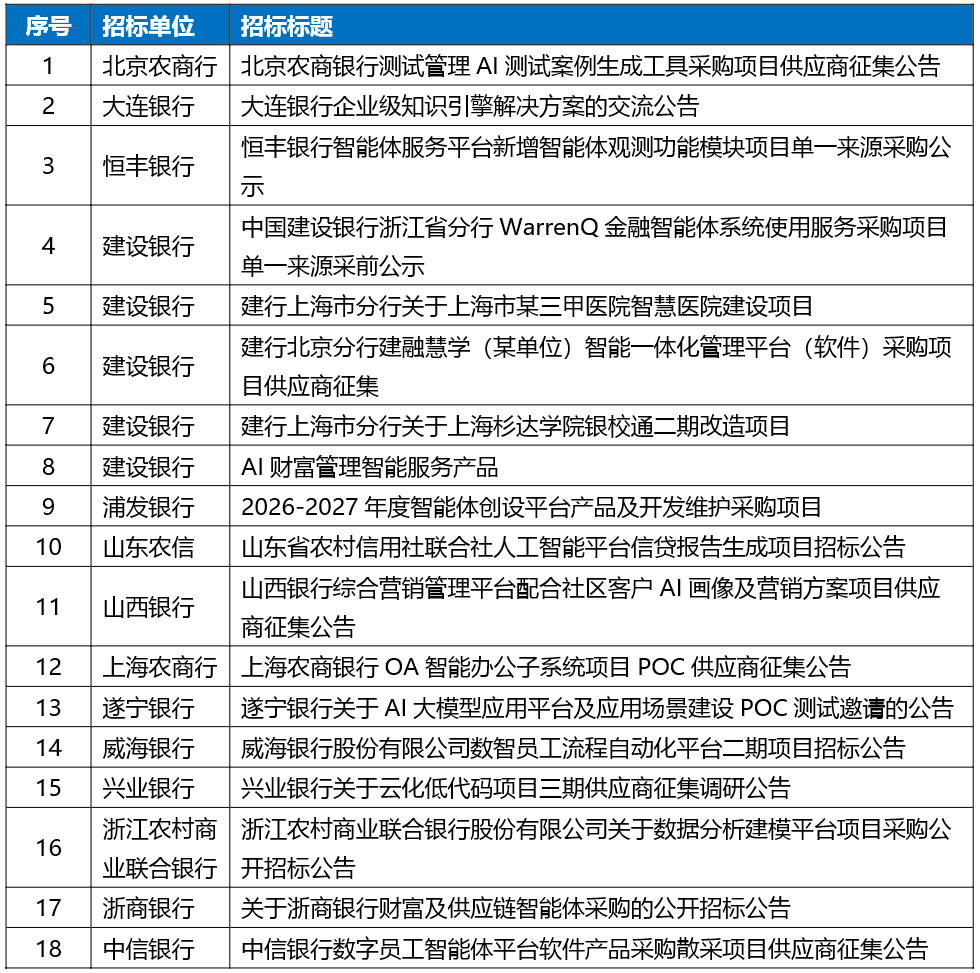
Banks continued to be the primary procurement force, with 18 tenders. Structural changes were evident in the second tier: securities firms increased their tenders to 10, accounting for 25%, while insurance rebounded to 4.
Consumer finance, guarantee, payment, and wealth management subsidiaries temporarily stepped back, making way for futures exchanges, AMCs (insurance asset managers), financial leasing, funds, and fintech subsidiaries.
Major banks started placing bulk orders through 'branch expansion + subscription/scenario packages.' China Construction Bank had 5 tenders in a single month. Zhejiang Branch procured WarrenQ financial agent system services through single-source procurement, Shanghai Branch initiated two projects for smart hospitals and bank-school connectivity Phase II, Beijing Branch sought a 'Jianrong Huixue' intelligent integrated management platform, and the head office introduced an AI wealth management intelligent service product.
Joint-stock banks further expanded their business scenarios. China Zheshang Bank issued a public tender for a 'wealth and supply chain agent' and swiftly awarded it (won by Ant Blockchain for RMB 9.46 million); CITIC Bank launched a 'digital employee agent platform' supporting multi-agent collaboration; Evergrowing Bank added an 'agent monitoring function module' to its existing HiAgent platform; Shanghai Pudong Development Bank procured products and development/maintenance services for an 'agent creation platform' for 2026-2027; Industrial Bank advanced to Phase III of cloud-based low-code development (including an agent plugin marketplace).
Local banks and rural credit systems exhibited diverse activities, with Beijing Rural Commercial Bank, Shanghai Rural Commercial Bank, Shandong Rural Credit, Weihai Bank, Dalian Bank, Shanxi Bank, and Suining Bank issuing tenders covering test case generation, office applications, green finance, knowledge bases, and customer marketing.
Table 1: Bank-Related Agent Demand Tenders in August 2026
Data Source: Enterprise Early Warning, 01CAI
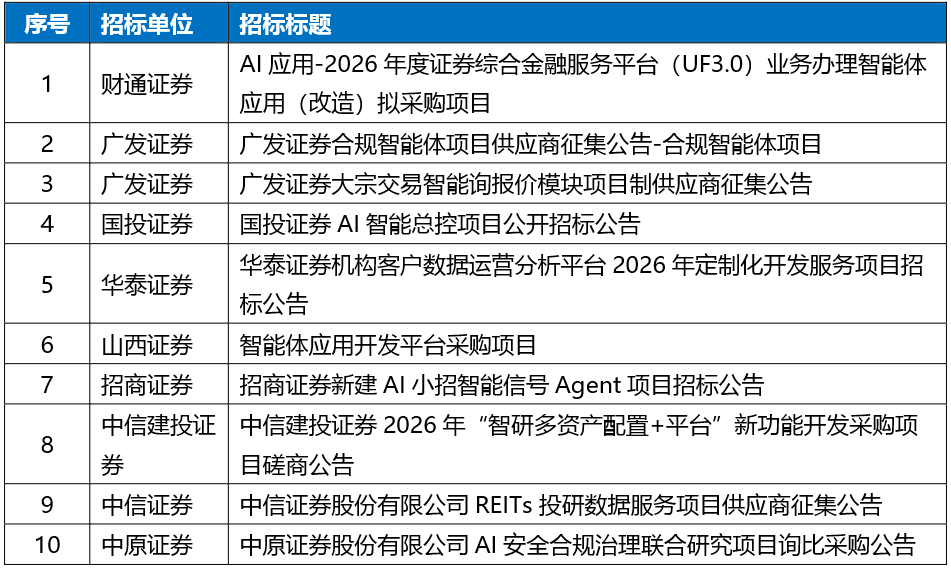
Shifting focus to securities firms, they made sporadic appearances in July's tenders, mostly in peripheral areas like content operations and knowledge management. In August, 9 securities firms released 10 tender demands, nearly all from top and mid-sized firms.
GF Securities was the most active, launching two projects in a month: a compliance agent and a block trade intelligent quoting agent. China Merchants Securities aimed to build an 'AI Xiaozhao intelligent signal agent' for trading signals; CITIC Securities and CSC Financial respectively applied agents to REITs investment research data services and 'Zhiyan' multi-asset allocation; Caitong Securities transformed a 'business processing agent' within the Hundsun UF3.0 platform.
Huatai Securities initiated 2026 customized development around institutional client data operations, aiming to apply agent services throughout institutional client marketing and operational services, strengthening AI-enabled data analysis and operational efficiency. SDIC Securities launched an AI intelligent control project to connect systems company-wide via agents; Shanxi Securities was among the few still building an 'agent application development platform.'
Table 2: Securities Firm and Bank-Related Agent Demand Tenders in August 2026
Data Source: Enterprise Early Warning, 01CAI
Agents have now penetrated from securities firms' wealth brokerage business into core areas like compliance, trading, institutional business, investment research, risk control, and middle-office control.
Three main drivers fueled the concentrated procurement by securities firms: industry fee reduction competition necessitating end-to-end cost reduction and efficiency gains; validation of investment research, trading, and compliance scenarios making AI a necessity rather than a luxury; and securities firms' smaller in-house R&D teams compared to banks, making them more inclined to procure mature external solutions.
Insurance institutions like Dadi Property & Casualty, Haigang Life, Taikang Pension, and China Continental Property & Casualty procured agent-related services for financial management, integrated applications, AI middle platforms, and risk control scenarios.
The 'long-tail rotation' among other buyers continued, with new entrants each month.
Futures exchanges entered the observation sample for the first time. Guangzhou Futures Exchange posted a budget of RMB 4.8255 million for a large model application project, procuring office AI applications (agent applications, AI knowledge base applications, writing assistant applications) and R&D AI applications (code assistant applications).
Meanwhile, New China Asset Management initiated the construction of a risk control intelligent Q&A agent, marking the entry of insurance asset managers and AMCs.
In financial leasing, Suzhou Financial Leasing procured an enterprise-exclusive architecture agent platform, while Yongwin Financial Leasing planned to build an AI intelligent marketing system.
Demand Shift: Platforms Decline, Governance and Control Rise
Over time, demand for 'platform' construction of agents has diminished.
In 2025, new platform projects accounted for over 60% of the market, dominating the landscape. By the first half of 2026, this fell to around 29%, and in July and August, it was below 20%. New platform tenders are increasingly giving way to Phase II projects, upgrades, feature additions, and scenario development.
For instance, Industrial Bank has reached Phase III in cloud-based low-code development, Weihai Bank purchased 'Phase II of the digital employee process automation platform,' Taikang Pension's AI middle platform 'Zhishu' entered Phase II, Evergrowing Bank sought to add a 'monitoring' function module to its agent service platform, and Caitong Securities transformed a business processing agent within UF3.0.
Truly new platform constructions are mainly undertaken by smaller institutions like Shanxi Securities, Suining Bank, and Suzhou Financial Leasing, which have yet to complete their first round. Platform construction hasn't disappeared but has become 'dual-track': sinking to the second tier while upgrading among early adopters.
A notable new trend is the rapid rise in demand for agent operational governance. Evergrowing Bank announced adding an 'agent monitoring function module' to its agent service platform, with Volcano Engine as the supplier. This marked the first appearance of 'monitoring' in financial agent procurement.
On August 11, Central China Securities launched joint research on AI security and compliance governance with a budget of RMB 490,000. Almost simultaneously, Industrial Securities completed procurement of 2026 group agent application security testing services, awarded to two security vendors, DBAPPSecurity and Zhiqian. Beijing Rural Commercial Bank sought AI test case generation tools.
In July, Bank of China had assigned its 'AI agent-based intelligent automated security operations' project to Zhiqian. Security and governance needs around agents are spreading from state-owned major banks to joint-stock banks and securities firms.
Procurement of governance-oriented agents for security, monitoring, testing, and risk assessment is gradually extending from state-owned major banks to joint-stock banks and securities firms. Market demand has shifted from 'building' to 'managing.'
Large Orders Return, Ant, Volcano, Hundsun Secure Multiple Bids
Among the awarded bids disclosed in August, large infrastructure orders made a comeback to the market.
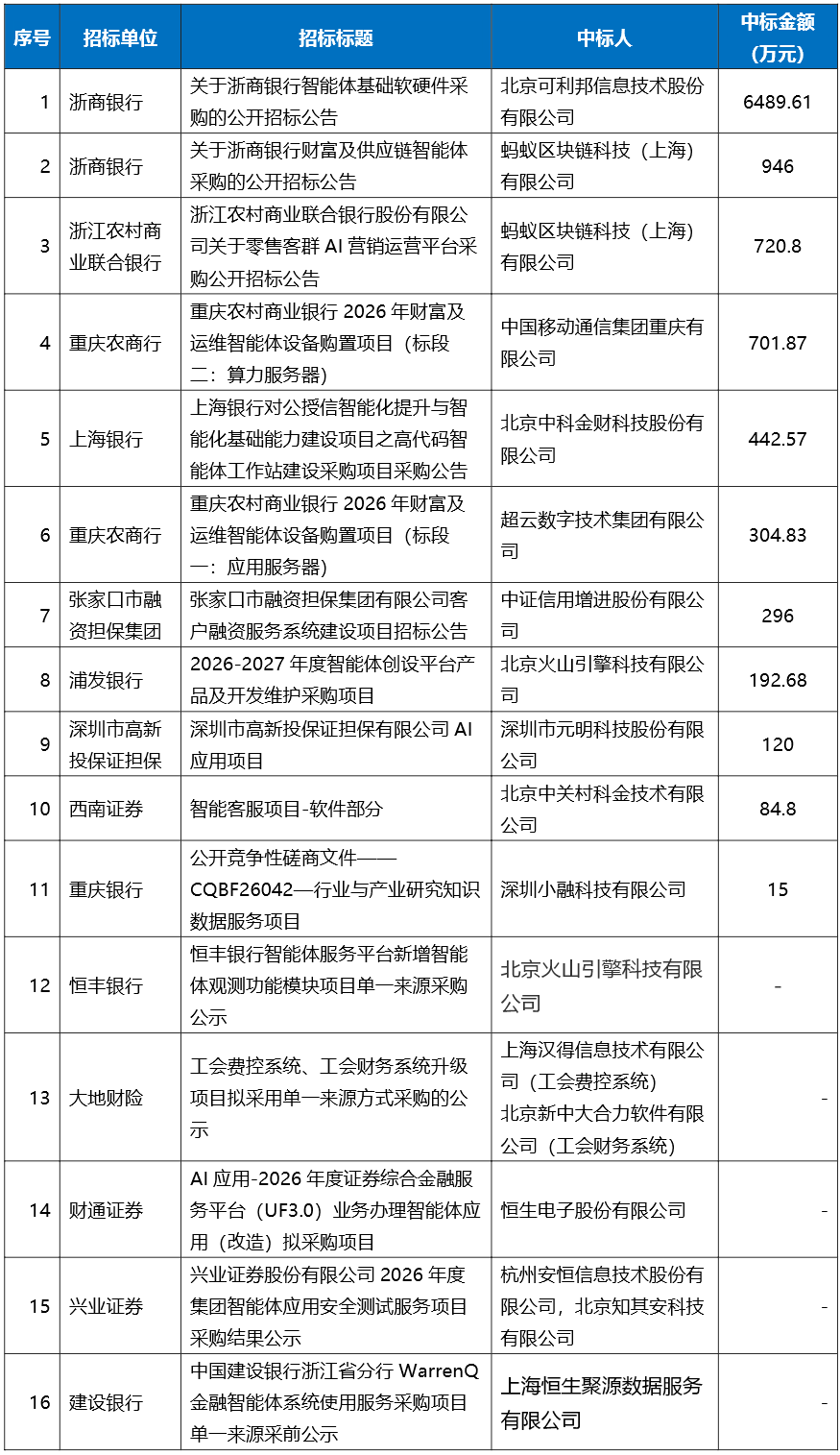
China Zheshang Bank's 'agent infrastructure hardware and software' tender reached RMB 64.896 million, awarded to Beijing CLB Information Technology, setting a new record for the largest publicly verifiable single order this year.
Chongqing Rural Commercial Bank awarded two lots for equipment procurement for wealth and operational agents—Lot 1 for application servers (RMB 3.0483 million) and Lot 2 for computing servers (RMB 7.0187 million), totaling over RMB 10 million. Shanghai Bank's 'high-code agent workstation' procurement was completed for RMB 4.4257 million. China Construction Bank Shanghai Branch also posted two lots for a smart hospital project, with a total budget of approximately RMB 8.76 million.
These funds were not for agents themselves but for the infrastructure supporting them: computing servers, application servers, development tools, and integration services.
On the supply side, the most visible change was the frequent appearance of 'familiar faces.'
Ant Group Digital Technology won two projects totaling RMB 16.668 million: China Zheshang Bank's wealth and supply chain agent (RMB 9.46 million) and Zhejiang Rural Commercial Bank's retail customer segment AI marketing and operational platform (RMB 7.208 million).
Volcano Engine secured Shanghai Pudong Development Bank's agent creation platform product and development/maintenance project (RMB 1.9268 million) and Evergrowing Bank's agent monitoring function module (single-source). In July, it had won Guangzhou Bank's agent development platform project (RMB 2.45 million).
The Hundsun group also won two projects. Caitong Securities transformed a business processing agent within the Hundsun UF3.0 integrated financial services platform, supplied by Hundsun Electronics. China Construction Bank Zhejiang Branch's WarrenQ subscription was undertaken by Hundsun Juyuan. In July, Guoyuan Securities' RMB 2.3 million knowledge governance project also went to Hundsun.
Platform infrastructure vendors like Ant Group Digital Technology (Ant Blockchain) and Volcano Engine secure medium- to long-term, systematic orders. Industry application and data vendors like Hundsun Electronics and Hundsun Juyuan sell products tied to existing systems and business scenarios. Local integration service providers like CLB Information Technology take on super-orders like the RMB 64.896 million project requiring extensive implementation and delivery.
Table 3: Financial Agent Bid Awards in August 2026
Data Source: Enterprise Early Warning, 01CAI
Data Note: This article is based on publicly announced tenders, awards, and single-source procurement notices, excluding retenders.
-End-
-
Value and Cost: Validations from Anthropic and Zhipu
-
Who Defines 'AGI' Defines the Future
-
![]()
What Unfolded Following Tesla's Substantial Price Reduction?
-
![]()
4-Minute Surge: 10,000 Orders Secured for Xiaomi Pengcheng, Sparking Hot Search Trend. Lei Jun: Extended-Range Vehicles Hold Immense Promise
-
The Future Trajectory of AI Large Models
-
![]()
Breakthrough! China Issues First National-Level Document on Account Period Management for Automotive Industry
-
![]()
Financial Agents Procurement Trends: Large-Scale Orders Rebound, Securities Firms Lead the Charge
-
![]()
Has Qualcomm Secured Its Second Growth Curve in AI by Partnering with Amazon?