iFLYTEK Launches AStudio in a 'Desktop Gateway' War It Cannot Afford to Lose
 09/16 2026
 471
471
On September 15, 2026, iFLYTEK unveiled AStudio, a next-gen desktop AI productivity platform.
The announcement was brief: Built on the Spark X2.5 large model and powered by the ACodeHarness intelligent agent core, AStudio integrates a rich array of tool plugins and Skills, enabling large models to 'complete tasks directly' and propelling desktop AI from 'assistive tools' to 'productivity platforms.'
But if you only see a product launch, you're missing what truly matters about this announcement.
01 Why Has the Desktop Become a Battleground?
An often-overlooked fact: By 2026, the primary battleground for AI-powered office tools in China has shifted from mobile screens and browser chatboxes to your computer desktop.

According to TMTpost, Tencent's WorkBuddy reached 20.97 million monthly visits in June, surpassing the combined total of the second and third-ranked competitors. Baidu Dazi followed with 6.74 million monthly active users, boasting a staggering 1,063% month-over-month growth. Alibaba consolidated QoderWork, Wukong, and MuleRun into 'Qianwen Office.' ByteDance is deepening the integration between Doubao and Feishu.
This is no coincidence.
The desktop is the first real testing ground for 'actionable AI.' AI in browsers can only offer suggestions; desktop Agents can directly open your folders, execute commands, modify code, and generate files. The leap from 'telling you what to do' to 'doing it for you' hinges on the desktop—an operating system-level gateway.
At the Bund Summit, Source Code Capital's investing partner Zhang Hongjiang outlined an evolutionary path: Agents are moving 'from conversation to assistance, from passive to proactive, from individual to collective.' The struggle for positioning among desktop Agents is fundamentally about securing 'the first touchpoint of human-AI collaboration'—whoever becomes the first AI you activate after booting up your computer will set the standard for the next generation of workflows.
02 iFLYTEK's 'Late Entry' and 'Different Ace'
Frankly, iFLYTEK is a latecomer to the desktop Agent arena.
Tencent's WorkBuddy has already achieved daily active users in the tens of millions. Baidu Dazi tops evaluation rankings. Alibaba has initiated ecosystem integration. AStudio's launch comes just six months after iFLYTEK's March release of Loomy, a desktop AI assistant. Some may ask: Is this too slow?
But a closer look at iFLYTEK's hand reveals a different strategy.
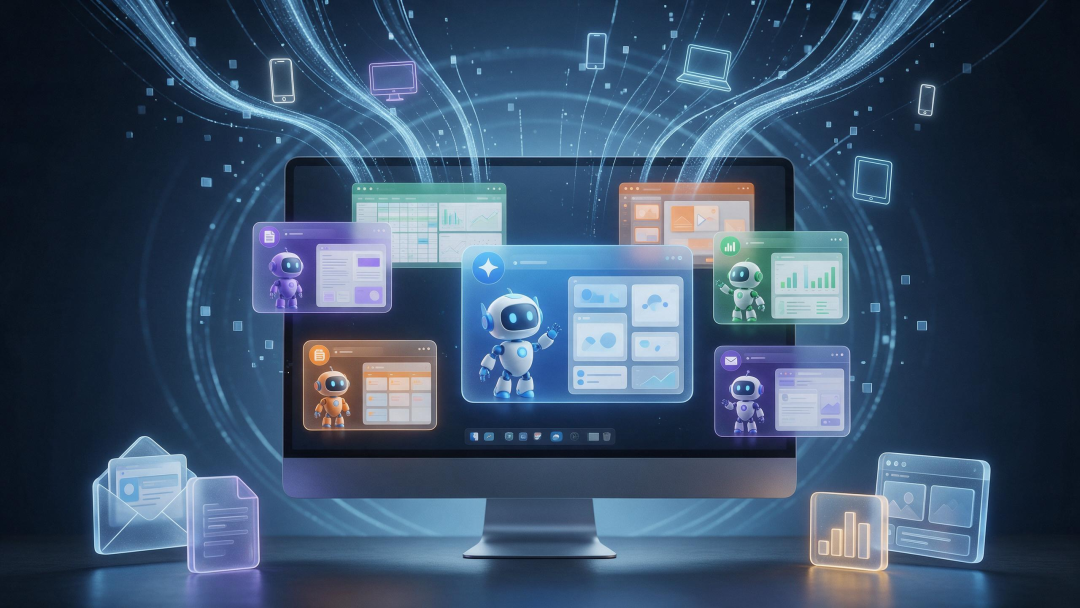
Its first card is full-scenario task closure. AStudio is not an 'upgraded chat assistant' but a workstation. In daily mode, it handles standalone tasks like research, documents, and spreadsheets; in project mode, it directly links to local folders, reading, modifying, and maintaining existing code projects. Users set goals, and AStudio autonomously plans, calls tools, executes, and delivers results. This 'goal mode' and 'planning mode' design targets complex tasks that traditional conversational AI cannot handle.
Its second card is domestic computing power. iFLYTEK's Spark X2.5 emphasizes training on domestic computing power, a subtle differentiator in the current landscape. While competitors rely on imported chips and overseas model architectures, iFLYTEK has accumulated experience in trusted AIPC deployments—its 'Liaoyuan' series computers deeply adapt Spark to domestic chips and UOS. If AStudio can establish itself in localized office scenarios, it will find a niche beyond the reach of major players.
Its third card is a 'skill accumulation' product philosophy. AStudio allows users to crystallize verified workflows, inspection standards, and operational experience into 'personal skills' for automatic reuse in similar tasks. This ambitious design aims to transform Agents from 'relearning every time' to 'understanding you better over time.' When an Agent accumulates enough of your personal skills, the cost of switching away skyrockets.
03 The Inevitable Question: Can It Afford to Burn Cash?
Evaluating iFLYTEK's AStudio requires examining its financials.
In the first half of 2026, iFLYTEK reported revenue of RMB 11.623 billion, up 6.52% year-over-year. However, net profit excluding non-recurring items plunged to a RMB 637 million loss, widening by nearly 75%. R&D investment reached RMB 3.007 billion, up 25.73% year-over-year, accounting for nearly 26% of revenue.
In other words, iFLYTEK is trading profits for the future. Management explicitly stated that R&D spending in the second half is expected to more than double the first half, with roughly half allocated to large models and multimodal directions.
Whether this 'gamble' pays off depends on two factors.
First, can AStudio truly retain users? Desktop Agent competition has a brutal reality: switching costs are higher than on mobile. Users who have installed WorkBuddy, linked Tencent Docs, and integrated WeChat Work will not switch for a 'slightly better' tool—they need something 'significantly better.' AStudio must prove its reliability in complex task execution to offset ecosystem migration friction.
Second, can commercialization keep pace? AStudio has announced pricing: RMB 36.8/month for the standard version, RMB 96.8/month for the premium version. The pricing is modest, but user payment habits for desktop Agents are still nascent. iFLYTEK already invests heavily in promoting C-side hardware (learning tablets, AI glasses). Whether AStudio can rapidly form a virtuous cycle of subscription revenue remains a variable to watch.
04 Deeper Layer: What Are Desktop Agents Really Competing For?
Zooming out, AStudio's launch reflects a broader proposition: AI is transforming from a 'technological variable' to an 'economic variable.'
For years, discussions about large models revolved around parameters, computing power, and benchmarks. Now, economists and business leaders at the Bund Summit are debating a more fundamental question: How much genuine productivity can AI create?
Nobel laureate Philippe Aghion's calculations offer a reference: AI automation of tasks in goods and services production could boost annual productivity growth by an additional 0.68 percentage points over the next decade.
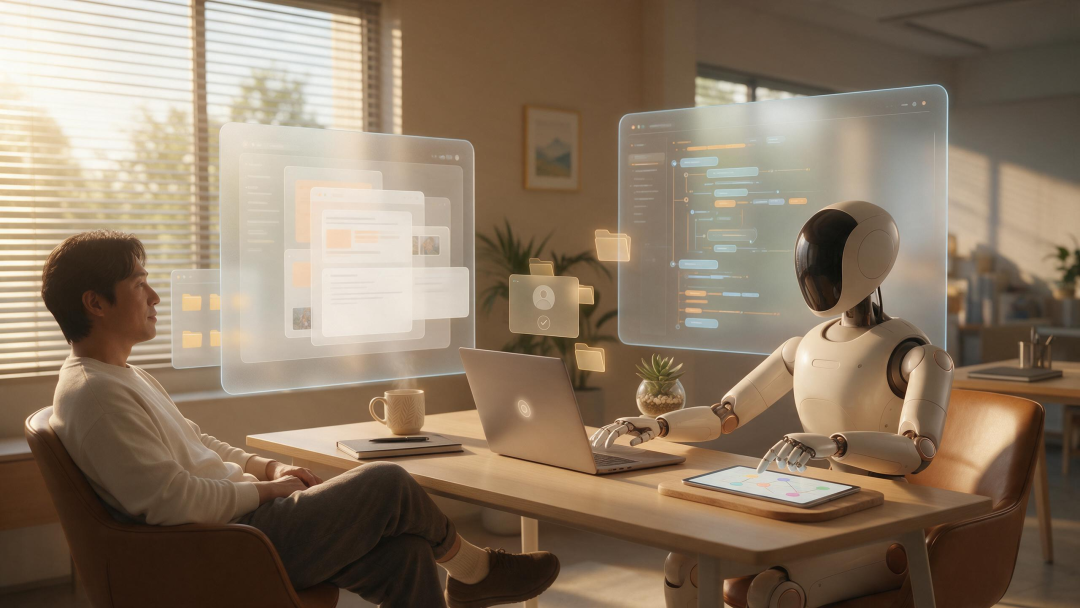
And desktop Agents are the most direct conduit for 'AI entering economic processes.' When an Agent can handle data compilation for a research report, code refactoring, or weekly report generation, it replaces not just 'a function' but 'a segment of labor.'
A joint report by Shanghai Advanced Institute of Finance and Ant Group Research Institute suggests that billing models may shift from traditional seat-based subscriptions to charging based on agent workload or even final business outcomes.
This means the ultimate competition for desktop Agents is not about feature count but trust depth. How many files are you willing to let AI access? What operations will you authorize? What tasks will you entrust it to 'complete directly'? The answers to these questions determine whether Agents evolve from 'toys' to 'colleagues.'
AStudio's permission tier design—three strategies: 'Help Me Approve,' 'Request Approval,' and 'Full Access'—responds to this trust-building imperative. But trust takes time to build and requires repeated validation that 'it truly delivers.'
05 A Marathon of 'Sacrifice' and 'Gain'
iFLYTEK's pursuit of AStudio represents a strategic choice: sacrificing short-term profits to secure a position in the new battleground of desktop Agents.

The path is arduous. Tencent has its ecosystem, ByteDance has traffic, and Alibaba has enterprise service depth. iFLYTEK's strengths lie in model autonomy, scenario deep cultivation (scene deep cultivation), and localization accumulation. But whether these advantages can translate into the 'default option' on users' desktops depends on AStudio's performance in real work scenarios—not in demo videos, but in the daily, tedious, complex, and accident-prone grind of actual tasks.
The battle for the desktop Agent gateway has just begun. AStudio is an entry ticket, not a finish line.
The real suspense (suspense) lies in this: When AI truly starts 'working for you,' what will your relationship with it become?
-
![]()
Doubao Mobile Phone Officially Launches: GUI as a Fallback, AI Office as a Support
-
![]()
iFLYTEK Launches AStudio in a 'Desktop Gateway' War It Cannot Afford to Lose
-
![]()
BYD Executive’s Clear Stance: The Era of Fuel Vehicles Is Over
-
![]()
Final Ruling: Double-Digit Decline in Auto Production and Sales Over First Eight Months
-
Mega-Funding of 33 Billion RMB! Zhipu AI's Monumental Financing Round: Zhang Peng Ascends as the Unrivaled AI Titan!
-
WorkBuddy, Qianwen Office, TRAE Work, Baidu Dazi: A Head-to-Head Comparison of Four Major AI Office Platforms
-
![]()
The AI Industry is Experiencing a Complete Overhaul! Leading Figures Issue Joint Warnings – What’s Amiss with AI?
-
![]()
One Rocket Launches 10 Satellites! Private Rocket Makes Its Grand Entrance into the Satellite Internet "Delivery Fleet"