Why Are Smart Glasses Bucking the Trend and Growing Exponentially in a Cold Winter?
 11/23 2026
 335
After sifting through the smart glasses data for the first half of the year, what surprised us most was not the doubling growth rate, but the fact that monochrome products overtook full-color ones for the first time. The "spatial computing" that has been hyped for years never took off; instead, products that look more like ordinary glasses were the first to gain traction.
IDC data shows that in Q2 2026, domestic AR&ER glasses shipments grew 123% year-on-year, with monochrome products surpassing full-color for the first time at a 51.2% shipment share. Is it that consumers dislike full-color? Or should we be asking how many functions smart glasses actually need—and which ones are worth paying for?
XREAL turns glasses into a portable giant screen, Rokid tries to make them a computing terminal capable of running applications, and Even Realities chooses to enter from the traditional prescription glasses market, integrating smart functions into ordinary glasses as much as possible. The three companies have moved in different directions, reflecting the shifts taking place in the smart glasses industry: market competition is beginning to move from feature demonstration to real usage needs.

A Growth Outlier Amid the Consumer Electronics Downturn
In the first half of 2026, both traditional consumer electronics markets—smartphones and TVs—were contracting. According to IDC, domestic smartphone shipments in the second quarter were about 66.01 million units, down 4.3% year-on-year, marking five consecutive quarters of decline. According to Runto Technology data, TV shipments also declined. In the first half of the year, complete TV set shipments by Chinese mainland TV brands totaled 14.947 million units, down 10.1% year-on-year.
According to Runto Technology statistics, over the same period, domestic smart glasses retail sales across all channels reached 909,000 units, with sales of 1.88 billion yuan, up 85.5% and 98.7% year-on-year respectively.
Looking at specific products, the glasses buyers choose are also somewhat different. In the first half of the year, for every 100 smart glasses sold, about 45 were AR glasses with displays, about 34 were camera glasses, and the remaining about 21 were audio glasses. Compared with the same period last year, the shares of the first two categories both rose.
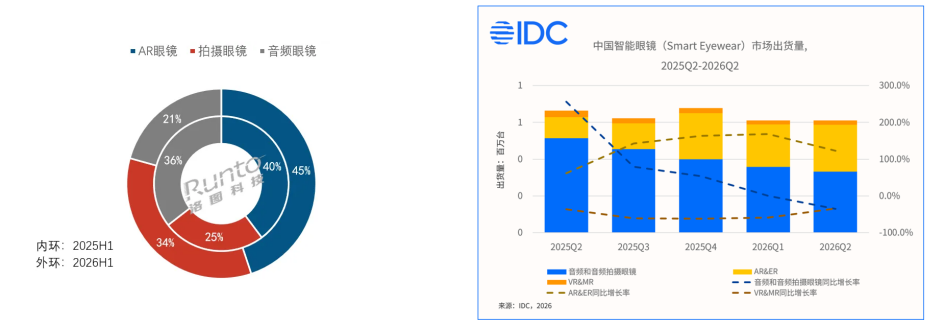
Image source: Runto Technology
On November 18, Runto also released third-quarter retail data. In that quarter, domestic smart glasses sales volume grew 14.3% year-on-year, but sales revenue fell 4.3%. Specifically, the average price of camera glasses dropped from 1,907 yuan in the second quarter to 877 yuan; AR glasses maintained an average price of 2,817 yuan, and their sales volume share rose from 20.6% in the same period last year to 35.8%.
The overall market cooled, yet more expensive AR glasses won more buyers. As for which functions on the lenses buyers are willing to pay for, XREAL, Rokid, and Even Realities have given three different answers.

Three Manufacturers, Three Product Definitions
The three manufacturers' different understandings of "the core value of smart glasses" have also led to three completely divergent product paths.
XREAL: Turning Glasses into a Portable Giant Screen
XREAL's approach is relatively direct: first make consumers willing to buy a pair of glasses for the display experience.
The company was founded in 2017, formerly known as Nreal. Its early product Light had already begun exploring consumer-grade AR displays, but what truly opened the mass consumer market was the Air series launched in 2022. It adopts the BirdBath optical solution, using relatively mature technology to achieve a larger virtual image. This product definition lowered the cost of market education and also determined that XREAL's core competitiveness is mainly concentrated in the display experience.
Afterward, the company launched the One series, improving image stability through its self-developed X1 spatial computing chip and further raising the product positioning. The One series, first launched in December 2024, has become the company's fastest-growing product line and largest revenue contributor.
From a financial performance perspective, product upgrades did bring revenue growth. XREAL's listing application filed with the Hong Kong Stock Exchange shows that from 2023 to 2025, the company's operating revenue was approximately 390 million yuan, 394 million yuan, and 516 million yuan, respectively. In 2025, One series sales reached 111,400 units, becoming an important source of revenue growth.
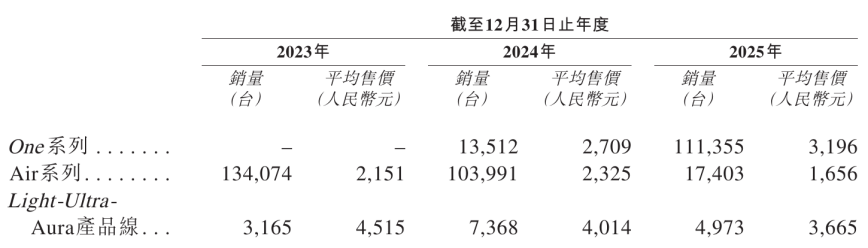
Image source: XREAL
But revenue growth did not immediately translate into profitability. In 2025, the company's gross profit was about 181 million yuan, R&D expenses were about 183 million yuan, and the full-year net loss was 456 million yuan; the adjusted net loss still reached 250 million yuan. Display effects, optical structures, and spatial interaction all require sustained R&D investment, and the revenue growth brought by high-end products is not yet enough to cover the company's overall operating costs.
XREAL's advantage is that it does not need to cultivate consumers' usage habits from scratch; watching movies and gaming are already mature demands. But how to increase daily usage frequency is the question this path needs to answer next.
Rokid: Moving from Display Devices Toward Spatial Computing
If XREAL focuses first on the image in front of the eyes, then what Rokid hopes to further solve is: can glasses become a true computing terminal capable of running applications?
Rokid was founded in 2014 and focuses on consumer-grade AR glasses. Centered on the core path of spatial display, Rokid first launched AR Lite, bringing multi-window interaction into mobile office scenarios; on this basis, it launched AR Studio, equipped with a dedicated computing terminal, upgrading the complete spatial computing experience. Taking a business trip scenario as an example, users can open three windows at the same time, such as contracts and quotations, so they do not have to switch pages back and forth when checking amounts.
To expand the application scope of this model, Rokid self-developed the spatial operating system YodaOS-Master. The system is responsible for determining where content is displayed and what the user has selected, and developers can directly call these functions to build their own applications into the glasses.
Beyond the consumer market, Rokid has also found customers willing to pay for specialized applications. The Zhejiang Provincial Museum collaborated with Rokid to launch the "Ten Thousand Years of Zhejiang" AR guide. Standing in front of a Liangzhu jade cong, visitors can see a three-dimensional deity-and-beast motif emerge above the object through the glasses.
This is also why Rokid is simultaneously building out both personal consumer and industry customer lines. C-end users who buy the glasses can directly use mature applications for watching movies and working; what the B-end needs is an integrated guide solution including digital models of exhibits, commentary content, and visiting routes. For Rokid, the business has the opportunity to extend from pure hardware sales to full-package project delivery.
Even Realities: Bringing Smart Glasses Back to Everyday Prescription Glasses
While the industry is still continuously adding cameras, speakers, and other functions to smart glasses, Even Realities, founded in 2023, chose the opposite path: subtraction.
Its Even Realities brand mainly targets high-end overseas markets. The G1 and G2 series products remove cameras and speakers, retaining only monochrome display, real-time translation, speech prompts, message reminders, and other functions. Taking G2 as an example, the device weighs about 36 grams, and about 40 grams with prescription lenses, with an appearance as close as possible to ordinary glasses.
This positioning targets business groups with high requirements for wearing comfort and work efficiency. Taking a meeting scenario as an example, information such as real-time translation and prompts can be projected directly into the field of view, eliminating the need to repeatedly take out a phone.
In terms of pricing, the G2 itself sells for $599, and with an approximately $249 smart ring and custom prescription lenses, the entire set's average order value can exceed $1,000. According to company disclosures, its daily active user ratio is about 60% to 70%, and the weekly active rate exceeds 90%, showing that the product has demonstrated a certain degree of daily usage stickiness.
In terms of sales channels, Even Realities actively enters overseas traditional glasses retail systems. Consumers can first try on frames, get an eye exam, choose lenses, and then decide whether to buy smart functions. This approach lowers the threshold for consumers to try new things and also addresses the practical needs of myopic users for lens customization and wearing comfort. Currently, the company has cooperated with more than 400 high-end glasses stores worldwide, with offline sales accounting for more than half.
This differentiated path close to the traditional prescription glasses business has also quickly gained recognition from the capital market. On July 6, 2026, Even Realities announced the completion of a $150 million Pre-B round of financing, led by Meituan Longzhu and Meituan Strategic Investment, with a post-investment valuation exceeding $1 billion, entering the unicorn ranks.

Behind the Growth
The three paths seem very different in direction, but in fact they have hit real user needs from different dimensions, together making the entire market pie bigger. The fact that smart glasses can grow against the trend within the consumer electronics market comes down to supply, demand, and policy all converging at the same point.
First, technological progress is moving smart glasses from parameter stacking toward usable experience.
In the past, more functions often meant a greater hardware burden. Now, manufacturers are beginning to optimize computing architecture through device-cloud collaboration and on-device model compression, delegating some complex tasks to phones and the cloud, reducing the computing power and battery pressure on the glasses side. Taking Even G2 as an example, the phone side handles application operation and computing processing, while the glasses side handles display; through task allocation among different devices, functions such as translation and prompting are realized within limited hardware space.
Display components are also reducing costs and improving efficiency simultaneously. In May this year, JBD announced that it would upgrade the wafer platform for MicroLED microdisplays from 4 inches to 12 inches, with wafer reconstruction yield on the pilot line exceeding 98%. The utilization rate of silicon-based backplanes has risen, and the cost per chip has naturally come down, paving the way for subsequent large-scale mass production and further price reductions.
Second, consumers finally know "what they are buying it for."
While traveling, viewing glasses can magnify videos on a phone into a private screen, allowing consumers to comfortably finish a movie without holding up their phone the whole time. At work, glasses supporting multi-window display can simultaneously present documents such as contracts and quotations for users to compare and view; when communicating with overseas clients, translation glasses can also convert the other party's speech into subtitles in real time, displayed directly in front of the eyes. In this way, users do not need to frequently look down at their phones and can maintain continuity in communication.
At the policy level, consumption subsidies are also lowering the purchase threshold for smart glasses. This year, smart glasses were included in the national trade-in subsidy scope for digital and smart products for the first time. Products priced at no more than 6,000 yuan per unit receive a subsidy of 15% of the final selling price, with a maximum subsidy of 500 yuan per unit. A consumer-grade AR glasses pair priced at around 3,000 yuan can save more than 400 yuan at checkout, directly lowering the threshold for the public to try new products and having a very direct driving effect on terminal sales volume.
All of this stems from the gradual maturity of the domestic industrial chain, which provides a supply foundation for the large-scale production of smart glasses.
From upstream optical waveguides, microdisplay modules, and optical lenses, to midstream chips, sensors, batteries, and structural parts, and then to downstream complete device design and production, China already has a relatively complete industrial supporting system. Enterprises such as Goertek, Crystal-Optech, and Lante Optics have already laid out in optical modules and related components; complete device manufacturers can also leverage China's mature electronics manufacturing capabilities to accelerate product R&D and production.
To put it plainly, products are becoming better and easier to use, usage scenarios are becoming more practical, and prices are becoming more acceptable to ordinary people—this is the fundamental force driving sales.

Xinliu Viewpoint
Doubling growth has thrust smart glasses back into the spotlight. Yet from rapid expansion off a low base to acceptance by a broader consumer base, the industry still has some way to go. XREAL must translate its giant-screen experience into sustainable profitability, Rokid needs to equip spatial computing with more everyday usable applications, and Even Realities has yet to prove that recognition from high-end users can extend to the wider population.
Looking at the industry as a whole, the cost of full-color display, battery life for all-day use, and the practicality of applications remain common challenges that no player can sidestep. Xinliu believes that the next stage of competition in smart glasses will hinge more on the most basic experience of a pair of ordinary glasses—whether they are comfortable to wear, whether the design looks natural, and whether prescription fitting is convenient.
New functions can entice consumers to try something new, but to make them willing to wear the glasses every day, the product still has to fit into daily life. After all, selling a pair of glasses is only the beginning; keeping them on the user's nose is the longer-term business.
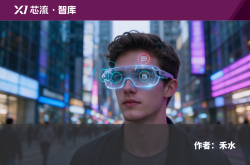
*The header image was generated by AI
- XINLIU -
-
![]()
Second-Hand Domestic Phones: African Buyers' Alternative to Transsion
-
![]()
Why Are Smart Glasses Bucking the Trend and Growing Exponentially in a Cold Winter?
-
Used Chinese Phones: Africa's Enthusiasts Embrace a Transsion Alternative
-
![]()
The Largest IPO in History: 14 Young Chinese Professionals Strike It Rich
-
![]()
AI Can't Understand Emotions, but It Has Spawned Seven New Businesses
-
![]()
Long Lead Times for Imported Rubidium Clocks? The SRS Stanford Research Systems FS725 Benchtop Rubidium Atomic Frequency Standard Is in Stock and Shipping Directly!
-
![]()
The 12th Munich Shanghai Analytica China Exhibition Concludes: Zolix Showcases Cutting-Edge Spectroscopy Solutions
-
![]()
Tengjing Technology Sets 2027 Revenue Target of at Least 1.8 Billion Yuan