Atlas Paves the Way with 3D Reconstruction, Ushering in a New Measurable Era for World Models
 09/16 2026
 480
480
The Way Robots Perceive the World is Being Redefined
In 2026, world models are gradually transitioning from academic concepts to industrial applications.
World Labs acquired robotic simulation company SceniX, NVIDIA's Cosmos focused on computational power for simulation, and Google's Genie series continued to iterate. Domestically, Manifold AI released its self-developed world model WorldScape, topping multiple ranking list (leaderboards), and Moore Threads open-sourced its full-stack simulation platform MT Lambda, completing Sim2Real hardware validation.
Major players are accelerating their Layout (deployments), but divergences in their approaches are becoming increasingly apparent. Are these models, which claim to "understand the world," generating visually appealing images or building usable spaces?
World Labs released the world's first multimodal world model, Atlas, in September, providing a sample for analysis. Its design philosophy and trade-offs may help us discern the true trajectory of this track (field).
01 Geometric Reconstruction: Shifting Training Grounds from Professional to Consumer Grade
After Atlas's release, many draw parallels to Sora. Both are built on generative model architectures and output visual content, appearing similar on the surface. However, beyond both involving "generation," they share almost no common ground.
Sora generates videos. Given a text prompt, it produces a visually plausible sequence. It focuses on pixel coherence, motion smoothness, and visual realism, ultimately delivering a video file.
Atlas operates differently. Given a few photos, it directly reconstructs an identical 3D scene, anchoring the photos to specific 3D coordinates and restoring geometric structures. Its primary concern is spatial accuracy, geometric precision, and direct programmatic readability.
The final output is not visuals but geometric data directly parsable by computers, such as point clouds or 3D Gaussian splats—collections of spatial points with coordinates or shaped, colored ellipsoids. Neither is meant for human viewing but for direct machine computation, usable by programs or robotic simulators.
In other words, Sora delivers "visuals," while Atlas delivers a "world"—a digital space where robots can directly "work." From photos to 3D space, Atlas relies not on pixel stitching but on a reimagined understanding of spatial relationships, redefining the underlying logic of how robots perceive the world.
1. Spatial Context Reshapes Visual Input Rules
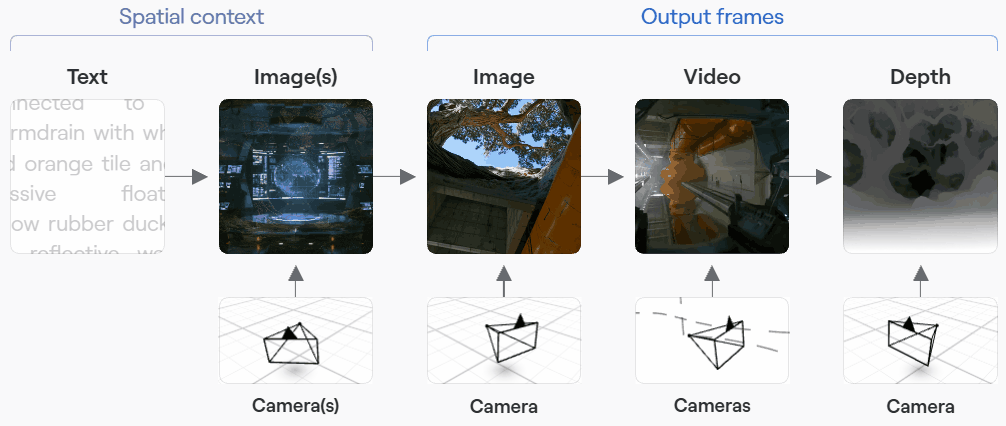
Traditional visual input processes 2D pixel arrays—a flat image without depth, scale, or occlusion relationships. Atlas's spatial context assigns 3D coordinates to each frame, transforming input from "what is captured" to "from where and in relation to what."
This change directly impacts the foundational structure of world models.
A world model typically comprises three modules: a visual module translates raw signals (e.g., cameras, microphones) into an internal format; a memory module learns environmental patterns to predict future states; and a control module decides actions based on these predictions.
Atlas significantly advances the visual and memory modules.
The key mechanism is Atlas's understanding of spatial context. While large language models use textual context to predict the next word, encoding input text into context for subsequent generation, Atlas follows a similar logic but uses photos with 3D coordinates. Each input photo is fixed in 3D space, enabling the model to recognize the shooting direction and relationships to other photos.
(Image Source: World Labs)
This mechanism's effect can be illustrated with a simple scenario. Imagine taking five photos in a room—one facing east, north, and west. Traditional models see five independent flat images. Atlas analyzes them as different angles of the same room, reconstructing a complete 3D map—not by stitching images but by restoring space.
2. Spatial Reconstruction Lowers the Barrier for 3D Scene Construction
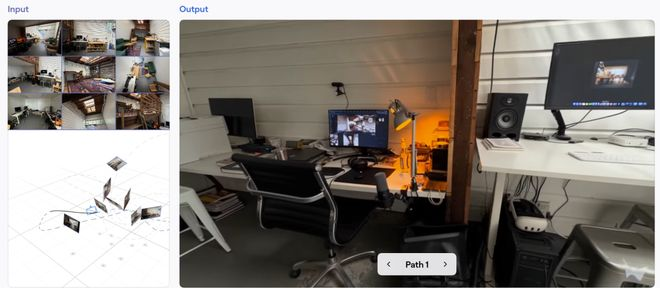
The core challenge of 3D scene construction lies in geometric precision. Atlas requires only 2–25 ordinary photos to output a complete 3D scene directly importable into simulators as a visual environment.
An official demonstration showed incremental construction: starting with a close-up of a desk, Atlas generated an indoor panorama with accurate desk and computer but imagined chairs and walls. Adding a second photo of the room's overall view corrected the desk and chairs but left a monitor area blank. A third photo of a side dual-screen workstation completed the scene.
(Image Source: World Labs)
More inputs reduce "imagined" portions. Atlas typically achieves usable reconstruction with 2–3 photos and handles over 100 for fine modeling. Another example: using only a few ground-level smartphone photos of Stanford University's Main Quad, Atlas generated a continuous aerial flight video.
This efficiency shifts 3D scene generation from professional surveying to everyday engineering tasks. Previously, building a 3D training ground for robots required professional equipment, dozens of rotations, hundreds of photos, and days of manual modeling. Now, a smartphone and a few minutes suffice.
3. Spatiotemporal Simulation Bridges Reality and Simulation
With a 3D world in place, the next challenge is flexible observation.
Atlas's controllable camera generation lets users input 1–6 reference images and design a camera path, generating videos up to 1440p and 1 minute long. Instead of "guessing" the next frame, users specify viewing angles via coordinates, and the model renders the corresponding view.
To validate this capability, World Labs conducted third-party blind tests. Atlas controlled camera movements using native pose inputs, while other models used text prompts. Atlas achieved 75% win rate (win rate) against MiniMax H3, 86% against Alibaba's HappyHorse 1.1, and 94% against ByteDance's Seedance 2.5. The win rate increased with motion complexity, highlighting Atlas's advantage in precise geometric understanding.
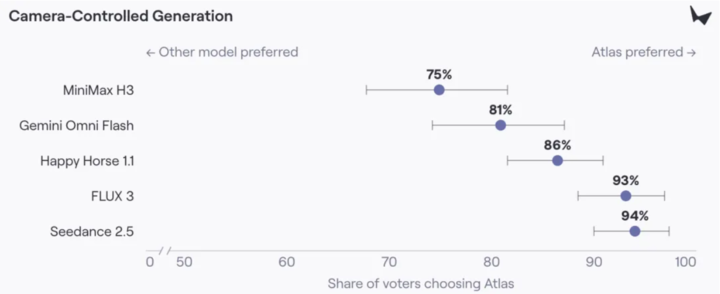
(Image Source: World Labs)
From observing to animating the world, Atlas extends into spatiotemporal simulation. By recording a video with 3–5 smartphones, Atlas enables time freezing and multi-angle replay—pausing at a frame and viewing it from any angle. Previously requiring dozens of synchronized cameras, this now needs only a few phones and Atlas, significantly lowering multi-view capture barriers.
More critically for robotics, Atlas's spatiotemporal simulation offers simulation value.
World Labs reconstructed two large environments from 24 frames each using smartphone photos, then simulated robots navigating different paths. Atlas generated real-time RGB and depth data for robot sensors. A single real scene could produce thousands of variants—altering routes, moving obstacles, or adjusting lighting—without rebuilding the Venue (site).
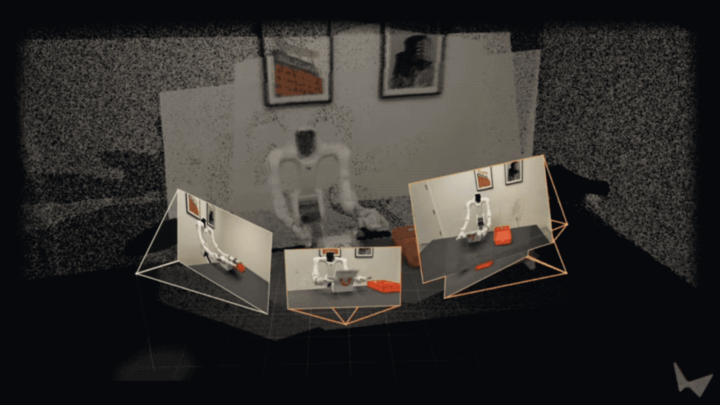
(Image Source: World Labs)
This shifts data collection from physical robots to virtual ones. Physical-world navigation happens once; the rest occurs digitally. Costs transform from "a trip per run" to "one trip, infinite uses."
But cost is only one aspect. Generated virtual data must align with reality.
Traditional workflows separate environment reconstruction and sensor rendering, accumulating errors at seams. Atlas unifies these steps in one model, eliminating error propagation and providing robots with highly consistent perception data in virtual environments, ensuring reliable training.
Overall, spatial reconstruction answers "what the world looks like," camera control addresses "viewing angles," and spatiotemporal simulation handles "time flow." These capabilities form a chain: geometric structure precedes perspective (view) control, which precedes temporal evolution.
In this chain, visual models no longer compress images into abstract vectors but directly output 3D point clouds; memory models simulate spatiotemporal changes in 3D space rather than abstract predictions; training grounds shift from professional to consumer grade; camera control moves from text descriptions to coordinates; data collection shifts from physical to virtual spaces. The first two world model modules reach new heights with Atlas.
But this is not the endpoint.
02 Physical Properties: The Simulator's Real Battle
Atlas currently addresses geometric challenges—what the world looks like, object locations, and spatial relationships—deducible from photos.
It cannot yet tackle physical challenges—how objects move, their weight, friction, or deformation. Photos do not reveal these, and Atlas cannot compute them.
To grasp this gap, consider Atlas's role in the Real-to-Sim workflow.
Atlas generates sensor data (RGB images and depth maps) for simulated robots but does not output collision detection, rigid-body dynamics, or contact force calculations. Physical computations require external engines like MuJoCo or PhysX. Atlas lacks built-in rigid-body dynamics equations, contact force solvers, or parameterized friction or material stiffness.
Moreover, Atlas's loss function optimizes image frame prediction errors and visual fidelity, not physical accuracy.
This imposes inherent architectural limitations. Atlas remains a "visual renderer" in simulation workflows, responsible for "drawing" scenes, not "calculating" object interactions.
This limitation is evident in Atlas's behavior with sparse inputs. It fills in visual gaps, inferring unseen geometric structures from existing pixels—a visual "fill-in-the-blank." Physical simulation requires "filling in forces"—knowing how objects respond to pushes, gravity, or deformation.
Pixels record appearance, not forces. Atlas fills in visuals but not force responses. Visual inference identifies "what should be here" but not "how this object reacts to forces."
World Labs recognizes this gap. To address physical simulation shortcomings, they acquired robotic simulation company SceniX in July 2026. SceniX enhances digital assets with physical properties, enabling virtual objects to mimic real-world behavior.
Post-acquisition, SceniX's team and technology integrated with World Labs, aiming to extend Atlas from geometric reconstruction to physical simulation by combining World Labs' spatial modeling and 3D reconstruction expertise with SceniX's robotic learning and physical simulation tech stack.
That same month, they unveiled the Real-to-Sim-to-Real workflow, demonstrating a closed loop: record a real-world operation video, convert it into a physically attributed simulation environment, train and optimize strategies there, and deploy them back to real robots.
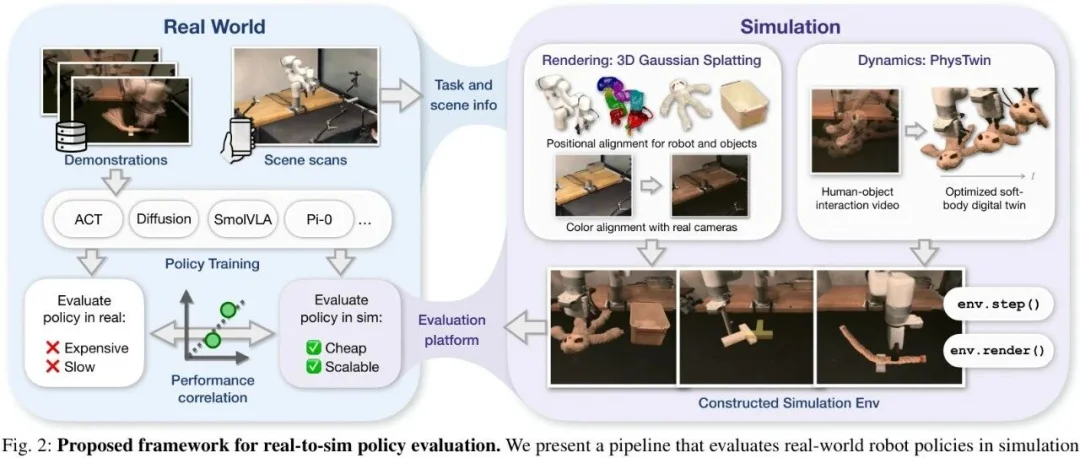
In demonstrations, the RB-Y1 robotic arm successfully completed cable operation tasks, and the YAM arm manipulated deformable objects. All strategies trained in simulation with zero real data migrated directly to multiple real robot platforms, operating autonomously for an hour without human intervention. This workflow proves the feasibility of physical simulation-to-reality transfer and charts Atlas's evolutionary path.
The core of what Atlas does is "from photos to geometric scenes." SceniX focuses on "from videos to physical simulations." If these two can be integrated—using Atlas to reconstruct geometric structures and SceniX to inject physical parameters—it could potentially establish a complete pipeline from the real world to a physically simulated environment.
World Labs also mentioned this point in the official blog post announcing Atlas: Atlas's spatiotemporal simulation capabilities "enable a real-to-simulation workflow for the field of robotics," although this workflow is still in its early stages.
For the embodied AI industry, Atlas's direction is clear. The bottleneck in data collection is shifting from "collecting more photos" to "making these photos carry physical information."
However, while geometry can be inferred algorithmically to reverse-engineer spatial structures from photos, the damping of every cable, the weaving pattern of every fabric, and the frictional properties of every joint can only be calibrated through real-world physical interactions.
Atlas has overcome the geometric hurdle, but the physical challenge still lies ahead. Only when it can truly unify spatial structures with physical rules will it have completed the full journey from perception to understanding.
By then, perhaps the embodied AI industry will truly reach its turning point.
* Image sourced from the internet. Please contact us for removal if there is any infringement.
-
![]()
After a 200 Billion Yuan Loss, Seres Reclaims Its 'Soul,' But Will Yu Chengdong Continue to Back AITO?
-
![]()
Will you still buy AITO after its prefix changes from 'HIMON Auto' to 'Seres'?
-
![]()
Atlas Paves the Way with 3D Reconstruction, Ushering in a New Measurable Era for World Models
-
![]()
Why Is AITO’s Shift to a ‘Light Asset’ Model a Strategic Boon for Seres?
-
![]()
Doubao Mobile Phone Officially Launches: GUI as a Safety Net, AI Office as a Revenue Stream
-
![]()
Doubao Mobile Phone Officially Launches: GUI as a Fallback, AI Office as a Support
-
![]()
iFLYTEK Launches AStudio in a 'Desktop Gateway' War It Cannot Afford to Lose
-
![]()
BYD Executive’s Clear Stance: The Era of Fuel Vehicles Is Over