Can Feishu Lead the Way? Will Qianwen and WorkBuddy Seal the Deals?
 09/16 2026
 420
420

AI Office Tools: Revolutionizing Corporate Work Practices
Author | Yixiu
Editor | Xiaobai
Produced by | Qiangdiao Next
On September 15th, Feishu unveiled version 8.0 and introduced its team-oriented product, 'Doubao Work Partner.' This innovative tool boasts its own identity, permissions, and memory, enabling it to participate in group chats, access documents, meetings, and other resources within authorized boundaries, and seamlessly continue team tasks. Presently, the product is in the enterprise-directed co-creation phase. Since March this year, Feishu has expanded the number of CLI functionalities available to agents from 247 to 767.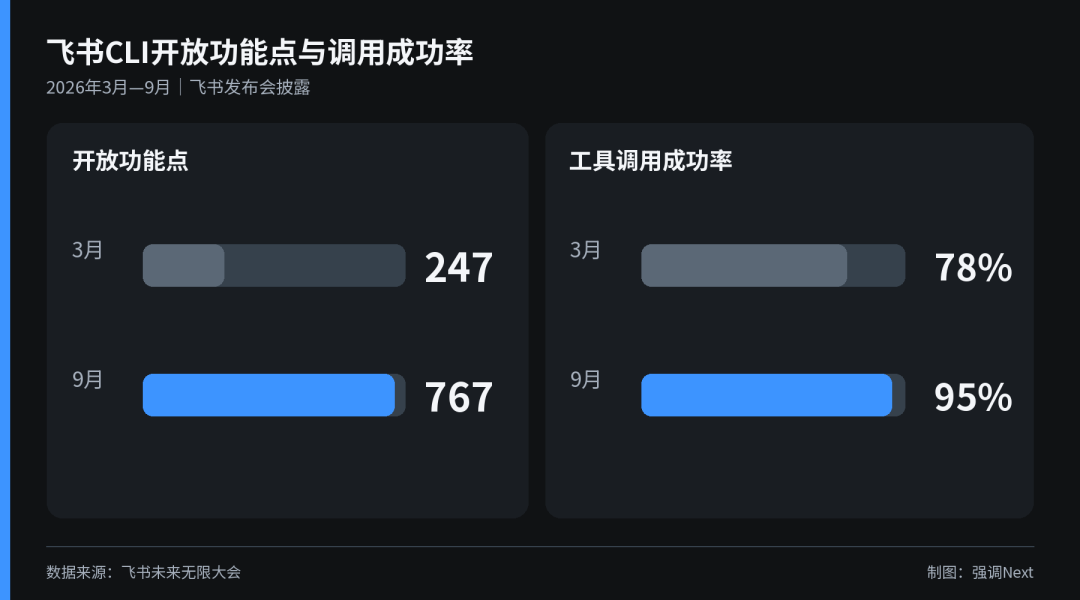
Focusing merely on 'group participation' and tool quantity may seem like another race to see which AI can harness more software. However, the true value of office software extends beyond mere file handling. Why does the sales review prioritize checking refunds before calculating deals? Who approves budgets exceeding specific thresholds? How should reports be revised upon rejection by superiors? These practices are embedded in group chats, approvals, and employee experiences. Transforming them into repeatable work methods for agents presents an opportunity to ensure sustained corporate usage and payment.
This is not just a localized skirmish among China's internet behemoths. In July, a16z highlighted in a corporate software special that as AI agents start to replace humans as primary software users, enterprise software is shifting from a 'human-centered interface' to a 'headless' architecture: value migrates from the interaction layer to the data and logic layers. Agents may eliminate the 'muscle memory' advantage but cannot eradicate the moat of business logic and context.
Around the same time, Salesforce launched 'Headless 360,' directly exposing its core software capabilities to external agents. Feishu's decision echoes the same dilemma: should it settle for being a 'system record' invoked by agents, or should it step in as an agent itself to capture revenue from the execution phase?
By opening up CLI to external agents while keeping Doubao Work Partner integrated within teams, ByteDance essentially opts not to settle for the former. Alibaba and Tencent are also vying for the same objective, but they have been assigned tasks from more sources initially.
Access Can Be Borrowed, but Work Experience Must Be Cultivated Internally
In August, Alibaba merged the capabilities of QoderWork, MuleRun, and Wukong into Qianwen Office, launching both web and desktop versions. Qianwen Office can function as a bot in group chats on Feishu, DingTalk, and WeCom, enabling users to continue tasks running on the desktop from message channels. This lowers the initial barrier: there's no need to persuade companies to switch collaboration software; employees can simply delegate work instructions to Qianwen.
In September, Tencent unveiled WorkBuddy's agent capabilities, introducing over 100 partners, nine co-branded smart hardware devices, and more than 30 industry applications. Recording devices can handle post-meeting organization tasks, while professional applications can address financial and legal scenarios. Tencent leverages partners to access more tasks but does not necessarily directly own the collaborative relationships and work data of these enterprises.
The allure of access points can easily overshadow the distinction between 'receiving' and 'taking over.' Alibaba Cloud's help documentation explicitly states that to use AI to access internal DingTalk data via a DingTalk account, an additional connector must be configured. A bot in a group chat may hear an instruction but may lack access to the necessary customer records to complete it, let alone the authority to modify records or initiate approvals.
QuestMobile's July data serves as a reminder not to confuse frequency with achievement: the AI efficiency office sector boasts 102 million monthly active users, a year-on-year increase of 8.2%, with total usage surging by 112.4%. The WorkBuddy PC client is used 19 times per person per month on average.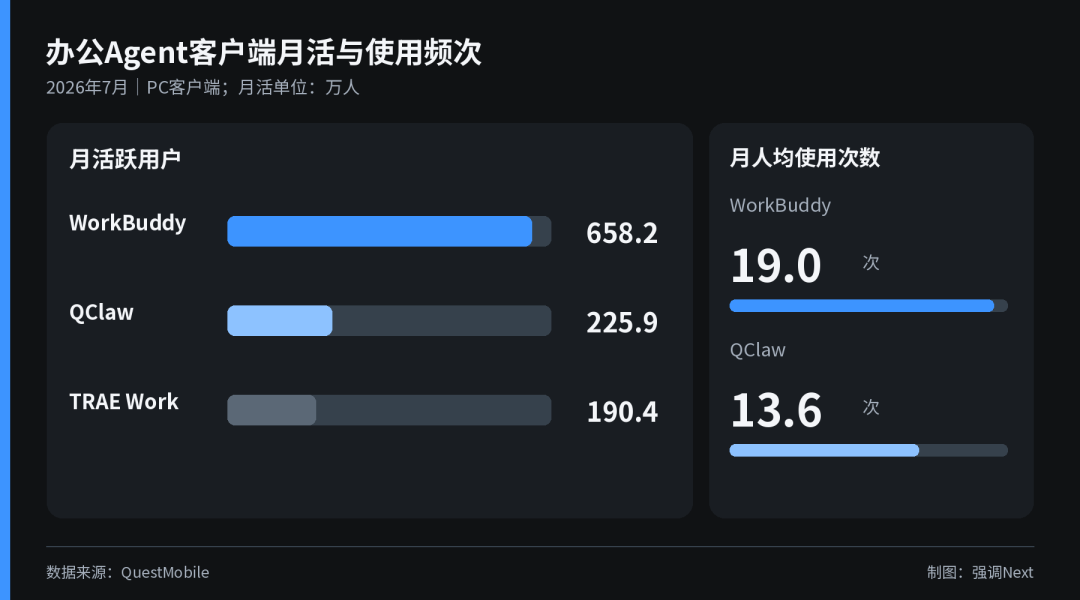
Employee trials and repeated inquiries are on the rise, but reports do not shed light on how much repetitive work has been truly delegated. Whether enterprises will renew subscriptions hinges on whether, when performing the same tasks the following month, agents can ask fewer background questions and avoid repeating past mistakes.
Documents Remain in Feishu, but Who Owns the Work Methods?
If an agent is granted a company's meeting records from the past two years, it can generate summaries but may not discern which data is outdated, how far client quotes can be negotiated, or whose opinions should be included in the final version.
These rules are often not fully documented anywhere. Employees learn them through interactions with colleagues and repeated revisions; agents must also learn through tasks, modifications, and approvals. This explains why Feishu positioned 'team identity' and 'memory' at the forefront of its launch event.
A personal assistant reads materials for an individual employee, operating within that person's authorization boundaries. A team partner, however, possesses an independent identity and permissions, aiming to continue work across members.
Feishu's official product descriptions also indicate that enterprises can configure partners with professional capabilities, knowledge scopes, and work methods, such as incorporating product selection criteria into a 'product selection expert.' Administrators can uniformly provide skills for teams to repeatedly utilize.
Alibaba is also making strides in this area.
Qianwen Office enables enterprises to subscribe to skills created, uploaded, and shared by users within the organization. A team can transform quote verification, material collection, and approval reminders into reusable processes. The next time someone assigns a task, the agent can still adhere to the company's standards.
While Qianwen can join Feishu group chats, it strives to keep these work methods within Qianwen's enterprise space rather than merely retrieving data from Feishu once.
Two Doubts About the Competitive Edge
The first doubt pertains to durability.
The current advantage of 'experience accumulation' rests on two assumptions: the model's ability to extract implicit rules is still inadequate, and the interfaces connecting to enterprise data remain sufficiently proprietary. Both assumptions are weakening.
Anthropic's MCP protocol is standardizing the connection between AI and tools and data. Salesforce's Headless open approach and Zapier's transformation of software actions into programmable interfaces all point in the same direction: as the connection layer becomes more standardized, the premium of proprietary integrations like Alibaba Cloud connectors and Feishu CLI diminishes. The truly scarce asset will more purely converge on 'who accumulates contextual memory for exception handling' rather than whose interfaces are more user-friendly.
This serves as a reminder to Feishu and Alibaba: if what they are stockpiling now is merely the number of connectors and APIs, their competitive edge may be shallower than imagined.
The second doubt revolves around organizational politics.
Entrusting agents with 'quote verification criteria and approval exceptions' is never just a technical issue within enterprises. It means that the discretionary power previously maintained by department heads through experience and networks will be systematized and audited.
This is merely an old problem that has plagued ERP and BPM implementations for years, resurfacing in a new guise. Business personnel may not be willing to package their judgmental experience into the system, as it would diminish their irreplaceability within the team. This may better explain why completion rates, reuse rates, and similar data have not yet been presented by Feishu, Alibaba, or Tencent than any limitation in model capabilities.
Beyond Seat Purchases: Potentially Tapping into Someone Else's Labor Budget
Another change brought by team agents is the billing target. Traditional collaboration software charges based on employee seats, but a team agent partner may generate reports, verify numbers, and adjust systems for different employees. With a single software account, the more complex the task, the more models and tools are invoked. Alibaba's Qianwen Office adopts a subscription plus points system, while Feishu AI offers enterprise plans configured by quota. In the future, enterprises will calculate not how many additional seats they have purchased but whether, after delegating a certain type of work to agents, costs—including manual reviews and rework—have decreased.
Ultimately, the competition may not be limited to peers. Sequoia Capital partner Julien Bek proposed this year that the traditional software industry logic was to workflow human processes and charge per head. However, now that AI can directly perform tasks, the real money lies not in software budgets but in the sixfold budget that enterprises spend on services. There are approximately 9 million implementation consultants globally, with annual labor expenditures exceeding $500 billion and still growing at around 10% annually.
If Feishu and Qianwen truly succeed in transforming 'work methods' into executable agent skills, their next target may be the business of traditional service providers such as financial outsourcing, HR shared services centers, and process outsourcing. This represents a much larger game than 'which major company wins' and is a question that none of the current companies have directly answered yet.
This involves more than just one execution bill. Team agents have their own identities, meaning someone must approve what they can see and do and keep records of erroneous operations. Microsoft officially launched Agent 365 in May, managing the identities and security of its own and some third-party agents, priced separately at $15 per person per month. Enterprises can switch to a different agent for tasks but must still pay for managing these agents. Collaboration platforms can compete for execution revenue while also selling bounded work qualifications to external agents; these two revenue streams do not necessarily go to the same company.
Feishu reported that over 90% of its new customers in the first half of the year simultaneously purchased Feishu AI, with ARR growth reaching 2.5 times that of the same period last year. This indicates that AI has entered the procurement lists of new customers, but public figures do not reveal how many tasks have been permanently delegated to it or how much revenue AI alone has generated.
ByteDance, Alibaba, and Tencent are currently expanding the reach of agents, but the outcome of this battle will likely not hinge on who has more access points. What truly determines the winner is whether proprietary connectors can sustain their premium after connection protocols become standardized and whether department heads within enterprises are willing to relinquish their judgmental experience to an auditable, reusable system that may also replace them.
For office AI to transition from a novel purchase to a stable business, it relies not just on tasks becoming more familiar but also on enterprises genuinely willing to relinquish their methods. Currently, no one may have a firm grasp on this.
Header Image: 'The Annual Meeting Cannot Stop' Note: The data in this article comes from public sources and does not constitute investment advice.
- END -
-
Huawei and Seres 'Part Ways'? Seres Takes the Lead in Five Key Areas, Huawei Steps into a Supportive Role
-
![]()
Snatching Half-Yuan Electricity at Midnight, Complaining About Service Fees by Day: Who Exactly is Profiting from New Energy Charging Stations?
-
![]()
Restructuring of FAW and GAC: Not Just Merging North and South Toyota with 20 Billion Yuan
-
![]()
AITO Model Adjustment: Seres' Strategic Shift to Reclaim Profit Control
-
![]()
Annual Production of 7 Million Optical Waveguides: Can the AR Glasses Market Absorb This Surge?
-
![]()
When a Decade-Old Feishu Meets a Newborn Doubao Work: What’s the Outcome?
-
![]()
Seres Faces Pressure to Mature, as New Energy Vehicle Sector Braces for Major Realignment
-
![]()
Can Feishu Lead the Way? Will Qianwen and WorkBuddy Seal the Deals?