When a Decade-Old Feishu Meets a Newborn Doubao Work: What’s the Outcome?
 09/16 2026
 499
499

Feishu is the driving force; Doubao Work is the result.
Written by | Zhao Weiwei
ByteDance CEO Liang Rubo has made his appearance.
His last public engagement was in June, via video at the Volcano Engine FORCE Conference. There, he emphasized that the company's focus for the year was on "reaching new heights," particularly in conquering the AI peak. He observed that the current AI wave signifies a more profound transformation than the three industrial shifts—PC, Web, and Mobile—seen in the past 50 years.
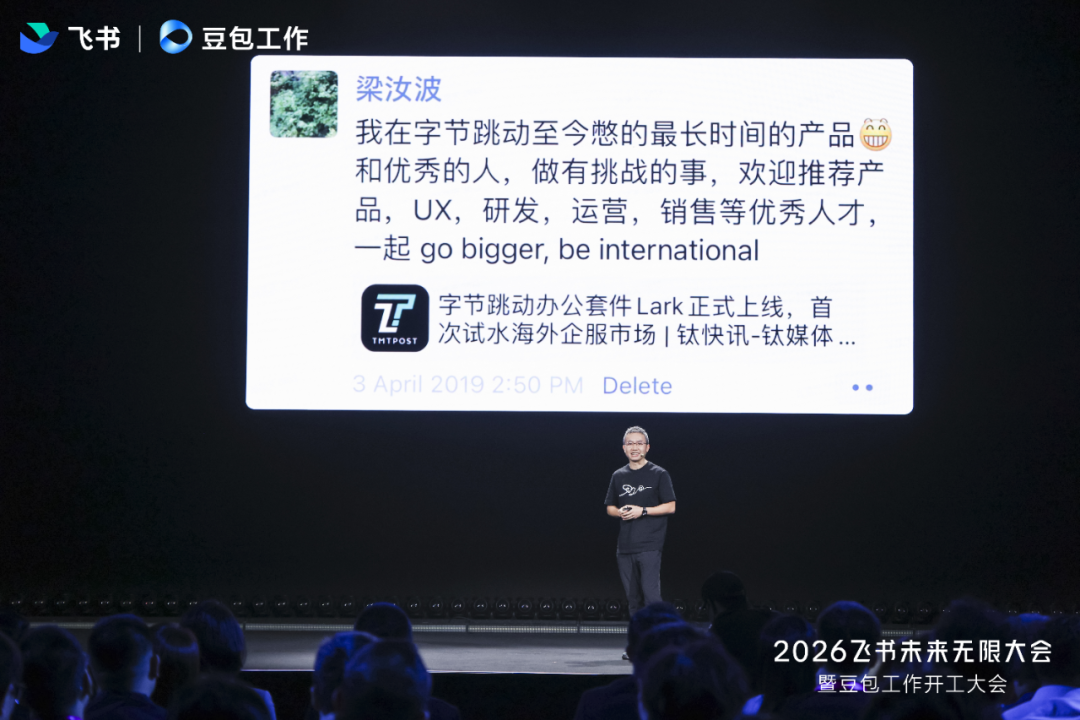
Three months later, Liang took the stage at the Feishu Future Unlimited Conference, speaking for twice as long as his previous appearance and addressing misconceptions about Feishu.
With the integration of the Feishu and Doubao product teams, along with the merger of Feishu's commercialization team with the Volcano Engine team, "Doubao Work" was swiftly introduced, officially entering the market alongside Alibaba's QianWen Office and Tencent's WorkBuddy. This led to speculation that Feishu's role was being diminished.
However, Liang clarified that Feishu's decade-long journey represents a triumph of "long-termism."
He recounted Feishu's initial product design, which initially lacked even avatars and failed to send messages. Feishu was ByteDance's "most patiently nurtured product." While typical products launch within three months, Feishu took three years before its public release. Over the past decade, Feishu has not only supported ByteDance's internal operations but also evolved through collaboration with client enterprises' IT partners.
The broader context for Feishu's development is the sense of crisis brought about by technological waves.
Liang reiterated his assessment from three months prior: the AI wave surpasses the significance of PC, Web, and Mobile. "Peaks are rare; opportunities are precious." The pattern shows that companies atop one peak have a better chance of succeeding at the next, but they can also fall. He cited Google, which dominated the Web era and leveraged Android for the Mobile era, while Microsoft failed to extend its PC dominance to Web and Mobile. This highlights the crisis sense brought about by era-defining shifts. In collaborative office tools, Microsoft's journey from Office to Office365 to Teams demonstrates an even more stable position than Windows.
"Feishu caught the Mobile era's train and hopes to seize its AI-era opportunities," Liang stated.
Thus, the integration of Doubao, Feishu, and Volcano Engine is based on a core insight: Agents cannot exist independently but must collaborate with humans, environments, and other Agents, relying on models for their capabilities.
After this adjustment, the three have clear logical divisions for clients: enterprise-level AI strategy involves Doubao providing general intelligence; Feishu, as a collaboration platform, supports enterprises' upstream and downstream operations, tools, and human-machine collaboration scenarios; Volcano Engine supplies models, computing power, and development tools to help enterprises craft exclusive Agents from their unique experiences. These Agents can also integrate into Feishu to collaborate with humans and other Agents.
Feishu is the driving force; Doubao Work is the result.
1. Feishu serves not just humans but also Agents
"Feishu is the best collaborative office product for the AI era," Feishu CEO Xie Xin emphasized twice.
The underlying logic is that Doubao Work enables Agents to perform tasks, while Feishu facilitates collaboration between humans and Agents. The upgraded Feishu 8.0 focuses on three core areas: natural collaboration between humans and Agents, Agents using various products like humans, and enterprises managing Agents with clear permissions and security, just like managing people.
"Feishu is the first office platform to redesign Agents as 'first-class citizens,'" Xie argued.
For example, in group chats, users can add Agents by searching their names, and multiple Agents can collaborate within groups. Agents can also write documents, operate multi-dimensional tables, schedule tasks, join meetings, access cloud drives and notes, and initiate approval processes in Feishu. This means Agents can perform nearly all tasks humans do in Feishu.
The real innovation lies in underlying changes.
CLI (Command-Line Interface) is a text-based interface designed for programmers, while GUI (Graphical User Interface) is designed for everyone. Now, Feishu's shift is making CLI users extend from programmers to Agents.
For instance, since March, Feishu expanded CLI-accessible functionalities for Agents from 247 to 767, improved call success rates from 78% to 95%, and reduced latency by 39%. Xie demonstrated Feishu's drawing board feature, which can now replace humans in creating highly complex, editable infographics from simple flowcharts.
More crucially, there's enterprise-level Agent security management.
What should enterprise Agents look like? Doubao Work product lead Hong Yao positioned them directly: people who get things done in the company need to be "professional, business-savvy, and rule-abiding," delivering on requests, reusing existing experience, and strictly following processes.
For example, it supports generating and partially modifying Word, Excel, PPT, web pages, applications, etc., and handles complex tasks through computer operations, multi-Agent collaboration, and continuous cloud operation, with full traceability. Moreover, Agents in Feishu always have permissions aligned with their users; employees can't see information that Agents can't access. Enterprise admins can uniformly manage Agents, trace usage, set AI usage caps, and control high-consumption models and scenarios. These permission controls create a secure environment for enterprise Agent use.
2. Doubao Work Partner: Agents gain formal roles
A highlight of Feishu's conference was the newly launched "Doubao Work Partner," touted as China's first team intelligence product, currently in targeted co-creation with enterprises and gradually opening to clients.
Its most prominent feature is expanding AI's service scope from individuals to entire teams. It has an independent identity, permissions, and team memory, joining Feishu group chats like colleagues, working proactively. Enterprises uniformly configure its permissions, capabilities, and usage, allowing all employees to collaborate with the same Agent without individual setups.
In fact, Doubao Work Partner evolved from Feishu Daily, giving Agents a "formal role" in organizations.
Previously, Feishu Daily required passive commands to trigger and served only individuals, making it merely a tool. Now, with deeper Feishu CLI capabilities, Agents can grow into colleagues, patrolling, identifying issues, analyzing, and repairing autonomously based on their roles—essentially replicating human organizational structures and approval flows onto Agents.
According to media articles with internal testing access, Doubao Work Partner's standout feature is its understanding of how teams work.
For example, memories accumulate across groups, eliminating repetitive background explanations. Doubao Work Partner can follow instructions like "proactively help with similar requests in the future," remembering and acting accordingly. The management interface shows memory details, and contexts aren't limited to specific group chats. Commands like "check what another group discussed and bring back conclusions" enable cross-group information stitching.
This significantly reduces organizational collaboration costs. It attends meetings with project group contexts, answers progress questions based on real discussions, and syncs conclusions, tasks, and risks back to the group afterward. It remembers verbally agreed tasks, reminds responsible parties when due, proactively pushes if unanswered, and knows who to approach for issues.
At its core, Doubao Work leverages Feishu's strengths—its long-accumulated office content like group chats, documents, and meetings—providing Agents with ready-to-use work objects.
For Agents' most needed organizational context, this implies the next Agent evolution: personal Agents save one person's operation time; team Agents save endless waiting, paraphrasing, syncing, and aligning across the entire organization.
3. Customer votes matter most
Which Agent works best? How do Tencent, Alibaba, and ByteDance compare? The most authoritative voices come from enterprises using collaborative office products and Agent services.
Feishu's conference mentioned that in the first half of 2026, Feishu's Annual Recurring Revenue (ARR) growth reached 2.5 times that of the same period last year, a new high since its inception. Over 90% of new clients simultaneously purchased Feishu AI products.
For comparison, Tencent's WorkBuddy promotion materials and articles feature star enterprises like Wallace (restaurant chain), Laoxiangji (restaurant chain), Miniso (consumer goods), Chando (cosmetics), GF Securities, Ping An Securities, and Ctrip (internet), among others.
However, companies like Miniso and Ctrip were earlier Feishu star clients. Miniso managed digital demands for 7,800 stores via Feishu in 2024, while Ctrip migrated its office platform to Feishu in 2025.
So, is Tencent WorkBuddy stealing Feishu's clients? Not so simply.
An employee from Jinjiang Hotel (China Region), the domestic leader in scale, told "Blue Hole Business" that their entire staff migrated from WeChat Work to Feishu last year, managing nationwide stores via multi-dimensional tables and other features. This year, Jinjiang Hotel and 11 other enterprises provided unlimited Token privileges to outstanding employees, supporting deep Feishu AI product usage.
Thus, this isn't merely a client battle; a larger trend is emerging where collaborative office products and AI office tools are coexisting in layers, each fulfilling distinct needs.
Some enterprise employees collaborate via Feishu but use Tencent WorkBuddy for task execution—each product serves a purpose. For their clients, AI entry points and collaboration platforms are being procured separately, with companies like Miniso and Ctrip becoming overlapping clients of Tencent and ByteDance services.
Recently, Tencent WorkBuddy launched an open platform, introducing over 100 partners, including smart hardware vendors like Rokid, Insta360, and iFLYTEK, as well as 30+ industry applications like Fanruan, Beisen, Yunzhangfang, and GF Securities.
Tencent's approach is openness: WorkBuddy's underlying model can be openly selected, not tied to WeChat Work, with capabilities, payment, and distribution channels all open. In contrast, Feishu + Doubao Work's approach is a "native integrated closed loop," keeping clients within its ecosystem through Doubao Work + Feishu + Volcano Engine. In the Agent era, what's truly locked in is memory and permissions—only by entering organizations can deep binding occur.
The future competition may hinge on who cultivates clients' AI usage habits.
Shared memory and permissions following job ranks, the contexts accumulated in Feishu, are Doubao Work's biggest selling points. This also means ByteDance's own Doubao model must carry greater ambitions, as all Agent work loops depend on scheduling the Doubao model, determining the "native integrated closed loop's" upper limit. It must remain in the industry's first tier.
"If the model fails, nothing is possible," Xie said in a pre-conference livestream.
-
![]()
3 Billion Yuan: Can Neta Cars Stage a Remarkable Comeback?
-
Huawei and Seres 'Part Ways'? Seres Takes the Lead in Five Key Areas, Huawei Steps into a Supportive Role
-
![]()
Snatching Half-Yuan Electricity at Midnight, Complaining About Service Fees by Day: Who Exactly is Profiting from New Energy Charging Stations?
-
![]()
Restructuring of FAW and GAC: Not Just Merging North and South Toyota with 20 Billion Yuan
-
![]()
AITO Model Adjustment: Seres' Strategic Shift to Reclaim Profit Control
-
![]()
Annual Production of 7 Million Optical Waveguides: Can the AR Glasses Market Absorb This Surge?
-
![]()
When a Decade-Old Feishu Meets a Newborn Doubao Work: What’s the Outcome?
-
![]()
Seres Faces Pressure to Mature, as New Energy Vehicle Sector Braces for Major Realignment