Burying Yesterday's Expertise: An AI Self-Reflection by a DeepSeek Engineer
 09/17 2026
 419
419
A leading DeepSeek engineer penned an extensive article titled "Having to Bury My Expertise in Yesterday," detailing his firsthand observations of AI's evolution. He recounted how AI's efficiency now surpasses that of humans, hastening a process of self-replacement. However, he clarified that his purpose was not to voice concerns about job displacement.
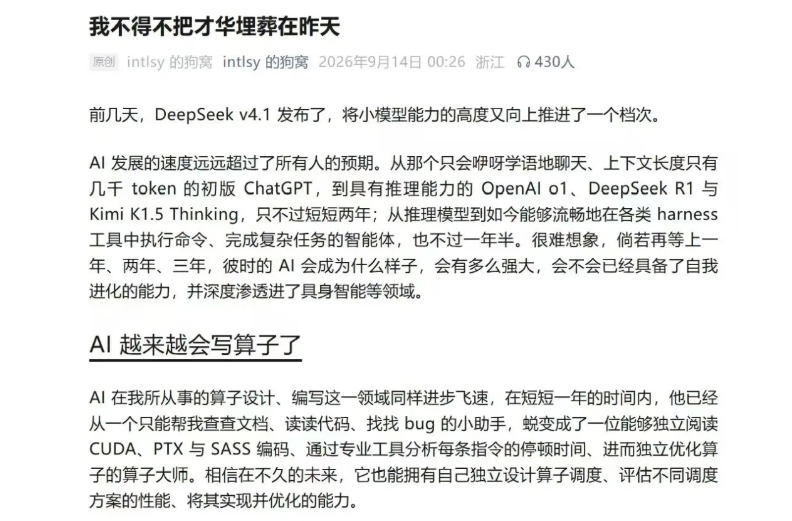
According to Haibao News, the article, "I Have No Choice but to Bury My Expertise in Yesterday," has quickly gained traction across the tech sector. Authored by Liu Shengyu, a machine learning systems engineer at DeepSeek, it was swiftly translated into multiple languages, sparking widespread debate in technical circles both in China and internationally. Related topics also trended on domestic social media, making it one of the most discussed topics in the industry recently.
Liu Shengyu boasts an impressive technical background. He is a member of the 2021 Peking University Turing Class and previously served as captain of the PKU Weiming Supercomputing Team, representing the university at the International Collegiate Supercomputing Competition SC23.
In April 2025, Liu joined DeepSeek. Just days before publishing his article, he completed the development of the main Attention operator for DeepSeek V4.1—a core component that directly determines the inference efficiency of large models and is crucial for their efficient operation.
(Image Source: Bianews)
It is precisely this top-tier developer, at the forefront of AI technology, who made a poignant observation in his article that resonated deeply with many of his peers. He stated that, while he personally developed the core operators for large models, he could foresee that within six months to a year, AI-generated operators would match or even surpass his own.
In his article, Liu described the rapid advancement of AI capabilities: just a year ago, AI served as a mere auxiliary tool, helping him review documentation and identify code vulnerabilities. Now, it can understand GPU-level instructions and independently optimize operators. He illustrated this gap with a vivid comparison: AI can process 300 tokens per second and write a complete code segment in twenty seconds—a feat unattainable for human engineers.
The most striking aspect of the article is Liu's revelation of an unavoidable technological paradox. The more efficiently he optimizes operators, the faster the model's training and inference speeds become. The faster the model iterates, the sooner AI will master operator-writing capabilities. And the earlier this day arrives, the faster his years of deeply cultivated technical skills will become obsolete. He lamented in the article that humanity has always shown no hesitation in rendering its own expertise redundant.
Liu predicted that the future role of engineers will undergo a fundamental transformation. Instead of being creators who personally write code, they will become "mecha pilots," directing AI agents in their work. This shift in identity led him to express: "My hands hold more gears, but my heart lacks its rhythm."
Beyond personal career reflections, the article also delves into the deeper risks of the AI industry. Liu mentioned that his decision to stay at DeepSeek stems from a desire to promote open-source and accessible AI technologies, preventing the monopolization of top-tier AI capabilities by a few institutions. He stated that if a technological revolution is inevitable, he prefers to be a driver of change rather than someone passively awaiting the impact of the times.
According to Jiemian News, after the article sparked widespread discussion, Liu issued a supplementary statement clarifying that his intention was not to express anxiety about unemployment or to compare technical approaches across different companies. Instead, he wanted to formally bid farewell to his career spent handcrafting operators.
He explained that perhaps one day in the future, handcrafting operators or even programming itself might transition from productive work into a form of competitive entertainment, much like how spears are no longer used for hunting but are treated as a sport.
This effectively forces individuals to abandon fields they once loved and deeply cultivated, compelling them to shift toward entirely new directions. Even if the new direction is equally appealing, the act of saying goodbye itself is difficult. As the article's title suggests, he has no choice but to bury his expertise in yesterday.
-
The Crux of AI Phones Resides in AI
-
![]()
Burying Yesterday's Expertise: An AI Self-Reflection by a DeepSeek Engineer
-
![]()
The Year's Most Unexpected "Power Couple": Not Sun Yuchen and Jing Tian, but Huawei and Seres?
-
Automotive Industry Major Reshuffle Countdown: Nine Departments Chart the Course for 2030, Weak Contenders Exit, Strong Ones Merge
-
![]()
Insta360: At the Dawn of a New Valuation Era
-
GAC Group’s Compelling Advantage: Exactly What FAW Seeks
-
Insta360: At the Dawn of a New Valuation Era
-
![]()
China’s Autonomous Delivery Vehicles Set Foot in Europe