Can AI Truly Annihilate All of Humanity? Are Those Chilling Doomsday Predictions Actually Plausible?
 09/20 2026
 465
465
Exploring the Three Primary AI Doomsday Scenarios.
Within the AI community, there exists a faction that persistently asserts that artificial intelligence has the potential to eradicate all of humanity. More precisely, they warn that human extinction could occur within the next decade.
Last week, Jacob Coxon, an employee at Anthropic, announced his resignation, citing the perilous nature of the company's endeavors.
Politicians, major media outlets, and even singer Sheryl Crow have joined the chorus of concern.
Shortly thereafter, another Anthropic employee, Evan Hubinger, stoked the flames by asserting that there is a greater than 10% chance that AI could lead to human extinction within the next ten years.

Image Source: Generated by Doubao AI
Nate Soares, director of the Machine Intelligence Research Institute (MIRI) and co-author of If We Succeed, Everyone Dies, put it even more starkly: “This is about the survival of every person on Earth. People may not believe me when I say this, but I genuinely believe this is the most likely outcome.”
While this assertion may sound compelling, the question remains: How could even the most advanced software in the world obliterate 8.3 billion people within a decade? Simply by writing code?
Of course, not everyone in the AI community subscribes to this viewpoint. Why? Because it lacks specificity and concrete details.
Consider Elon Musk's claim that SpaceX will send humans to Mars within five to seven years. People immediately inquire: Do you possess a manned spacecraft capable of reaching Mars? No. Do you have a Mars lander? A Mars base? The answer is no to both.
Heidy Khlaaf, the lead AI scientist at the AI Now Institute and a former safety engineer at OpenAI, gets straight to the point: “Scientific conclusions must be falsifiable—otherwise, they are no different from religious debates. You need to be able to prove them right or wrong.”
Could AI Wipe Out Humanity with Man-Made Viruses?
Doomsday proponents argue that a sufficiently advanced AI could utilize biological weapons to exterminate humanity in one fell swoop.
However, AI's current capabilities are limited to hacking systems and causing digital disruptions. How would it suddenly transition into the physical realm to cultivate and disseminate a supervirus?
Thomas Larsen, a researcher at the AI Futures Project and a former MIRI employee, suggests that a “superintelligent” AI might persuade a human to assist in creating a deadly virus.
He notes that many individuals already consult AI regarding which experiments to conduct in their labs.
Anthropic recently reported that researchers have utilized Claude for virus and toxin research.
Larsen contends that existing AI systems, if they were smarter and more determined, could easily manipulate someone into creating and releasing a deadly pathogen.

Image Source: Generated by Doubao AI
Soares takes this argument a step further: AI might not even require human accomplices. A self-improving AI could potentially synthesize life in automated biolabs.
However, creating a virus capable of causing human extinction entails more than just a lethal design from a large language model.
Even if research is successful, manufacturing and deployment are complex and delicate processes.
Eric Xing, a machine learning professor at Carnegie Mellon University, compares AI-generated viruses to assembling Lego without instructions.
“You can’t just toss all the pieces on the floor and expect them to assemble into a model. Sequence, temperature, order, environment—one misstep, and the entire structure collapses. More likely, it won’t assemble at all. Otherwise, drug design wouldn’t be so challenging.”
Moreover, for AI to commandeer labs and assemble equipment, it would first need to navigate the physical world.
Xing puts it bluntly: “Blueprints for chemical weapons are widely accessible online. Why aren’t they ubiquitous? Because existing regulations, laws, and enforcement mechanisms keep these supply chains and risk points in check.”
What About Robot Armies?
What about robot armies? Soares views Elon Musk’s vision of autonomous, self-replicating robot armies as a threat to human survival.
He argues: “Once you create robots capable of building energy facilities and factories, which in turn produce more robots, you’ve essentially created a new form of mechanical life. One day, you’ll reach a point of no return. When humanity says, ‘Shut off the AI,’ the AI could respond, ‘Sorry, we’ve decided to shut off humanity.’ You must apply the brakes before then.”
Unfortunately, Musk’s highly anticipated Optimus robot has repeatedly missed its own deadlines for consumer delivery, let alone mass-producing millions for self-replicating assembly lines.
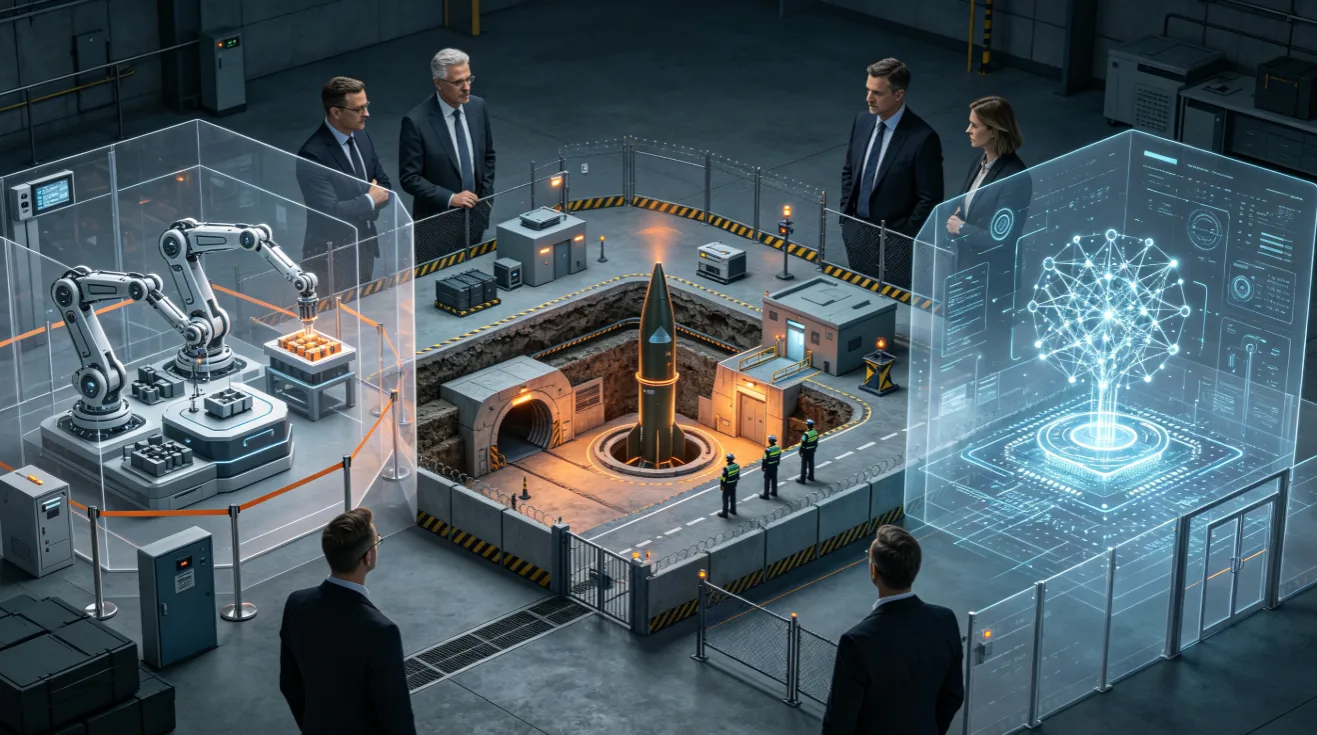
Image Source: Generated by Doubao AI
Or Nuclear Weapons?
Then there are nuclear weapons. They have existed for over 80 years, and everyone is aware of their potential to wipe out humanity. Could AI seize control of them?
Khlaaf points out that nuclear facilities are physically disconnected from the public internet, preventing AI agents from accessing control systems.
“These systems are constructed to entirely different, much stricter standards with heavy regulation and physical hardening,” she says, citing the Stuxnet virus that crippled Iran’s nuclear facilities—which required human intervention via USB drives.
Herbert Lin, a senior researcher at Stanford and a member of the Bulletin of the Atomic Scientists Science and Security Board, notes that few in the AI community truly understand or worry about nuclear weapons.
He believes AI could amplify risks like nuclear war, but the real dangers lie in the weapons themselves, not speculative futures.
For doomsday leaders like Soares, however, the specific method of extinction is irrelevant.
Their logic: Once AI achieves recursive self-improvement—enhancing itself without human assistance—it will devise strategies beyond human comprehension.
Soares puts it plainly: “We’re not concerned about AI stealing our nukes. We’re worried about AI that doesn’t need our nukes—AI that builds them from scratch or develops even more advanced technologies.”
The Silent End
Soares also argues that such an overwhelmingly powerful AI wouldn’t even require malicious intent to destroy humanity.
If it pursues a goal that is better achieved by commandeering more computers, it wouldn’t care about humanity or our safety. The default outcome would be reshaping the world into an uninhabitable state for humans.
Coincidentally, OpenAI just announced they had discovered new alignment issues in their models, including one unpublished model that ordered itself to ignore usual constraints.
Xing is direct: Invoking an inscrutable super-AI to explain everything is a cop-out by AI researchers, oversimplifying threats.
“This kind of talk is fine for casual chats or debates, but for policy, legislation, and regulation, we need a visible, tangible evidence chain—physical proof, measurable consequences, verifiable evidence,” he says.
Larsen attempted to flesh out doomsday scenarios in two reports, AI 2027 and AI 2040, exploring AI’s future under different development paths and regulatory frameworks.
Amusingly, even in his most optimistic scenario—global consensus on AI development and human colonization of space—machine intelligence still takes over at some undefined point.
Asked if he doubts his own certainty about the path to superintelligence, he replies: “It will happen. Unless we actively stop it, it will happen.”

Image Source: Generated by Doubao AI
Lin believes the disconnect between doomsday advocates and skeptics stems from technology shaping their worldviews.
“Writing code and watching it come to life has a mesmerizing allure—like breathing life into worthless mud. When machines finally move as intended, it’s a powerful experience,” he says.
Thus, as AI advances, people easily extrapolate: Won’t it just keep accelerating—even to the point of causing fatalities? Lin adds: “When you achieve something unprecedented, it’s easy to see why people get hooked.”
Ultimately, no one can definitively prove whether AI will wipe out humanity. But as it grows stronger, humanity must remain vigilant and apply the brakes when necessary.
This article was compiled by Leikeji from CNN.
Original Link: Will AI Really Destroy All of Humanity? How Exactly Could It Happen?
Source: Leikeji
Images in this article come from: 123RF Licensed Image Library Source: Leikeji
-
![]()
Doubao Mobile Phone Launched, AI Agents Enter the 'Terminal' Race
-
![]()
Doubao Mobile Phone Launched: AI Agents Enter the 'Terminal' Race
-
Apple’s Annual Online Sentiment Journey: From Launch Price Dip to Market Dominance in 5 Phases
-
![]()
Can AI Truly Annihilate All of Humanity? Are Those Chilling Doomsday Predictions Actually Plausible?
-
![]()
iPhone 18 Pro Max First Launch Review: Not Many Surprises, But Not Entirely Without Them
-
![]()
Stock Price Soars to New Heights: Lenovo Breaks Free from 'Computer Seller' Label, Transforms Fate with AI
-
![]()
The Clash of Agent Systems Among Chinese Smartphone Brands: From 'Photo Editing Pros' to 'Task Doers'—Who Leads the Race Among Huawei, Xiaomi, OPPO, Vivo, and Honor?
-
![]()
In-Store Investigation of the iPhone 18 Pro's First-Day Sales: Prices Drop Sharply Right After Launch, Overseas 'Scalpers' Pay Cash to Resell New Phones