OpenAI GPT-6 Practical Test Unveils: Tactile Sensors, a New Frontier in the Humanoid Robot Supply Chain
 09/20 2026
 553
553
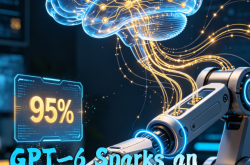
With a 95% grasping success rate but only a 10% assembly success rate, GPT-6 has exposed the Achilles' heel of humanoid robots. It successfully grasps and places a block in a bowl in four and a half out of five attempts. However, when it comes to aligning a puzzle piece with a slot and inserting it, the success rate drops to just two out of twenty attempts. Using the same model and robotic arm, the performance gap between these two tasks is a staggering 85 percentage points.
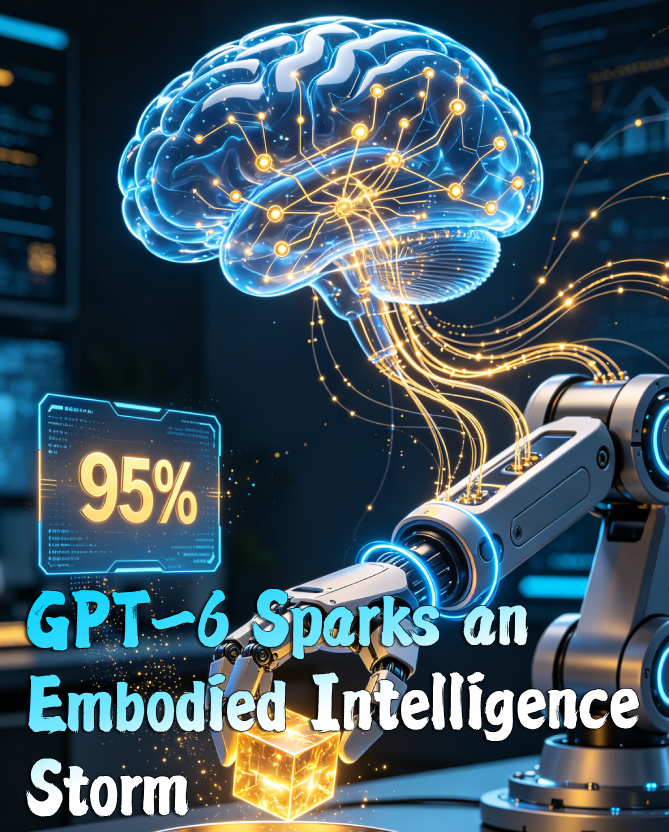
In early September, OpenAI unveiled GPT-6 Astra. Real-world tests conducted by Robocurve revealed that Astra achieved a remarkable 95% success rate in the task of "grasping a block and placing it in a bowl," significantly outperforming Claude Fable 5.1's 40% success rate. However, when faced with the millimeter-precision task of aligning and inserting a puzzle piece, the success rate plummeted to a mere 10%. Almost simultaneously, Altman explicitly stated for the first time in a podcast that OpenAI will develop its own humanoid robot body.
Short Commentary: Can Large Models Bridge the Gap in Embodied Intelligence? First, Overcome the Tactile Challenge
Xiao Zhi's initial reaction to these comparative data was that GPT-6's capabilities in embodied tasks deviate from the industry's assessments over the past year.
Where does this deviation lie? The industry previously believed that the bottleneck in embodied intelligence lay in "cognition"—robots' inability to understand instructions or interpret scenes. Consequently, the focus was on developing VLA models and world models to make robots "smarter."
GPT-6 Astra's 95% success rate demonstrates that large models can indeed compensate for cognitive shortcomings. Without any specialized training for embodied tasks, it can directly control a robotic arm to achieve a 95% grasping success rate. The seamless transfer of this capability has alarmed many entrepreneurs working on embodied models. He Yonghao, former head of embodied intelligence at Digu Robot, candidly stated on social media that schemes like VLA and world models may no longer hold significant investment value.
However, the 10% assembly success rate highlights a problem in another dimension.
To put it bluntly, grasping a block and placing it in a bowl is essentially a "macro-spatial operation"—the robot only needs to know the locations of the block and the bowl and how to navigate the path. This is precisely what large models excel at: spatial understanding and semantic generalization. After testing, Xu Huazhe, an assistant professor at Tsinghua's Institute for Interdisciplinary Information Sciences, concluded that Astra is strong in semantic and spatial generalization but weak in physical generalization.
Aligning a puzzle piece with a slot, on the other hand, tests "micro-force control." The robot needs to perceive subtle resistance changes at its fingertips, judge whether the puzzle piece is misaligned or correctly positioned, and then adjust force and angle in real-time. This process occurs within millimeter-scale spaces and millisecond-scale timeframes. Cameras cannot capture it, and language models cannot understand it—only tactile sensors can.
This is the "Achilles' heel" revealed by GPT-6 Astra: it can understand the world but cannot physically interact with it.
From another perspective, this 10% data point is, in fact, the most compelling "endorsement" for the tactile perception sector. Over the past two years, tactile sensor companies seeking financing in the primary market have mostly emphasized that "tactile perception is crucial for fine operations." However, investors found it difficult to quantify the value of this "crucial" aspect. GPT-6 Astra provides a set of quantitative references: without tactile perception, the upper limit of success rate for fine assembly is just 10%. The gap between 10% and 90% depends on the precision of tactile sensors, the scale of data collection, and the maturity of force-control algorithms.
The capital market is already reflecting this judgment with real investments.
In the primary market, the tactile perception sector has raised over 7 billion yuan in new financing in the first seven months of this year, with at least two companies achieving unicorn status. Pasini has raised a cumulative 3.5 billion yuan, setting a record for the largest financing in the global tactile perception sector, with its valuation exceeding 10 billion yuan. Pasini secured 1 billion yuan in financing: A trillion-dollar giant's only two investments go to robot "skin." Daimeng Robot completed a 100-million-yuan Series A round, jointly invested by Inovance Industrial Investment and China Telecom. Ant Group made its first bet on robot "fingertips": Daimeng raised two rounds in two months, with tactile perception becoming a new battleground in embodied intelligence. Qianjue Robot completed 100 million yuan in financing, with over 300 paying customers for its sensors.
The transmission path in the secondary market is clearer. Fulai New Material signed a 100,000-unit order for tactile sensors with Lingxin Qiaoshou, triggering a daily limit up on the announcement day. Hanwei Technology's subsidiary Suzhou Nengstar produces 20 million flexible tactile sensors annually, with a stable gross margin of over 40%. Keli Sensor sold over 1,500 force sensors throughout the year, with monthly shipments exceeding 1,000 units by 2026.
Interestingly, the pricing logics in the primary and secondary markets are entirely different. The primary market bets on the judgment that "tactile perception is a rigid demand," with valuations anchored to the long-term penetration rate of a trillion-yuan market. The secondary market bets on "whether orders can materialize"—Fulai New Material's limit up was triggered by a "100,000-unit order," not a "tactile technology breakthrough."
These two pricing logics will ultimately converge on the same question: Can tactile sensors be mass-produced, and can their prices be reduced? Pasini has lowered the price of high-end tactile sensors from the 100,000-yuan range to the hundred-yuan range. Reducing by an order of magnitude means shifting from "high-end options" to "mass-production standards." This is the true turning point for the tactile sector to move from "storytelling" to "business."
Altman said OpenAI must develop humanoid robots. But GPT-6 Astra's 10% success rate already tells everyone: large models can solve "brain" problems but not "touch" problems. And that "last centimeter" of tactile perception happens to be the fastest-growing segment in China's humanoid robot supply chain.
GPT-6 has opened the curtain on "cognitive democratization" in embodied intelligence but has also made the "tactile divide" clearer. When large models give all robots "smart brains," whoever enables robots to have "sensitive hands" will secure the next entry ticket.
#EmbodiedIntelligence #HumanoidRobots #TactileSensors #HumanoidRobotSupplyChain
Note: This article is based on publicly available sources as of September 18, 2026. Industry predictions and profitability judgments involve uncertainties and do not constitute investment advice.
Follow "Zhicaishe" for insights into embodied intelligence technology iterations and capital trends.
-
![]()
A Detailed Explanation of Li Feifei's World Model Atlas: How It Impacts Physical AI Industries Such as Autonomous Driving and Humanoid Robots
-
![]()
China's Intelligent Driving Ventures Abroad Face Rivals: Europe and US's Momenta 'Wayve'
-
![]()
Has the Modular Architecture of Autonomous Driving Disappeared After the Emergence of End-to-End Systems?
-
![]()
OpenAI GPT-6 Practical Test Unveils: Tactile Sensors, a New Frontier in the Humanoid Robot Supply Chain
-
![]()
Can the Intelligent Driving Solutions for Fuel-Powered Cars Mirror Those of Pure Electric Vehicles? Why Does Momenta Craft Specialized Algorithms for Fuel-Powered Cars?
-
![]()
Beijing Unveils 'Ten Measures for Token Economy,' Creating a Comprehensive Industrial Development Blueprint for Tokenomics
-
![]()
Trident Crafted with Chinese Tech? Maserati's Electrification Drive Taps HarmonyOS, as European Automakers Leverage China's New Energy Prowess
-
Use Anthropic's Large Model with Caution: Handing Over Global User Data to US Intelligence Agencies