Practical Testing of Doubao AI for Work: Multimodal Video Generation Provides Differentiated Advantages for Office Scenarios, Strong in Structured Tasks
 09/22 2026
 538
538
Practical Testing of Doubao AI Workflow: All Metrics Met, Especially Videos Leveraging Seedance Bring Differentiated Advantages for Office Use, Though Detailed Prompts Require More Tokens

After OpenClaw triggered an Agent open-source craze at the beginning of the year, major companies quickly sensed the optimal landing choice for AI Agents, which is the office scenario. Subsequently, Tencent launched WorkBuddy.
Following that, other major companies like Baidu and Alibaba also successively introduced their own Agent products for the office sector. In August, ByteDance's Doubao launched its office Agent, Doubao for Work, announcing its entry into the market.
Currently, while these Agent products on the market do not differ significantly in terms of overall product architecture and direction, they each have their own specialized areas. For example, WorkBuddy and Baidu Dazi primarily target basic office needs for C-end users, while Qianwen Office focuses on B-end mid-to-high-end scenarios.
Doubao for Work is different. Backed by ByteDance's ecosystem, it incorporates a unique advantage: the multimodal scenarios enabled by video models like Seedance. This advantage represents a differentiated threshold that is difficult for other Agent products to surpass.
Although Doubao for Work has established this threshold, its usability can only be determined through practical experience.
1. Can a Single Sentence Solve a PPT?
First, we conducted the initial test. Using the topic "2025 China AI Office Tool Market Landscape and Trends," we asked Doubao for Work to create a PPT, providing only this single sentence as the task premise, and did not intervene further thereafter.
Doubao for Work first independently consulted authoritative online data sources, such as ZhiYan Consulting, QuestMobile, iiMedia Research, and IDC. It compiled multiple potentially useful data points, attaching source references after each data point for independent verification. This step essentially eliminated the most time-consuming data collection phase typically involved in report writing.
After completing data collection, Doubao for Work directly generated a 12-page PPT based on the existing database. The overall structure of the PPT was relatively complete, with an automatically matched simple business style for the background and design. Data was appropriately converted into charts, resulting in a visually concise presentation.
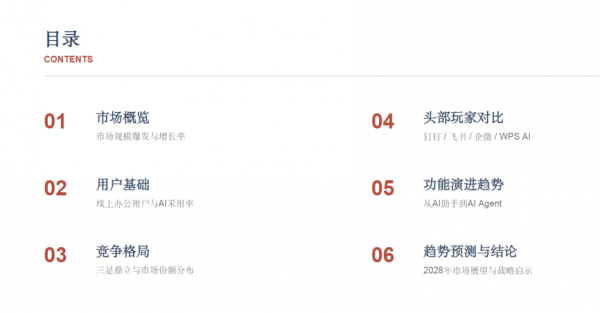
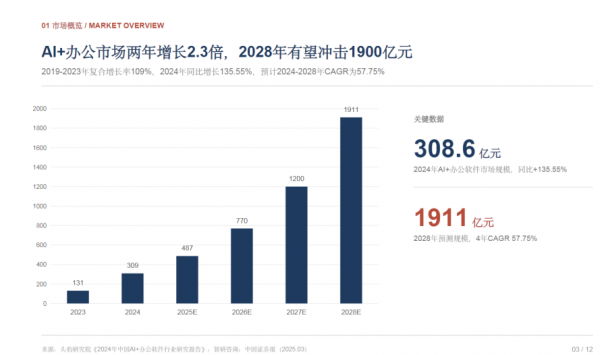
However, the execution process was not completed in one go; there were three rounds of revisions. Two instances were due to automatically generated bar charts triggering formatting misjudgments, and one instance involved text overflow on the data source page. This indicates room for improvement in execution efficiency, though the final PPT content turned out satisfactory.
The only drawback was the overly simplistic style of the generated PPT, lacking complementary images and sophisticated charts. The content and data refinement were insufficient, requiring additional details to be filled in for direct external presentation.
Thus, Doubao for Work can assist with time-consuming data collection and framework construction for reports from scratch, serving as a foundational framework tool. However, it has not yet reached the point of delivering complete and detailed results with a single sentence.
2. Video Generation: Creating High-Definition Short Videos with a Single Sentence
Next, we conducted the second test, focusing on multimodal capabilities. Xinshi Research Institute provided no material (materials) to Doubao for Work, only inputting a brief instruction in the chatbox: "Generate a 15-second video of galactic stars transforming."
Doubao for Work did not immediately act on this vague instruction. Instead, it first roughly understood the intent and then outlined a set of parameters for confirmation.

For example, the model selected was the default seedance_2.0_fast, with a duration of 15 seconds and a 16:9 horizontal aspect ratio. The scene description: In the deep night sky, a brilliant galaxy flows slowly, with countless stars Flicker (twinkling) and transforming. Starlight and nebulae interweave and flow, with star particles gradually converging into a splendid galactic light band. The camera slowly zooms in, creating a dreamy, tranquil, and vast atmosphere.
This interactive logic—first conceiving a set of parameters and detailed video requirements, then confirming with the user before execution—not only reduces ineffective rework and token waste due to user dissatisfaction with output but also returns control over the overall visual style to the user.
Furthermore, Doubao for Work's interactive logic significantly lowers the barrier for users who do not know how to describe the visuals in their minds, addressing the issue of users being unsure about what or how to modify if the generated video does not match their needs.
Most importantly, regarding the output, the final delivered video not only featured high-definition resolution and aesthetically pleasing visuals but also demonstrated smooth scene transitions in terms of video shots, without any instances of going out of frame, errors, or clipping issues. It was automatically paired with grand and atmospheric background music, enhancing the overall audiovisual experience.

Although Doubao for Work demonstrates strong multimodal capabilities, it still has a minor shortcoming: there is an upper limit to the duration of videos generated in a single instance. The default model allows a maximum of 15 seconds, which can be extended to 30 seconds by switching models. However, for longer videos, users would need to splice (stitch) segments together manually. In other words, Doubao for Work is sufficient for generating semi-finished video material (materials) but cannot directly produce long-form finished videos.
3. Strong Data Analysis Capabilities: Accurately Identifying Errors and Anomalies in Multi-Data Sets
After completing the multimodal skills test, we evaluated Doubao for Work's data analysis and summarization capabilities. We tasked it with constructing a set of e-commerce data that closely resembled real-world scenarios, requiring it to independently complete a full analysis—from data cleaning to anomaly attribution—and generate a report.
To test Doubao for Work's data cleaning abilities, Xinshi Research Institute intentionally embedded dirty data, including 12 rows of duplicates, 15 instances of missing quantities, 56 instances of missing costs, and 2 abnormal values.
During task execution, Doubao for Work automatically deleted duplicate rows, reasonably backfilled missing values, and preemptively identified all two embedded abnormal values.
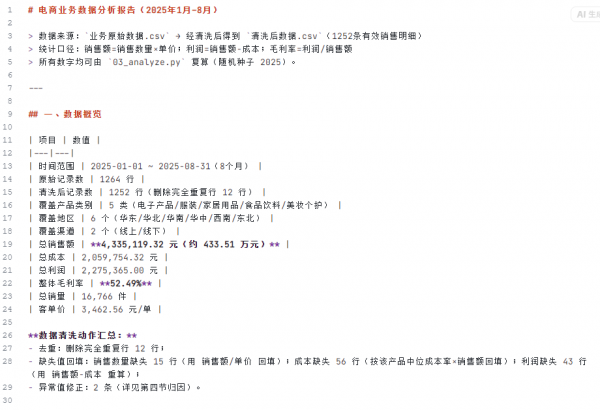
After completing indicator calculations, Doubao for Work output a comprehensive business profile: total sales of 4.3351 million yuan, gross profit margin of 52.49%, average transaction value of 3,462.56 yuan, with June as the sales peak at 845,100 yuan, representing a 69.47% month-on-month increase.
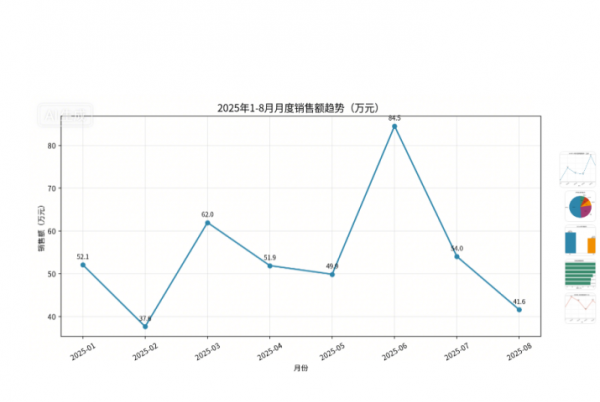
Electronics contributed 51.2% of sales but had a gross profit margin of only 49.76%; home goods had the highest gross profit margin at 64.65% but accounted for only 6.62% of revenue. The weak profitability of high-volume categories highlighted a structural contradiction in the business, offering more valuable insights than isolated indicators.
However, Doubao for Work's most impressive capability was anomaly attribution. Faced with a sales surge in June, it did not vaguely describe it as positive performance but pinpointed the six-day period from June 15th to 20th, attributing the rapid growth to the 618 shopping festival.
Additionally, for abnormal orders in July, Doubao for Work separately calculated the impact. Without corrections, the month-on-month change would have been misinterpreted as -25.1%; after correction, the true decline was -36.08%.
After completing these data analyses and calculations, Doubao for Work generated five visual charts to facilitate result presentation. Overall, its efficiency and accuracy in handling relatively complex data processing tasks were commendable.
4. Upgrading a Static Ledger into a Multi-View Collaboration System to Enhance Management Efficiency
Finally, we conducted an interesting test to see if Doubao for Work could transform a static project management ledger in CSV format into a functional collaboration system.
Many projects still rely on static Excel ledgers, which are slow to update and require manual effort from responsible individuals to synchronize data by inquiring with others. This results in inefficient processes and wasted communication costs. Therefore, Xinshi Research Institute aimed to test whether Doubao for Work could convert such static tables into interactive tools.
We provided Doubao for Work with a CSV file containing 34 project records and 12 fields. Using app_builder, Doubao for Work built a web application in just four steps.
The generated system included three independent views. The dashboard displayed five KPI cards: total projects, in progress, completed, delayed projects, and budget utilization rate, accompanied by a status distribution donut chart, department bar chart, and budget comparison chart. Users could instantly grasp the overall health of the projects.
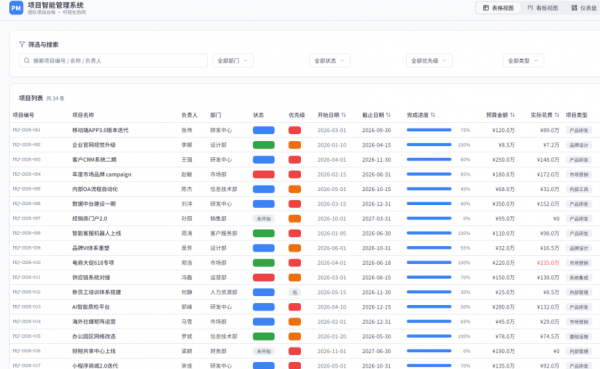

The table view displayed the full raw data, supporting search, multi-condition filtering, sorting, and detail viewing. The kanban view was divided into four columns: not started, in progress, completed, and delayed. Each card was labeled with the responsible person, priority, progress bar, and deadline. These three views shared the same data source but addressed different management needs.
Of course, it still falls short of a mature enterprise-grade system: the kanban does not support drag-and-drop status changes, lacks persistent storage, does not support online editing, and lacks permission management functions. Essentially, it is a viewable and demonstrable prototype that cannot yet be directly used as a team's daily production system.
Its greatest value lies in speed. A CSV file can be transformed into a multi-view interactive system in just four steps, significantly improving efficiency for teams needing to quickly validate business processes or build lightweight tools.
However, Doubao for Work's current output cannot replace professional project management software. Nevertheless, it shifts the process of building simple systems from waiting for development scheduling to being instantly achievable.
5. Conclusion
After completing these four tests, we gained a basic understanding of Doubao for Work's capabilities. The more structured the task and the clearer the given rules, the higher its completion quality.
In addition to PPT generation, video generation, data analysis, and simple system building, Doubao for Work also demonstrates end-to-end execution capabilities. Users only need to provide a goal, and Doubao for Work can automatically break down tasks, invoke tools, and deliver results.
If there is a minor shortcoming, it is that without sufficiently detailed prompts, Doubao for Work may lack refinement in details, such as PPT layout refinement, video subtitle editing, and system interaction optimization, all of which require manual finishing.
In other words, if users do not provide detailed requirements, Doubao for Work can only deliver approximate results, necessitating user revisions. Failing to provide complete requirements at once may waste unnecessary tokens.
However, achieving autonomous understanding and detail refinement requires advancing Agent capabilities, which is a limitation of current industry-wide technical capabilities rather than a flaw in Doubao for Work's Agent capabilities. After all, from the results, Doubao for Work can already adapt to most office scenarios.
Of course, Doubao for Work will not be the final destination for Agents.
-
![]()
Mysterious New Model Cracks 100+ World-Class Problems in 24 Days! OpenAI Unveils Mathematics and AI Advisory Board
-
![]()
vivo X500 Pro Imaging Professional Review: Strong Telephoto, Powerful Video, Enhancing Imaging Dominance with High Output Rate
-
![]()
Practical Testing of Doubao AI for Work: Multimodal Video Generation Provides Differentiated Advantages for Office Scenarios, Strong in Structured Tasks
-
Why Are Chinese Cybersecurity Stocks Still Falling Despite Zhipu Securing 1 Billion Yuan in Orders?
-
The ‘Korean Bentley’ in Beijing, Shanghai, and Guangzhou Stores: Hanging On by a Thread
-
Corporate Splurge on AI Box
-
![]()
RoboX’s Breakthrough Year: From Hype to Reality
-
![]()
Nitto Denko Pours $160 Million into New Factory to Bolster Global Polarizer Strategy