China is Disassembling a 'Data Center' and Sending It into Space
 09/23 2026
 338
338
If you were to move a data center into space, how many steps would it take?
Step 1: Send the computers up. Step 2: Enable these computers to be uniformly managed by software. Step 3: Connect them to each other using a high-speed network and send the data back to the ground.
The two satellites recently launched into orbit by the Lijian-1 Yao-18 mission are doing something similar.
The Chaozhisu-1 carries a 4-meter visible light camera and an AI computer, enabling on-orbit image processing and target identification. The Pengcheng-NKU-1 integrates 5G NTN, on-orbit computing, and satellite-ground laser communications into a single satellite, with plans to validate a 100 Gbps laser link in the future.
One satellite is solving the 'computing' problem, while the other is already combining 'computing' and 'connectivity.'
The history of computer development has repeatedly proven one thing: single-machine performance sets the upper limit, while the network determines the scale. From mainframes and local area networks to the Internet and cloud computing, computing power has truly become infrastructure not just because processors are getting faster, but because machines can connect to each other, tasks can be scheduled, and data can flow efficiently.
Now, this logic is entering orbit.
China is sending the capabilities needed for a data center into space, one piece at a time.
01
The first piece, of course, is the computer.
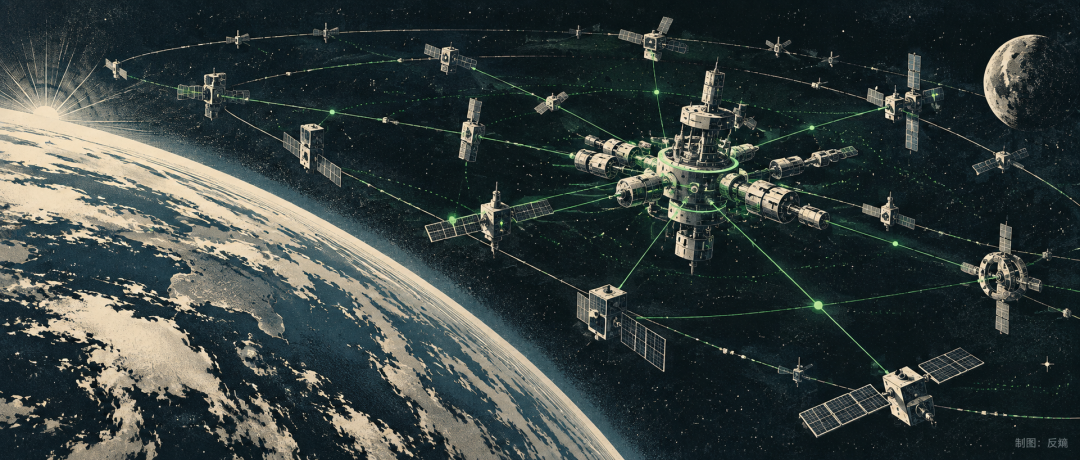
In May 2025, the Zhejiang Lab-led Santih Computing Constellation launched its first 12 computing satellites into orbit, with each satellite achieving a peak computing power of 744 TOPS and the entire initial mission reaching an on-orbit computing power of 5 POPS. By February of this year, the team had already established links among six satellites in orbit and, through a space-based distributed operating system, uniformly managed and scheduled computing, storage, and network resources.
More important than 5 POPS is that computing resources are beginning to transcend single-satellite boundaries.
The Santih Computing Constellation has already deployed multiple AI models and applications. One model used for astronomical observations can directly classify and judge gamma-ray bursts on-orbit, reducing the daily data downlink from hundreds of MB to tens of KB and cutting processing time from hours to seconds.
This is precisely why edge computing exists. Satellites generate vast amounts of data daily, but many operations do not require all raw data to be transmitted back to the ground for processing. If sufficient computing power is already available in orbit, the data can be filtered, identified, and compressed first, with only the most valuable information sent down.
However, as the number of computing nodes increases, another question arises: How do you install, update, and adapt software on these machines for different tasks?
02
The Tiansuan Constellation, driven by Beijing University of Posts and Telecommunications, has shifted its focus to software and resource management.
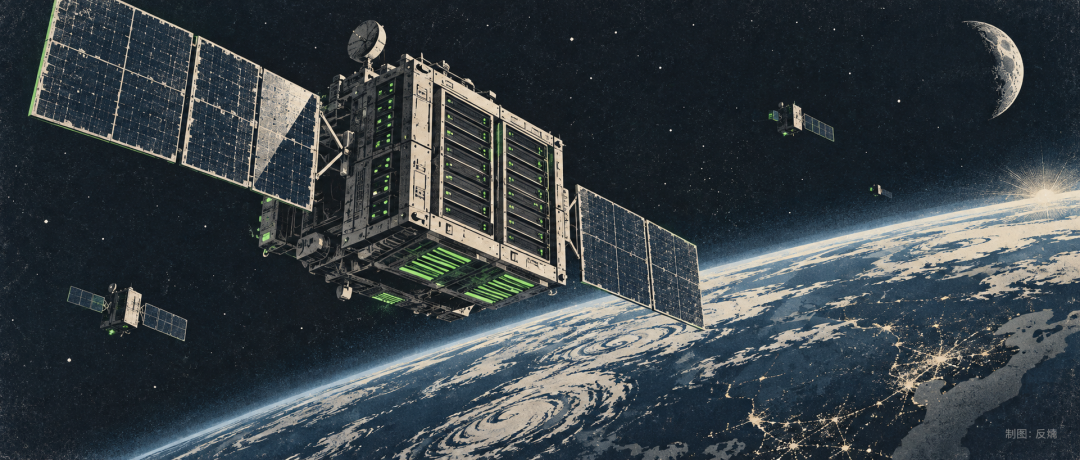
The BUPT-1 has brought cloud-native technology to satellites and conducted experiments such as distributed onboard AI inference and onboard 5G core networks. The BUPT-2 sent a self-developed high-performance server as a computing payload into orbit, validating capabilities such as dynamic updates of onboard containers and incremental updates of models.
Such work is far less eye-catching than 'hundreds of TOPS,' but it determines whether space computing power can be used on a large scale.
Traditional satellites are highly customized, with software, payloads, and hardware tightly bound, and missions typically determined before launch. Computing infrastructure requires a different capability: software can be updated, applications can be redeployed, different hardware can be uniformly managed, and computing resources can be scheduled according to tasks.
In today's data centers, no one would redevelop software for the entire business just to add a server. If space computing power cannot achieve this in the long run, each computing satellite will remain an expensive specialized device, and as the scale grows, management costs will rise.
So, after TOPS, operating systems, software environments, and resource scheduling are taking center stage. This is not a conceptual upgrade but fundamental work that any large-scale computing system cannot avoid.
03
Once computing resources can be managed, bandwidth quickly becomes the next bottleneck.
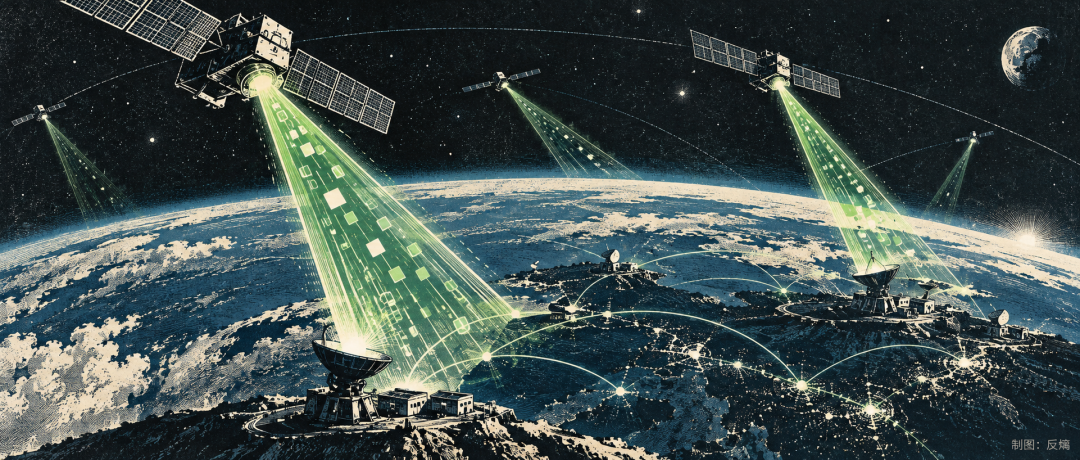
In January of this year, the Aerospace Information Research Institute of the Chinese Academy of Sciences used AIRSAT-02 to conduct a super-100 Gbps satellite-ground laser communication experiment, increasing the communication rate from 60 Gbps to 120 Gbps through on-orbit software reconfiguration without changing the satellite's hardware. The maximum continuous communication time reached 108 seconds, during which 12.656 Tb of data was transmitted.
As computing power increases, the pressure on data transmission becomes apparent sooner.
If processor performance continues to rise while communication capabilities stagnate, data will still get stuck in orbit. Ground-based AI data centers have already demonstrated this problem in recent years: after the explosive growth of GPU performance, high-speed interconnects quickly shifted from a supporting role to a core capability because only by exchanging data fast enough could thousands of chips work efficiently as a cluster.
The conditions in space are even harsher. Satellites move at high speeds, satellite-ground visibility is limited, and laser communications are affected by weather, atmosphere, and acquisition and tracking accuracy. If the network in a ground-based server room is insufficient, more switches and fiber can be added. Expanding capacity in orbit often means new satellites, new links, or even new launches.
The Pengcheng-NKU-1, launched on September 20, is therefore highly representative. Instead of focusing solely on computing power, it integrates 5G NTN, an onboard core network, AI computing, and satellite-ground laser communications into a single 150 kg-class satellite and plans to conduct a 100 Gbps satellite-ground laser communication experiment. According to Pengcheng Laboratory's plan, this satellite will also validate terminal access, onboard protocol processing, and service transmission.
Chips are starting to force the network to upgrade alongside them.
04
Similar technological paths have already been validated overseas.
The Φsat-2, launched by the European Space Agency in 2024, is only 6U but can already run multiple AI applications on-orbit for tasks such as cloud detection, ship identification, and disaster mapping. The HPE Spaceborne Computer-2 on the International Space Station has also validated commercial servers performing high-performance computing and AI tasks in orbit.
These projects validate a further capability: data can be processed directly on-orbit, AI applications can be deployed to satellites, and commercial computing devices used on the ground can also handle some space computing tasks.
China's space computing power projects are no longer just focusing on single-satellite computing power; software management, networking, and high-speed communications are also advancing together. The Santih Computing Constellation is experimenting with multi-satellite collaboration, the Tiansuan Constellation is bringing software environments and resource management into orbit, AIRSAT-02 is improving satellite-ground data transmission capabilities, and the Pengcheng-NKU-1 is compressing communications, computing, and high-speed links into a single node.
These projects come from different institutions with varying routes and maturity levels, and they do not yet form a complete orbital data center. However, if we only focus on single-satellite computing power, it is difficult to explain why these projects are simultaneously working on networking, scheduling, software updates, and high-speed communications.
While it is, of course, important for a single satellite to compute faster, as the number of computing nodes in orbit increases, system efficiency will increasingly depend on whether these nodes can collaborate stably, whether tasks can be flexibly allocated, and whether data can flow in a timely manner.
A single satellite completing an on-orbit computation is fundamentally different in difficulty from dozens or hundreds of satellites collaborating stably over the long term. The latter also faces challenges such as power consumption, heat dissipation, radiation, link stability, resource scheduling, and operational costs. If any of these aspects fall behind, the computing power of the others will be held back.
So, what China is sending into space today is not just more powerful computing payloads. It is attempting to organize computing, networking, software, and high-speed data links into a system that can operate sustainably over the long term.
Forty years ago, Silicon Valley used the phrase 'the network is the computer' to explain the future on the ground. Today, that phrase is gaining a new version hundreds of kilometers above Earth.
-
![]()
Why Would NVIDIA Splash Out $12.9 Billion on a Website with $100 Million Annual Revenue? The Secret Lies with 18 Million Users
-
![]()
China is Sending a 'Data Center' Piece by Piece into Space
-
![]()
China is Disassembling a 'Data Center' and Sending It into Space
-
![]()
Apple Relies More on Scalpers Than Ever Before
-
![]()
Starting at 235,800 Yuan! Honda Unveils Another New Model: Official Release Set for September 28
-
![]()
Starting from 122,600 Yuan? Subaru Unveils New Model: On Sale from September 22
-
![]()
In-Depth Performance Analysis of iPhone 18 Pro: Unmatched Superiority, Enhanced Cooling, and the Advantages of 2nm Chip Technology
-
![]()
OPPO Find X10 Pro Max Imaging Review: Perfect for Beginners in Street Photography, The Only 'All 200MP' Claim That Stands Up