Huawei's Ecosystem Gives Birth to Another Physical AI: XIRRA Raises Hundreds of Millions in Two Financing Rounds, Valuation Hits US$500 Million
 09/24 2026
 444
444

AI Surge Editorial Team
On September 23, XIRRA, a physical AI company, declared the successful completion of seed and angel round financing, securing hundreds of millions of yuan within a span of two months. This financing round was spearheaded by Dunhong Asset, with participation from notable investors such as Huakong Fund, Sanhua Holding, Ginkgo Valley Capital, Zeran Capital, Benjian Fund, Angel Cornerstone, Biaopu Investment, and other institutions. This achievement has propelled XIRRA's valuation to an impressive US$500 million.
The freshly acquired funds will be strategically allocated to the large-scale pre-training of XIRRA's native physical AI model, the construction of real-world physical interaction datasets, and the validation of various scenarios.
XIRRA was founded in July 2026.
The company boasts a stellar founding team. Li Yin, the Founder and CEO, previously served as the CTO of Huawei Cloud's Large Models. He was a pivotal figure in the development of Huawei Cloud's large models from scratch, leading the team to accomplish video large model training and deployment on a 10,000-card cluster. Co-founder and Chief Scientist Zhang Hanwang is a distinguished Chair Professor at Nanyang Technological University and also serves as Huawei's Chief Scientist for Multimodal AI. In 2026, he ranked 8th globally in the "causality" category on Google Scholar. The core team members are all drawn from Huawei's large model ecosystem. 
Li Yin (left), Zhang Hanwang (right)
XIRRA has chosen a unique trajectory compared to mainstream embodied models.
While the majority of embodied models build upon visual-language models by adding action modules, XIRRA takes a different approach. It establishes connections between physical states, actions, and outcomes directly from the pre-training foundation, independently developing the Native Physical Foundation Model (LPM). The theoretical design of this model is rooted in the Bellman equation, effectively decoupling world simulation from visual rendering. An autoregressive module is responsible for causal historical simulation, while a diffusion model handles visual rendering.
This model goes beyond merely fitting data appearances; it learns physical laws during the pre-training phase.
In terms of supporting toolchains, XIRRA has constructed XR data and evaluation platforms. These platforms integrate real-world robot trajectories, human demonstrations, and actual failure cases, transforming data from diverse robots and scenarios into trainable assets. The evaluation platform encompasses scenario construction, model execution, result recording, and report generation. Failed samples undergo data supplementation and retraining before proceeding to the next validation round.
In the WorldArena 2.0 global finals, announced on September 16, XIRRA emerged as the global leader in trajectory accuracy and secured a top-three position globally in physical compliance within Track 1 for video quality.
XIRRA's commercialization strategy unfolds across three tiers: L0 foundation models, L1 domain models, and L2 vertical applications. The initial phase is dedicated to achieving closed-loop operation in robotics scenarios, while the second phase extends the same foundation to closed-loop simulation for autonomous driving, extreme weather prediction, and drug molecule development. 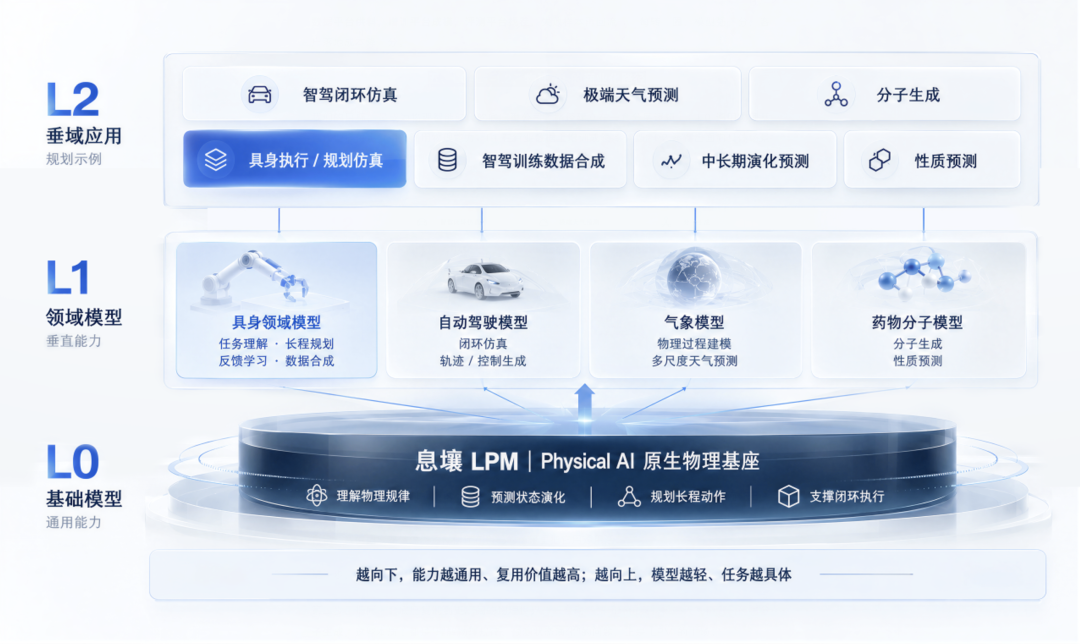
According to the company, the team has a proven track record, having previously delivered over 200 AI projects across more than 30 industries, including finance, manufacturing, energy, and government services. The cumulative value of these projects exceeds 1 billion yuan.
The divergence between native physical pre-training and mainstream incremental training routes is significant. The former strives to form physical common sense during pre-training, while the latter adds robot control on top of existing visual-language models.
WorldArena's evaluation results offer initial validation. However, achieving stable operation from metrics to production lines necessitates batch delivery in robotics scenarios for further testing.
While the cross-domain extension from robotics to weather prediction and drug development is technically feasible, the vast differences in physical data collection methods across these fields make the effectiveness of foundation model transfer a topic worthy of observation.
-
![]()
Why is interaction, rather than intelligence, the core of Physical AI?
-
![]()
Honda’s New Avancier Unveiled: Anticipated Official Launch in January 2027
-
![]()
Chery Unveils New Car: Launching September 29 with Huawei Qiankun ADS 5
-
![]()
Starting at 147,900 Yuan! Buick Unveils New ZHIJING E7 Model: Launching Renewed Version on September 23rd
-
![]()
Starting from 279,800 Yuan? BYD’s New SUV Officially Unveiled: Major Launch Set for October
-
![]()
Mercedes-Benz Unexpectedly Unveils New Car: Launching in October, Its First Fully Electric SUV!
-
![]()
Wang Chuanfu Plays His 'Ace': Weekly Orders Skyrocket—Is the Xiaomi SU7 'Rival' Truly Here?
-
![]()
Huawei's Ecosystem Gives Birth to Another Physical AI: XIRRA Raises Hundreds of Millions in Two Financing Rounds, Valuation Hits US$500 Million