QClaw Is Ultimately Acquired by WorkBuddy
 09/28 2026
 543
543
Chaoyong AI Editorial Department
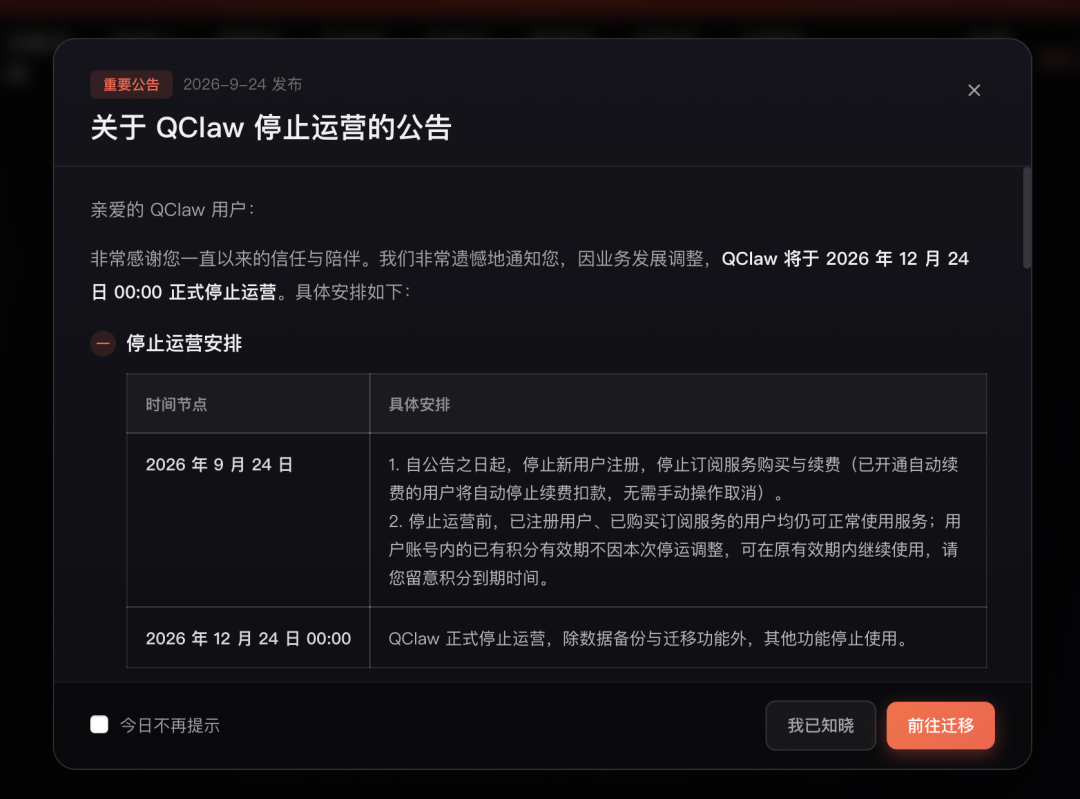
On September 24, the Tencent QClaw team announced that, owing to business development adjustments, QClaw will officially cease operations at midnight on December 24, 2026. Effective immediately, new user registrations, as well as the purchase and renewal of subscription services, will be halted, marking a product lifecycle of less than a year.
A Tencent spokesperson clarified that the service shutdown is part of the company's strategic business adjustments, aimed at further consolidating resources to offer users enhanced Agent services.
The announcement detailed that users have the option to transfer their configurations, memories, Agent personas, conversation records, and other data to WorkBuddy via the "Migrate to WorkBuddy" portal located at the top of the QClaw official website.
Users who successfully complete the migration will be awarded a subsidy of 1,000 points. Additionally, new users who have never made a payment to WorkBuddy will be eligible for a maximum reward of 5,000 points upon their first membership purchase.
Unused subscription packages and point packs in user accounts are eligible for refunds. Data export and migration tools will remain accessible until March 24, 2027.
QClaw, developed by the Tencent Computer Manager team based on OpenClaw, commenced its beta testing in March of this year. Positioned as a local AI assistant, it facilitated remote computer control through WeChat. On July 20, Tencent underwent internal organizational restructuring, leading to the transfer of QClaw product center-related businesses and some teams to Cloud Product Division VI. The notice explicitly stated, "QClaw will continue operations." However, just two months later, the shutdown announcement was made.
Cloud Product Division VI, which assumed responsibility for QClaw's business, is the same division overseeing WorkBuddy.
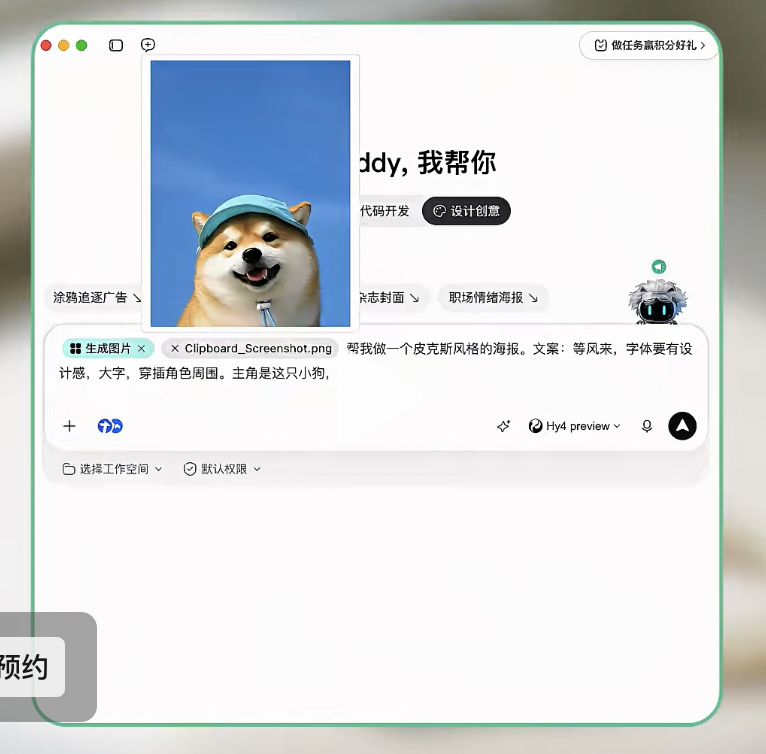
Chaoyong AI has chronicled WorkBuddy's ascent: It garnered 8.85 million visits in its launch month in March; by June, it had ascended to the pinnacle of the domestic desktop AI office agent rankings with 20.97 million monthly visits, outpacing the combined total of ByteDance's TRAE (domestic version) in second place and Alibaba's QoderWork in third; its independent app was launched in July, and the open platform welcomed over 100 ecosystem partners in September.
The timeline of QClaw's shutdown closely mirrors Tencent's internal organizational restructuring. The product lead resigned at the end of June, the team was integrated into WorkBuddy's department in July, and the shutdown announcement was issued in September. The duration between the assurance of "continued operations" and the official closure was a mere two months.
This signifies Tencent's consolidation following the conclusion of its internal competition in the Agent sector.
Within the same corporate framework, resources will inevitably concentrate on the victorious product. Alibaba's Qianwen Office, ByteDance's Doubao Work, and Baidu's Baidu Dazi—all companies are pursuing the same strategy: amalgamating fragmented agent products under the triumphant one.
WorkBuddy's acquisition of QClaw exemplifies the execution of this principle within Tencent.
Regarding other office Agent contenders in the market, Chaoyong AI's stance, as reflected in the "AI Office·Digital Employee TOP50" list release—"Some have amassed hundreds of millions of dollars through digital employees?!"—is unequivocal: The domestic market is a protracted battle among industry giants, while overseas markets represent the profit haven for emerging companies.
-
![]()
Contrast! Xiaomi Pengcheng SUV's Order Volume Drops in Second Week: Are Netizens Right to Say It's Below Expectations?
-
![]()
0 yuan phone purchase, ends in 2026
-
![]()
Explosive News! Xu Jiayin’s Evergrande Auto Launches a 'New Business Venture' Amid 186 Million Yuan H1 Profit
-
![]()
Quantum AI Track Begins to Explode: Tsinghua-Affiliated Sober Heterogeneous Secures Nearly 100 Million Yuan Across Two Financing Rounds in Three Months
-
![]()
QClaw Is Ultimately Acquired by WorkBuddy
-
![]()
China Launches Space Computing Initiative: A 'Data Center' in the Sky Comprising Over 1,000 Satellites
-
![]()
Why Is Starship Planning to Orbit Earth Six Times on Its 14th Flight?
-
![]()
Detailed Explanation of Zhuoyu ZYT World: While the Industry is Still Reviewing Recordings, Zhuoyu has Already Thrown AI into the 'GTA World' for Driving Practice