The Unveiling of 'Mega Project - Dawning 8000': How Cutting-Edge Computing Power Transforms Scientific Research
 09/29 2026
 520
520
On September 25, China Media Group premiered its grand documentary 'Mega Project - Dawning 8000'. This series, known for spotlighting iconic and groundbreaking projects of our time, has previously chronicled the construction of the Hong Kong-Zhuhai-Macao Bridge and the marvels of China's high-speed rail network. Now, for the first time, it turns its camera towards the colossal infrastructure of supercomputing power.

'Mega Project - Dawning 8000' delves into the journey of China's inaugural domestically produced AI supercluster, the Dawning 8000, boasting 100,000 cards. It meticulously follows the process from architectural blueprint and system development to construction, debugging, and eventual scientific research applications. The crux of the narrative revolves around a singular question: How can 100,000 locally manufactured intelligent computing chips, intertwined with over a billion components, coalesce into a computing powerhouse capable of driving scientific innovation?
After six years of relentless effort, the Dawning 8000 was officially launched in July 2026. However, the true challenge lay ahead: Could researchers effectively harness its capabilities? Could it tackle the intricate tasks from diverse scientific disciplines?


Going Live: The Beginning of a New Era
The Real Challenge: Handling a Flood of Scientific Research Tasks
In its inaugural week of operation, the Dawning 8000 processed an average of over 150,000 application requests daily, with a single-day peak surpassing 500,000. The scope of application scenarios expanded from 100 traditional categories to 400. These requests, emanating from various fields, each had unique demands for computing power performance and precision. Ensuring their seamless operation posed challenges far beyond initial expectations.
The First Hurdle: Architectural Design and System Capabilities
Some scientific research endeavors necessitate AI to swiftly sift through numerous possibilities, while others require high-precision calculations for meticulous verification. Some even demand a blend of both capabilities. The 'super-intelligence fusion' approach, highlighted in the documentary's first episode, leverages heterogeneous computing capabilities to enable a single system to handle diverse tasks simultaneously.
Yet, architecture alone is insufficient; the 100,000 cards must genuinely work in unison. The technical hurdles in networking, storage, and cooling, along with the coordination of cabinets, power supply, and cooling systems, as depicted in the second and third episodes, all aim to address the same issue: facilitating efficient collaboration among 100,000 chips, over 10,000 computing nodes, and more than a billion components to unleash formidable computing power.

The Second Hurdle: Software and Hardware Adaptation
Following the system's launch, the rapid expansion of application scenarios necessitated corresponding ecological adaptation. He Mujun, the Implementation Director of the Dawning 8000 AI Supercluster, candidly stated in the documentary that some application software vendors had yet to adapt their products for such a large-scale computing power system. Consequently, this initial adaptation work was primarily undertaken by Sugon engineers.
Ensuring smooth program deployment and identifying potential bottlenecks during runtime were critical issues that had to be resolved before researchers could fully leverage the computing power. For the industry, this signified that delivering equipment was merely the first step. The ability to integrate diverse software ecosystems and enable seamless user operation represented a more enduring competitive advantage.
The Third Hurdle: Human Collaboration
Transforming a scientific research concept in a scientist's mind into an engineering reality demands seamless collaboration among multiple teams. Researchers propose scientific queries, such as how sediment flows in the Yellow River or how the human brain functions. Engineers then dissect these into specific tasks involving computing, communication, storage, and scheduling, optimizing them step by step. This process of repeated refinement holds value comparable to any technological breakthrough.

Heterogeneous Computing: Paving New Pathways for Scientific Research
Transforming the Impossible into Reality
Computing power does not automatically equate to scientific research productivity. The documentary's fourth episode focuses on the more daunting proposition: after constructing the 100,000-card system, how to ensure its continuous production of scientific research achievements.
Currently, the Dawning 8000 provides computing power support for over 400 application scenarios, including quantum computing, robotics, biopharmaceuticals, energy and chemical engineering, intelligent manufacturing, and aerospace. Over 15 applications meet the criteria for the Gordon Bell Prize. With the support of the Dawning 8000, researchers can now undertake studies that were previously unfeasible.
Yellow River Sediment: Conducting a 'Meter-Level' Scan of the Yellow River
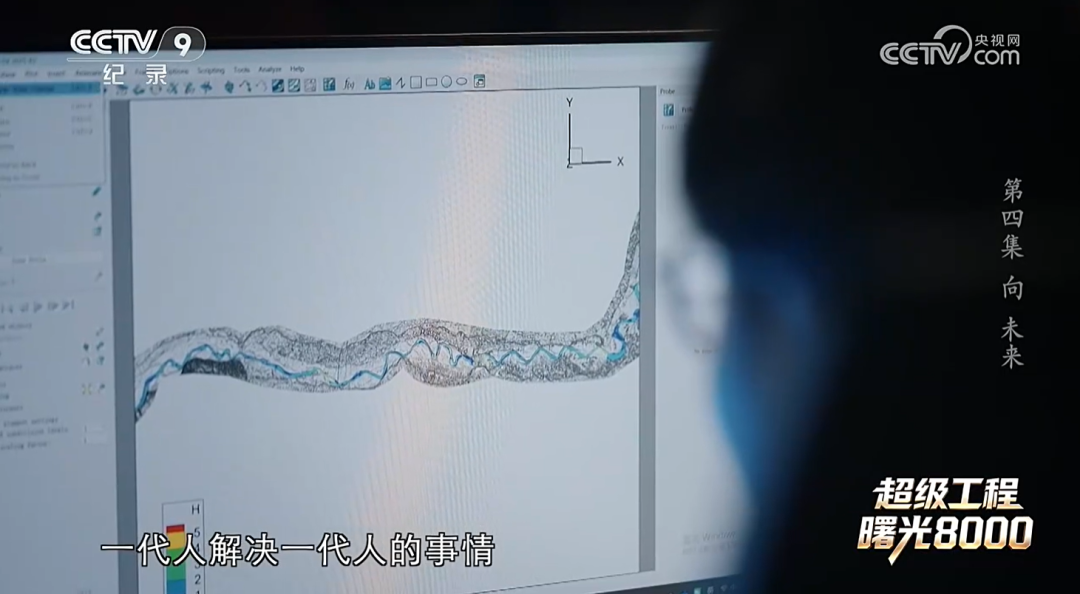
Sun Jian, the Deputy Director of the Institute of River and Ecology at Tsinghua University's Department of Hydraulic Engineering, has dedicated years to studying the sediment issues of the Yellow River. The river, characterized by low water volume and high sediment content, presents an intricate relationship between flow, sediment, and riverbed. In the past, due to computing power constraints, model grids could only achieve a resolution of tens of meters, making it difficult to simulate many details.
Sun Jian's ambition is to construct a meter-level high-resolution digital model. However, using traditional computing methods, this could take several years.

The solution provided by the Dawning 8000 involves combining two types of computing: first, utilizing intelligent computing power to intelligently deduce river variables and swiftly screen out the most probable river topographies; then, employing high-precision calculations to numerically verify these scenarios. Within hours, the system can vividly present the river's course, sediment deposition, and water level changes over the next few months.
"Overall, the results are quite satisfactory, indicating that our model can run smoothly on the Dawning 8000," Sun Jian remarked.
Digital Twin Brain: Communication: A Greater Challenge Than Computing
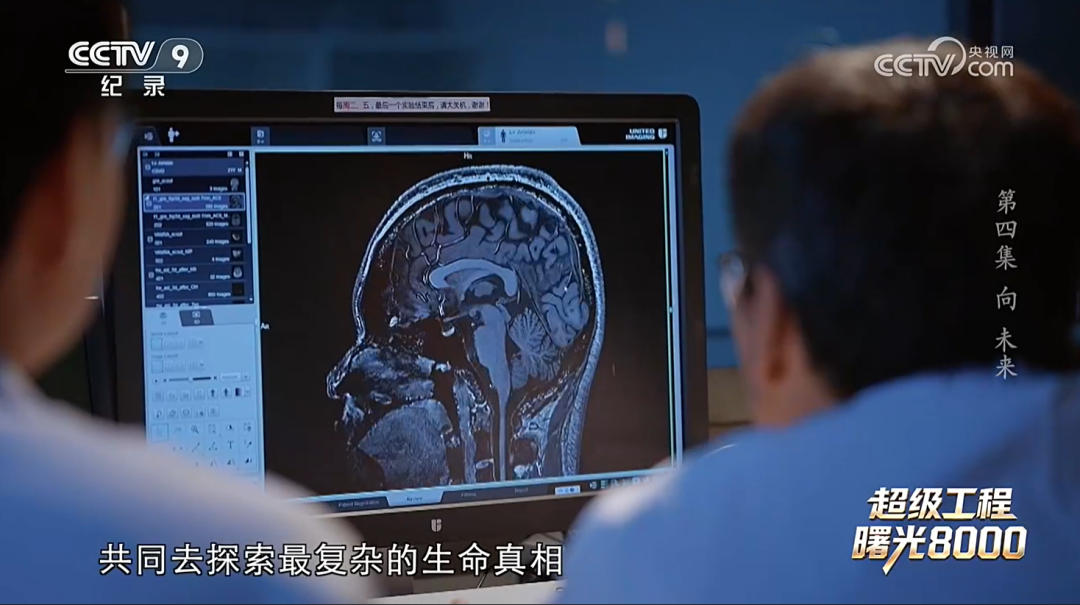
Feng Jianfeng's team at the Institute of Brain-Inspired Intelligence Science and Technology and the School of Big Data at Fudan University aims to achieve a feat that seems straight out of science fiction: using a computer to reconstruct a digital brain that reacts at the same speed as a human brain.
The human brain, weighing a mere 1.4 kilograms, contains 86 billion neurons and over 100 trillion neural connections. Feng Jianfeng's team has already achieved the ability to fully simulate activities that take one second in the human brain within 70 seconds in the digital twin brain. However, Feng Jianfeng's goal is a "one-to-one" correspondence, meaning the digital twin brain should compute as swiftly as the human brain.
What are the challenges? Brain-inspired computing is an application that demands extremely intensive communication. The parallel operation of 86 billion virtual neurons across tens of thousands of cards is akin to tens of thousands of cities simultaneously exchanging packages, with billions of parcels circulating among servers every second. Any slight congestion can bring the entire virtual brain to a halt.
The Dawning 8000 was designed with ultra-wide bandwidth in mind at the hardware level, effectively "widening the roads." However, simply widening the roads is insufficient; algorithmic optimization is also essential to ensure the orderly passage of data packets. Only through the synergy of hardware and algorithms can communication-intensive tasks run smoothly.
"I hope to achieve, on the Dawning 8000, the ability to compute as swiftly as the human brain works," Feng Jianfeng expressed.
High-Resolution Meteorological Forecasting: A Test of Comprehensive Capabilities
The meteorological numerical forecasting system independently developed by the China Meteorological Administration's Earth System Numerical Forecasting Center relies on the Dawning 8000 to shorten the computation time for global 5-kilometer resolution, 10-day forecasts to just one hour.
High-resolution numerical forecasting involves processing vast amounts of data and performing complex calculations within a limited timeframe, posing a comprehensive challenge to computing, communication, and storage. Unlike other scientific explorations that can be gradually adjusted, this type of task requires stable, timely, and repeatable operations capable of functioning like a business.
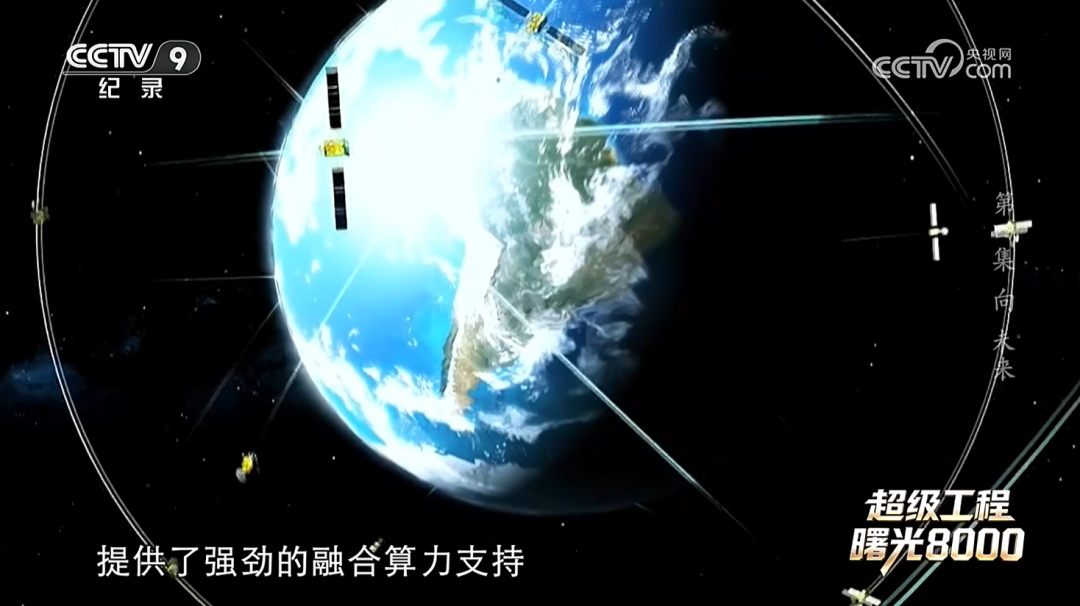
This breakthrough propels China's operational capabilities in meteorological forecasting into the global top tier, laying a crucial foundation for more accurate future weather predictions in China.
Real scientific research tasks serve as a litmus test for computing power. Researchers need not concern themselves with underlying scheduling; they only care about the accuracy and speed of the results. This represents a crucial step for computing power to truly integrate into the scientific research process and become an infrastructure.

Empowering More Researchers: Top-Tier Computing Power as a Public Service
For computing power to become a driving force in scientific research, it cannot solely serve a select few scientists. It must evolve into a low-threshold, user-friendly public infrastructure that more researchers can access and afford.
In the past, top-tier computing power was a "luxury." Its users were primarily researchers, and even then, they often had to be senior scientists. However, after the Dawning 8000 was connected to the National Supercomputing Internet, the situation began to change. Users can now access computing power-supported large models and services through an app marketplace, making it convenient even for university students.
Li Jun, the Chairman of Sugon, stated in the documentary that only by staying ahead in computing power infrastructure can a platform for scientific discovery be provided.
Li Guojie, an academician of the Chinese Academy of Engineering, discussed more profound changes, believing that humanity is entering a new era of intelligence, and society will indeed undergo significant transformations. Behind these changes, supercomputing power will serve as an engine driving societal change.

When supercomputing power like the Dawning 8000 becomes a readily available tool for researchers, computing power infrastructure truly completes the transition from "being built" to "being used," endowing the 'mega project' with practical significance.
Starting from scratch, achieving full localization of core components, and then empowering world-class application achievements, China's advanced computing journey has spanned over three decades. In the next thirty years, computing power will become an infrastructure for societal operation, just like water and electricity.
As a mega project of the new era, the true value of the Dawning 8000 lies in the number of scientific research achievements it generates and the number of innovative challenges it resolves. Building 100,000 cards is just the beginning; its true mission is to serve as a foundation for sustaining breakthroughs in Chinese scientific research.
END
This article is an original work by 'Intelligent Evolution Theory.' Reproduction requires obtaining authorization from the author.
-
The Milestone of the 100,000th Vehicle: How Far Has BYD Progressed in Thailand?
-
![]()
【Electric Equipment】First National Subsidy for All-Electric Cargo Ship Received
-
![]()
Geely and NIO’s Charging and Battery Swap Networks Go Live
-
![]()
Four Trading Days, Three Daily Limits: JAC Motors Surpasses Seres to Become Huawei's Premier Auto Concept Stock!
-
![]()
What Cars Can You Buy with a 100,000 Yuan Budget? The Options Far Surpass Your Expectations
-
![]()
AI Fuels Wealth Creation, Shakes Up the Rich List
-
![]()
The Unveiling of 'Mega Project - Dawning 8000': How Cutting-Edge Computing Power Transforms Scientific Research
-
![]()
Why Are European and American Automakers Venturing into Diverse Sectors?