Fliggy is Becoming More and More Like a Plugin
 09/29 2026
 482
482
Fliggy is entrusting part of its efforts to attract travel users to those developing AI applications.
During the September Cloud Town Conference, Fliggy, in partnership with Alibaba Cloud's BaiLian, initiated the AI Travel Innovation Contest. Developers can leverage Fliggy's travel tools to create their own travel applications. The concept of a hackathon involves transforming ideas into functional products within a limited timeframe. Submissions for this contest are accepted until October 25, and it is currently in the solicitation phase.
Fliggy and Alibaba Cloud's BaiLian jointly host the AI Travel Innovation Contest.
Combined with Fliggy's already launched Promoter Program, there is a clear business path: developers create applications to attract users, while Fliggy provides bookable travel products. When users purchase eligible hotels or vacation packages, developers earn commissions.
Fliggy gains more opportunities to sell products, and users have an additional platform to voice their travel needs. Whether this platform is called Fliggy does not hinder order generation.
This precisely highlights Fliggy's most challenging issue at present. Alibaba can provide access points, and Fliggy can distribute its products through more applications. However, after each transaction is completed, will consumers actively seek out Fliggy for their next trip? Or, will Qianwen become a better access point for Alibaba to integrate its OTA resources?
Just before this contest commenced, on September 19, the Beijing Municipal Market Regulation Bureau announced an investigation into four platform companies, including Fliggy's related entity, Hangzhou Taomei Aviation Service Co., Ltd. The announcement did not provide a final determination of violations or penalty amounts.
The industry order is adjusting, and Fliggy's position is also changing. It must face competition and regulation from travel platforms while adhering to Alibaba's arrangements for consumer business and AI access points.
Being useful to the group and becoming a platform actively chosen by users are becoming essential questions that Fliggy must answer separately.
01 The Independent Path Leads Back to Alibaba
Fliggy once seriously prepared to face the market independently.
On March 31, 2022, Zhuang Zhuoran sent a company-wide letter initiating organizational reform. He proposed to “fully prepare for future independent market-facing operations.” Alibaba would increase investment in funds and strategic resources, while Fliggy had established a working group to advance management system reforms and job restructuring, planning to implement an employee stock ownership plan.
At the time, Fliggy explained to the media that this did not represent existing listing plans but rather the need to develop independent market-facing capabilities. The reform focused on enhancing services and fulfillment to align the organization with the tourism industry's demands.
This starting point was practical. Unlike ordinary commodities, hotel rooms tied to specific check-in dates cannot be sold slowly over time. When users arrive at their destination to find no available rooms or experience flight cancellations, the platform cannot resolve issues through a mere product page. Attracting users to a store is far from delivering a satisfactory travel experience.
To face the market independently, Fliggy needs a service suite compelling enough for consumers to repeatedly choose it. While group-provided traffic can facilitate initial transactions, securing return visits requires Fliggy's own efforts.
Three years later, the direction of organizational reform began to adjust.
On June 23, 2025, Alibaba announced the integration of Fliggy and Ele.me into the China E-commerce Business Group. Zhuang Zhuoran continued to lead Fliggy, with Alibaba retaining corporate management of both businesses while requiring business decision-making and execution to align with the group's centralized objectives and unified operations.
Fliggy still needs to manage its travel business, but it must now also serve Taobao's overall goals. According to a report by *Caijing Tuya* in October 2025, Fliggy added a primary access point within the Taobao App, and its membership system was integrated with Taobao's comprehensive membership. Travel services thus entered Taobao's shopping and membership scenarios. Whether orders originate from the Fliggy App or Taobao holds different implications for the group.
After integrating into Alibaba's e-commerce sector, Fliggy disclosed growth data. During the 2025 National Day and Mid-Autumn Festival holidays, its fulfilled GMV increased by 48%, with hotel room nights growing by 78%. Orders for Fliggy travel services booked through Taobao rose by 74%.
These orders are undoubtedly valuable. Hotels sell rooms, consumers utilize travel benefits, and Taobao members gain another reason to continue using membership services. Fliggy's integration into the group meets the needs of multiple parties simultaneously.
However, this arrangement could also result in Fliggy enriching its travel services to enhance Taobao membership usability, making consumers more inclined to stay within Taobao. The benefits of group synergy may not manifest as an enhancement of Fliggy's independent brand.
User data already indicates pressure.
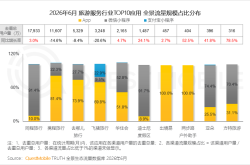
QuestMobile's 2026 mid-year report revealed that in June, Fliggy's panoramic deduplicated user base stood at 32.48 million, a 20.6% year-over-year decline. In the same chart, Ctrip had 116.07 million users (-14.6% YoY), Qunar had 53.29 million (-8.4% YoY), and Tongcheng increased by 3.0%. Among these comprehensive travel platforms, Fliggy experienced the largest decline.
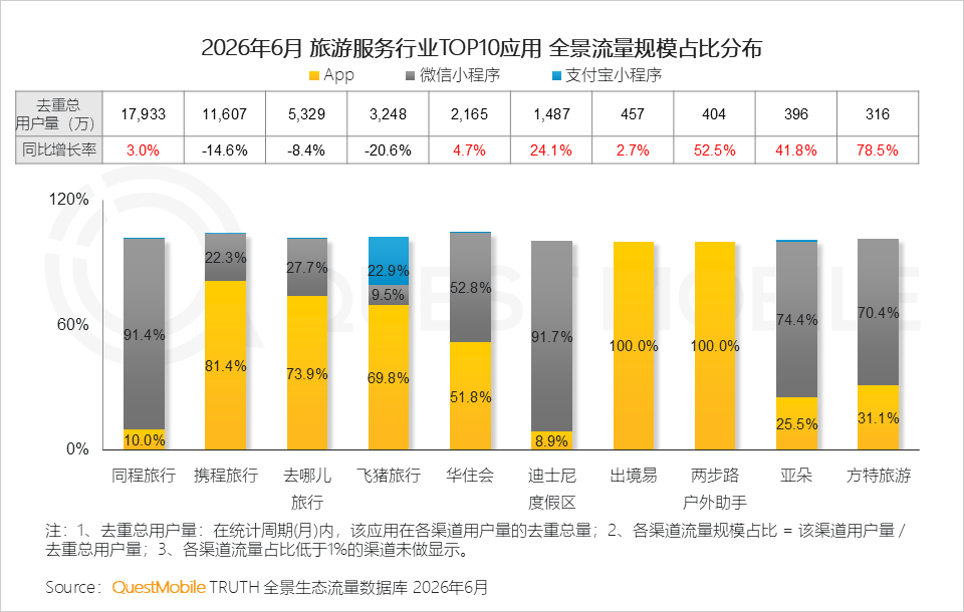
Panoramic user scale and channel distribution of travel service applications in June 2026.
These data statistics cover deduplicated users across Apps, WeChat mini-programs, and Alipay mini-programs, excluding standalone Taobao embedded service access points. They reflect changes in the usage of these access points, with Fliggy's total transactions also including other pathways.
This makes Fliggy's challenge more specific: Even if Taobao continues to drive orders, the rationale for users to open Fliggy independently still needs re-establishment.
Fliggy has also experienced growth in its standalone App. In Moonfox's 2025 annual rankings, Fliggy's App MAU increased by 14.6%. These two sets of data come from different timeframes and statistical methods: While Fliggy's App still grew in 2025, by June 2026, the access points covered by QuestMobile were clearly under pressure.
For managers, accommodating group demands is a pragmatic choice. Taobao already has users, and membership benefits can drive purchases. Cultivating an independent travel brand requires ongoing investment in products, marketing, and services, waiting for consumers to return for their next trip.
When Fliggy serves both its operations and Alibaba's overall consumer goals, striving for users to remember Fliggy may not always be the most urgent task. The less tangible the return on investment for independent access points, the more attractive leveraging the group to complete transactions becomes.
In 2022, Fliggy aimed to address how to face the market independently. After 2025, it must also answer how to better participate in Alibaba's business. While the company's management form can remain, its operational autonomy must be re-evaluated within the context of group objectives.
02 Will Fliggy Become the Next Mafengwo?
A travel company can continue operating for a long time while gradually fading from consumers' daily choices.
Mafengwo provides a ready reference. In Moonfox's 2025 online travel App rankings, Mafengwo's MAU was 2.83 million, with an annual growth rate of -38.0%. While abundant guides and travelogues remain, the active scale of its standalone App has significantly contracted.
Mafengwo has not ceased operations. In February 2023, it announced a new round of financing, with investors including Guizhou-related local funds. By August 2026, Mafengwo's corporate promotional materials at the China International Big Data Industry Expo showcased businesses encompassing destination AI services and offline travel projects.
The company can still provide services to local destinations, and its original content retains value. However, continuing these businesses does not require consumers to open Mafengwo daily or for every trip.
AI has further altered the relationship between content and access points.
In its May 2026 AI information source study, QuestMobile observed DeepSeek citing Mafengwo in 24.7% of sample questions regarding destination guides. This evaluation, conducted from May 11 to 15, measured the proportion of sample questions referencing information sources. For those planning trips, travel information can be reorganized within AI responses, eliminating the need to start with individual travelogues on the original website.
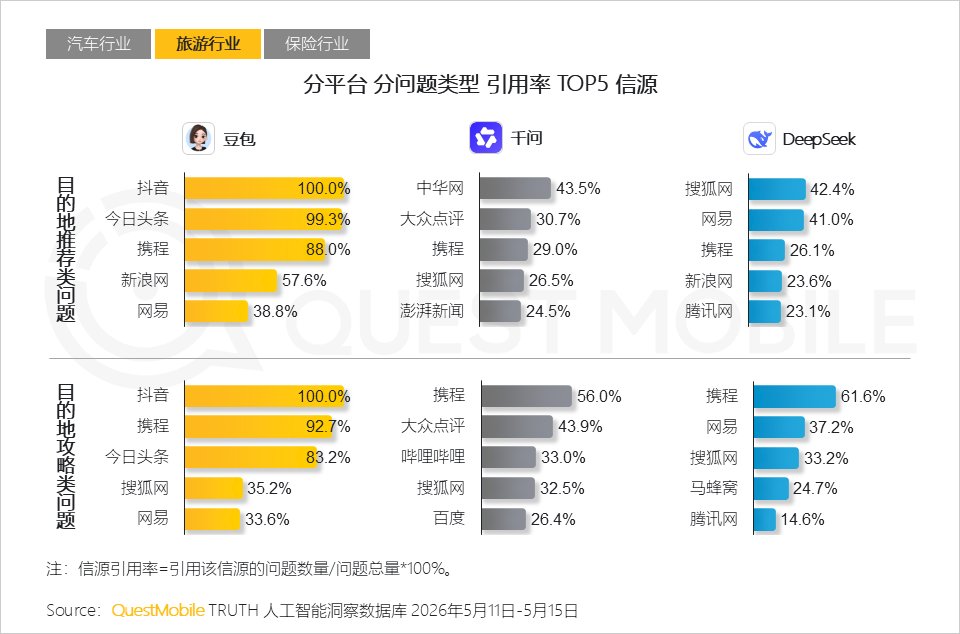
Leading information sources cited by different AI platforms in destination recommendations and guide-related questions.
The original community business model required content to attract users, who would then continue researching guides, participating in discussions, or selecting travel products. AI citations offer a shorter path: content reaches users, who may remain within the AI application.
Citations may drive return visits, and Mafengwo can still vie for these readers. However, Mafengwo must still provide a dedicated reason for users to open its platform. Useful information only fulfills part of the business equation.
Fliggy's circumstances differ from Mafengwo's. While travel guides can be excerpted and summarized, real-time information about hotel availability, pricing, and cancellation policies requires connections to actual products and booking rules. Fliggy's transactional capabilities make it easier to participate in revenue distribution.
This positions Fliggy to become a travel transaction “plugin.” While commodity and booking services drive business, consumers may initiate requests through other applications.
Mafengwo cautions Fliggy: Despite a significant contraction in standalone App activity, the company continues operating destination-oriented businesses. It can still serve tourism destinations but must still strive to persuade consumers to open its App.
For Fliggy, Alibaba's resources might even make this process less visible. Order growth driven by Taobao can continually demonstrate the travel business's utility to the group. However, if consumers' next requests still originate from Taobao, Fliggy secures another order rather than fostering an independent choice.
03 Alibaba Needs a Fliggy It Can Leverage
Qianwen has already integrated this path into its product.
On January 15, 2026, Qianwen integrated with Fliggy and other Alibaba businesses, opening flight and hotel booking functionality for testing. As demonstrated at launch, consumers can first inform Qianwen of their travel needs, which then leverages Fliggy to find suitable flights or hotels.
Consumers bypass the initial step of selecting a travel platform. For Alibaba, Fliggy enables Qianwen to progress from making suggestions to facilitating consumption. Previously accumulated travel products, merchant resources, and booking capabilities continue to add value within this new access point.
Alibaba's judgment on access points is straightforward. At the launch event, Wu Jia, responsible for Qianwen's consumer-facing business, told *Caixin* and other media that future standalone AI applications serving as access points will be limited, with comprehensive agents being more competitive.
Pursuing this direction, the group naturally requires Fliggy to provide reliable travel capabilities. Simultaneously, retaining consumers within Qianwen to accomplish more tasks aligns with the comprehensive assistant's objectives. Fliggy's independent traffic and Qianwen's user experience may not receive simultaneous priority.
This division of labor extends from within the group to external developers.
FlyAI Skill enables other AI applications to access Fliggy's travel queries and product links. Developers can enhance their applications with travel services without individually connecting hotels and airlines. However, Fliggy's official FAQ clarifies that some products still require redirecting to Fliggy's detail pages for the latest pricing.
It is not yet a system that handles all travel affair (matters) through a single call. Nevertheless, distribution relationships are already codified.
Promoters, after registering on the platform and configuring formal invocation credentials, can earn commissions on eligible referral orders. Commissions enter an estimated state upon successful user payment and become withdrawable after transaction completion. Currently, hotel and vacation products primarily participate in commission sharing, while transportation does not.

FlyAI promoters earn commissions through eligible completed orders.
Rules reward actual transactions. Developers must create applications that prompt user requests and facilitate purchases, while Fliggy must ensure product discoverability and bookability. This revenue arrangement does not require developers to first cultivate users as regular Fliggy App visitors.
The Cloud Town Conference contest thus finds commercial justification. Alibaba Cloud's BaiLian provides AI development support, Fliggy supplies travel capabilities, and participants experiment with new applications. Upon success, the promotion program can continue incentivizing developers with completed transaction rewards.
This path could certainly drive Fliggy's growth. Opening up to more applications also offers opportunities for orders outside Alibaba's ecosystem. Profiting from products and transaction services remains a valid business model.
The trade-off is that Fliggy must share customer acquisition benefits with these access points and continually vie for recommendations. Users initiate requests within developers' applications, which may also determine product recommendations and display order. To secure such orders, Fliggy must first ensure its products are recommended.
Fliggy still strives to serve users directly. On August 10, it launched the travel AI “Fliggy Assistant,” incorporating planning, booking, check-in, room upgrades, and other services into its product. This move indicates that Fliggy has not abandoned improving its user experience.
It also leaves Fliggy a path: When users encounter complex cancellations or itinerary changes requiring ongoing service, Fliggy can position itself as a travel platform worth revisiting. The service and fulfillment issues raised during the 2022 reform remain contingent on concrete experiences in the AI era.
However, in query and booking scenarios—areas already integrated with Qianwen—users can directly invoke Fliggy from Qianwen. For Fliggy Assistant to retain users within its product, consumers must perceive greater value in opening Fliggy than continuing within Qianwen. Regardless of whether users book through Qianwen or Fliggy Assistant, Alibaba benefits; Fliggy must strive for users to willingly open its product for their next trip.
-
![]()
Office Agent Showdown: Kingsoft, SenseTime, iFLYTEK, Youdao - Who Makes the Cut, Who's Just Along for the Ride?
-
![]()
Starting at 118,800 yuan with standard LiDAR, the new Lynk & Co 20 is all business this time around.
-
COSTAR Auto Optoelectronic Display Branch Passes Supplier Admittance Review by a Leading Headlamp Enterprise!
-
![]()
Domestic Memory Behemoth Unveils Plan to Invest 34.9 Billion Yuan in Production Scale-Up
-
![]()
Why Is Luxshare Precision Covering the Costs for Chenling Optics, Despite Harson’s Aborted Acquisition?
-
![]()
Dialogue with Phoenix Optics: Riding the 'Optics + AI' Wave with Six Decades of Expertise
-
![]()
Competing on Assets, Not Just Price: 10 Key Insights from NIO and Geely's Battery Swap Integration
-
![]()
Fliggy is Becoming More and More Like a Plugin