Naive.AI Secures $400 Million in Funding Within Three Months: Backed by Tencent, Sequoia, IDG, and Matrix Partners, the Tsinghua-Linked LLM Startup Makes Waves
 09/30 2026
 476
476
Trending AI Editorial Team
Today, Naive.AI, a Tsinghua-affiliated large language model (LLM) company, unveiled its inaugural open-source model, Naive-N0.5-Flash, boasting an impressive 309 billion parameters. Leveraging a Mixture of Experts (MoE) architecture, the model activates 15.5 billion parameters per token and natively supports contexts of up to 1 million tokens. The model's weights and inference code are openly available under the MIT license.
Formally registered as Beijing Zhiyan Huisheng Technology Co., Ltd., the company was established in February 2026 by Dai Jifeng, an associate professor in the Department of Electronic Engineering at Tsinghua University.
Dai Jifeng completed both his bachelor's and doctoral degrees at the Department of Automation, Tsinghua University, in 2009 and 2014, respectively. From 2014 to 2019, he served as a principal researcher in the Vision Group at Microsoft Research Asia. Between 2019 and 2022, he held the position of Executive Research Director at SenseTime Research Institute. In July 2022, he transitioned to a full-time role at Tsinghua University. The core team comprises former members of MiroMind and seasoned experts from SenseTime and Microsoft Research Asia.
Dai Jifeng
Naive.AI has successfully completed three funding rounds this year, amassing a total of $400 million, with a post-money valuation of $1.42 billion.
Key investors include Tencent, Sequoia China, IDG Capital, and Matrix Partners China.
The initial funding round raised $100 million, followed by $180 million in the second round, and $120 million in the third.
Naive-N0.5-Flash is built upon Xiaomi's open-source model, MiMo-V2.5. Among its 48 Transformer layers, 39 utilize sliding window attention, while the remaining 9 employ DeepSeek sparse attention. Notably, the model eschews full attention layers across its entire architecture.
The accompanying inference system, NaiveRT, is predominantly optimized by AI. In standard operation, it achieves a single-user inference speed of 50 tokens per second, with the capability to reach a maximum of 2000 tokens per second in extreme mode. The model is specifically tailored for coding and AI R&D, with AI models directly involved in the R&D process, handling tasks such as code writing, experiment execution, progress monitoring, and iterative refinement.
The company currently has a workforce of fewer than 100 employees. Rather than embarking on pre-training from scratch, it focuses on modifying the structure and optimizing through reinforcement learning, utilizing existing open-source weighted models, while also exploring recursive self-improvement techniques.
Previously, the official website featured only the slogan '100x Intelligence for the pioneers,' with its X account launching in September.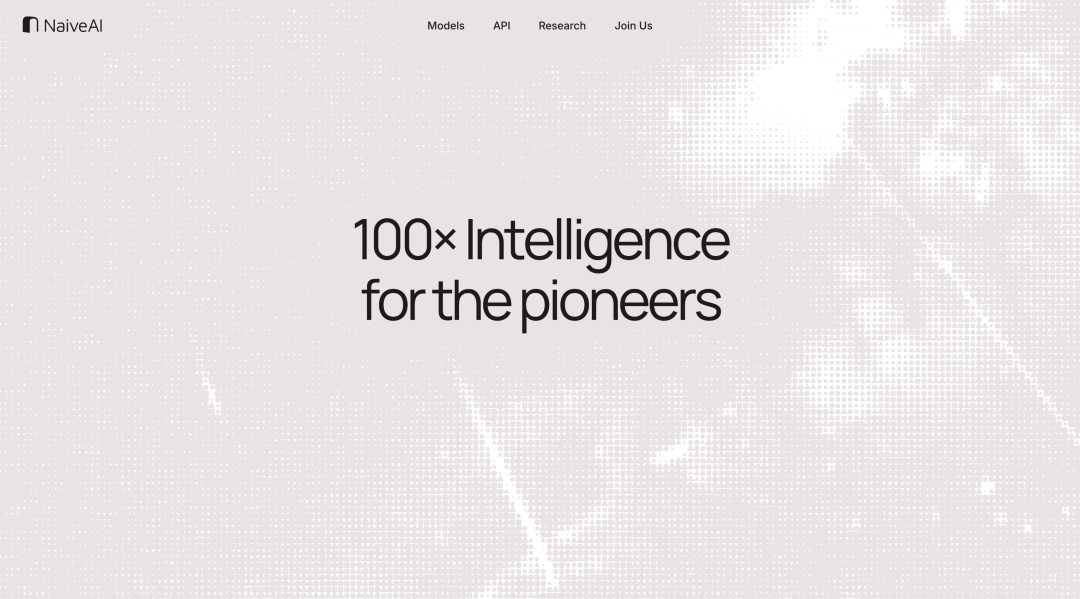
Screenshot of Naive.AI's official website
With $400 million raised across three funding rounds and a valuation of $1.42 billion, Naive.AI has achieved the swiftest capital accumulation in China's NeoLab sector within a mere seven months.
Dai Jifeng's distinguished academic and industry background has significantly bolstered this funding round. However, the true litmus test for sustaining this valuation lies in the actual performance of Naive-N0.5-Flash in coding agent scenarios.
The company's strategic decision to conduct post-training based on MiMo-V2.5, rather than initiating pre-training from scratch, offers high cost efficiency. Yet, the model's capability ceiling remains inherently constrained by the base model.
The architecture's design, featuring 1 million token contexts and the absence of full attention layers, is geared towards two specific domains: long-document encoding and AI R&D automation. Future attention should be directed towards monitoring API call volumes and gathering developer feedback.
-
![]()
Magic9 Teams Up with ARRI, Honor Takes Center Stage
-
![]()
Naive.AI Secures $400 Million in Funding Within Three Months: Backed by Tencent, Sequoia, IDG, and Matrix Partners, the Tsinghua-Linked LLM Startup Makes Waves
-
![]()
The World Mocks the Starship’s Explosion, Yet Overlooks Its Silent Revolution
-
![]()
Deal Sealed: Strategic Collaboration Between FAW and GAC Unveiled, Paving the Way for a New Era of Central-Local Synergy in China’s Auto Sector
-
Is This the Largest IPO in AI History? Anthropic’s Valuation Could Surpass $2 Trillion
-
DataCanvas Applies for Hong Kong IPO: Revenue Soars Ninefold in Two Years, Third-Party Intelligent Computing Faces Breakthrough Challenges
-
![]()
After Investing 20 Billion Yuan in Battery Swapping, Why Has NIO Entered into a 'Strategic Alliance' with Geely?
-
Hot Topic | ByteDance and JD.com Roll Out World Models, Eyeing a Prime Spot in the Spatial Computing Ecosystem