Manus Aims to Be the 'All-in-One Suite' for the AI Era
 09/30 2026
 479
479

AI Agent: A Precursor to Future Superintelligence?
Image Source | Internet (Please contact for removal if infringing) Partially AI-generated
Manus, the company whose single invitation code once fetched up to 100,000 yuan, dropped a bombshell less than a month after resuming independent operations.
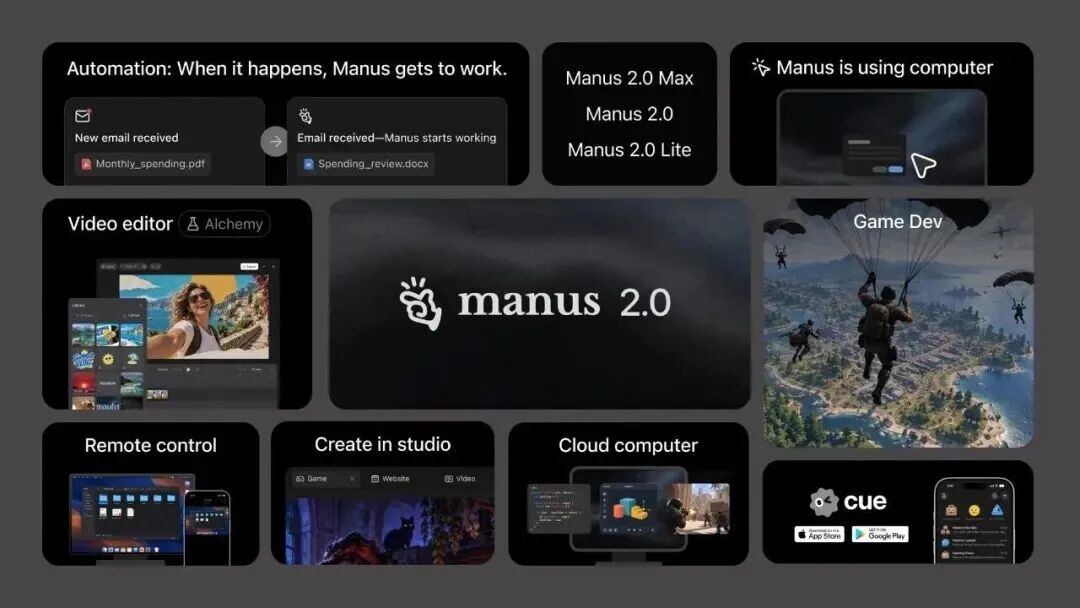
On the night of September 28, Manus officially released version 2.0 and introduced Cue, an independent intelligent agent application for personal life scenarios. The official blog unusually opened with 'We're back,' and founder Xiao Hong bluntly stated on social media: 'Manus is a bit like selling computers.'
Why would an AI Agent company say it's selling computers? To understand the strategic logic behind this, we must first examine what Manus 2.0 has to offer.

Manus Aims to Offer an 'All-in-One Suite'
If we were to summarize the Manus 2.0 update in one sentence, it would be the transformation from 'helping you complete a task' to 'helping you build a complete work environment.'
Viewed from the bottom up, this upgrade consists of three layers.
The bottom layer is the self-developed Agent framework, Cascade. Its design philosophy is counterintuitive—it keeps projects as lightweight as possible at the initial stage, only invoking specialized capabilities when truly needed for the task.
Official test data shows that Cascade reduces Token consumption by 23.2%, task completion time by 28.2%, and operational costs by 32%. Together, these figures essentially address the biggest pain point in the Agent industry: high costs.
In the past, AI Agents often consumed large amounts of Tokens when handling complex tasks, with a single long-chain task potentially costing tens of dollars. Cascade has figured out this equation.
The middle layer involves cloud computing and automation. Users can directly purchase cloud-based operational environments from Manus, including Linux, Mac, and Windows, meaning Agents no longer rely on your computer being on to function.
Multiplayer game servers and 24/7 automation processes remain online even after you close your laptop.
Automation capabilities have also been upgraded from simple scheduled tasks to event-triggered actions: new emails, advertising data fluctuations, calendar events, Slack messages, and Notion updates can all trigger Manus to execute preset workflows.
The top layer consists of a tool matrix for specific scenarios. The desktop application has been upgraded to Manus Studio, covering documents, spreadsheets, PDFs, presentations, websites, code, games, and videos.
The video editor and game development environment are two of the most representative new capabilities. The former allows users to directly modify AI-generated videos in a timeline format without regenerating the entire content; the latter supports starting from templates, managing assets, modifying code, adjusting scenes, and publishing as websites or configuring multiplayer connectivity.
Together, these three layers represent Manus's vision of an 'AI All-in-One Suite': the base layer manages efficiency, the middle layer ensures continuous operation, and the top layer delivers specific outputs. The 'bucket' contains more and more items, but each project only uses what it needs.

Issuing ID Cards to AI
If Manus 2.0 represents a major iteration of its product line, then Cue is the most imaginative element of this release.
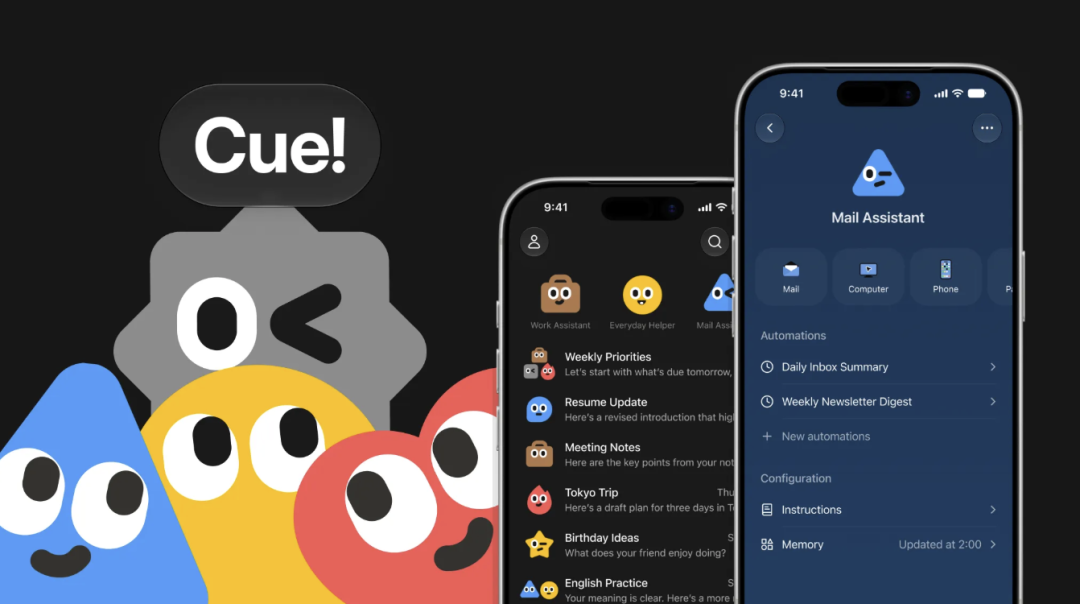
Cue is a standalone personal Agent application. Upon opening it, you'll notice it resembles an instant messaging software: contacts, chats, avatars, and groups. However, all the 'contacts' in this 'messaging app' are AI.
Each Cue Agent has its own email, phone number, digital wallet, and cloud computer. It can send messages, receive calls, and make autonomous payments within a user-set budget in its own 'identity.'
Multiple Agents can also be brought into the same group chat to collaborate on a goal, with one responsible for research, another for compiling lists, and another for drafting documents.
This means AI is no longer just a tool waiting in a dialog box for your prompts—it now has an 'identity' that can be contacted by the external world.
Cue is currently in an early access phase with an invitation-only system. Users can create Agents with different responsibilities, name them, assign roles, and form them into teams.
Xiao Hong's definition of Cue is bold. He wrote on social media: 'A 'thing' with an independent phone number, email, payment method, computer, and sufficient 'intelligence' might as well be called a 'person.'
This statement may sound provocative, but the product logic behind it is clear: only when AI possesses an independent identity and communication capabilities can it truly handle tasks that require 'interacting with people' on your behalf.
Answering landlord calls, verifying hospital bills, waiting for appointment slots, checking refund statuses—these tasks all require a 'contactable presence' to execute.
Returning to the founder's metaphor.
'I've always thought Manus is a bit like selling computers. Maybe people buy computers mainly for work, but a computer that can't watch videos or play games would be pretty boring.'
On the surface, this is user education—telling everyone that AI Agents aren't just tools for work but can also be partners for leisure. But on a deeper level, this metaphor reveals a fundamental shift in Manus's business model.
Traditional AI products operate on a pay-per-use or subscription model. Users complete a task, consume some Tokens, pay a fee, and that's it. But with the introduction of cloud computing in Manus 2.0, things have changed: users are no longer just purchasing a single task but renting computing resources, software environments, and continuous runtime.
Cloud computers host not just single tasks but long-running automation processes, always-online game servers, and the digital spaces where Agents 'live.'
This model more closely resembles the business logic of consumer electronics or even cloud computing—you're not buying a one-time service but the right to use a 'computer.'
This also explains why Manus is venturing into video editing and game development now: if cloud computers were only used for automation tasks, users wouldn't feel the need to 'own one.' But if it can run games, edit videos, and create fun content, then this 'computer' has a reason to stay.
Xiao Hong even envisions a more distant future: 'In the near future, an individual will be able to control massive computing clusters to satisfy their curiosity and make mathematical or scientific attempts.'

Meta's 'All-in-One Suite' Takes a Different Approach
When Manus aims to offer an all-in-one suite, it can't avoid comparing itself to Meta.
In early September, Meta officially launched its personal AI Agent, Muse, at the Connect conference. Mark Zuckerberg positioned it as a 'personal superintelligence': an all-round Agent that understands user goals and can represent them in work. It surpassed 2.5 million downloads within two weeks of launch.
Muse and Cue emerged in almost the same time window but with fundamentally different underlying logics.
Meta prioritizes distribution. Muse is directly embedded into Instagram, Facebook, WhatsApp, Messenger, and Meta smart glasses. Users don't need to download a separate, unfamiliar app to access AI capabilities within their existing social scenarios.
Meta also opened the Connector Platform, integrating external services like Spotify, OpenTable, Stripe, Shopify, and PayPal, receiving over 1,500 developer applications within two weeks.
Alexandr Wang explicitly stated that Meta's strategy is to 'distribute technology widely rather than concentrate it in the hands of a few organizations.'
Manus prioritizes product depth. Without billions of users on social platforms to leverage, Manus must focus on the experience and feature density of the product itself.
Cue's 'multi-Agent group chat' is a differentiated design that Meta hasn't pursued. You can simultaneously coordinate multiple specialized AI assistants in a single group to complete complex tasks. Meta's Hatch platform, while also developing Agents, emphasizes long-term memory and cross-service operations deeply tied to Meta's social ecosystem.
The two approaches have different foundations but aim for the same goal: whoever can truly integrate AI Agents into users' daily lives will gain the upper hand in this race. 
Can the Numbers Add Up?
After discussing the product, we must discuss money.
Manus's highest subscription tier costs $200 per month, while Meta's Hatch is priced at a maximum of $199.99. The prices are nearly identical, but the cost structures differ entirely.
Manus's Cascade framework reduces operational costs by 32%, which gives it the confidence to maintain high pricing without operating at a loss.
However, the issue lies in the fact that Cue equips each Agent with independent cloud computing, phone numbers, and payment capabilities—infrastructure with non-negligible marginal costs. The more Agents there are and the higher their activity levels, the greater the cost pressure.
According to public information, Meta completed its acquisition of Manus for $2 billion in December 2025 but was later forced to divest due to regulatory reasons. Tencent is now leading a Chinese consortium to repurchase all of Manus's equity from Meta at a valuation of approximately $2 billion.
After resuming independent operations, Manus must complete commercialization validation without the support of giant corporate resources.
During its seven fastest-growing months of revenue, Manus proved its market appeal, but whether it can achieve scalable profitability while keeping costs under control remains an unanswered question.
If we zoom out, we'll see that the direct competition between Manus and Meta is just a slice of the escalating competition across the entire AI Agent sector.
The competitive focus is shifting from model capabilities to product experience. When the gap in underlying model capabilities narrows to the point where average users can't perceive it, the deciding factor for Agent products is no longer whose model is stronger but whose product is more usable, understands users better, and covers more scenarios.
Manus 2.0 packs video editing, game development, and remote control into a single product, essentially building competitive barriers through feature density.
'Identity' is becoming a standard feature of Agent products. Cue equips AI with emails, phone numbers, and wallets, while Meta's Muse also has independent cloud virtual machines and dedicated email addresses. When each Agent has its own 'identity,' multi-Agent collaboration will become the next Flashpoint (breakthrough point) for product innovation.
Manus's domestic expansion is worth watching. The company has explicitly stated it is assembling a team to develop products for the Chinese market, with steady progress in collaborations with domestic model vendors and ecosystem partners. Xiao Hong admitted that 'the overseas ecosystem is open, making it easy to create a decent experience,' implying that domestic market implementation will face more challenges.
However, Tencent's background as a potential majority shareholder may provide unique resource support for Manus's domestic journey.
2026 has been defined by multiple industry insiders as the first year of large-scale commercialization for intelligent agents. Gartner predicts that by 2028, the average Fortune 500 company will have over 150,000 AI Agents.
Against this backdrop, Manus's choice to launch 2.0 and Cue immediately after resuming independence is both a showcase of its product capabilities and a declaration of strategic positioning.
It's as if, after immersing itself in development, the company is now stepping out to announce that it won't miss the opportunities in AI Agent development.
-
![]()
August Online Market for Consumer-Grade Action Cameras: Volume, Value, and Price All Rise Year-on-Year, with New Products Fueling High-End Expansion
-
![]()
Surging by 1.3 Trillion Yuan in a Single Day! Meta's AI Triumph Led by a Chinese AI Guru
-
The Hidden Risks in Second-Hand Transactions of Intelligent Driving Vehicles
-
Yutong Optics’ Array-Molded C-Lens Hits Monthly Shipments of Tens of Millions!
-
Survival Game of New Energy Vehicles Accelerating Industry Reshuffle
-
![]()
Why Doesn't a 58% Gross Profit Margin Lead to Growth? The IPO of an Optical Industry Giant
-
Qijing GT7 Fails to Make a Breakthrough, Liu Jiaming’s Debut Ends in Disappointment: GAC Group’s Premium Push Hits Another Snag
-
Sales Plummet Over 40% Again: Can Qian Yang’s JiaYue 07 Revive Roewe?