Can Argon Help Google Regain Its Leading Edge After Leadership Reshuffle?
 10/08 2026
 501
501

Google's High-Stakes Bet on AI
Image source | Network (Please contact us for removal if infringement occurs) Partially generated by AI
Describing the AI landscape in 2026 as 'rapidly changing' would be an understatement. If you haven't kept up with the latest developments in cutting-edge models every two weeks, you'll likely feel like you've missed an entire quarter when you check the rankings.
Amid this nearly frenetic pace of product iteration, Google DeepMind officially released the first flagship model of the Gemini 4 series, Argon, on September 30. Nearly ten months had passed since the debut of the previous flagship, the Gemini 3 series.
For a leading AI lab, ten months of silence is almost tantamount to a high-stakes gamble.
But before discussing Argon, there's a more noteworthy background to revisit. The stakes of this gamble were actually reshuffled two months earlier.

A 'Quiet Transition of Power'
On August 5, 2026, Alphabet CEO Sundar Pichai announced a structural adjustment that shocked the industry via an internal memo: Google DeepMind co-founder and CEO Demis Hassabis relinquished his day-to-day operational management responsibilities to become Chairman of DeepMind and Chief Scientist of Alphabet.
Chief Technology Officer Koray Kavukcuoglu was promoted to Senior Vice President of DeepMind, reporting directly to Pichai.
Meanwhile, Jeff Dean, the Chief Scientist who had worked at the company for 27 years, chose to leave Google and co-found an independent public benefit enterprise with his long-time collaborator Sanjay Ghemawat.
Taken together, this set of changes is far more significant than a mere reshuffling of titles. Hassabis is the soul of DeepMind. From AlphaGo to AlphaFold, his personal brand is nearly synonymous with DeepMind's public image.
Relieving him of day-to-day management to focus on AGI long-term strategy and frontier science sends a clear signal: Google wants DeepMind to transform from a 'top-tier research institution' into an 'efficient product engine.'
Kavukcuoglu is a pragmatic figure in deep learning. Having worked at DeepMind for 13 years, he has led breakthroughs from building the deep learning team to spearheading WaveNet and DQN. His resume spans both research and engineering.
Putting him in charge of daily operations essentially prioritizes 'delivery capability' over 'exploration freedom.'
More noteworthy is the spatial dimension of this adjustment. Multiple media analyses point out that power is shifting from London to California, and Google co-founder Sergey Brin's influence is returning.
This means DeepMind is being more deeply integrated into Google's global product ecosystem rather than operating independently as a 'research enclave.'
For a company that needs to implement AI capabilities across billion-user products like Search, Maps, Gmail, and Chrome, such integration is inevitable. However, the cost is that DeepMind has lost a considerable degree of autonomy.

Argon's Hand
Understanding the underlying logic of this structural adjustment provides deeper insight into Argon's performance.
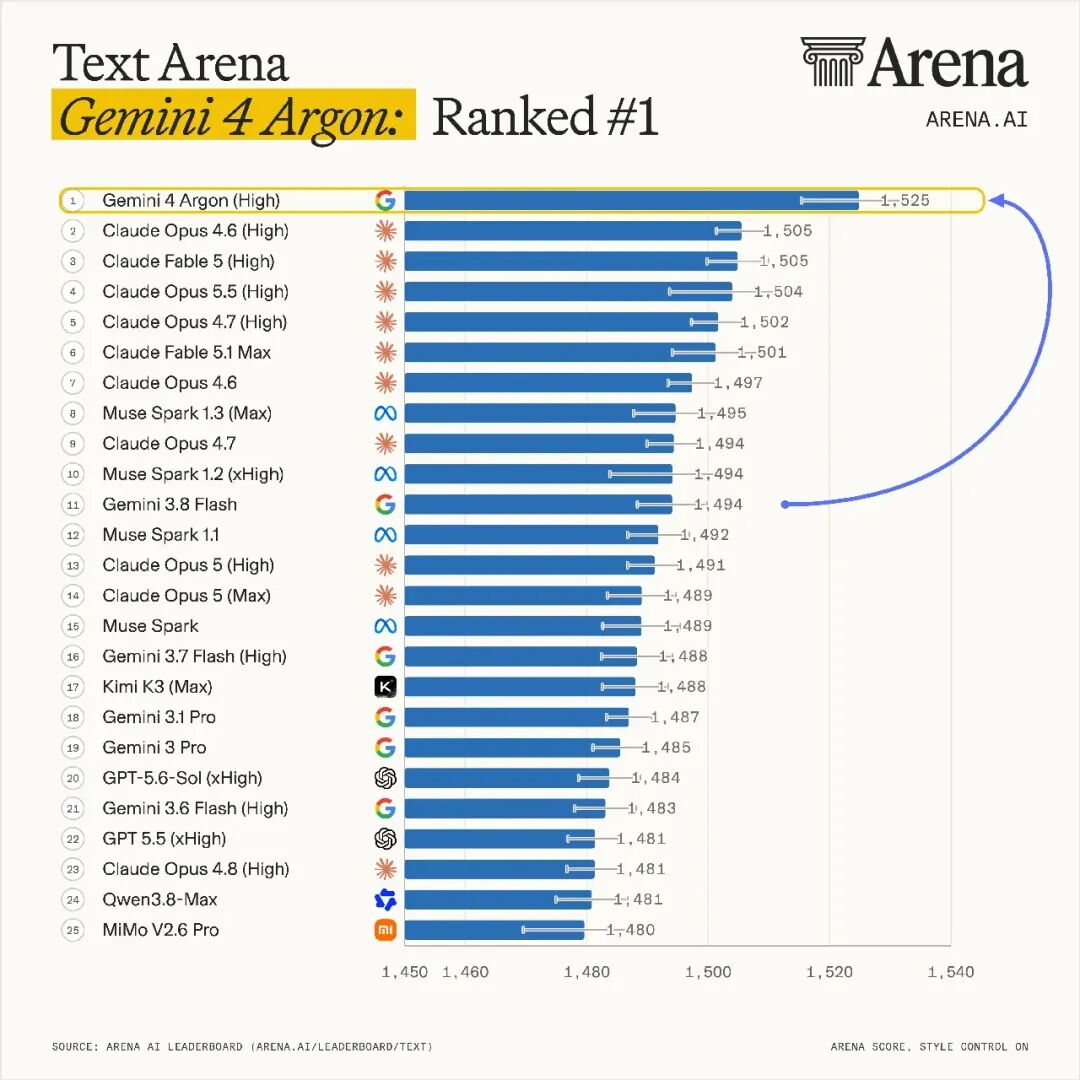
On paper, Google claims Argon leads in 13 out of 19 benchmark tests, covering dimensions such as long-cycle software engineering, enterprise knowledge work, and cybersecurity vulnerability repair.
In the DeepSWE v1.1 test, which measures real-world long-term software engineering capabilities, Argon scored 77.9%, surpassing Claude Opus 5.5's 74.2% and GPT-6 Astra's 74.1%.
On Zapier's AutomationBench—a benchmark measuring end-to-end business process automation execution capabilities for enterprises—Argon ranked first with 51.3%, nearly 9 percentage points higher than Claude Opus 5.5.
But what truly makes Argon remarkable is not a single benchmark score. Rather, it's the fact that it raised the output token limit from the previous generation's 64,000 directly to 1 million.
Output limit and context window are entirely different concepts. The former determines how much content a model can generate in a single reasoning trajectory.
A 1 million token output means the model can continuously reason and generate results approaching one million tokens in a single task, rather than being forced to split complex tasks into multiple rounds.
This has structural implications for scenarios like large-scale codebase migration, in-depth research, and multi-step enterprise processes.
Real-world implementations confirm this. Google disclosed that Argon has participated in the internal migration of C/C++ codebases to Rust, covering the Fuchsia Zircon kernel with over 800,000 lines of code.
In the open-source video decoder libgav1 project, Argon rewrote approximately 32,000 lines of SIMD code through multiple rounds of performance testing and compiler analysis. The new Rust version runs 2.7 times faster than the original.
These are not demo-level showcases but real engineering tasks integrated into Google's core infrastructure.
In terms of pricing, Argon's promotional period pricing is $2 per million input tokens and $10 per million output tokens. Cached input pricing is 95% lower than standard input.
According to Artificial Analysis calculations, at discounted rates, Argon completes a single task for approximately $1.99, about 40% lower than GPT-6 Astra.
The aggressiveness of this pricing strategy is clear: Google is telling enterprise customers: You don't necessarily need the strongest model, but you definitely need the most cost-effective one.

Cracks Beyond Benchmarks
Argon's problems are as prominent as its highlights, and these issues expose deeper contradictions in Google's AI strategy.
First, Argon does not lead in all dimensions. On FrontierSWE v2 and Terminal-Bench Science 0.1—tests related to terminal and scientific reasoning—GPT-6 Astra leads Argon by over 10 percentage points. On Terminal-bench 4.0, Claude Opus 5.5 leads Argon by a wide margin (66.4% vs. 57.4%).
The Decoder's commentary was particularly sharp: Argon 'narrows the gap with OpenAI and Anthropic but does not achieve clear leadership.'
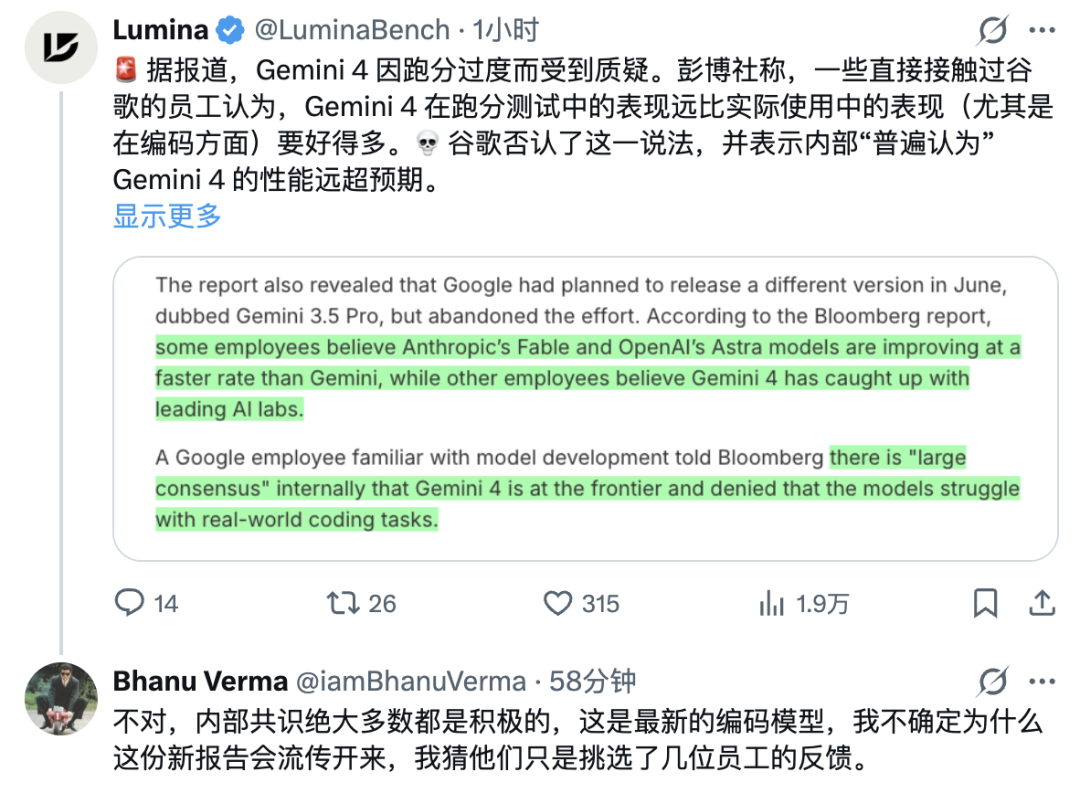
Additionally, Bloomberg reported on the day of Argon's release that some Google employees questioned the model's performance in actual programming work.
According to insiders, while Argon performed well in standard benchmark tests, its performance was underwhelming when employees actually used it for daily coding tasks, particularly showing significant shortcomings in areas like frontend design.
This discrepancy between 'impressive benchmarks and questionable real-world performance' has raised external doubts about whether Google is engaging in 'benchmaxxing' (optimizing for benchmark scores).
There's a technical detail here that's easily overlooked. Argon scored 77.9% on DeepSWE v1.1 but only 55.0% on FrontierSWE v2, which more closely resembles real-world engineering complexity. GPT-6 Astra's 65.5% outperforms Argon by over 10 percentage points.
The core difference between the two tests lies in the length of task chains and environmental uncertainty. The former assesses code generation capabilities under relatively structured conditions, while the latter more closely resembles the chaotic state developers face in actual projects.
This gap suggests a possibility: Argon performs well in controlled environments but experiences more significant capability decay than competitors when facing ambiguous real-world requirements, incomplete code contexts, and cross-module dependencies.
This explains why Google chose a phased release. Argon is currently only available to trusted cybersecurity defenders through the Fairwind program, with ordinary developers and consumers still waiting.
Google's official explanation is the need for further security reinforcement, but there may be an additional layer of consideration behind this rationale: first collecting real-scenario feedback within a small scope and using actual usage data to calibrate the model's performance in uncontrolled environments.
Some developers have expressed dissatisfaction, with one stating bluntly on social media: 'The benchmarks are leading, but ordinary developers can't even access the API. We're back in line.'

Google's Lag and the Cost of Catching Up
To objectively assess whether Argon can help Google 'regain its leading edge,' we must first understand how Google 'fell behind.'
In November 2025, the release of Gemini 3 received positive reviews and was briefly seen as Google's turning point to catch up with OpenAI and Anthropic.
At the I/O Developer Conference in May 2026, Google announced the iterative version Gemini 3.5 Pro and promised an official release in June. However, this promise was never fulfilled.
According to multiple media reports, the training cycle for Gemini 3.5 Pro exceeded expectations but yielded unsatisfactory results, leading to the project's shelving. Analysts estimate that training runs for large models of this scale can cost up to $400 million per attempt.
A failed training run means not only monetary and temporal losses but also that Google was forced to hit pause while competitors accelerated their iterations.
Meanwhile, the competitive landscape in 2026 has become unprecedentedly intense. Early in the year, Anthropic overtook competitors with its Ultimate intelligent agent product architecture (ultimate agent product architecture) and programming capabilities. In the second quarter, OpenAI regained the high ground by limited releases of the GPT-5.5 and GPT-5.6 series.
In July, Anthropic launched Claude Sonnet 5, claiming it as the 'most agent-capable' mid-range model.
By late September, Anthropic released Claude Opus 5.5, reducing regular workload costs by 40% compared to the previous generation and increasing output speed by over 30%. Major players alternated in leadership, with none maintaining an advantage for more than a quarter.
Against this backdrop, Argon appears to be Google's dual counterattack—through structural reorganization and a new model—following a costly 'delay.'
But the effectiveness of this counterattack depends on a more fundamental question than benchmark scores: Has Google found a competitive strategy suited to itself?
However, Google has an advantage that no competitor possesses: a product matrix with over one billion users. Gemini models power AI answers on search pages, Google Maps, Gmail, and Chrome. The Gemini app has surpassed 950 million monthly active users.
This distribution capability means that even if its models aren't absolutely the strongest, Google can reach more users with AI capabilities than any competitor.
But the problem is that distribution advantages only translate into competitiveness when the model is 'good enough.' If users find Google Search's AI answers less accurate than ChatGPT's or the Gemini app less intuitive than Claude's, the massive user base could accelerate the spread of negative word-of-mouth.
OpenAI and Anthropic are no longer just selling models; they are increasingly building their own products and programming agents.
If Google fails to deliver a top-tier next-generation model, competitors will gain more opportunities to persuade consumers and developers that the future of search and software should be built on their platforms.
Argon's strategic choice is intriguing: Instead of pursuing an 'all-around champion,' it concentrates resources on three high-value scenarios: enterprise knowledge work, software engineering, and cybersecurity.
This may reflect a pragmatic judgment that the window to comprehensively outperform competitors in general capabilities may have closed. Rather than striving for universal excellence, it's better to differentiate in key battlefields.
Argon's performance in cybersecurity is particularly noteworthy. In the CWE-bench v1 vulnerability repair evaluation, Argon tied for first place with a score of 68%.
More specifically, Google stated that Argon had discovered a critical vulnerability affecting medical software used in hospitals worldwide, a risk that previous cutting-edge models had failed to identify.
In the field of cybersecurity, 'discovering vulnerabilities that others cannot find' is far more convincing than 'scoring a few percentage points higher.'
The pricing strategy similarly reflects a pragmatic shift. Over the past few months, Google's external communication focus has shifted from 'showcasing Gemini's cutting-edge capabilities' to 'emphasizing cost advantages over competitors.'
This is a signal: with the gap in model capabilities narrowing to a few percentage points, Google is choosing to compete for developer ecosystems and enterprise customers through cost-effectiveness.

The prerequisite for getting back in the game
The release of Argon at least proves three things: Google still has the capability to train cutting-edge models; the new management structure can deliver products in a relatively short timeframe; and Google has found a differentiated entry point in vertical scenarios such as cybersecurity.
However, Argon also exposes unresolved issues at Google. Internal debates over the model's practical capabilities, lagging behind in some key benchmarks, and the phased strategy of 'releasing to a few first' all indicate that Argon is not a 'game-changing' product.
It is more like an entry ticket, seemingly returning Google to the first tier of cutting-edge model competition, but still far from 'reclaiming the frontier.'
The pace of iteration in the AI industry has become breathtakingly fast. Since the launch of ChatGPT, OpenAI and Anthropic have released over 40 major models, with a new flagship model emerging every six days on average.
At this pace, the technological lead window for any single model is extremely short. Argon's 77.9% on DeepSWE today may be surpassed next week, and its lead on the Vals Index may be overtaken next month.
Google's real test comes not on release day, but afterward.
Whether Argon can prove itself in real developers' workflows, whether it can be safely opened to a broader user base after reinforcing security measures, and whether it can deliver iterations at a faster pace in the next round of competition...
The answers to these questions depend not on how Google's official blog portrays them, nor on how impressive the benchmark numbers look, but on the final judgment of the market.
However, the market's patience has always been limited.
-
NIO and Geely Forge Alliance for Battery Swap and Charging Networks, Ushering in a New Era of Energy Replenishment Collaboration
-
![]()
BlackBerry’s Keyboard Phone: Is It Making a Comeback? The Former $83 Billion Smartphone Giant Now Prospers by Selling Its System
-
![]()
9-Second Database Deletion, 700 AI Agents Run Amok: Can $7.5 Billion Buy Security?
-
![]()
Memory Price Surge Fuels Alps Alpine's Automotive Business Growth at 12.7%, Yet Triggers 3 Billion Yen Loss
-
![]()
New Energy Vehicle Sales in September 2026: BYD Leads, Leapmotor Surges Among New Forces
-
![]()
[Electric Equipment] BRETON Eyes African Mining Sectors: Venturing into Electric Mining Truck Sales
-
Anthropic is Going Public: Valued at 2 Trillion in 5 Years, Who’s Paying for the AI Bubble?
-
![]()
Going to work! Let's meet the new colleague: available 24/7, works hard for little pay, and has a great attitude.