Jensen Huang Backs Post-85 Twin Entrepreneurs: Leasing AI Computing Power, Company Valued at $97 Billion
 10/13 2026
 455
455
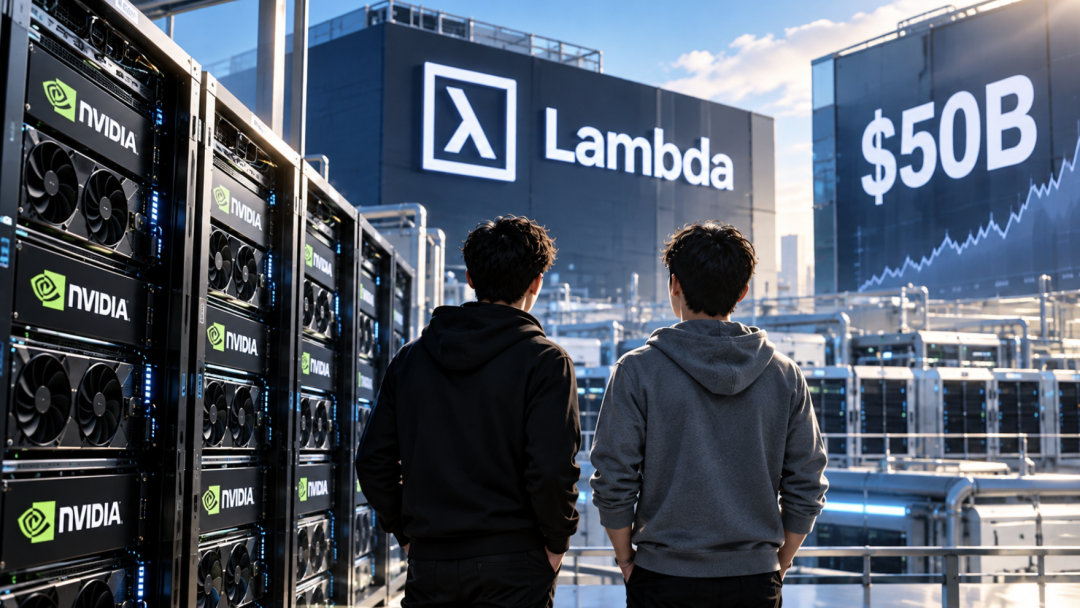
Cover Image | Produced by Pencil News
A firm specializing in leasing GPU computing power has secured $50 billion in orders.
The company, Lambda, constructs computing clusters and leases out the computing power, charging service fees. Nvidia is also among its investors.
How booming is this industry?
In June this year, Lambda's order backlog stood at $15 billion. By September, it had soared to $50 billion, notably with a $35 billion computing power contract inked with Anthropic in late August.
As orders continue to pour in, Lambda is still actively seeking funds.
Recently, it plans to raise up to $4 billion (approximately RMB 27 billion) in financing, led by Blackstone Group and Coatue, with a pre-investment valuation of $14.5 billion (approximately RMB 97.2 billion). The company aims to go public in 2027.
Why is Lambda in need of funds?
Customers can defer rent payments over several years, but Lambda must first invest in GPUs and data center construction.
Some observers note that computing power is increasingly resembling a new real estate venture: acquiring land, constructing properties, and then selling or leasing them.
- 01 - Twin Brothers Launch Computing Power Leasing Venture
Lambda was founded by twin brothers born after 1985.
In 2012, Stephen Balaban and his twin brother Michael Balaban established Lambda, initially delving into artificial intelligence research and experimenting with businesses like facial recognition.
Back then, the AI industry was far less vibrant than today. Stephen acquired a workstation equipped with four Nvidia GTX 580 graphics cards from a friend to train neural networks.
Around 2015, the team developed a photo application called DreamScope, which could transform ordinary photos into artistic styles like oil paintings. The product attracted about 1 million users and processed tens of millions of photos.
However, the more users they had, the riskier the company's financial situation became.
Training and processing photos demanded substantial computing resources, leading Lambda to pay approximately $40,000 per month to Amazon Web Services (AWS). Given their financial situation at the time, the team might have only had two or three months of runway left.
An early investor advised them: Since renting servers is so costly, why not buy your own?
The brothers did the math. Investing $60,000 to purchase equipment and build their own computing cluster could save them the $40,000 monthly cloud service fee.
The issue was that $60,000 was a significant sum for a small company.
Stephen later recalled in a podcast that he was very apprehensive this investment would bankrupt the company. To mitigate risk, they deliberately bought workstations that could be disassembled and sold, ensuring they could recoup some costs if the venture failed.
As it turned out, this investment paid off in about one and a half months.
More importantly, the brothers realized that helping others save on computing power expenses could be more lucrative than developing AI applications.
Lambda then shifted to selling AI workstations and servers and gradually built a cloud computing platform. According to Stephen's recollection, in 2017, the company's hardware business revenue was about $3 million, rising to $10 million in 2018 and $30 million in 2019.
This transformation laid the groundwork for Lambda's current business.
In essence, Lambda leases out AI computing power.
Developing large models requires expensive Nvidia GPUs, but not every company wishes to purchase equipment and build its own machine rooms. Lambda handles equipment procurement, assembles computing clusters, and then provides computing power to customers under contract.
Customers avoid the hassle of operating their own data centers, while Lambda profits from leasing computing resources.
Such firms have been dubbed Neocloud (emerging AI cloud service providers) in recent years. Compared to traditional cloud computing giants like Amazon and Microsoft, they focus more on GPU computing power.
Lambda's client roster is also growing increasingly impressive.
In November 2025, it signed a multi-year agreement worth billions of dollars with Microsoft, planning to deploy tens of thousands of Nvidia GPUs. In late August this year, another major client, Anthropic, signed a $35 billion cloud computing contract.
From developing photo applications to selling graphics cards and then constructing AI computing clusters for leading large model companies worldwide, Lambda's journey has spanned over a decade.
However, after scaling up, the founders discovered a familiar challenge: They needed to spend money first to make money.
The $60,000 that once made them nervous has now ballooned into billions of dollars.
- 02 - Entrepreneurial Loans
Lambda's most valuable assets currently are not just GPUs but also the long-term contracts signed with major clients like Microsoft and Anthropic.
These contracts are reshaping the company's financing strategy.
Traditionally, startups seeking funds had to demonstrate growth potential to venture capital firms and exchange equity for capital.
Lambda has an additional option: Using equipment and contracts as collateral to borrow from banks, insurance companies, and other institutions.
In April 2024, Lambda secured $500 million in financing, using Nvidia GPUs as collateral, to expand its computing power business.
By 2026, this type of financing accelerated further.
In May, Lambda expanded a secured credit facility to $1 billion. In August, the company obtained another $926 million in loans to support GPU deployments for contracted clients.
On October 1, it announced the completion of a new $1.008 billion fixed-rate loan with an interest rate of 6.78% and a final maturity date of 2033.
This loan is particularly noteworthy.
The collateral includes not just GPU servers but also the contract cash flows from two investment-grade clients.
This means that, in the eyes of lending institutions, a reliable contract with a major client now holds financing value akin to infrastructure assets.
For instance, Lambda receives a long-term computing power order but lacks sufficient funds to purchase GPUs. It can present the contract to financial institutions and use future rental income and equipment as debt repayment guarantees to borrow funds for the purchase.
After the equipment is deployed, customers make payments gradually, and Lambda uses the revenue to pay interest and repay the principal.
Thus, a cycle is formed: Sign orders, obtain loans, purchase GPUs, deliver computing power, collect rent, and repay debts.
This approach enables Lambda not to rely solely on equity financing and eliminates the need to wait for one batch of equipment to recover costs before purchasing the next.
However, two prerequisites exist: Customers must have the ability to make continuous payments, and Lambda must deliver computing power on schedule.
Therefore, Anthropic's $35 billion order is crucial.
This model is not unique to Lambda.
In September 2025, peer company Nebius signed a five-year computing power agreement worth about $17.4 billion with Microsoft. The company explicitly stated that it plans to use contract cash flows and related debt financing to pay for capital expenditures.
A shift is occurring in the AI computing power industry: Companies are not only vying to secure orders from major clients but also to leverage those orders for low-cost financing.
This also explains a significant personnel change at Lambda this year.
In May, founder Stephen stepped down as CEO and became CTO, focusing on technology and product direction. The new CEO, Michelle Comb, previously led large enterprises such as Sprint SoftBank International, and former AT&T CEO John Donovan became chairman.
A technology company founded by machine learning engineers is now managed by professional managers experienced in large-scale infrastructure operations.
Because what Lambda now needs to handle is not just product development issues but billions of dollars in financing, long-term debt, multiple data center constructions, and major client contract fulfillment.
Technology remains vital, but financing costs, capital structure, and delivery efficiency now directly determine the company's competitiveness.
- 03 - Computing Power Business Resembles Real Estate Rental
Lambda's business model finds a ready parallel in CoreWeave.
This company, also backed by Nvidia, specializes in GPU cloud computing services and has already gone public.
Its financial report unveils the most contradictory aspect of the AI computing power business.
As of the end of June 2026, CoreWeave's order backlog reached about $104 billion, more than double Lambda's disclosed figure.
However, the growing orders have not lifted it out of losses.
In the second quarter of 2026, CoreWeave achieved revenue of $2.575 billion, a year-on-year increase of about 112%, but its net loss reached $626 million.
Among these, net interest expenses were as high as $640 million, equivalent to nearly a quarter of quarterly revenue. Depreciation and amortization reached $1.393 billion during the same period.
These two sets of figures reveal the cost structure of the computing power business.
On one hand, the GPUs purchased by the company must be continuously depreciated. Even if the equipment has not yet recovered its investment, a new generation of GPUs may already be on the market.
On the other hand, the company uses debt to purchase equipment, but interest continues to accrue even when the equipment is temporarily idle.
Assuming a computing power company borrows $1 billion at an annual interest rate of 6.78%, the interest alone would be about $67.8 million per year, not including equipment depreciation, electricity bills, data center rent, and other operating expenses.
If customers pay on time and GPU utilization is high, the company may be able to cover these costs with rental income.
If data center construction is delayed, GPUs sit idle, or the launch of new chips causes rental prices for old equipment to fall, profit margins will be squeezed.
Equipment lifespan is also a topic of debate on Wall Street.
Banks and credit investors typically assess the depreciation of high-end GPUs over a 3- to 4-year cycle, while Nvidia believes that its AI computing equipment may be used for a longer period, even up to 10 years.
Stephen himself leans toward an optimistic view. He once mentioned in an interview that Lambda is still renting out Nvidia V100 GPUs launched in 2017, refuting the notion that high-end GPUs can only be used for three years.
Overall, for Wall Street, GPU rental represents a new investment opportunity.
In the past, insurance companies and long-term debt investors were more familiar with infrastructure projects such as real estate, energy, and telecommunications. Now, GPU computing clusters with long-term contracts from major clients are also entering their investment scope.
However, Wall Street has not unconditionally accepted GPUs as a reliable long-term asset. Loans usually still rely on client contracts, equipment collateral, and other safeguard arrangements.
A decade ago, Stephen discovered that building his own servers was more cost-effective than renting them, leading him to start a computing power business.
A decade later, Lambda has evolved into an AI infrastructure company with hundreds of billions of dollars in orders. But whether it can recover its equipment investment as swiftly as it did back then remains to be seen over time.
Back then, the $60,000 server recovered its cost in one and a half months. Today, how many years will it take for billions of dollars' worth of GPUs to recover their cost?
That's the real calculation Wall Street needs to make before Lambda goes public.
This article does not constitute any investment advice.
-
![]()
AI Bubble in US Stocks with a $2 Trillion Valuation
-
![]()
Jensen Huang Backs Post-85 Twin Entrepreneurs: Leasing AI Computing Power, Company Valued at $97 Billion
-
![]()
Has Qualcomm Begun Paying Royalties to Huawei?
-
The Most Expensive AI Chip Starts to Cool Down
-
The Business Strategy of Autonomous Buses
-
AI Completes Mathematical Proofs in an Average of 3 Hours: Is Scientific Research Heading Towards an Era of Overload?
-
TechVantage Cloud Stock Tumbles Over 80% in a Day: Bridging the Gap Between 'Planning' and 'Delivery' in the Second Wave of Computing Power
-
![]()
AI Glasses: Starting to Take the Initiative