OPPO 'Outsources' AI to Manus After Shipments Drop Over 20%
 10/15 2026
 545
545
On October 12, market research firm Counterpoint released its global smartphone report for the third quarter of 2026, delivering a less-than-impressive performance review for OPPO.
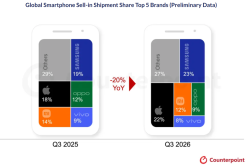
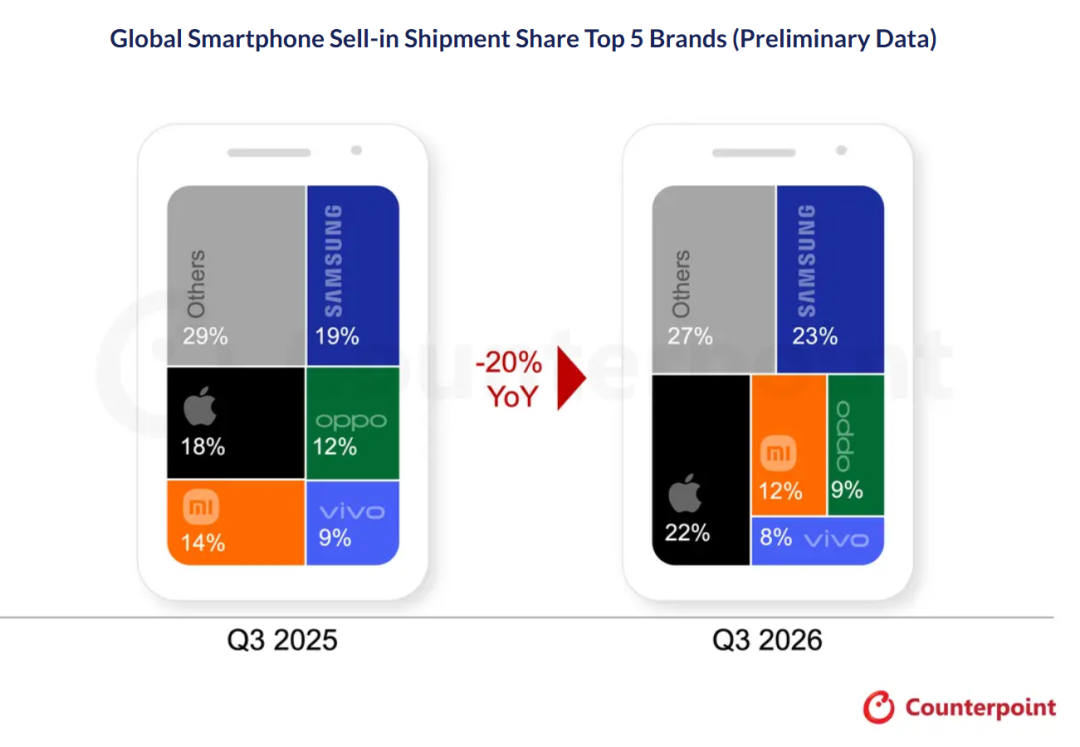
Under a statistical caliber (Note: statistical scope, this term is kept as is due to its specialized context) that includes OnePlus and realme,OPPO's global shipments declined by over 20% year-on-year, with its market share dropping to 9%. During the same period, global smartphone shipments fell by 20% overall, marking the lowest third-quarter level since 2012. Samsung's shipments declined by only 3%, with its share rising to 23%; Apple also saw a decline but its share increased to 22%. While the industry faced widespread pressure, the impact varied across manufacturers.
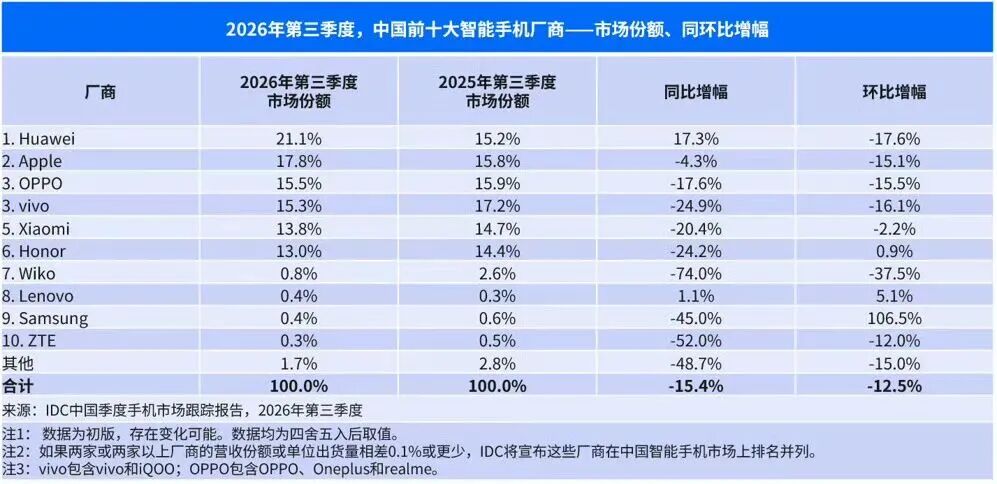
The following day,IDC's China market results further highlighted the pressure OPPO faces domestically. In the third quarter, China's smartphone shipments totaled 57.9 million units, down 15.4% year-on-year, marking the sixth consecutive quarter of decline. OPPO held onto third place with around a 15.5% share, but its shipments fell by 17.6% year-on-year. During the same period, Huawei achieved a 17.3% increase against the trend, while Apple's decline was a modest 4.3%. From global to domestic markets, OPPO failed to maintain its shipment volumes from the previous year.
Attributing this decline solely to operational missteps would be unfair. The expansion of AI data centers drove up demand for memory chips, raising procurement costs for smartphone manufacturers, while consumers extended their device replacement cycles. Counterpoint also noted that OPPO is consolidating its three brands and reducing low-margin products, shifting supply toward more lucrative markets. The changes in shipment volumes thus reflect a degree of strategic prioritization.
In tandem with its scale contraction, OPPO continues to ramp up investments in premium products and system capabilities. In September, the Find X10 series was launched; in early October, rumors emerged about OPPO's foldable and large-screen slab prototypes, though official confirmation is pending. These leaks reflect external interest in OPPO's new product strategies.
On October 13,OPPO announced a partnership with AI agent platform Manus, integrating its multi-step task execution capabilities into AI Mind Pilot, with plans to debut on the Find X10 series running ColorOS 17. That same evening, StepFun launched the STEPX Neo, a smart agent phone priced at 3,999 yuan. While OPPO chose to incorporate external agents into its system, StepFun attempted to redesign smartphones from the model to the operating system. Previously, the second-generation smart agent phone from Doubao and Nubia had also entered the market.
With shrinking shipment volumes, OPPO must rely on pricier products to generate higher revenue. Meanwhile, AI is reshaping how consumers evaluate premium smartphones and redistributing value between smartphone makers and internet platforms.
For OPPO, which has long built advantages through hardware, distribution channels, and product refresh cycles, the latter challenge warrants far greater attention than quarterly sales fluctuations.

According to IDC, domestic market shipments declined by 15.4% in the third quarter, while OPPO's shipments fell by 17.6%—a mere 2.2 percentage point difference. This gap is insufficient to declare a manufacturer as falling behind, especially since quarterly shipments are influenced by channel stocking, inventory adjustments, and new product launches. However, when contrasted with Huawei's 17.3% growth during the same period, it reveals varying resilience among brands amid shrinking demand.
Consumers haven't stopped buying smartphones; they're simply concentrating their purchases on devices they deem worth upgrading to.
Rising memory costs disproportionately impact mid-to-low-end products: a smartphone priced around 2,000 yuan could exceed budgets with a few hundred yuan in price hikes, while maintaining old prices would rapidly erode per-unit profits. Sustaining channel supply for multiple models also incurs costs for material procurement, inventory turnover, and after-sales spare parts.
Counterpoint explicitly noted in its global report that OPPO is reducing business overlap among its brands and redirecting supply resources toward products and markets with relatively higher gross margins. For an asset-heavy, long-supply-chain industry like smartphones, proactively reducing channel inventory and controlling low-margin models can sometimes be more rational than clinging to market share.
To be sure, OPPO's premiumization efforts have yielded partial success. Counterpoint reported that in the first half of 2026,OPPO's global wholesale shipments of smartphones priced at 600 or above grew by 69% year-on-year, among the fastest growth rates among major brands. The Find X9 series was a key driver, with a new model launched in April further boosting sales. This suggests that OPPO's long-term investments in imaging, design, and premium R&D are gaining traction with consumers.
However, from an operational standpoint, rapid growth in premium sales has yet to offset the scale pressures facing OPPO's overall smartphone business. Counterpoint previously estimated that in the second quarter, the average selling price (ASP) of OPPO's smartphones rose by 9% year-on-year, yet smartphone revenue declined by 10%. In the third quarter, global shipments fell by over 20%. A higher ASP could result from either growth in higher-priced models or a decline in low-priced shipments, making it an unreliable sole indicator of improved pricing power.
Since OPPO hasn't disclosed smartphone business profits that align with these third-party figures, it's unclear whether it has achieved better profitability with fewer sales.
While profitability changes remain opaque, channel pressures are tangible. OPPO's scale advantage over the past decade has largely relied on its offline retail network. Whether through the early R series or later Reno series, its vast user base in mainstream price segments drove steady foot traffic to stores, amortizing operational costs for sales, services, and after-sales networks.
The value of this system cannot be measured solely by per-unit gross margins. A smartphone priced at 2,000–3,000 yuan may yield lower profits than a premium flagship, but its buyers could remain within OPPO's ecosystem for years, even upgrading to a Find series device. A single in-store purchase can serve as the starting point for future upgrades, after-sales services, and accessory sales.
Low-margin users are not necessarily low-value users. While OPPO can reduce unprofitable models, it struggles to recoup subsequent revenue from lost customers.
Online brands can swiftly adjust their product portfolios with flexible channel costs, but manufacturers reliant on offline networks require sustained terminal sales to support retail partners. When volume products decline and inventory turnover slows, fixed store costs do not disappear proportionally.
OPPO's integration of OnePlus and realme this year clearly aims to improve efficiency.
However, the reality is that OnePlus and Find are now encroaching on similar premium price segments. The newly launched OnePlus 16, priced at 5,999 yuan (with a first-sale discount of 5,699 yuan) on October 12, sits very close to the Find X10 standard edition's starting price of 5,499 yuan. While OnePlus leans toward performance and Find toward imaging, their budgets now overlap significantly.
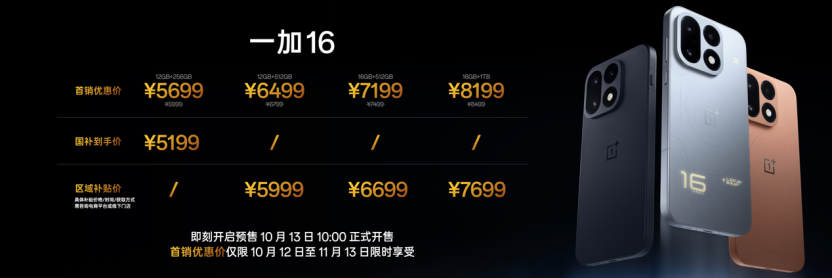
Following the OnePlus 16's launch, OPPO announced first-hour sales exceeding 70,000 units, indicating a loyal user base willing to pay for performance. However, single-brand first-sale figures do not reveal how much new customer acquisition the group achieved. If some growth came from users who might have otherwise purchased a Find device, internal brand cannibalization would diminish the group's overall scale contribution.
OPPO once leveraged its expanding smartphone user base for scale advantages but now pursues higher per-unit value. Meanwhile, the next generation of smartphone competition is shifting toward operating systems and smart agents. Rather than launching another flagship, ensuring users choose OPPO for their next upgrade has become a more strategically impactful challenge.

When ColorOS 17 was unveiled in September, OPPO positioned it as a major upgrade for the AIOS era. The company revealed that ColorOS has over 770 million global active users across 90+ countries and regions. The system incorporates on-device models, long-term memory, and a smart agent ecosystem framework, enabling Xiao Bu (OPPO's AI assistant) to organize schedules, identify critical information, and invoke third-party services.
For example, users can access 200 Alipay services via Xiao Bu, which collaborates with 40+ top third-party providers across 700+ scenarios. OPPO also disclosed that its "AI One-Click Flash Note" feature for capturing order codes has been used over 1 billion times.
QuestMobile reported that as of June this year, Xiao Bu had approximately 165 million monthly active users, ranking among the top AI assistants among smartphone manufacturers. With such a massive user base for its system and assistant, OPPO should have a significant advantage in developing personal smart agents. However, translating user scale into product capabilities requires more than just daily information recognition and service invocation—it demands cross-application complex task execution.
Despite its vast AI user base, OPPO still relies on external agents to bridge gaps in complex task execution.
Previously, in "Flood Dividends vs. Drought AI: A Detailed Analysis of OPPO's Ostrich-Like Survival Strategy," *New Position* cited a source close to OPPO revealing that Pete Lau (OPPO's Chief Product Officer) once approached Zhang Peng, founder of GeekPark, to recommend AI talent. Zhang introduced Jiang Yuchen, now OPPO's ColorOS Smart Product R&D Director.
In July this year, Jiang told *Jiemian News* that smartphone operating systems have always served as "aggregation and distribution" platforms. In the future, they will route user demands through A2A protocols and smart agent distribution. Cross-application personal memory, formed with user consent, represents a key competitive barrier for smartphone makers. She also mentioned that OPPO is not rushing to monetize AI yet, prioritizing ecosystem building instead.
This explains OPPO's continued pursuit of external partnerships. During its collaboration with Alipay's smart agent "Abao," OPPO handled user intent understanding and personal memory, while Alipay executed services. Now, by integrating Manus, OPPO extends cooperation to task planning, multi-step execution, and content generation.
From recruiting external AI talent to incorporating mature agents, OPPO's approach to enhancing its AI capabilities has become increasingly direct. External support shortens development cycles but also delegates critical capabilities to partners.
On October 13, OPPO and Manus officially announced their partnership, integrating Manus's agent capabilities into AI Mind Pilot's new Agent mode. As described, users can task the system with organizing flight, hotel, and attraction bookings scattered across apps, generating itineraries using online data, or creating presentations from phone files and photos.
Leveraging external platforms to rapidly acquire complex task capabilities is a pragmatic business choice. However, Manus's technical strengths do not fully align with daily smartphone needs.
Manus excels at web research, document processing, content generation, and multi-step tasks, often relying on cloud computing, browsers, and external tools. Users provide a relatively complete goal, wait a few minutes, and receive a report, table, or webpage.
Smartphone agents, however, operate in a different environment. Payments, social interactions, travel, messaging, and cross-app operations demand low latency while handling account verification, permission confirmations, interface changes, and task interruptions.
Manus thrives in its controlled execution environment but must navigate others' app rules when operating on smartphones.
This discrepancy means OPPO must still undertake substantial system-level adaptation. While Manus already focuses on complex task breakdown and execution, deploying these workflows at scale across ColorOS devices requires significant engineering work from OPPO.
OPPO's global website recently disclosed that AI Mind Pilot's new Agent mode will initially support both Manus and ChatGPT, offering limited free usage. Users with existing subscriptions can link their accounts to continue using services under their current plans. This provides consumer choice and prevents OPPO from over-relying on a single platform.
Conversely, Manus and ChatGPT's capabilities are also accessible through other devices and services. As agent-provided task capabilities converge, ColorOS's long-term differentiation will increasingly depend on system memory, device synergy, and user experience.
If users merely access their existing paid Manus services via OPPO phones, the value distribution between smartphone makers and external platforms warrants reevaluation.
Manus's cost structure also merits attention. According to its official explanation, complex tasks consume credits based on model calls, cloud virtual machines, and third-party interfaces, with actual costs varying by task complexity and execution time.
Furthermore, specific launch dates, supported regions, and service entitles for this collaboration remain undisclosed. Based solely on product demos, it's difficult to gauge how much real-world usage Manus will drive for OPPO.
By integrating Manus into ColorOS, OPPO saves development time but also inherits its partner's service costs, commercial rules, and product iteration pace.
Jiang Yuchen previously emphasized that a system's core value lies in personal memory and aggregation-distribution. This approach remains logical in the agent era, but with more partners, OPPO must cultivate a unique user experience within its system.
After seeking external talent, OPPO now incorporates Manus. While its AI acquisition channels have diversified, its own irreplaceability still requires clearer product differentiation to support.

On the same day OPPO chose to integrate Manus, another company opted for a more aggressive approach.
On the evening of October 13, Jieyue Xingchen officially launched the STEP X Neo intelligent agent mobile phone pilot version, priced at 3999 yuan. The package includes mobile phone hardware, the Step AOS intelligent agent operating system, Step series models, development tool Step Studio, and 12 months of Token usage rights.
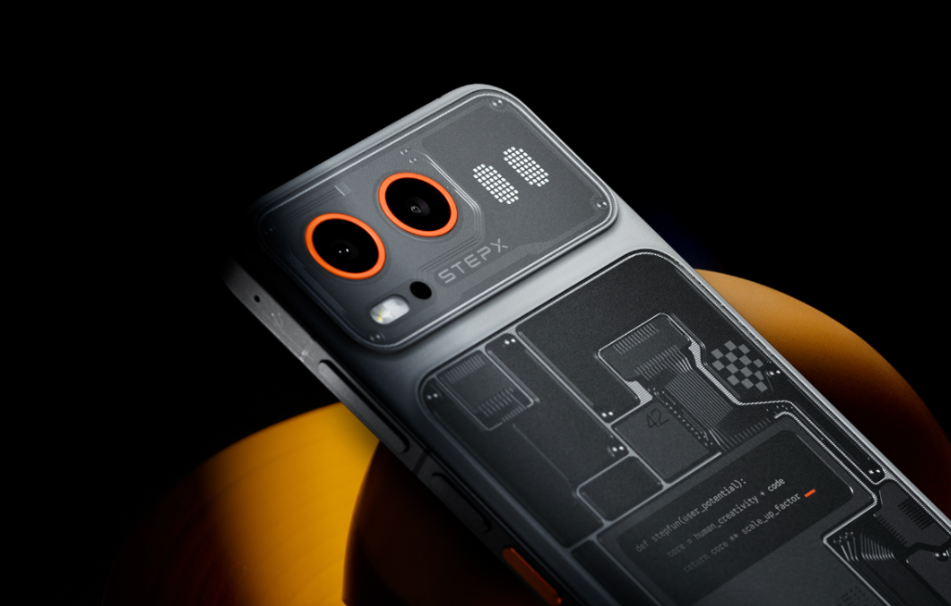
As a pilot version, the system maturity, third-party application compatibility, and scalability of the STEP X Neo remain to be tested. However, it at least offers a different competitive approach: The selling points of mobile phones are shifting from chips, imaging, and screens to how many tasks intelligent agents can complete.
The cooperation between ByteDance and Nubia has already demonstrated the appeal and limitations of this path. In December last year, the technical preview version of the Doubao mobile assistant entered the market through Nubia's M153 engineering prototype. On September 16, the Nubia NaviX Ultra, equipped with the consumer version of the Doubao mobile assistant, officially went on sale, starting at 5999 yuan (or 5499 yuan after subsidies).
Doubao provides the model and agent capabilities, while Nubia handles hardware and system adaptation. This model shares similarities with OPPO's integration of Manus, but Doubao's mobile phone has deeper integration at the operating system level, with cross-application execution as its core selling point.
However, after the product's launch, tests by
Controversies arising from app risk control in the preview version prompted a reevaluation of relevant capabilities. Even if mobile phone manufacturers are willing to open system permissions, other platforms may not be willing to allow intelligent agents to freely operate their services.
Doubao has already encountered the barriers of the app ecosystem. After Manus enters ColorOS, there is no inherent reason for it to automatically gain a passkey.
When Jieyue Xingchen released the STEP X Neo, it specially (deliberately) emphasized collaborations with platforms like Alipay, Baidu, Meituan, JD.com, Didi, Ctrip, and Gaode Maps. This indicates that new entrants are also aware that models and hardware alone cannot independently build a complete intelligent agent experience.
Mobile phone manufacturers have system permissions, internet platforms have services and transactional relationships, and model companies have task planning capabilities. All three want to reach users, and cooperation agreements are beginning to address competitive issues that product features alone could not solve in the past.
OPPO's advantage lies in its mature supply chain, distribution channels, and system ecosystem, eliminating the need to rebuild hardware manufacturing and after-sales service networks like new entrants. ColorOS's edge-side processing capabilities, long-term memory, and user information management also provide a relatively complete foundation for agents.
However, new entrants also have the opportunity to reshape market expectations. Once consumers become accustomed to letting AI arrange travel, organize work files, or proactively handle daily tasks across apps, comparisons between flagship devices may extend to the performance of system intelligent agents. While better imaging and stronger chips will still hold value, their weight in high-end mobile phone purchasing decisions may shift.
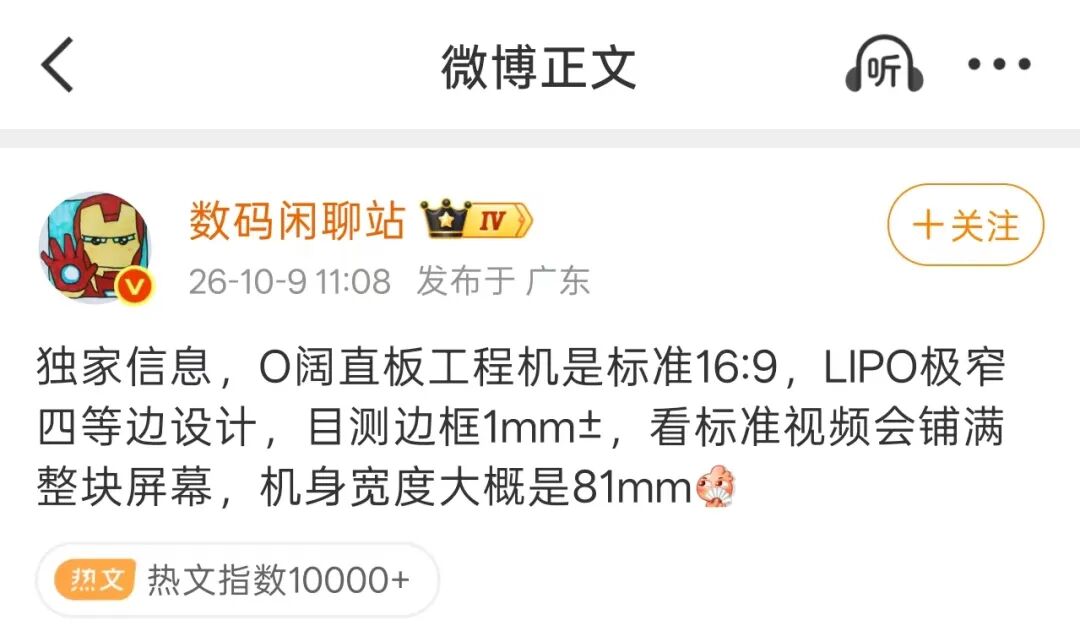
This competition is also beginning to influence OPPO's flagship product planning. On October 9, tech blogger @Shuma Xianliaozhan revealed that OPPO is testing a standard 16:9 aspect ratio, wide straight-screen engineering prototype featuring an LIPO ultra-narrow four-sided equal-bezel design. The screen width is approximately 81 millimeters, with the overall device width expected to remain under 85 millimeters.
Around the same time, another leak about a wide foldable device brought OPPO into the discussion. On October 10, a tech blogger exposed a wide foldable engineering prototype equipped with a 2nm chip, a 7.6-inch inner screen, and a Hasselblad imaging solution. Media speculation based on clues suggested it belonged to OPPO.
Regardless of whether the final product enters mass production, a wider foldable screen, if it can improve multi-window operations and mobile office experiences, could indeed complement system agents. However, the new screen form factor also means a more complex supply chain, higher adaptation costs, and a smaller potential user base.
Especially as OPPO is compressing its low-margin product lines while expanding high-end projects, trade-offs in R&D resources will become more sensitive.
From a market perspective, Find, OnePlus, and future new form factor products can cover different needs, but the group must also maintain clear brand differentiation. If multiple flagships primarily redistribute sales among existing users, no matter how large the hardware investment, overall scale improvements will be limited.
As the backends of the three brands converge, the form factors of flagship products continue to diversify. The organizational costs OPPO saves may soon be reinvested in new product experiments.
Especially for a mobile phone group whose global market share has dropped to just 9%, premiumization can no longer rely solely on continuously upgrading hardware specifications. OPPO must convince more consumers who previously used other brands to switch to ColorOS and continue using it throughout a complete device replacement cycle.
While hardware procurement and product iteration have relatively mature business methods, the agent ecosystem involves model providers, internet platforms, system permissions, subscription fees, and user authorization. The commercial rules for the latter are still taking shape, and how much initiative mobile phone manufacturers can retain remains far from certain.

Over the past decade, competition in the mobile phone industry has followed a relatively clear main storyline (main thread): Manufacturers attract consumers through hardware innovation and channel investments, then rely on systems, apps, and services to extend user retention. Under this model, OPPO built a vast retail network and positioned Find, Reno, OnePlus, and Realme across different price bands and markets.
Today, the Interest relationship (interest relationships) in the mobile phone industry are changing. The same technological wave is compressing hardware manufacturers' profit margins on one end while providing new model companies and service platforms with opportunities to enter the operating system.
OPPO's cooperation with Manus indicates its choice to respond to this change in a more open manner. From a product development perspective, this facilitates rapid acquisition of complex task execution capabilities and avoids keeping all technical risks in-house. Facing continuous iteration of model capabilities, relying on external partners does not inherently put it at a disadvantage.
However, once AI enters mobile phones, existing business relationships will also be rearranged. Users can complete operations that previously required accessing multiple apps through a single intelligent agent. The services invoked by the agent, the inference fees generated, the task contexts retained, and who ultimately collects service fees will all become new links in interest distribution.
This transformation has not yet formed a stable pattern. Jieyue Xingchen is still validating market demand for AI-native mobile phones, Doubao's mobile phone still faces third-party app permission restrictions, and OPPO's cooperation with Manus awaits large-scale user testing. No single player can be said to have established a clear advantage.
Nevertheless, OPPO's operational pressures will not pause as a result. A 9% global market share in Q3 means it must pay even closer attention to every user loss. Continuous investment in high-end hardware and AI also makes every product decision carry higher costs.
OPPO has excelled at selling mobile phones to consumers, but now, after the screen lights up, who arranges the next step for consumers is gradually becoming a new business.
In this business, mobile phone manufacturers remain important but can no longer single-handedly determine all the rules.
*The featured image and illustrations in the text are sourced from the internet.
-
Global Tech Titans' Gambit: Steering Clear of NVIDIA's Dominance
-
AI Companies' IPOs Start Hitting the Brakes Collectively
-
![]()
OPPO 'Outsources' AI to Manus After Shipments Drop Over 20%
-
OPPO Outsources AI to Manus After Shipments Drop Over 20%
-
WorkBuddy Wins the Product Race, But Tencent Hasn't Secured the Win in AI-Powered Office Solutions Yet", "Tencent, WorkBuddy, WeCom, AI-Powered Office Solutions, Deep Integration", "Tencent's WeCom an
-
![]()
[Attendee Guide] The WAIE (10th) 2026 AI Industry Conference & AI Agent Industry Application Conference Kicks Off on October 23! (Including Conference Schedule + Transportation Guide)
-
![]()
Achieving 100% Year-on-Year Growth! Domestic Ultra-Precision Optical Equipment Emerges as a 'Dark Horse' with Thousand-Unit Shipments
-
Q3 Report | Inspur Information’s Net Profit Soars 176%, Fueled by Robust Server Demand