Algorithmic Addiction: Meta Faces $1.4 Trillion Trial
 10/19 2026
 357


Meta's astronomical compensation claim is unlikely to materialize, but its legal shield is weakening.

According to foreign media reports, on August 12, a lawsuit jointly filed by California, Colorado, Kentucky, and New Jersey initiated jury selection proceedings in federal court in Oakland, California. Prosecutors allege that Meta's addictive designs for Facebook and Instagram have harmed minors, seeking $1.4 trillion in damages.
This amount nearly matches Meta's current market capitalization of approximately $1.5 trillion, setting a record for the highest compensation claim in global consumer protection litigation. The day before the trial began, the U.S. Ninth Circuit Court of Appeals rejected Meta's request to suspend proceedings. Opening statements are scheduled for August 18, with the trial expected to last six to eight weeks.
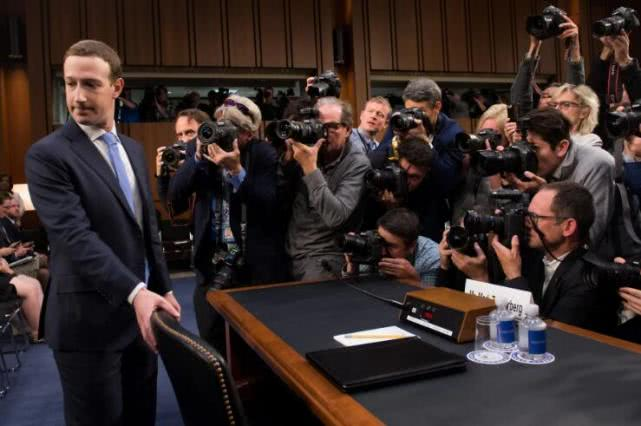
Image source: Tom Williams/CQ Roll Call | Zuckerberg testifies before Congress
According to the indictment documents submitted by prosecutors from the four states, the core facts of the lawsuit focus on two aspects. First, Meta knowingly allowed its algorithmic designs to cause psychological harm to minors while concealing internal research findings from the public and regulators for years. Internal documents obtained by prosecutors show that as early as 2021, Meta confirmed through internal research that Instagram exacerbates body image anxiety and depression in about one-third of teenage girls. Features like infinite scroll, autoplay, and like notifications were psychologically designed to be addictive, significantly extending usage time among young users—yet the company consistently claimed its platform was safe for teenagers. Second, Meta failed to effectively implement age verification mechanisms, allowing significant numbers of children under 13 to register and use the platform without parental consent, in violation of the Children's Online Privacy Protection Act (COPPA) by illegally collecting minors' personal data.
In response, Meta denies all charges, calling the compensation claim "without factual or legal basis" and planning to defend itself using Section 230 of the 1996 Communications Decency Act—a law that has protected internet platforms from liability for user-generated content for three decades. However, the Ninth Circuit Court of Appeals rejected its request to suspend proceedings. Meta's legal defenses are now facing significant challenges.
01 Addictive Algorithms
The origins of this lawsuit trace back to a leak five years ago. In 2021, former Facebook employee Frances Haugen provided thousands of pages of internal documents to U.S. regulators and media, later known as the "Facebook Files." The Wall Street Journal published a series of reports starting in September that year, disclosing Facebook's internal research on product harms. After the documents became public, attorneys general from dozens of U.S. states launched investigations. Two years later, approximately 29 state attorneys general filed multiple lawsuits against Meta, with the case beginning this week being the largest to date.
Image source: Xinhua News Agency/AFP (file photo) | Meta headquarters in Menlo Park, California
Internal documents cited by prosecutors show that by 2021, Meta had confirmed through internal research that Instagram exacerbates body image anxiety and depression in about one-third of teenage girls. Internal slides disclosed by The Wall Street Journal recorded more specific figures: 32% of teenage girls said Instagram made them feel worse when they felt bad about their bodies; among adolescents with suicidal thoughts, 13% of British users and 6% of American users attributed their desire to die to Instagram. During the same period, Meta publicly claimed that "the platform is beneficial for teenage safety."
Prosecutors argue that the harm stems from product design, not user-generated content. Internal documents reveal that Instagram and Facebook's infinite scroll, autoplay, and like notifications were "psychologically designed to be addictive," significantly extending usage time among young users.
The designers of these features later publicly discussed their motivations. In 2017, Facebook's first president, Sean Parker, stated at an event: "The thought process that went into building these applications was all about—'How do we consume as much of your time and conscious attention as possible?'" He explained that like and comment notifications provided users with a "dopamine hit" and admitted to exploiting human psychological vulnerabilities. He added that multiple platform founders, including Zuckerberg, were fully aware of this but allowed the products to launch regardless.
The ranking system behind these features is the technological core of this case. Instagram relies on machine learning models to determine what users see and in what order: the model predicts user interaction probabilities for each piece of content and ranks them accordingly. Instagram head Adam Mosseri has publicly stated that the most important signals for ranking are watch time, likes, and private message shares.
The consequences of this system were confirmed in the Facebook Files. Meta's own research admitted that its algorithms push vulnerable users toward content promoting eating disorders. The impact was vividly illustrated in one family's case. In 2022, a California family sued Meta, documenting their daughter Alexis's experience: she created her first Instagram account at 11, two years below the platform's minimum age, and was almost immediately pushed into an echo chamber glorifying self-harm and anorexia; at 12, she drew a picture of herself crying on the floor with her phone screen reading "stupid, ugly, fat" and a chat bubble saying "die"; by 15, she required emergency psychiatric treatment for anorexia, purging, and suicidal ideation. Internal Meta documents cited in the lawsuit referred to pre-adolescent children as "herd animals" who "want to find communities they can fit into." Another document described teenagers creating multiple accounts to evade parental supervision as a "value add proposition." Attorneys pointed out that Meta was fully aware of what it was doing to children but continued harmful practices regardless.
The dangers of algorithmic addiction are already evident. According to a 2024 World Health Organization report, over one-tenth of adolescents exhibit problematic social media behavior. A 2023 Gallup and Family Institute study found that American teenagers average 4.8 hours of social media use daily, with nearly 30% exceeding six hours per day. The same study showed that over the past decade, suicide rates among American teenage girls have doubled, while rates among boys have increased by 50%.
Based on these studies and conclusions, prosecutors from the four states are seeking $1.4 trillion in compensation from Meta.
02 Astronomical Compensation
The $1.4 trillion compensation claim has become the focal point of this lawsuit. This amount was calculated using each state's consumer protection laws, with penalties ranging from $2,000 to $20,000 per violation. Prosecutors multiplied this base amount by the number of affected minor users and the duration of violations to reach the statutory maximum of $1.4 trillion—a figure comparable to Meta's market capitalization, which stood at $1.52 trillion as of August 10.
Image source: Sina.com (file photo)
In court filings, Meta called this amount "unsupported by evidence" and "unprecedented in consumer protection enforcement history," citing the U.S. Constitution's Eighth Amendment prohibition against excessive fines. Multiple legal experts stated that full court support for this amount is unlikely; however, even if the final penalty is only one-tenth of the claim, it would still reach the $100 billion level, far exceeding similar penalties in the tech industry's history.
Before the $1.4 trillion figure, Meta had already paid significant sums in other lawsuits. In late 2022, Meta reached a $725 million settlement in the Cambridge Analytica user data class-action lawsuit; in 2025, it settled a derivative lawsuit brought by investors over the Cambridge Analytica incident for approximately $8 billion in Delaware court.
The first judgments came from two penalties in New Mexico, the first state to hold trials and reach conclusions. In March, a state jury ordered Meta to pay $375 million; on August 6, a judge added $567 million, bringing the total to $942 million—the largest child safety ruling against Meta to date. The presiding judge called Meta's actions a "public nuisance" comparable to air pollution, comparing the company to a factory: advertisements and content are its products, while psychological harm to children is pollution requiring remediation. $420 million of the fine will fund clinical and behavioral health programs.
In March, a Los Angeles jury ruled in a personal lawsuit that Meta and Google were negligent in their duty of care to a young woman who had used Instagram and YouTube since childhood, awarding $6 million in damages. This marked the first U.S. jury verdict in a social media addiction case, led by the plaintiff's mother. Unlike New Mexico's state-initiated enforcement action, this case was brought by an individual family alleging product design flaws—proving that ordinary families can successfully sue tech giants and opening pathways for thousands of subsequent personal and school district lawsuits. Zuckerberg was listed as a key witness prosecutors plan to call; six months ago, he testified in the Los Angeles case and has been requested to appear again.
While outside observers consider the $1.4 trillion compensation claim unlikely to materialize, successive judgments suggest that a legal defense relied on by social media platforms for nearly three decades is weakening.
03 The Eroding Legal Shield
This defense is Section 230 of the 1996 Communications Decency Act.
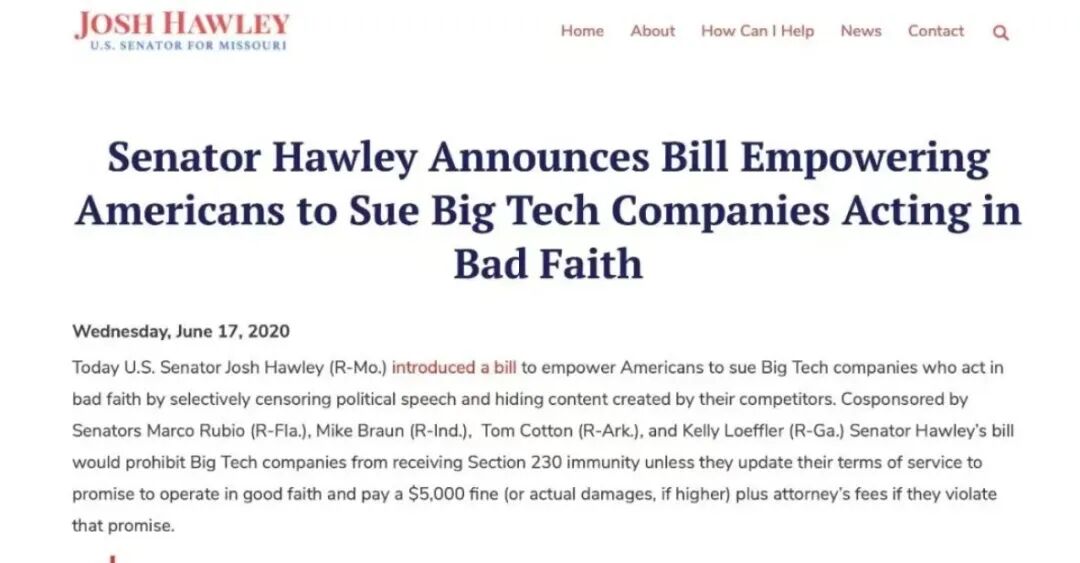
Image source: Senator Josh Hawley's official press release | Senator Josh Hawley proposes legislation to strip major tech companies of Section 230 immunity
This law originated from two identical lawsuits: users posted defamatory content about others on a website's forum, leading the defamed parties to sue the online content service providers.
The first case involved CompuServe. In 1991, a user posted defamatory content about CompuServe's competitor on its forum, prompting the defamed company to sue CompuServe. However, the court ruled that CompuServe, which never reviewed user posts and merely provided the platform, was not a "publisher" and thus not liable.
The second case involved Prodigy. In 1995, a user posted abusive content about an investment company on its forum, leading the company to sue Prodigy. The court reached the opposite conclusion—because Prodigy proactively deleted some offensive posts, the court deemed it a "publisher" responsible for user-generated content.
These contradictory rulings prompted the U.S. Congress to pass Section 230 in 1996, stipulating that platforms are not liable for user-generated content regardless of whether they moderate it. This 26-word core provision later became known as "the 26 words that created the internet."
The law's impact has been profound. In 1995, after the Oklahoma City bombing killed 168 people, an anonymous user posted an advertisement on America Online's forum selling T-shirts printed with "Remember the Bombing," leaving a phone number belonging to Zelan, a Seattle television producer with no connection to the incident. After the ad was posted, Zelan received numerous angry and threatening calls, prompting police involvement. He requested that America Online delete the post, but the company delayed action. Zelan sued America Online, arguing that the company knew the content was harmful and should be held responsible for not removing it promptly.
In 1997, the court dismissed his claim, ruling that America Online remained protected under Section 230 even if it knew the content was harmful and failed to remove it promptly.
Zelan lost the case, but the court's broad interpretation of immunity has been followed by nearly all courts for nearly three decades.
Against this backdrop, the Meta case's ruling appears exceptional. Meta, TikTok, Google, and Snap all argue that addiction lawsuits essentially target platform-distributed content and should be protected under Section 230. However, on August 10, the Ninth Circuit Court of Appeals rejected this argument, distinguishing that Section 230 protects platforms from liability for user-generated content but not for their own product design decisions, such as infinite scroll, notification mechanisms, and age verification failures. In April, the Massachusetts Supreme Court reached the same conclusion in a separate lawsuit against Meta, stating that Section 230's immunity is "not unlimited" and does not apply when allegations target Meta's own conduct.
Under these rulings, the scale of litigation is expanding. According to foreign media statistics, there are currently over 3,000 federal lawsuits and more than 3,300 state-level cases across the United States involving allegations of social media addiction, with defendants including Meta, YouTube (owned by Google), TikTok (owned by ByteDance), and Snapchat (owned by Snap). The plaintiffs in these cases come from three main groups. Individual families accuse platforms of causing harm to their children through addiction; school districts demand compensation from the platforms for increased costs related to psychological counseling, disciplinary management, and technological protections, as well as losses due to student absenteeism; and attorneys general from over 40 states are pursuing accountability under consumer protection laws. Additionally, thousands of school districts have filed claims.
In January of this year, prior to the opening of the Los Angeles case, TikTok and Snap reached a settlement with the plaintiffs. Meta and Google chose to continue litigating but ultimately lost. In addition to fines, the demands from state prosecutors included requiring the platforms to modify their product designs: implementing age verification, limiting usage time for minors, and strengthening parental controls.
"A trial is the only way to let the public know what Meta knew, when it knew it, and what actions it chose to take," said Lacey Hazzahm, the plaintiff's attorney, following the ruling by the Ninth Circuit Court.
The case is expected to be decided in October. Lawsuits filed by other states under their own laws are scheduled as far out as February 2027.
(The images and public data materials used in this article are sourced from the internet and public industry platforms. If there is any infringement, please contact us for timely modification.)
-
![]()
Q3 Report | Hengtong Optoelectronic’s Performance Soars, Achieving Up to 61% Quarter-over-Quarter Net Profit Growth in a Single Quarter
-
![]()
Manus Restarts Independent Operations, Yet Avoids Starting Anew
-
One Photo Suffices for Celebrity Endorsements: Merchants Offer Custom AI Videos from 150 to 1000 Yuan per Minute
-
![]()
Total Investment Reaches 450 Million Yuan! Luke Optical Launches Its First Pilot Production Line for an Annual Output of 20 Million Pairs of Glasses
-
Chery Leads in Auto Exports, But When Will It Dominate the Domestic Market?
-
![]()
7 Billion Yuan in Orders Secured Until 2032! What Sets This Optical Company Apart?
-
Just a moment ago, Mark Wahlberg made a daring declaration: “I’m not scared of AI cloning me; what truly worries me is its misuse.”
-
![]()
Qianwen Office Merges with WeCom: New Dynamics Unfold in the AI Office Ecosystem