Qianwen Office Merges with WeCom: New Dynamics Unfold in the AI Office Ecosystem
 10/19 2026
 548

Alibaba and Tencent have adopted contrasting strategies, both deliberate moves, signaling that the real competition is just beginning.
On August 18, Alibaba's Agent offering, Qianwen Office, officially integrated with WeCom. Prior to this, the product had already been incorporated into DingTalk and Feishu, thus spanning the three leading collaborative office platforms in China, as well as Slack internationally.
On the same day, WeCom unveiled version 5.0.10, granting CLI and MCP capabilities to enterprises of all scales. Media reports indicate that prominent agents like WorkBuddy, DeepSeek, MiniMax, and Qianwen Office can now directly access and utilize ten modules, including documents, spreadsheets, emails, meetings, schedules, and contacts, with no limitations on company size or qualifications.
The simultaneous push by these two internet titans into Agent technology is no mere coincidence. The AI productivity tool market, exemplified by intelligent agents, is flourishing, and the giants' drive to capture market share is palpable. Yet, their strategic choices in ecosystem integration reflect a dynamic interplay of expansion and consolidation.
This marks a departure from past trends.
AI Office: A Balance of Expansion and Consolidation
Qianwen Office launched its public beta on August 3, integrating three internal Alibaba products: QoderWork, MuleRun, and Wukong. According to a Guosheng Securities research report dated July 28, the personal version is offered at three price points: free, 98 yuan, and 198 yuan, while the enterprise standard version is priced at 198 yuan per seat per month.
Alibaba's investment in this product extends beyond the product itself. Multiple media sources report that Qianwen Office has been designated as a first-tier business unit under Alibaba's ATH Group, alongside the consumer-facing Qianwen Business Unit and the model-side Token Foundry. Executives like Wu Yongming participate in its key meetings. Chen Yusen, who succeeded DingTalk founder Chen Hang in June this year, was immediately tasked with integrating the three products.
Alibaba's emphasis on the enterprise organization side is tied to its competitive stance. According to Analysys data, Tencent's WorkBuddy had 20.97 million PC-end visits in June, ranking first in China, followed by ByteDance's Trae and Alibaba's QoderWork. On the consumer-facing personal office front, Alibaba is not in the lead.
However, Alibaba's focus lies elsewhere. An Alibaba insider believes that while WorkBuddy can only access personal context, enterprise context is equally vital in office scenarios, which is what Alibaba prioritizes.
Enterprise context refers to the data flows related to organizational structure, permissions, processes, and business systems. WorkBuddy operates through personal entry points, relying on users' personal computers and local permissions. In contrast, Qianwen Office prioritizes these organizational-level elements. The service objectives of the two differ significantly. Currently, media reports suggest that Alibaba will not prioritize monthly active users as a core metric in the short term, instead focusing on refining product experience and enterprise scenario implementation.
This approach is embodied in the product as a connector model. After Qianwen Office users authorize their WeCom accounts, they can utilize WeCom capabilities through conversations, including reading smart sheets, reading and writing documents, sending notifications, querying schedules, scheduling meetings, and creating to-dos. Its IM channel also integrates with DingTalk, Feishu, WeChat, WhatsApp, and more.
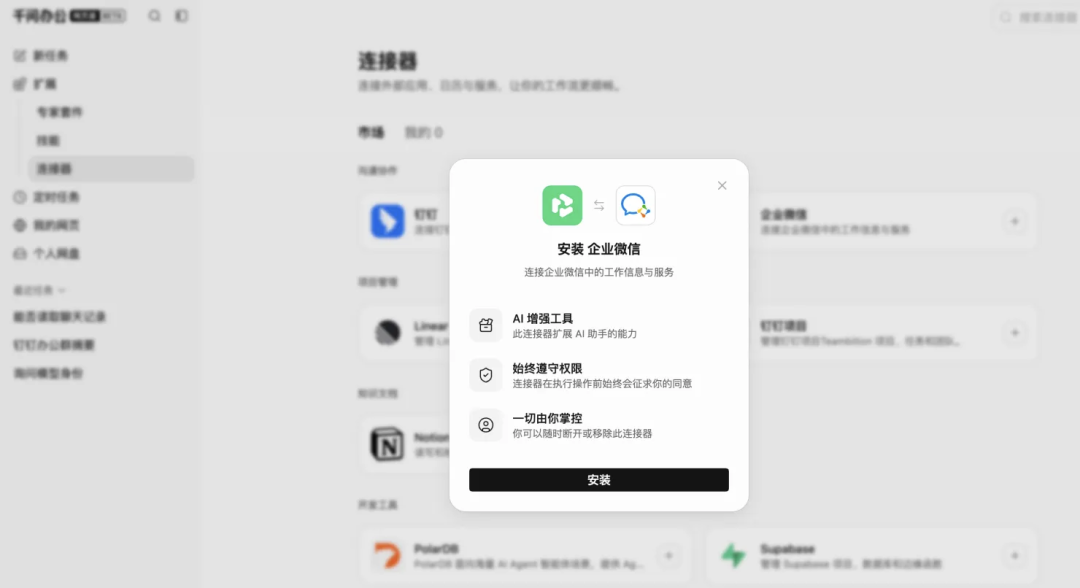
Integrating with WeCom enables Qianwen Office to address scenarios less covered by DingTalk. DingTalk originated in attendance and approval, serving internal organizational management. WeCom's core strength lies elsewhere—according to its official introduction, enterprises can "add customers' WeChat accounts and continuously provide services through one-on-one chats, group chats, and Moments." This side corresponds to sales, customer service, and private domain operations. By integrating with WeCom, Qianwen Office extends its capabilities to this external connection line.
Tencent's motivation for opening interfaces is also discernible.
In March this year, when WeCom open-sourced wecom-cli, it was initially available only to small teams of fewer than 10 people, with seven capabilities open. By August, it had expanded to full availability with 11 capabilities, offering both CLI and MCP access methods. This transition was gradual.
Tencent's choice of an open strategy is linked to WeCom's product positioning. Since its launch in 2016, WeCom has positioned itself as an open platform, with a service provider ecosystem as its foundation. According to a Photon planet report last September, its number of partners reached 80,000 in 2021. Ma Huateng stated at Tencent's 2023 annual meeting that Tencent would "focus on building products to be integrated."
The other aspect of "being integrated" is the boundary between openness and control. WeCom opens up the tool invocation layer, but Agent invocations must pass through WeCom's permission, approval, and auditing systems—personnel permissions and AI operation permissions are configured independently, critical actions require manual approval, authorization can be set with an expiration date, and data invocation and execution are fully traceable. Data such as contacts and documents remain under Tencent's control.
Opening up access capabilities does not imply impacting Tencent's own products. According to AI product rankings, Tencent's WorkBuddy saw a 397.5% month-over-month growth in July, ranking first globally. This leading position allows Tencent to open WeCom interfaces without needing to protect its own products through closure.
Thus, the logic of cooperation between the two giants becomes evident: Alibaba enters sales, customer service, and private domain scenarios by connecting to WeCom through a connector; Tencent opens up the tool invocation layer while retaining permissions, approvals, and auditing on its side. The former expands Qianwen Office's coverage, while the latter enriches WeCom's ecosystem.
Interestingly, barriers are being dismantled.
Beyond Immediate Demands: A Longer-Term Context
This context can be traced back to policy. In September 2021, the Ministry of Industry and Information Technology held an administrative guidance meeting, requiring platforms to lift link blocking. Subsequently, WeChat gradually opened up external links to Taobao and Douyin. In September 2024, Taobao integrated with WeChat Pay, and in 2025, JD.com integrated with Alipay.
The policy direction is the marketization of data elements. In April 2020, central documents listed data as the fifth major production factor for the first time. In 2022, the "Data Twenty Measures" established basic systems for data property rights and circulation transactions. In 2023, the National Data Bureau was established. In early 2024, 17 departments launched the "Data Elements ×" three-year action plan. Defining data as a production factor means data should enter circulation.
Policy explains why barriers are being torn down. However, the acceleration of barrier removal in the AI era has another reason.
This reason lies in the technical realm. In the mobile internet era, platform isolation primarily targeted traffic—external links, payments, and user redirects. However, an Agent today needs to read documents, query schedules, invoke systems, and write back to spreadsheets in real time, relying on data flows. MCP—a unified standard for AI to invoke external tools—illustrates this point: the protocol had 100,000 monthly downloads when released in November 2024, reaching 97 million by March 2026, with OpenAI, Google, and Microsoft all having integrated it. When this standard becomes the default, platforms that do not open their interfaces will lose the ability to participate in the Agent ecosystem.
Beyond technology, economic reasons also exist. Large model training costs are high, and inference is billed per token, so cost amortization requires larger invocation scales. ByteDance's Doubao processes 180 trillion tokens daily and has an annualized revenue of 4 billion USD from large model services, both contingent on opening capabilities to more scenarios. A closed strategy would reduce the scenarios available to AI products, raising unit costs.
Meanwhile, the three companies are also consolidating their office AI products. Alibaba integrated three Agent products into Qianwen Office, ByteDance merged its Feishu product team into Doubao, and Tencent transferred QClaw to the department housing WorkBuddy. All three are consolidating scattered office AI products into a single entry point. Feishu's ARR exceeded 3 billion yuan in 2025 and grew by over 100% year-over-year in Q2 2026, yet it was still merged into Doubao and Volcano Engine. ByteDance no longer treats collaborative office as an independent functional product but as an application scenario for the Doubao large model. According to Analysys data, domestic desktop-end AI office agent visits exceeded 60 million in June, with Tencent accounting for about half.
However, openness has its limits. WeCom's CLI and MCP allow external Agents to invoke WeCom capabilities—reading smart sheets, creating documents, sending notifications, scheduling meetings. These are operational interfaces; Agents can invoke them but cannot read or take away the underlying data.
WeCom's contacts, documents, and workflows do not flow out due to interface openness. Every Agent invocation must pass through WeCom's permission, approval, and auditing systems, and the records generated by invocations remain on WeCom's side. The more thoroughly interfaces are opened, the more Agents access, and the more frequent the invocations, the thicker the data layer accumulated on the platform side. This is the other side of what Ma Huateng meant by "being integrated": others buy Tencent's standard products to sell, but the data and scenarios remain with Tencent.
Alibaba also guards the same boundaries. The shopping scenario in the Qianwen App currently only supports Alipay. On the external connection front, Alibaba has opened office interfaces but locked down payment data.
Thus, the focus of competition becomes specific. Qianwen Office's integration with WeCom provides interfaces but not data; Tencent cedes interfaces but guards data. The current competition in AI office agents is widely seen as in a critical window period of about 6 to 12 months. Alibaba and Tencent's contrasting strategies are both calculated moves, and the real competition has only just begun.
-
![]()
Q3 Report | Hengtong Optoelectronic’s Performance Soars, Achieving Up to 61% Quarter-over-Quarter Net Profit Growth in a Single Quarter
-
![]()
Manus Restarts Independent Operations, Yet Avoids Starting Anew
-
One Photo Suffices for Celebrity Endorsements: Merchants Offer Custom AI Videos from 150 to 1000 Yuan per Minute
-
![]()
Total Investment Reaches 450 Million Yuan! Luke Optical Launches Its First Pilot Production Line for an Annual Output of 20 Million Pairs of Glasses
-
Chery Leads in Auto Exports, But When Will It Dominate the Domestic Market?
-
![]()
7 Billion Yuan in Orders Secured Until 2032! What Sets This Optical Company Apart?
-
Just a moment ago, Mark Wahlberg made a daring declaration: “I’m not scared of AI cloning me; what truly worries me is its misuse.”
-
![]()
Qianwen Office Merges with WeCom: New Dynamics Unfold in the AI Office Ecosystem