WorkBuddy's "Channel Victory" and the "Landlord's Dilemma" in the AI Era
 11/03 2026
 332

Caigou Business Review | Original by the Caigou Business Editorial Team
Author | Xuanniao
In 2026, Tencent finally has an AI product it can hold up as a "number one." Seven months after launch, WorkBuddy Enterprise Edition has racked up 9 billion task requests, surpassed 32 million MAU, and hit 20.97 million monthly desktop visits—more than the second- and third-place players combined. It covers 50% of China's Fortune 500 companies and 60% of the top 100, hosts over 200,000 Skills, and counts more than 50,000 open-platform partners and developers. By any external measure, WorkBuddy is the fastest-running player on China's AI office-agent track to date.
But WorkBuddy's lead is not, at bottom, a lead in model capability or in Agent technical architecture. It is a temporary triumph of channel efficiency over technological competition. Tencent took the playbook it had mastered most thoroughly in the game-distribution era—traffic entrances, agent rebates, ecosystem bundling, model-aggregation commissions—and transplanted it onto the AI Agent track. In a window when the market has yet to take shape, it traded distribution density for user scale.
The trouble is that the underlying economic logic of the AI era is fundamentally different from that of game distribution. Game channels can exist independently of content; AI Agent "channels" cannot exist independently of model capability. On the day model vendors turn from "suppliers" into "competitors," the channel toll booths will find there is no moat beneath their feet.
WorkBuddy's "Victory"
In March 2026, the explosive popularity of OpenClaw showed Pony Ma an entrance form he had previously overlooked: AI Agents are no longer just conversations in a chat box, but "digital labor" that can directly operate computers, invoke tools, and complete tasks. Tencent responded with extraordinary speed, running several Agent products almost simultaneously in-house—WorkBuddy, QClaw, Marvis, ima, CodeBuddy—under different business groups such as CSIG and PCG, dubbed by outsiders the "six princes competing for the throne." This horse-racing mechanism is itself a familiar Tencent playbook and does not warrant much discussion.
From birth, WorkBuddy did something its internal rivals did not do systematically: it turned itself into an open distribution layer. It does not insist on calling only Hunyuan, but simultaneously connects to DeepSeek, GLM, Kimi, and enterprise self-deployed models. It does not ask users to change their work systems, but embeds directly into existing workflows through the account systems of WeCom, Tencent Docs, Tencent Meeting, and QQ.
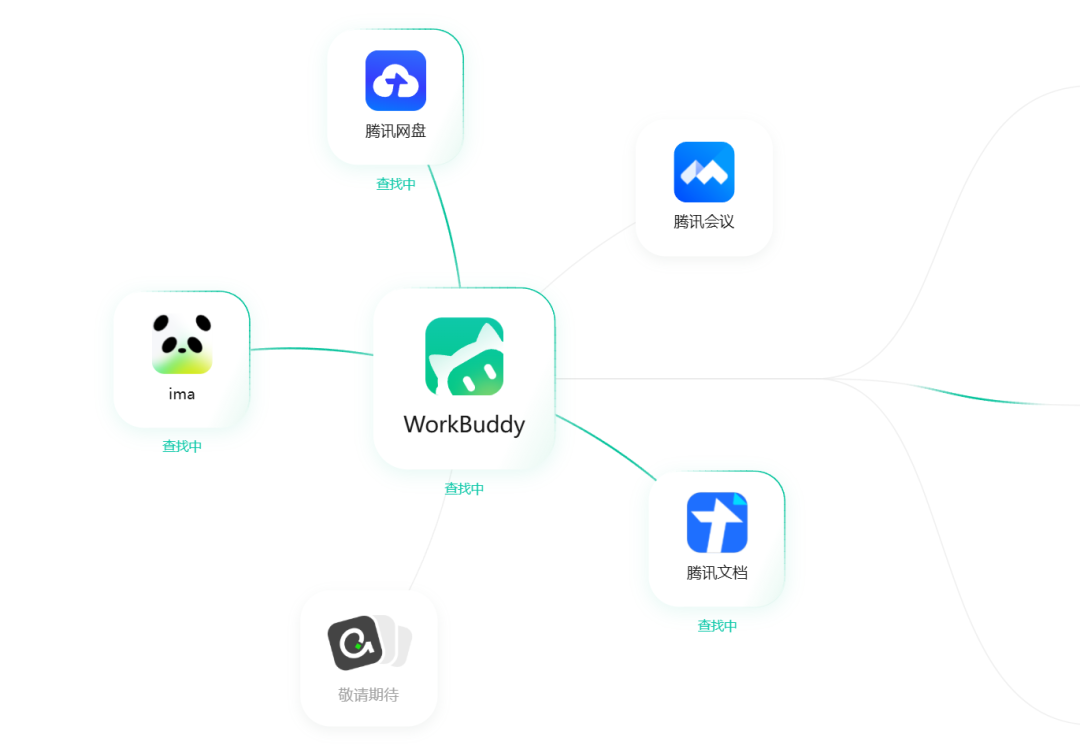
The essence of this playbook is to downgrade the competition among AI Agents from "whose model is smarter, whose Agent planning capability is stronger" to "who can stuff the product into the most enterprises' existing processes fastest." In the window of the first half of 2026, when enterprise demand for Agents shifted from "whether to do it" to "how to do it," the downgraded strike worked.
WorkBuddy does not need to prove its model is stronger than competitors'; it only needs to prove its entrance is easier to open than theirs. Analysys's July report was called "the straw that ended the horse race," but what ended the horse race was not WorkBuddy's technological advantage—it was the scale signal sent by distribution efficiency. Once the first-place player has opened an order-of-magnitude gap through channel density, the marginal return on continued internal competition over technological iteration becomes very low.
Hunyuan's "Slight" Presence and Tencent's Path Dependence
WorkBuddy's channel playbook works for an easily overlooked reason: Tencent's self-developed model capability is insufficient to support a "technology-driven" Agent route.
In IDC's China large-model MaaS market ranking for the first half of 2026, the leaders are Alibaba Cloud and Volcano Engine, with shares between 45% and 47%, while Zhipu and Volcano Engine rank second and third under another measure. Tencent Hunyuan did not appear in the top positions of this list. Hunyuan Hy3 preview's call volume on OpenRouter was indeed impressive for a time, with a weekly call volume of 3.66 trillion Tokens achieving "double first" in both the overall ranking and market share.
But OpenRouter's call-volume ranking reflects developers' short-term enthusiasm for trying free or low-cost models—an indicator of a different order of magnitude from enterprises' sustained willingness to pay for model capability in core business. Hunyuan has "slight presence, but hardly dominance" in the industry, and this judgment still holds in the competitive landscape of the second half of 2026.
This precisely explains why Tencent chose WorkBuddy. If Hunyuan were a DeepSeek-level model, Tencent could have taken a "harder" path: using model capability to define the Agent experience and technological barriers to retain users. But when the model itself is not a strength, using channel capability to compensate becomes a path-dependent natural choice—where R&D falls short, use distribution to make up for it.
Tencent knows this all too well from its gaming business: App Store's revenue share in third-party Android channels has long ranged between 50-50 and 30-70, and the game centers of WeChat and QQ mean Tencent hardly needs to concede any substantive benefits to external channels when distributing its own games. The logic of "channel is king" works in gaming because game content is highly differentiated, and channels that control user reach control pricing power.
But AI Agents are not games. Game distribution and game content can belong to different entities; channel providers do not need to understand how the game engine renders each frame, only deliver the installation package to users. AI Agent distribution and Agent intelligence cannot be separated: when a user uses WorkBuddy to complete an investment research report, the quality of the experience depends on the comprehension and reasoning quality of the underlying model, not on how large WorkBuddy's installation package is or how deep the WeCom entrance is.
No matter how smooth WorkBuddy makes the entrance, if the invoked model is not reliable enough on key tasks, user retention will be decided not by the channel but by the model. Channels can "lock in" content providers in games, but cannot lock in model providers in Agents—because model providers can bypass WorkBuddy entirely and reach the same users directly with their own Agent products.
Model Vendors' "Awakening"
WorkBuddy's current business model rests on a delicate tacit understanding: as a model aggregation platform, it connects to third-party models such as DeepSeek, GLM, and Kimi, earning revenue through credit top-ups and invocation commissions, while model vendors temporarily accept this arrangement because WorkBuddy brings additional call volume and user reach. Early on, this was a mutually beneficial arrangement: model vendors gained an additional distribution channel, and WorkBuddy obtained callable intelligent supply.
Zhipu and MiniMax completed Hong Kong stock listings in early 2026, DeepSeek and Kimi's competitiveness in code and reasoning capability persists, and model vendors' capital strength and commercialization pressure are rising simultaneously.
When a model vendor has sufficient brand recognition and the ability to reach enterprises directly, its willingness to keep tolerating an intermediary taking commissions on its call volume will decline.
This is not a moral issue but an arithmetic one: if the gross-margin structure of a model vendor running its own Agent product is significantly better than the net revenue after WorkBuddy's commission, then "bypassing the channel" is a matter of time, not of whether it will happen.
More critically, almost all Chinese large-model vendors are building their own Agent products. DeepSeek has interfaces and toolchains aimed directly at developers and enterprises; Zhipu and MiniMax, in their post-IPO commercialization narratives, put Agents and industry solutions at the core; Moonshot AI and StepFun are likewise extending into the application layer.
The role WorkBuddy tries to play—"the operating system of the Agent era"—is precisely the layer model vendors are least willing to concede in the application layer. An operating system can schedule everything, but no ambitious model vendor is willing to permanently position itself as the scheduled party.
Another structural weakness of WorkBuddy lies in the inaccessibility of overseas models. The model pool of the domestic version of WorkBuddy is mainly domestic models. Although the overseas version connects to GPT series and other models through international sites, there are obvious compliance restrictions and direct-connection obstacles.
This means WorkBuddy's "aggregation" advantage is incomplete at geographical and regulatory boundaries: it cannot become a truly neutral scheduling layer covering the world's best models. In an industry where model capability is still iterating rapidly and the best model may appear in any region at any time, a channel that can only aggregate part of the supply will have its pricing power and user stickiness systematically weakened.
AI Agent Is a Good Business
WorkBuddy's case is worth serious analysis not because of the probability of its own success or failure, but because it exposes a habitual way of thinking: understanding entrance competition in the AI era as the redistribution of traffic entrances rather than the redefinition of intelligent capability.
The AI Agent market is indeed growing astonishingly fast. China's enterprise-level AI Agent market is expected to grow from 21.2 billion yuan in 2025 to 44.9 billion yuan in 2026, with a compound annual growth rate exceeding 100%, and may exceed 330 billion yuan by 2029. But high growth does not mean it will flow evenly to the "channel layer." Globally, the revenue concentration of AI startups provides a more meaningful signal: OpenAI and Anthropic together took 89% of AI startups' 80 billion dollars in annualized revenue.
Anthropic's main revenue comes from enterprise APIs and coding Agents, following the path of "direct monetization of model capability," leaving no significant commission space for the channel layer in between. This is not to say the Agent distribution layer has no value, but that in the AI industry—which has obvious "winner-takes-all" characteristics—value settles toward models and core capabilities, not toward traffic entrances.
Does WorkBuddy have a chance? Yes, but the window is very narrow. The massive user behavior data it has accumulated and the plugin ecosystem of 200,000 Skills do constitute a certain first-mover advantage. If WorkBuddy can use this data and scenario feedback to reverse-acquire or deeply bind a team with genuine model competitiveness, transforming "channel capability" into a "combined entity of channel plus model capability," it may climb upward from the scheduling layer and become a product with a technological foundation.
This path is not without precedent, but its prerequisite is that Tencent is willing to make a genuine investment in the model layer without regard to short-term returns, rather than continuing to treat WorkBuddy as a shortcut to "compensating for R&D with distribution."
The greater risk lies in time. The competitive rhythm of the AI industry will not wait for a channel product to slowly fill its technological shortcomings. Every time a model vendor completes a capability leap, the necessity of WorkBuddy's existence as an intermediary layer will be re-examined. When the model itself is powerful enough and the Agent's planning and tool-calling capabilities are reliable enough, enterprise users will increasingly prefer to directly use the Agent provided by the model vendor rather than going through an additional aggregation layer. WorkBuddy's "toll booth" is valuable when roads are scarce, but when every road starts building its own toll booth, the toll booth business becomes difficult to sustain.
Tencent Will Continue to Be "Great"
WorkBuddy's story is, in the final analysis, a story about path dependence. In China's internet PC and mobile eras, Tencent built an almost unshakable business empire through channel capability and traffic distribution. This methodology has been repeatedly validated in gaming, social networking, and content distribution. When the AI Agent window appeared, Tencent's instinctive reaction was to transplant the same methodology: find the entrance, open access, use agents and rebates to spread volume, use ecosystem bundling to lock in users, and then sit back and take commissions after "kidnapping" data and applications.
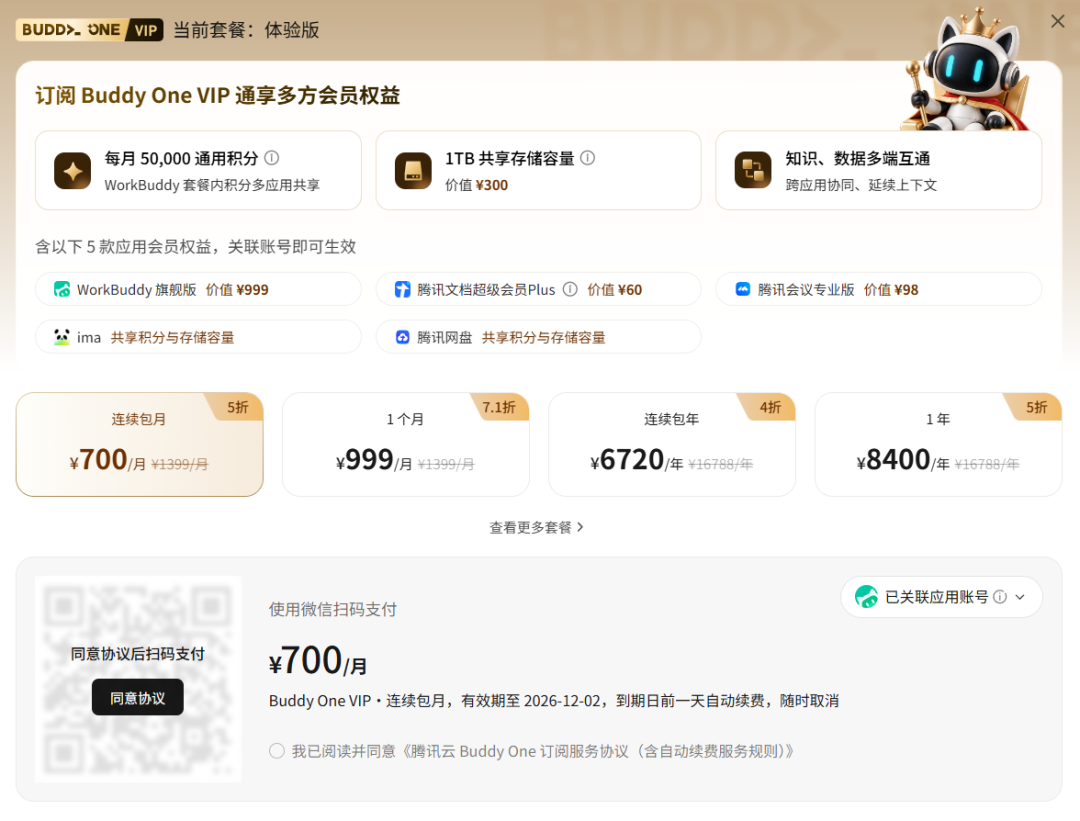
This playbook produced beautiful numbers in the short term, but it sidestepped a question the AI industry cannot avoid: the ultimate competitiveness of Agents lies not in distribution but in intelligence. A channel can determine "which one users use," but cannot determine "whether users are satisfied after using it." When the gap in model capability becomes perceptible at the user-experience level, the channel's efficiency advantage will be devoured by the capability gap.
WorkBuddy's current position is a time window won through distribution density, but this window is being squeezed simultaneously from multiple directions—by model vendors' natural extension into the application layer, by the industry concentration trend of "winner-takes-all," and by the structural limitation of inaccessible overseas models.
Tencent need not be accused of pursuing a "not illegal" channel strategy, but the industry needs a reminder: China's AI competitiveness will ultimately not be defined by whose Agent has the largest installed base, but by whose model is most reliable on critical tasks and whose large model is most irreplaceable in real-world workflows. In an industry where model capabilities still iterate on a monthly basis, channels can win a time window, but they cannot win an era. WorkBuddy's "spring breeze and galloping horse" is aimed precisely at the foundation of the AI era. Tencent still wants to be the landlord of the next era, and the efforts of the era's elites will continue to make Tencent great again!
Disclaimer: This article is written based on publicly available information or information provided by interviewees, but Caigou Business Review and the article author do not guarantee the completeness or accuracy of the associated information and materials mentioned or displayed in this article, and it does not represent the position of any institution. If there is any infringement, please contact us for deletion. Under no circumstances shall the information or opinions expressed in this article constitute investment advice to anyone.
▼
-END-
-
![]()
What Exactly Are World Models For? How Autonomous Driving Learns in the Virtual World
-
![]()
Volcano Engine and Alibaba Cloud Both Claim the MaaS Crown — Myth and Reality
-
![]()
Palantir: Guidance Turns More Aggressive, but New Orders Become a Target for Nitpicking
-
![]()
Apple: The Storage Cost Backlash Has Finally Arrived—Is AI's "Safe Haven" About to Spring a Leak?
-
![]()
Facing Fierce Rivals: Tesla's European Sales Surge 271% in October, Yet It Trails Chinese Automakers in Many Countries
-
![]()
Build Factories Now! Thailand Cracks Down on Fully Imported EVs: Tax Rate to Rise from 10% to 35%
-
![]()
AI Programming Pitfalls: Don't Let Fallback Code Fake Success
-
Insight | From Racks to Validation Grounds: IDC Asset Securitization Reaches a New Juncture