Volcano Engine and Alibaba Cloud Both Claim the MaaS Crown — Myth and Reality
 11/03 2026
 373
One plays a high-margin, high-unit-price game; the other fights a high-volume war of scale.
Author | Dingshan
Editor | Xiaobai
Illustrations | AI-generated
Produced by | Emphasize Next
On October 29, Volcano Engine and Alibaba Cloud published announcements in quick succession, each claiming the top spot in IDC's latest MaaS report.
Volcano cited 45.1%; Alibaba cited 46.6%. The headline was identical, and both drew on the same report IDC had released the day before — the "China AI Software Market Semiannual Tracker, 26H1."
The discrepancy comes down to statistical scope: Volcano claimed the overall MaaS market, while Alibaba claimed the large language model segment within it. Such cherry-picking is hardly new — last year the two companies ran airport advertisements touting their respective "first place" claims.
More telling is another set of figures in the report. In the first half of the year, China's MaaS market generated 10.63 billion yuan in revenue, up 889.4% year on year, while Token consumption over the same period grew only 432.5%.
Calculated from these two datasets, revenue per million Tokens rose from roughly 2 yuan in the same period last year to about 3.7 yuan — an increase of about 86%.
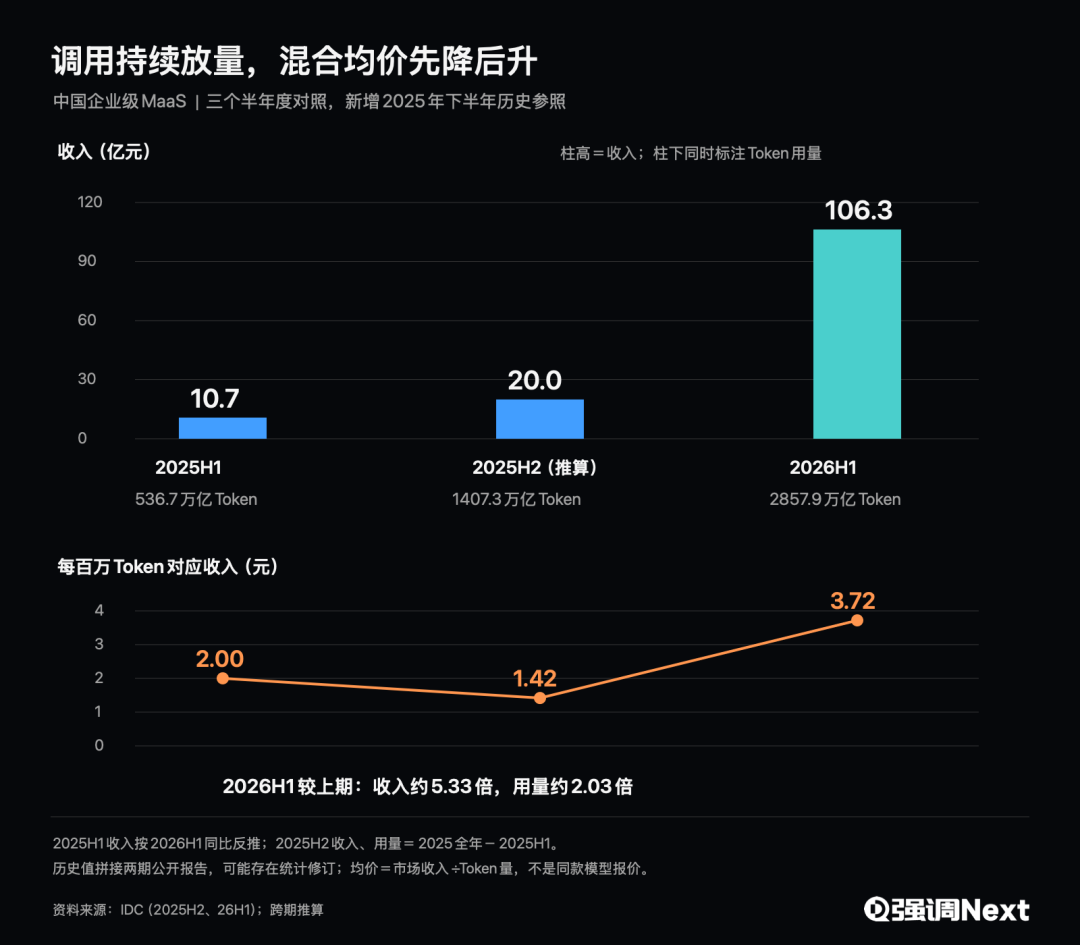
Price competition continues, yet the blended average price across the entire market has gone up. The entry of high-priced modalities such as video into the revenue mix is a key clue to understanding this shift — and explains why the two "first places" can both hold true simultaneously.
Two first places, resting on different revenue structures
IDC breaks down the 10.63 billion yuan by modality: large language models account for 47.0%, video generation 32.7%, and other modalities 20.2%. Video generation amounts to about 3.48 billion yuan in half a year.
The report does not disclose modality revenue by vendor. Plugging in the public shares yields the following estimate table. Cross-checking with Zhipu: its 10.6% language model share converts to about 530 million yuan, which matches the Zhipu revenue IDC gave in reports.
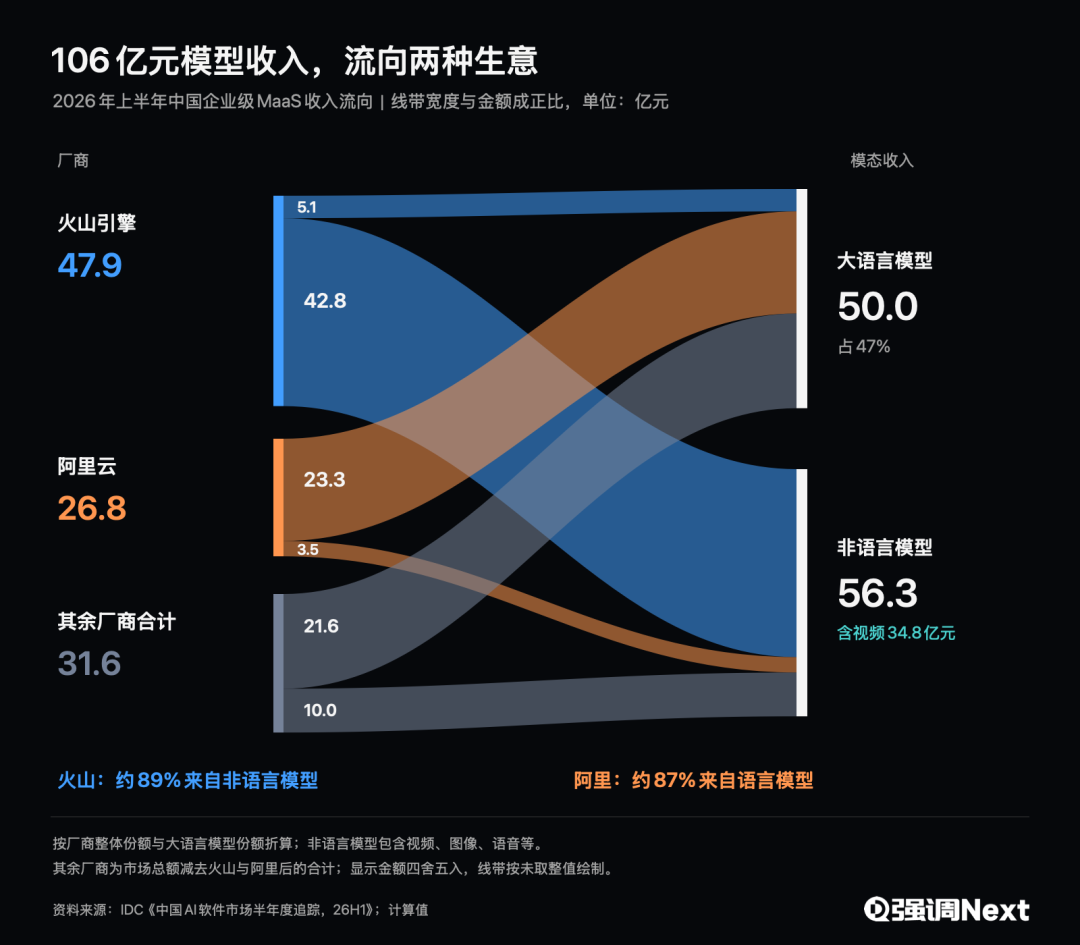
About 89% of Volcano's revenue comes from the non-language side, accounting for about three-quarters of that market; about 87% of Alibaba's revenue comes from the language side, accounting for 46.6% of that market, with only about 6% from the non-language side. The first places both companies obtained came from the revenue segment the other barely participated in.
According to media reports, Volcano's MaaS gross margin exceeded 55% in the first half of the year. Had its share been bought with subsidies, the margin would not be this high — which shows there is real pricing room on the video side. How large that pricing room is depends on how much a single Token sells for.
Video accounts for only a few percentage points of Tokens but contributes 30% of revenue
The pricing Volcano Ark published for Seedance 2.0 is: 46 yuan per million Tokens for pure generation scenarios, and 28 yuan per million Tokens for editing scenarios that include video input. Generating a 15-second, 720p video consumes about 309,000 Tokens; at the pure generation price, that is about 14 yuan per video.
Video generation is also billed by Token, so its usage is included in IDC's total Token volume. Converting the 3.48 billion yuan of video revenue back at 28 to 46 yuan corresponds to 76 trillion to 124 trillion Tokens — only 2.6% to 4.3% of the 2,857.9 trillion total.
The remaining more than 95% of Tokens support the other 67.3% of revenue, averaging about 2.6 yuan per million Tokens. The unit price of video Tokens is more than ten times that of the rest. This is an order-of-magnitude estimate based on Seedance's public prices; video pricing varies by vendor, and only the order of magnitude is taken here.
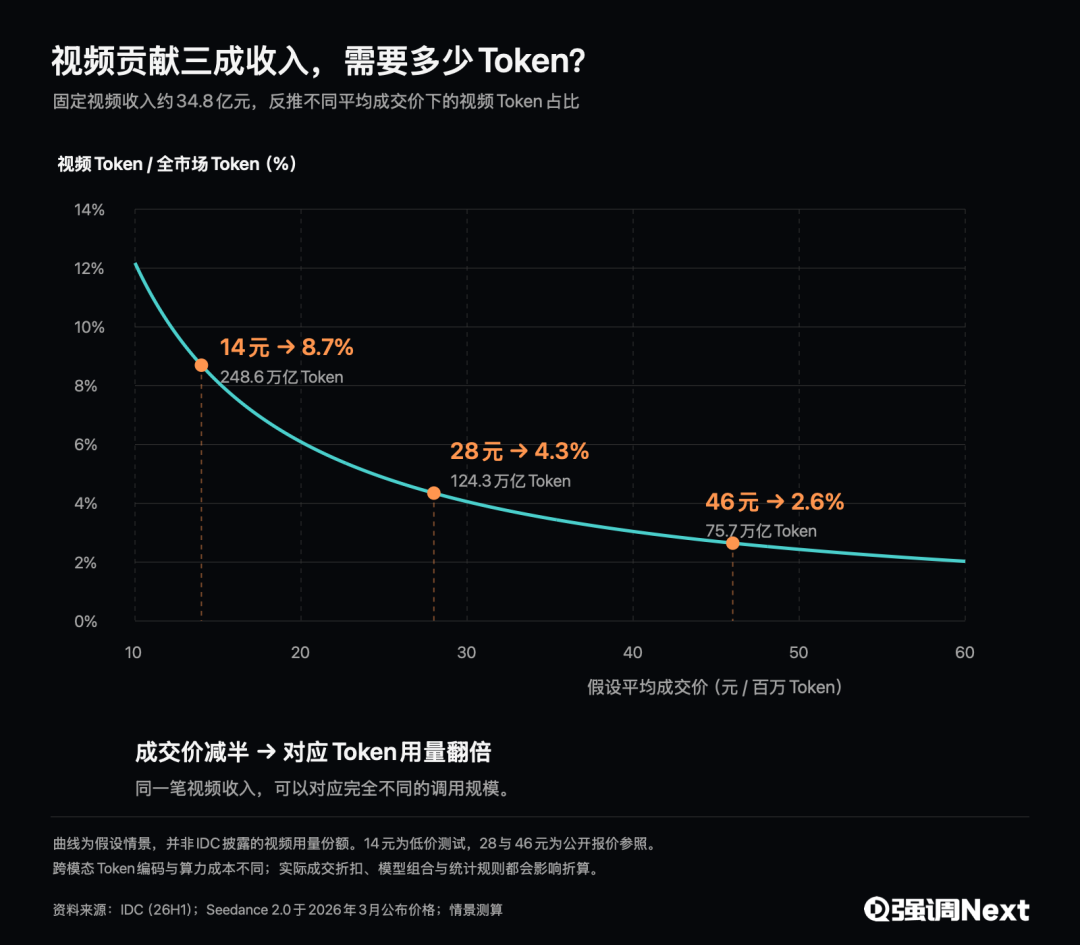
Returning to the doubling growth rate mentioned at the beginning, it is easy to explain. IDC disclosed Token consumption of 536.7 trillion in the first half of 2025, corresponding to revenue of about 1.07 billion yuan, or about 2.0 yuan per million Tokens; this year's first half was about 3.7 yuan, up about 86%.
Seedance 2.0 went viral around this year's Spring Festival, and commercial pricing was announced in March. The 46-yuan tier of Tokens entered the pool, pushing up the blended average price.
The price war on the text side has not stopped. This is also why IDC changed its methodology this year. In the 2025 data, Volcano ranked first by call volume share at 49.5%, and Alibaba Cloud at 28%; this period's headline switched to revenue share.
LatePost's report also mentioned that entering 2026, Token consumption alone is no longer enough to measure a MaaS vendor's position. Alibaba would not agree with this reading.
The counter-evidence it offers is volume: on the earnings call, management disclosed that API Token demand in May and June grew more than tenfold compared with November and December last year. The logic on the text side is low unit price and large volume, pushing usage up through Agents and coding.
The difference between the two logics is that video revenue is supported by unit price, while text revenue must be supported by usage — and how much revenue usage can translate into depends on how far text Token prices will continue to fall.
The ceiling on video revenue lies in delivery and rivals; demand is not a problem for now
Volcano's video revenue has an inherent constraint. When Seedance 2.0 pricing was announced, the API was not yet open to the public. According to reports, relevant sources said it would not be opened to tool providers for the time being and had only onboarded the first batch of enterprise customers, including a leading comic drama company.
After the Spring Festival, user queue times lengthened substantially. CMGE told NBD that even with the 499 yuan/month Jimeng premium membership, users often had to wait more than 3 hours, so it could not yet be used as a stable production tool.
This was the situation for consumer-facing products in the early launch period. Today Volcano Ark already provides API access documentation for the Seedance series, and enterprise customers face more specific delivery questions: how much concurrency quota is available at peak times, whether a single generation meets requirements, and how many retries are needed after failures.
A video is listed at 14 yuan, but if it must be generated repeatedly to pick a usable version, the customer's actual cost multiplies. For professional customers, the cost per usable asset matters more than the per-million-Token quote on the pricing page.
Usability rate and delivery speed also determine how much price a vendor can defend. Rivals are filling the gap.
Kuaishou's financial report shows that Kling AI's second-quarter revenue exceeded 850 million yuan, up more than 200% year on year, with cumulative first-half revenue exceeding 1.5 billion yuan and nearly 50,000 enterprise customers; in July it completed a financing of nearly $3 billion, at a post-money valuation of about $18 billion.
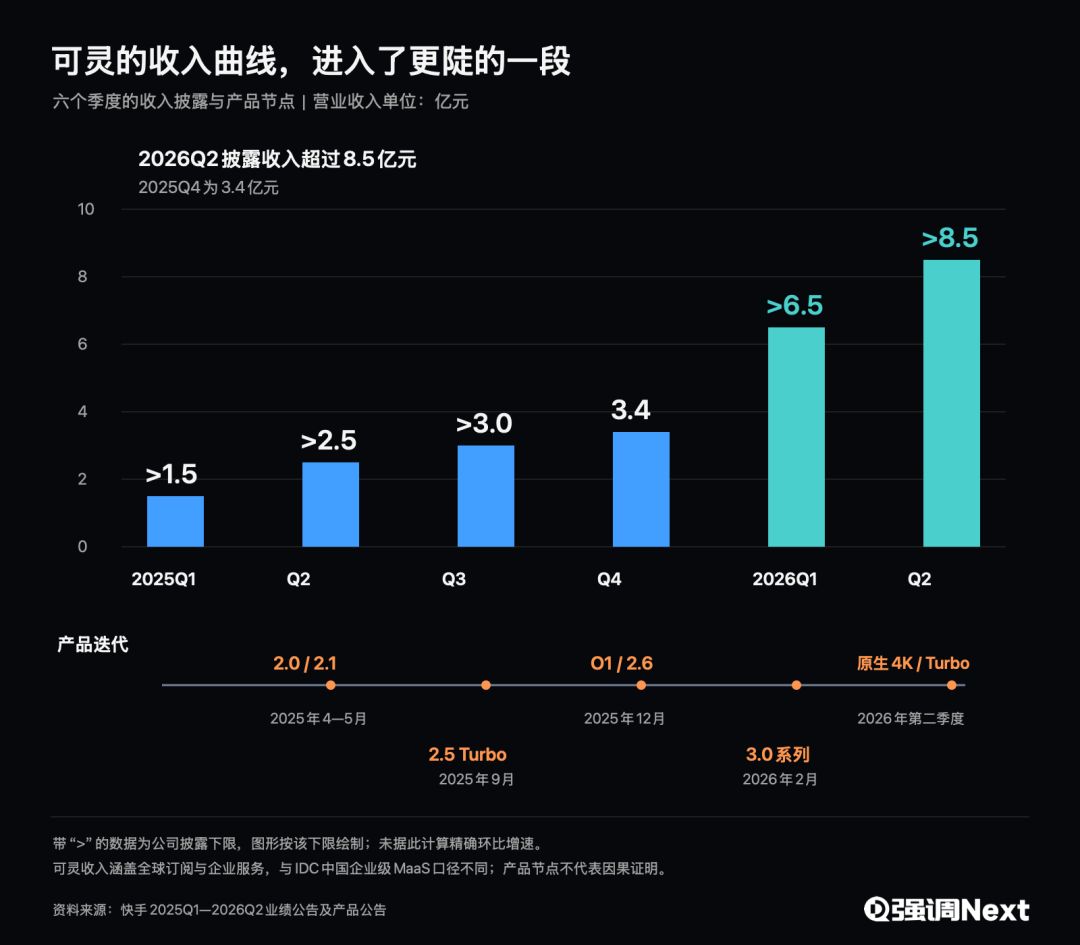
This figure is Kling's total revenue and cannot be directly compared with IDC's MaaS scope; it serves only as an order-of-magnitude reference, at about one-third of Volcano's converted non-language revenue.
Kling 3.0 introduced native 4K video direct output, aimed at professional customers in film and advertising. Competition in video generation is entering professional scenarios.
How long video's high unit price can hold depends on how far rivals catch up in these scenarios. Volcano's own target is steeper.
Media previously reported that in April Volcano raised its full-year MaaS revenue target from 10 billion yuan to 15 billion yuan, and a report on October 30 further stated that the original 15 billion yuan annual target had been raised again.
Taking only 15 billion yuan as a reference, with about 4.8 billion yuan in the first half, the second half needs about 10.2 billion yuan — 2.1 times the first half. The latest target implies an even greater volume requirement.
How much video must bear depends on whether computing capacity expansion can translate into stable delivery, and whether customers continue to add orders. The language model, with only a 10.2% share, is another space for Volcano to expand its revenue sources.
In Alibaba's ledger, MaaS is just an entry point to AI cloud
Putting Alibaba's MaaS back into its own financial reports, the proportion is small. In the June 2026 quarter, Alibaba's "AI cloud and computing services" segment revenue was 48.437 billion yuan, up 45% year on year, of which AI-related product revenue was 12.376 billion yuan. In the March quarter this item was 8.971 billion yuan, totaling about 21.35 billion yuan for the first half. IDC's converted Alibaba MaaS of about 2.68 billion yuan is roughly one-eighth of that.
The two scopes differ — AI-related products include a large amount of computing power — but the order-of-magnitude relationship shows that the main body of Alibaba's AI revenue is in computing power and cloud, and the weight of MaaS rankings on its ledger is lower than for Volcano.
The reason management values MaaS is written in the May earnings call minutes. MaaS gross margin is higher than IaaS, and the vast majority of Bailian revenue comes from self-developed models.
The target management gave in May was also high: "model and application services," including Bailian MaaS API and AI-native software subscriptions, were to break 10 billion yuan in annualized revenue in the June quarter and reach 30 billion yuan by year-end, tripling within half a year.
This scope includes software subscriptions and cannot directly correspond to IDC's revenue, but the direction is clear.
IDC noted that penetration in early-adopter scenarios such as Coding is approaching saturation, and the room to push up purely through Token usage is narrowing, so Alibaba wants to package text capabilities into subscriptions and office products to sell.
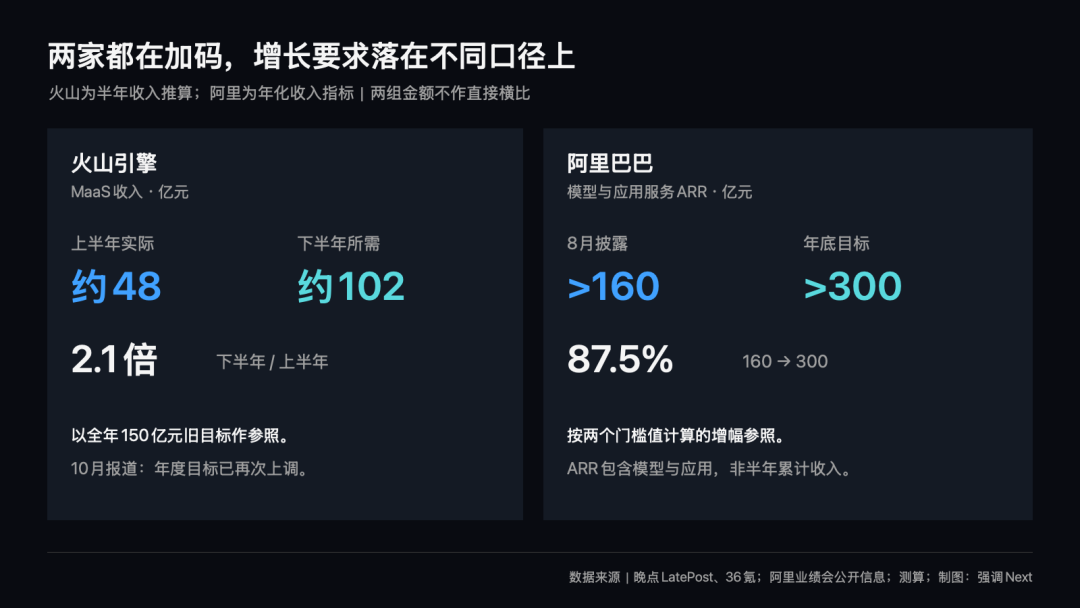
This and Volcano's per-finished-video pricing are two approaches to the same thing — both are trying to escape Token-based commoditization. Alibaba's converted non-language revenue is only about 350 million yuan.
Wu Yongming said in the financial report that the recently released language, coding, video, voice, image, and music models all rank in the first tier in performance; between model capability and revenue, there is still a distance of customer scenarios.
The revenue Volcano needs to complete in the second half already exceeds the 10.2 billion yuan corresponding to the old target; Alibaba, meanwhile, needs to push its model and application services ARR, which exceeded 16 billion yuan in August, toward 30 billion yuan by year-end.
Both sides are adding to model revenue. In the expansion process, how much gross margin each usable video and each completed task can leave will determine how thick this round of growth ultimately is.
Note: The data in this article comes from public sources and does not constitute investment advice.
- END -
-
![]()
What Exactly Are World Models For? How Autonomous Driving Learns in the Virtual World
-
![]()
Volcano Engine and Alibaba Cloud Both Claim the MaaS Crown — Myth and Reality
-
![]()
Palantir: Guidance Turns More Aggressive, but New Orders Become a Target for Nitpicking
-
![]()
Apple: The Storage Cost Backlash Has Finally Arrived—Is AI's "Safe Haven" About to Spring a Leak?
-
![]()
Facing Fierce Rivals: Tesla's European Sales Surge 271% in October, Yet It Trails Chinese Automakers in Many Countries
-
![]()
Build Factories Now! Thailand Cracks Down on Fully Imported EVs: Tax Rate to Rise from 10% to 35%
-
![]()
AI Programming Pitfalls: Don't Let Fallback Code Fake Success
-
Insight | From Racks to Validation Grounds: IDC Asset Securitization Reaches a New Juncture