Double 11: I Let the AIs Do My Shopping—and They All Failed Spectacularly
 11/09 2026
 367
This year's Double 11 kicked off in mid-October. This time around, I decided to try something new: letting the platforms' own AIs handle my shopping.
I picked a few items I'd been meaning to buy anyway: an iPhone 17 Pro 256GB Silver China edition, AirPods Pro 3 China edition, Xinxiangyin Chayu Sixiang facial tissues in S size (120 sheets, 24 packs), and Three Squirrels Daily Nuts 750g (30 packs). I chose these to cover digital products, daily stock-up items, and snacks—so the sample wouldn't be too concentrated and the results wouldn't be skewed.
Taobao has its own AI, JD has Jingyan, and Douyin uses Doubao. After checking several platforms, I couldn't find an obvious AI entry point on Pinduoduo. While looking around, I also noticed that Ant had recently launched Lingguang 2.0, which is said to focus on personal agents, so I threw it into the mix to see how it performed.
01 How Many Prices Does the iPhone Actually Have?
Before letting the AI take the wheel, I first manually searched the same exact model on JD, Taobao, Pinduoduo, and other platforms. What I found was that consumers' own search results are easily misled by the listed prices merchants put up.
JD's top listings were flooded with third-party buyer stores, while Taobao mixed in activated units (already unboxed and activated, with the warranty period already running), resource machines (non-official channel supply, possibly refurbished or assembled units), and second-hand premium items. For instance, a Taobao listing priced at 7,460 yuan turned out to be an activated machine; JD also had a global purchase (cross-border channel) resource machine priced at 7,283 yuan. With product conditions all over the place, aligning prices was nearly impossible.
If you only look at search results, it's easy to mistake these prices for quotes on brand-new China-edition devices.
The iPhone 17 Pro 256GB China edition launched at 8,999 yuan, was later officially reduced to 7,999 yuan, and was removed from the official website after the iPhone 18 was released; most of what's sold now is channel inventory.
After checking each one, I compiled seven prices:
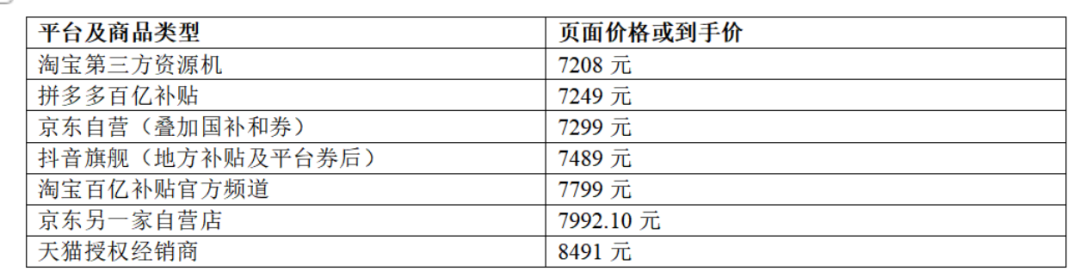
Summary table of the seven prices
These include both resource machines and subsidized brand-new products; the prices don't reflect completely identical product conditions, so they can only serve as references for search results on each platform.
Among the seven prices, the highest and lowest differ by 1,283 yuan. But that number alone doesn't tell you much. What really reveals the problem is the gap between sellers of the same type: both are JD self-operated, yet the actual payment prices at two stores differ by nearly 700 yuan.
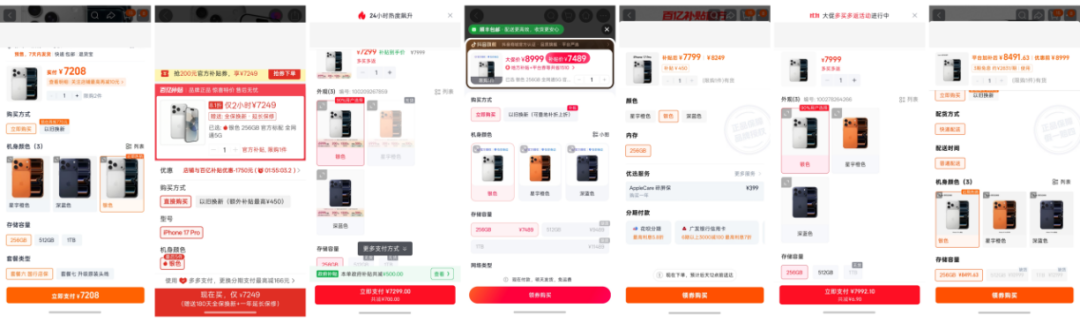
From left: Taobao third-party resource machine 7,208 yuan, Pinduoduo subsidy 7,249 yuan, JD self-operated 7,299 yuan, Douyin flagship 7,489 yuan, Taobao subsidy official 7,799 yuan, another JD self-operated store 7,992.10 yuan, Tmall authorized dealer 8,491 yuan
One phenomenon is worth noting: the so-called "Taobao price" and "JD price" are not actually a single unified answer. Taobao's official subsidy is 7,799 yuan, a third-party resource machine is 7,208 yuan, and a Tmall authorized dealer is 8,491 yuan; the two JD self-operated stores also don't have the same price.
So simply telling me which platform is cheaper is actually of little significance. Which specific store it is and what version is being sold—those are the more important questions.
02 How Good Are the Platforms' Own AI Recommendations?
Next, I sent the list of four products to Taobao AI, JD Jingyan, and Doubao respectively, with a simple question: which is cheaper, how much, and which specific store?
The three AIs each had their own characteristics.
Taobao AI stated from the outset that it could only compare products within Taobao and wouldn't casually use prices from other platforms to answer. It was relatively good at explaining the differences between products—for example, dividing the iPhone into resource machines and sealed machines (brand-new unopened China edition) and reminding me to pay attention to the difference between store warranty and national warranty; for nuts, it also further analyzed the ratio differences among different stores.
For facial tissues, it didn't find the S size 120 sheets 24 packs I specified, but explained that there might be differences between old and new versions, and didn't force a result.
Jingyan gave me the impression that it was more willing to dig into product parameters. It found a 588 yuan AirPods Pro 3 listing, further read the product model, found that it showed WHALEDAR-OPEN Pro, and directly warned me that there might be false advertising or refurbishment issues.
Moreover, it searched for facial tissues very carefully. Not only did it find the specified size, it also additionally recommended an S size 150 sheets 24 packs for 43.9 yuan.
Doubao's answer was relatively direct: iPhone 7,489 yuan, headphones 1,499 yuan, tissues 42.9 yuan, nuts 59.9 yuan. Adding the four together, it calculated a total price of 9,090.7 yuan, and also asked whether I wanted to split the order to reach full reduction thresholds. The calculation was fast—except that the four price numbers added up to one mao less. But it also explained its price comparison scope in advance: prioritizing Douyin e-commerce official flagship stores, calculated based on Double 11 presale coupon prices. To use its coupons, I would also need to authorize and link a Douyin account.
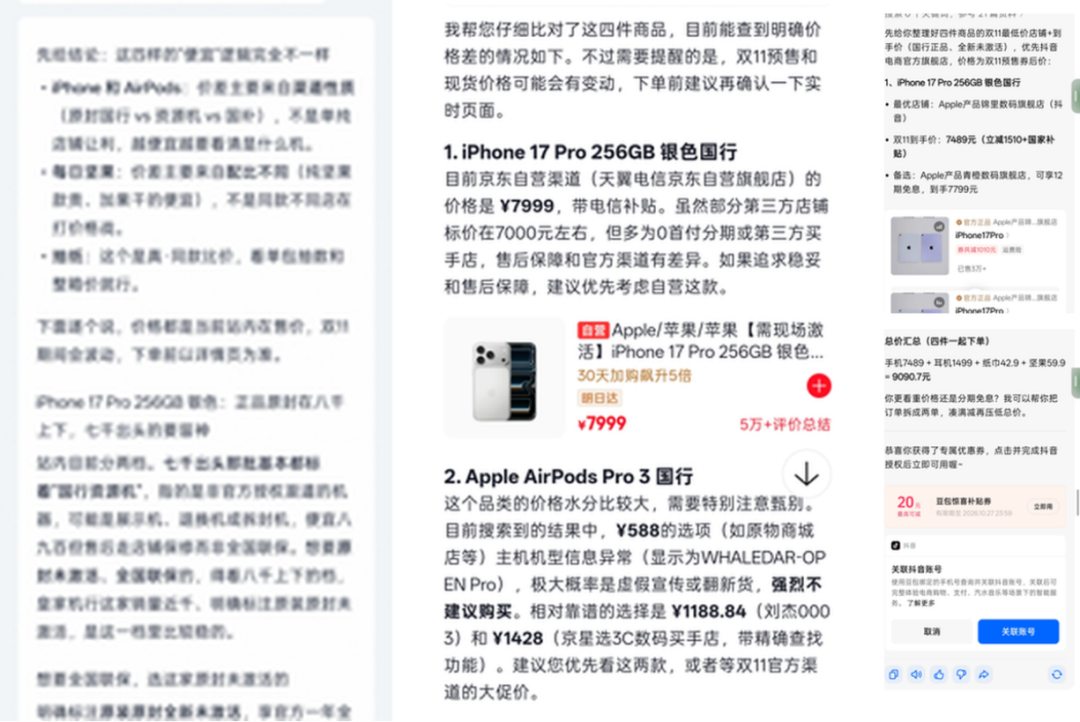
The three platforms'
AI answers (excerpt): from left Taobao AI, Jingyan, Doubao; below the Doubao screenshot is the Douyin account authorization it required
However, no matter how well the AI talks, in the end you still have to look at the product page. I picked the iPhone item and opened the products recommended by the three AIs one by one to verify:
Doubao reported 7,489 yuan. On the Douyin flagship product page I found, the silver 256GB after subsidy was indeed this price.
The product recommended by Jingyan was quoted at 7,999 yuan, with an actual payment price of 7,992.10 yuan—a difference of less than 7 yuan. But similarly JD self-operated, another store I had found earlier cost only 7,299 yuan. In other words, the price it reported was real, but it simply didn't find the cheaper store.
The third-party store recommended by Taobao AI had an actual payment of 7,208 yuan, also exactly consistent with the number it reported. The product package also specifically noted "China edition store warranty," which corresponded exactly to the resource machine warranty difference Taobao AI had reminded me about earlier.
This price corresponds to the China edition store warranty version, and is not completely identical in product condition to a brand-new China edition device.
The iPhone products and prices recommended by the three platforms could all be found on actual pages. No fabricated prices were found—but that doesn't mean the recommended products are necessarily the cheapest or most worth buying.
03 Lingguang, the AI That Proactively Tracks Prices
Lingguang is different from these platform AIs' question-and-answer model; it proactively follows up.
I assigned Lingguang a task: track the iPhone 17 Pro 256GB Silver China edition on both JD and Taobao, and notify me when the final price drops below 7,500 yuan, tracking until November 16.
The plan it gave was to check 5 times a day from 9 a.m. to 9 p.m., looking at JD self-operated and Taobao subsidy together, and push a notification when either reached the price requirement.
In addition, it proactively reported a round of market conditions: the JD self-operated page price was 7,999 yuan; after stacking the national subsidy and Plus coupon, transaction plans of 7,199 to 7,460 yuan had recently appeared; Taobao subsidy had previously gone as low as about 7,649 yuan.
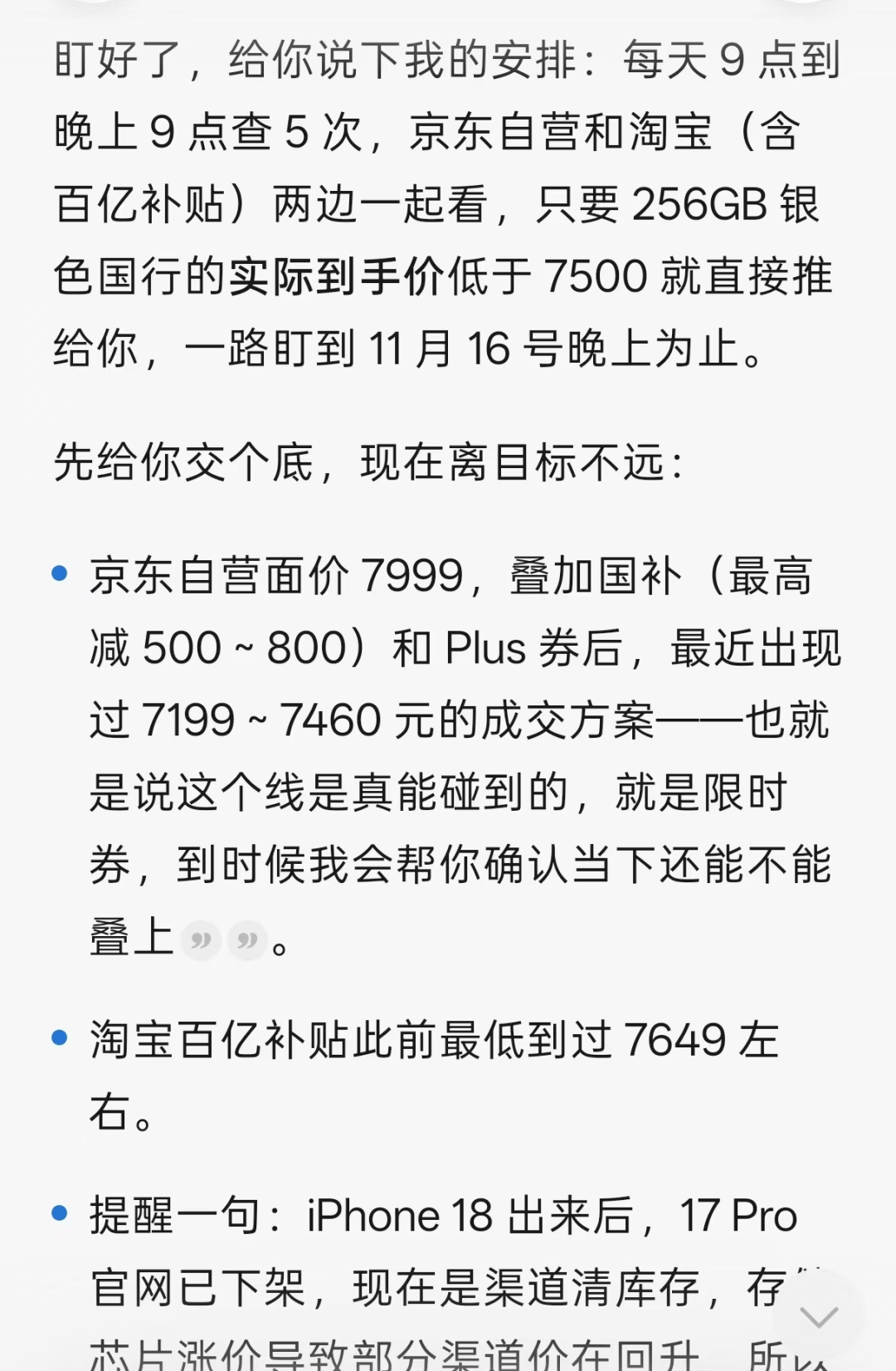
The plan Lingguang 2.0 restated after accepting the price tracking task, and the first round of market conditions it proactively reported
Lingguang spoke coherently, but whether it was accurate still had to be checked against the page. The JD self-operated page price of 7,999 yuan was consistent with the strikethrough price of one self-operated store I found; after stacking coupons, 7,199 to 7,460 yuan, and the 7,299 yuan I actually found was also within this range. Taobao subsidy's previous low of 7,649 yuan was a historical price, while the page was already 7,799 yuan at the time, so it couldn't be directly verified. After the first round of verification, the market conditions it reported basically withstood scrutiny.
Later I also expanded the price tracking scope to four platforms: JD, Taobao, Pinduoduo, and Douyin. In less than two hours, the first push notification arrived.
The JD self-operated silver 256GB final price was about 7,458 yuan, already meeting the previously set condition of below 7,500 yuan.
It also listed the price composition: page price 8,199 yuan, plus a coupon of 200 yuan off for every 3,000 yuan spent, a government subsidy of 500 yuan, and a Plus instant discount of about 41 yuan.
There's a small detail here: when I checked it myself in the afternoon, the JD self-operated page price was still 7,999 yuan, but when Lingguang pushed the notification it used 8,199 yuan. It looked like both were JD self-operated, but in fact they were different stores with different price standards.
That evening, the second push notification arrived.
This time it found that the store's page price had dropped from 8,199 yuan to 7,999 yuan, and the recalculated actual final price was about 7,259.01 yuan. Compared with the 7,299 yuan I had screenshotted at another store in the afternoon, it was about 40 yuan lower.
More interestingly, it also reminded me: if I had already placed an order at 7,458 yuan in the afternoon, I could pay attention to JD price protection and apply for a refund of the difference after receiving the goods.
In the routine briefing at noon the next day, it also filtered out several low prices circulating online. For example, 6,999 yuan was a trade-in price and couldn't be directly compared with a plan without an old device; the 6,899 yuan circulating in WeChat groups had not been confirmed and was not treated as a valid price.
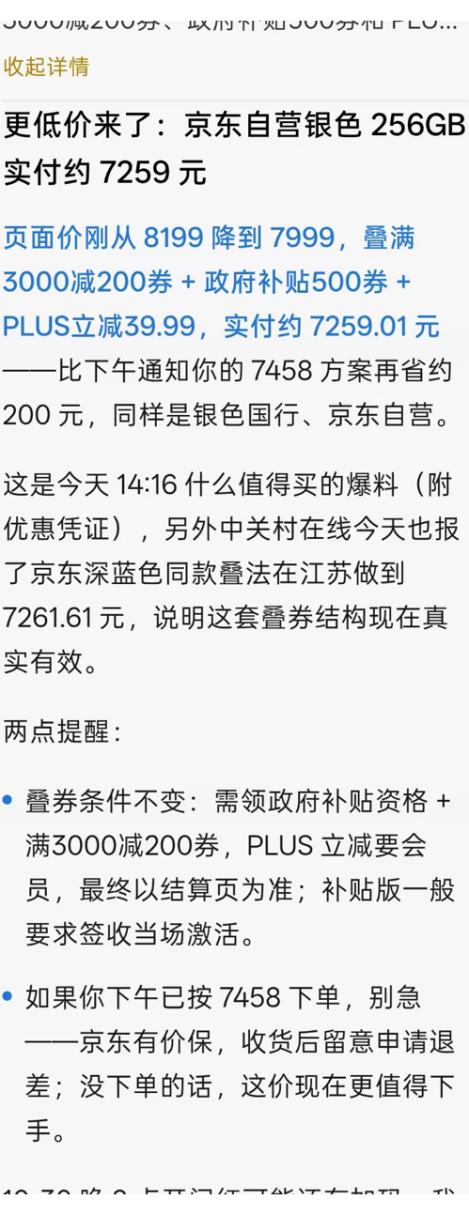
The routine briefing at noon the next day: filtering the standards of circulating low prices
This part of the experience was indeed different from simple question and answer. At least in this test, it could continuously track price changes and also proactively remind me which prices couldn't be directly compared.
04 Buying Headphones: The AI Failed
The previous tests had gone fairly smoothly, and I was preparing to place an order for headphones, so I also casually checked the AirPods Pro 3 products recommended by Taobao AI and Jingyan.
This time, instead, I found a more noteworthy problem.
The official price of AirPods Pro 3 is 1,899 yuan. Taobao AI recommended a store quoting 1,345 yuan, claiming this was a lower-priced choice among genuine products. Clicking into the page showed 1,349.1 yuan after platform additional subsidy.
Jingyan recommended two stores, priced at 1,188.84 yuan and 1,428 yuan respectively (both from Jingyan's answer at the time), and classified both as relatively reliable choices.
But after clicking into each one, the situation was not quite right.
First, look at the 1,428 yuan store recommended by Jingyan. On the product page, the thumbnail of each specification was marked with four words: "Apple resource machine."
A resource machine and a brand-new China edition device are not the same thing, and this information was not raised at the time of recommendation.
The other 1,188.84 yuan product was actually a Jingxi store, and the page showed that the product was currently not supported for sale in the current region. That alone already made the recommendation somewhat untenable.
The store recommended by Taobao AI also had problems on closer inspection.
This store page showed an "official authorization" mark. When I continued to check related products, I also saw so-called AirPods 4 standard version P63 and noise-canceling version P93. P63 and P93 are not official Apple model names.
This was a bit awkward.
Jingyan had previously identified a suspicious 588 yuan headphone through the product model field and reminded me not to buy it; then it turned around and recommended products marked "Apple resource machine," as well as a store not currently supported for sale in the region, as relatively reliable choices.
Taobao AI was a different case. Earlier it could remind me to distinguish resource machines from sealed machines and knew the difference between store warranty and national warranty; when recommending the 7,208 yuan store-warranty item, it clearly explained the nature of the machine in advance, and this point was more standardized than Jingyan. But in the headphone round, the store it recommended also had aspects that did not withstand close inspection.
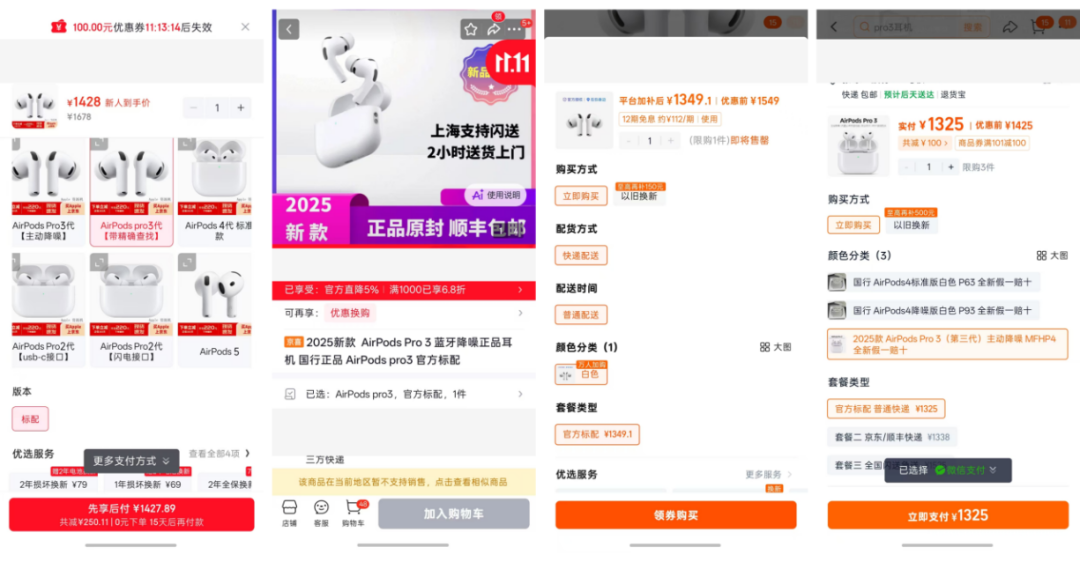
Four pieces of evidence from the headphone verification: the 1,428 yuan page marked "Apple resource machine"; 1,188.84 yuan was a Jingxi store and currently not supported for sale in the region; the "official authorization" store page showed 1,349.1 yuan after platform additional subsidy; another product seen during verification showed non-official model names P63/P93
I could find the prices of these stores on the product pages. The prices were real, but real does not mean the recommendation is reliable. What really creates the gap is whether the nature of the product is clearly explained at the time of recommendation: recommending a resource machine is not a failure; describing a resource machine as brand-new is.
05 Final Thoughts
AI can genuinely help me secure better deals. For the iPhone, the JD self-operated listing showed 7,999 yuan, but after Lingguang tracked and recalculated, the final price came to around 7,259 yuan—a difference of roughly 740 yuan.
Taobao AI, Jingyan, and Doubao were all able to locate products within their respective platform scopes and provide verifiable prices, and they did save some time on searching and price comparison.
What Lingguang actually stood out for, however, was a different kind of experience: it didn't just quote a price once—it tracked continuously, pushed proactive updates, and recalculated whenever prices changed. The value of long-running tasks really showed in this iPhone tracking case.
That said, the headphone-buying process exposed a problem with AI shopping: AI can flag suspicious products in search results, but it may not apply the same scrutiny to products it recommends itself.
But if we're truly going to hand shopping over to AI, I think there's still another hurdle: it not only has to help me find cheap deals, but also has to know what should—and shouldn't—be bought, and which merchants aren't worth recommending.
-
So Embarrassing: Apple Alone Takes 50% of Global Phone Revenue—All Domestic Brands Combined Only 30%!
-
![]()
160 Million Views Earn Just 390,000 Yuan: Who Really Profits from AI Short Dramas?
-
Is Cost-Effectiveness Dead? Average Phone Prices Have Risen by 620 Yuan in a Year—Even Xiaomi Is Up 410 Yuan
-
One Headline, Big Headache: "Buy One Get One Free Across the Entire Lineup" Backfires—SAIC Audi Under Investigation
-
From "Competing on Parameters" to "Getting Things Done": AI Is No Longer Just "Pleasing Itself"
-
With a 5-Fold Hourly Wage Gap, Strike-Driven Pay Raises Are Speeding German Cars Toward Their Own Funeral
-
Global Annual Sales of Just 15,000 Units—Can Moving Production to India Cure Honda's EV Woes?
-
Maserati: 7,900 Vehicles Sold Annually With a Net Loss of €840 Million—Will a Chinese Automaker Acquire It?