160 Million Views Earn Just 390,000 Yuan: Who Really Profits from AI Short Dramas?
 11/09 2026
 469
Moore Observation
|||||||||||||||||||||||||

160 million views earned a mere 390,000 yuan—yet trial and error for a single 5-second shot alone can burn through more than 20 yuan. As ordinary people rush headlong into AI short dramas, who exactly are they ultimately paying?
[ Author: He Yuzhi | Editor: Lu Yue ]
Most people get the idea of making AI short dramas after seeing enticing success stories on short video platforms.
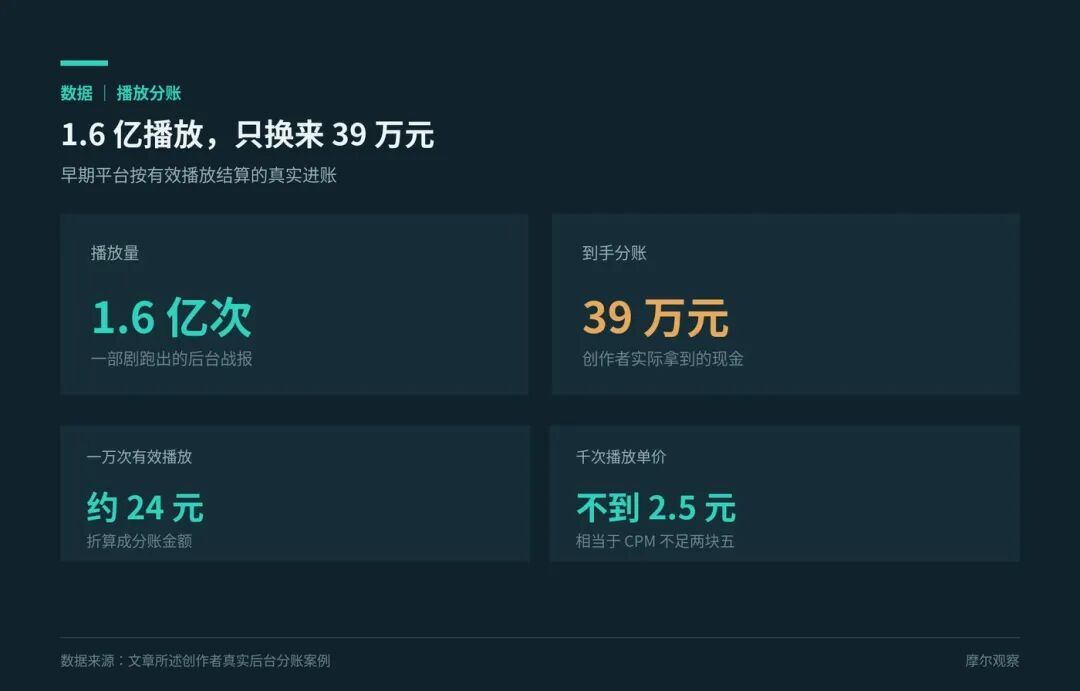
Some creators have shared their actual backend data: one drama racked up 160 million views and received 390,000 yuan in revenue sharing. There are even claims that an all-part-time team continuously produced ten seasons and a thousand episodes, accumulating billions of views and walking away with tens of millions in cash.
Those glamorous success stories on screen easily create an illusion: if stay-at-home moms and delivery drivers can make comebacks, and AI has lowered the barrier to film and television production to the floor, then can't you also grab a piece of the pie by buying an account and clicking around to generate content?
However, once you personally build a pipeline and run cloud models for a few days, you'll find that reality is far less rosy than the success stories suggest.
When you bring up a mainstream 720P video generation model on the market and enter your first prompt, the real bill will cool your enthusiasm. The platform's advertised unit price seems low—only about sixty cents per second—but as soon as character actions and camera movement are involved, hand clipping and limb deformation are commonplace.
To filter out one qualified 5-second shot that can make it into the final cut, generating it seven or eight times is normal, and the actual trial-and-error cost per shot easily exceeds 20 yuan.

For a serial short drama with over a hundred episodes, even if each episode cuts more than a dozen shots, after trial and error across hundreds or thousands of shots, the computing power fees paid to cloud large models can surge to tens of thousands or even hundreds of thousands of yuan.
On one side is the 390,000 yuan in gross profit that can only be squeezed out after 160 million views; on the other is the computing power black hole billed by the second. If you don't know how much money it really takes to make one episode and can't handle the local engineering workflow, ordinary people plunging in will ultimately only become computing power fuel, paying electricity bills for cloud providers.
>_ Section 01
160 Million Views for 390,000 Yuan: Cloud Computing Power Takes the Biggest Cut First
In the short drama business, what most easily misleads laypeople is view counts in the hundreds of millions.
Breaking down that real income of 390,000 yuan from 160 million views corresponds to the early platform revenue model settled by valid views.
Converted, the revenue share per 10,000 valid views is about 24 yuan—equivalent to a unit price of less than 2.5 yuan per thousand views. Every cent creators receive is squeezed out of extremely meager per-thousand-view revenue.
But on the other side, cloud generation costs are rigid and billed by the second.
When promoting, mainstream commercial platforms often only tell you that 720P video costs about sixty cents per second, and a 5-second shot seems to cost only three yuan.
But this calculation conceals a fatal variable: the extremely high defective rate of generative video. At the current stage, diffusion models still have a fragile understanding of spatial logic, and characters are highly prone to twitching or deformation when moving.
Frontline production teams generally report that the defective rate of AI video is currently around 70 to 80 percent—what the industry calls "one out of eight" or even "one out of ten." This means that to get one qualified 5-second shot, you must first pay for seven or eight defective ones.
Converted, the true production cost of a single qualified shot firmly lands above 20 yuan.

This account directly pushes small and medium teams to the edge of loss. According to an interview by Chinese Entrepreneur magazine with Shi Yiyuan, a short drama practitioner in Zhengzhou, he took on a 180-minute comic drama order with a contract stipulating settlement at 400 yuan per minute.
As a result, after the first six episodes, because details kept giving away errors and required repeated regeneration, computing power alone cost 10,000 yuan—equivalent to an actual computing power cost of nearly 800 yuan per minute, almost twice the contract quote. By the time the whole film was finished, computing power spending exceeded 60,000 yuan, and before post-production dubbing was even counted, the total budget had already been blown through.
According to a Cover News report, full-time stay-at-home dad Jiang Lan produced the short drama Guixu, which surpassed 100 million views across the internet. It looked like a miracle made by one person and one computer, but behind it the computing power investment for a 12-episode short drama was nearly 200,000 yuan—averaging about 2,000 yuan per minute in computing power cost.

When 160 million views can only bring 390,000 yuan in revenue sharing, and the cloud trial-and-error cost of a short drama often devours hundreds of thousands, the business model of making short dramas purely with cloud tools is already mathematically difficult to sustain.
>_ Section 02
Buy a Graphics Card and Take It Home—So Why Do You Then Get Stuck on Time?
Since pay-per-use cloud is a bottomless pit, many people's first reaction is straightforward: buy a top-tier graphics card and run it at home, pay for your own electricity, and at least you no longer have to pay a "head tax," right?
But once this account is applied to real hardware parameters, ordinary people hit another wall: the time wall.
At present, the high-performance graphics card ordinary people can afford is mainly the RTX 4090 with 24GB of VRAM, with a single card priced above 15,000 yuan.
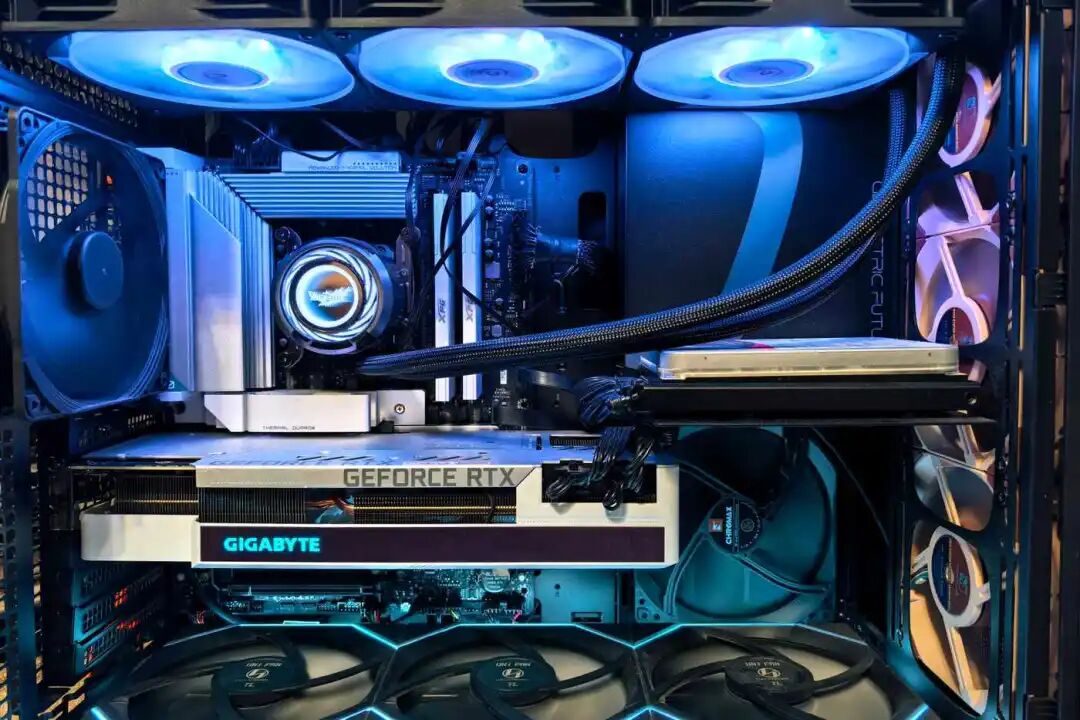
But deploying open-source video models locally is not gentle on VRAM. Generating a high-precision video requires high-density spatiotemporal denoising in latent space. If you insist on running native 720P quality locally with denoising steps maxed out, it easily triggers out-of-memory errors directly.
Even if the model is squeezed into VRAM through quantization, generating a 5-second dynamic clip on a single graphics card still takes 3 to 8 minutes.
What is even more headache-inducing is still the defective rate. When running video locally, to pick out a shot with natural movement, you likewise need to generate five or six candidate versions. With five trial versions per shot, a single card takes half an hour.
Even if the graphics card runs 24 hours a day, at full capacity it can produce only thirty or forty qualified shots a day. Yet a single episode of a short drama needs more than a dozen shots, so one flagship graphics card working to death can squeeze out only two or three episodes of content a day.
Facing the fast serialization pace of platforms, the time span of single-machine local rendering will disconnect efficiency. To raise production capacity, you have to build multi-card workstations, and hardware investment plus industrial electricity costs quickly approach the 100,000 yuan mark.
Buying graphics cards to fight cloud fees ultimately only converts cash expenses into hardware depreciation and time consumption.
>_ Section 03
Those Who Truly Make Money Are All Using This Layered Mixed Workflow
Since pure cloud bleeds you dry and pure local gets you stuck to death, how do those grassroots teams on social platforms who have closed the business loop and turned a profit survive?
The solution they have figured out is extremely pragmatic: a layered mixed workflow. The core logic is to separate text, static images, dynamic trial and error, and quality upscaling—letting the cheapest tools bear the link with the highest trial-and-error cost.
Layer one: text scripts firmly go to the cloud. Writing scripts and storyboards with plot twists, hook conflicts, and camera prompt words requires high-dimensional semantic understanding. Local small language models easily produce contradictory settings from beginning to end.
Current top cloud language models, however, have extremely cheap text tokens, and the cost of reasoning and storyboard decomposition for millions of words is usually only a few yuan. Using extremely low cloud overhead to obtain a stable directing draft—this step is never skipped.
Layer two: visual character designs are first locked locally with lightweight image generation models. Never directly use text to blindly draw videos.
Industry veterans first use local Stable Diffusion or ComfyUI with feature locks attached to generate the character's three-view sheet and scene composition as static images.
A static image takes only a few seconds, and at this step dozens of draws are used to freeze the character, thoroughly solving the chronic problem of wearing glasses one second and the glasses disappearing the next.
Layer three: high-defect-rate action trial and error is moved back to local low-resolution runs. This is the most critical cost-reduction lifeline of the entire pipeline. Feed the already-locked character reference images into the image-to-video model and let it only handle tiny dynamics and movement.
At this step, veterans never insist on running 720P locally, but directly compress the resolution to 420P or even 480P, using quantized lightweight video models to run actions. Low resolution greatly reduces VRAM overhead and increases inference speed several times over.
Even if the defective rate is as high as 80 percent, what is consumed is only a few cents of local electricity—cutting off the tube that lets cloud providers suck blood by billing per second.
Layer four: final image quality is boosted through post-production upscaling. After you locally pick out dynamic clips with qualified action, throw these 420P materials into Topaz Video AI or open-source tools for local frame interpolation and super-resolution reconstruction.
Using image algorithms to stretch low-resolution footage to 720P or even 1080P consumes far less computing power than natively generating high-quality video.
Leave complex thinking to cheap cloud large models, leave cheap composition to lightweight image generation, pin expensive action trial and error to local low resolution, and finally deliver the finished film through upscaling. This combination truly presses the comprehensive trial-and-error cost per shot from more than 20 yuan down to a few tenths of a yuan.

>_ Section 04
Building This Local Workflow Is the Real Invisible High Wall
Having grasped the tricks of layered mixed workflows, it seems one has found a smooth road to profitability. But for the vast majority of ordinary people, the crueler test has just begun.
Bloggers selling courses on the market will not tell you: this pipeline that can make you money simply does not have a client called "one-click finished film."
To run this chain completely, you must personally play the role of a local systems engineer. Open the node-based ComfyUI interface and face a dense pipeline; from prompt parsing and feature injection to weighing noise sampling steps, every link requires manual configuration.
The slightest environment conflict—such as incompatible dependency library versions or mismatched graphics card drivers and operators—will make the terminal throw an error and stop working.
Running quantized video models within 24GB of VRAM also requires you to learn to finely configure VRAM sharding parameters and enable gradient checkpointing. A slight mistake, and the system will pop up an out-of-memory crash at the last second of rendering.
Even more exhausting is automated task orchestration. Relying solely on manually sitting in front of the screen and clicking generate shot by shot still cannot meet serialization demand in production rhythm.
Individuals who truly scale up often need to write their own batch scripts, letting the system automatically monitor the generation directory, send queued tasks to the graphics card in order, and automatically call upscaling tools to compress the finished film after a segment is done.
This is precisely the most hidden watershed in current AI short dramas.
AI has indeed leveled the threshold for screenwriters writing scripts and artists drawing sketches, but the engineering threshold has actually shifted to workflow orchestration and computing power cost control. The creators who can earn 390,000 yuan from 160 million views are by no means pure beginners who know nothing; they are either tech-savvy geeks themselves or people who have struggled in local environments and flattened hundreds of error pits.
If you can neither handle the software and hardware debugging of local workflows nor bear the high cloud trial-and-error bills, then under the current technical environment, rushing into short dramas will most likely be only an expensive experience of working for computing power suppliers.
>_ Section 05
Final Thoughts
Over the past year, the wealth-creation myths surrounding AI short dramas have heated the entire industry. From grassroots comebacks to raking in tens of millions, various tales of huge profits keep stimulating ordinary people's nerves.
But any carnival that discusses business returns apart from actual expenses is essentially a dangerous bubble.
The actual revenue share of 390,000 yuan from 160 million views serves as a sobering reality check, drawing short dramas back to the fundamental business logic of low-margin manufacturing.
In this industry, the decisive factor has never been who can write more elaborate prompts or who uses models with larger parameter counts, but rather who can, at the most frugal cost, effectively absorb the industrial trial and error associated with high defect rates.
For the general public, understanding the true boundaries of technology is often more valuable than blindly following the hype.
Do not imagine that you can effortlessly earn money with zero barriers through some mysterious piece of software. Until generative AI truly matures to the stage of zero-defect footage and high controllability, this business remains the domain of exceptional individuals who can account for every cent of GPU computing expenses and possess the capability to build a rigorous local pipeline. Only by calculating the real costs on the ground can you grasp the true price behind those playback myths that seem to float in the sky.
>_ Making complex technology accessible.
>_ Moore Observation · Original Production
Unauthorized reproduction prohibited
Disclaimer
This article provides an in-depth review and business logic analysis based on public materials such as corporate announcements, technical patents, Tianyancha, and authoritative media reports, and is intended to explore technical pathways and industry trends. The product parameters and performance descriptions referenced in the article are quoted from official disclosures and represent only theoretical analysis based on existing data, not absolute feedback from hands-on experience. Given that technology products (especially new energy vehicles and robots) involve software and hardware OTA iterations, should relevant data differ from actual device performance, please refer to the company's final official release. The views expressed in this article are for reference only and do not constitute any basis for investment or purchase decisions.
-
So Embarrassing: Apple Alone Takes 50% of Global Phone Revenue—All Domestic Brands Combined Only 30%!
-
![]()
160 Million Views Earn Just 390,000 Yuan: Who Really Profits from AI Short Dramas?
-
Is Cost-Effectiveness Dead? Average Phone Prices Have Risen by 620 Yuan in a Year—Even Xiaomi Is Up 410 Yuan
-
One Headline, Big Headache: "Buy One Get One Free Across the Entire Lineup" Backfires—SAIC Audi Under Investigation
-
From "Competing on Parameters" to "Getting Things Done": AI Is No Longer Just "Pleasing Itself"
-
With a 5-Fold Hourly Wage Gap, Strike-Driven Pay Raises Are Speeding German Cars Toward Their Own Funeral
-
Global Annual Sales of Just 15,000 Units—Can Moving Production to India Cure Honda's EV Woes?
-
Maserati: 7,900 Vehicles Sold Annually With a Net Loss of €840 Million—Will a Chinese Automaker Acquire It?