2026 Crash Arrives Ahead of Schedule: Why the 2029 AI Bubble That Institutions Predicted Never Materialized
 11/12 2026
 361
Between 2024 and 2026, a remarkably unified consensus circulated in institutional circles. Multiple well-known overseas hedge funds and research institutions jointly concluded that a systemic bubble burst and deep correction in the AI sector would occur in 2029. At the time, the market widely converged on a single view: before 2029, AI carried no systemic risk.
This timeline was derived layer by layer by combining capital expenditure, capacity cycles, and liquidity frameworks. It once became the core risk-control benchmark for many funds allocating to the AI sector. But the 2026 AI market shattered this seemingly rigorous, logically airtight prophecy.
The far-off 2029 risk that everyone was watching had not yet arrived—but unexpectedly, 2026 staged the valuation clearing of the AI sector first.
I. Mainstream Institutional Views That Favored an AI Bubble Burst in 2029
Quite a few institutions firmly believed AI would face a major reckoning in 2029. Each had its own independent calculation framework; their core views are summarized in one sentence each below.
Gartner: Around 2029, massive AI infrastructure investment will face concentrated impairment, more than 80% of new cloud service providers will struggle to survive independently, and the return trap of computing power capital expenditure will be exposed in concentrated fashion.
JPMorgan Chase: A large amount of AI-related private credit and sub-B-grade software debt will concentrate for refinancing in 2028–2029. If AI commercialization falls short of expectations, this will be a key window for concentrated exposure of credit risk, requiring heightened vigilance.
Goldman Sachs: The scale of AI capital expenditure is enormous, and bubble clearing will lag; it may not burst immediately. Around 2029 is a key node for testing the returns on computing power capital expenditure. If productivity is insufficiently delivered, valuations will face repricing pressure.
The deductions of these institutions jointly supported the 2029 crash narrative of that time. The underlying logic centered on three dimensions: capacity, commercialization, and liquidity. This was also the reason many investors were willing to hold AI assets for the long term at the time.
1. Computing power capacity concentratedly released in 2028–2029, with a complete mismatch in the capital return cycle
Global tech giants continuously and frantically ramped up AI computing power capital expenditure for years, with optical modules, AI chips, and data center capacity continuing to climb and expand at high speed. Institutional estimates suggested that 2028–2029 would see concentrated landing of global newly added computing power supply. By then, the growth rate of computing power supply would far exceed real demand from enterprise AI commercialization.
The cumulative AI capital expenditure of overseas hyperscaler giants had already exceeded the trillion level, and large-scale infrastructure investment brought enormous depreciation and amortization pressure. Around 2029, the industry's overall ROI would face a systemic downward inflection point. This was benchmarked against the overcapacity crises at the end of the 2000 internet bubble and telecom bubble.
Hedge fund veteran Michael Burry explicitly warned that the AI infrastructure investment boom would trigger large-scale asset impairment and financial blowups in 2028–2029. The share of capital investment in tech stocks as a proportion of GDP had reached the second-highest peak in forty years, with bubble risk levels comparable to the eve of the Nasdaq internet crash.
2. Technology expectations severely overdrawn, with commercialization landing lagging linearly
According to Perez's classic framework of technological revolutions and financial capital cycles, the AI industry is in the transition stage from the technology introduction phase to the large-scale landing phase. Around 2029, autonomous driving, AI Agents, and enterprise intelligent transformation will usher in concentrated demonstration deployments, igniting extreme market optimism.
The capital market will linearly extrapolate a few benchmark cases into industry-wide adoption, forming exponential optimistic expectations and thoroughly overdrafting growth space for years to come. But real AI commercialization, paid conversion, and cost reduction and efficiency improvement are slow, linear processes. The huge gap between expectations and reality will directly pierce the AI sector's valuation bubble.
Investor Wang Yuquan explicitly pointed out that 2029 is a window for correcting core AI risks. It is not that technological development peaks, but rather an inevitable reckoning after excessive financial capital overheating. Technology iteration is always faster than business models, and business models are always faster than market expectations. This is the unified underlying law behind the bursting of bubbles in all disruptive technology industries.
3. Liquidity and primary-market exit cycles resonate, triggering concentrated valuation killing
Institutional macroeconomic cycle projections showed that from 2027 to 2029, global monetary policy would end the easing cycle and re-enter a rate-hiking tightening channel. High-valuation AI growth stocks are extremely sensitive to interest rate fluctuations, and their valuation systems would be reconstructed. Crowded AI funds at high levels would face systemic outflow pressure.
Dalio also warned that the AI bubble had approached the risk level of 1929 and 2000. Two major signals—rising interest rates and intensive corporate financing and cash-outs—would concentrate around 2029, igniting a deep sector adjustment. This cycle prediction was once the core time anchor for institutional risk control.
At the same time, 2029 coincides with a concentrated exit window for primary-market AI projects. Primary equity and private placement chips accumulated over years will concentratedly unlock and circulate. Coupled with the concentrated exposure of hidden AI risks in overseas 600-billion-level private credit, tightening liquidity plus unlocking of chips would easily trigger stampede-style declines in the sector.
The above views on AI basically conform to business logic and make sense. But amid the AI frenzy, everyone assumed the crash time window had not yet arrived, and believed it was safe before 2029.
II. Data Evidence: In 2026, Leaders in the AI Industry Chain Had Already Suffered Crash-Level Drawdowns
The market stared at the distant 2029 risk but ignored the immediate overdrawing of valuations. There was no need to wait until 2029; in 2026 the AI sector had already taken the lead in deep clearing.
The table below summarizes the maximum drawdown from stage highs to the current round's lows for core AI industry chain targets, including market performance data for optical modules, optical fiber, and large-model leaders.
Table: Maximum drawdown from stage highs to current lows for core AI industry chain targets
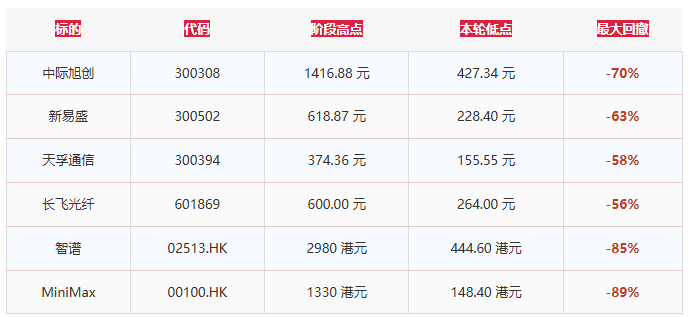
From the data it can be directly seen that the two Hong Kong large-model leaders suffered the most severe drawdowns. Zhipu and MiniMax both fell more than 80%, showing extremely strong bubble-clearing intensity. Most leaders in optical modules, optical fiber, and lithium battery copper foil fell close to or more than 60%. By the 50% drawdown standard, the sector had already completed a phased crash in 2026.
So far, the above leaders have already fallen this much, but is this round's low the ultimate low? Not necessarily. Wait a year and see.
This set of data directly challenges the mainstream prediction of a 2029 crash. The market did not wait for the far-off cyclical risk; it first collapsed under the current overdrawing of expectations. No matter how rigorous the cycle model or institutional consensus, it will fail in the face of real capital.
III. In-Depth Review: The Biggest Trap in Investment Markets—Consensus Expectations
The unexpected reversal in this round of AI market reflects an underlying law of capital markets. The risk timing that everyone collectively predicts is often not the timing of the real crash. Consensus expectations themselves are the market's strongest contrarian indicator. This is also the core essence of why the 2029 prediction failed and why the decline came early in 2026.
When a large number of institutions and investors unanimously identify risk as being in 2029, capital forms unified behavior: confidently go long in the short term and manage risk only in the distant future. Everyone is avoiding the risk two years away while ignoring that current valuations are already overheated. The consistent behavior of capital in advance overdrafts short-term upside space.
A true crash-style decline never gives advance notice. Risk is often born when the market is numb and everyone collectively relaxes vigilance. No matter how refined the cycle deduction or how confident the judgment of a big shot, it can easily become a cognitive trap for ordinary investors.
Not only are top predictions unreliable, but all kinds of bottom predictions are equally meaningless. Countless institutions calculate bottom ranges and predict inflection points every day. But history has repeatedly proven that no one can precisely catch the market's lowest point. Top and bottom predictions are essentially probabilistic guesses; there is no standard answer.
Looking back at the 2000 internet bubble, there were likewise a large number of time predictions. The real node of the bubble burst completely departed from everyone's deduction framework. Today's AI sector is just another repetition in the history of technology growth bubbles. The timing of bubble reckoning is always full of randomness and surprises.
Conclusion: Abandon Prediction and Respect Market Uncertainty
This round of major AI adjustment gives all technology sector investors a warning: do not predict market tops, and even more, do not obsess over betting on absolute bottoms. No matter which time node a well-known institution or top investor gives, one should not blindly follow it. No matter how self-consistent the logical chain, it cannot withstand sudden changes in capital, sentiment, and external variables.
The most dangerous action in investing is to make trading decisions based on other people's time predictions. If someone tells you it is safe before 2029, you go heavy and hold on for dear life. But the market will not run according to any institution's prewritten script. All "certain market predictions" are essentially subjective assumptions.
For the current AI sector, there is no need to struggle over whether it has completely bottomed. Nor should one fantasize about new highs immediately, or worry that a new round of crash is about to arrive. After multiple core leaders have fallen more than 50%, the sector's frenzied sentiment has been fully cleared. The previously overdrawn valuations have undergone a round of violent digestion.
The core of long-term investing has never been precise timing or predicting rises and falls. It is letting go of obsession with tops and bottoms and acknowledging that the market itself is full of uncertainty. Abandon the inertia of following institutional consensus expectations and adhere to an independent judgment framework. This is the most important inspiration that the early AI crash of 2026 leaves investors.
I have not invested in AI; I invest in new energy, but the essence is the same. I will not believe any institution's predictions about when new energy will bottom or top.
I only think about which good company in which new energy industry is cheap enough. As long as it is cheap enough, I buy!
Of course, if at some point new energy stocks surge far beyond the company's value range, I will sell too. I never need to look at other institutions' predictive remarks—not a single word do I believe!
Disclaimer: This article is only for historical market review and investment cognition sharing, and does not constitute any individual stock investment advice. All market data in the text are historical statistics, and historical trends do not represent future performance. AI, computing power, and large-model sectors are highly volatile, and risks persist. All investment decisions should be made independently and prudently.
-
![]()
Jiuzhang Cloud's IPO: Can Computing Power Metrics Determine Pricing Power?
-
Cerebras' Stock Plunged 77% Within Six Months of Going Public—What Happened to Nvidia's "Challenger"?
-
![]()
01.AI Sets Up Headquarters in Hangzhou
-
![]()
The Three German Auto Giants Have All Stalled—What Exactly Happened to Them?
-
![]()
Great Wall Motor October Sales: Why Great Wall Has a Stronger Presence in the 200,000–300,000 Yuan Range Without Relying on 100,000-Yuan-Class Models
-
![]()
How Much of Li Auto's October Sales Beyond the L Series Can Its All-Electric Vehicles Capture?
-
Optical Module Order Cut Rumors Resurface
-
![]()
Domestic Competition Hits Rock Bottom—Can Going Global Save New Energy Vehicle Makers?