Jiuzhang Cloud's IPO: Can Computing Power Metrics Determine Pricing Power?
 11/12 2026
 382

The AI industry is in the midst of a storm, and the computing power sector has drawn particular attention for its enormous capital requirements.
A study released by the International Monetary Fund in October 2026 found significant differences in capital intensity, profitability, and financing risk across segments of the AI value chain. Compared with large technology enterprises that enjoy strong profitability and solid balance sheets, GPU cloud service providers generally face heavier capital investment and financing pressure. As investment in computing power facilities expands, the study noted, such enterprises must not only contend with rapid GPU technology iteration and asset economic lives that may be shorter than their financing terms, but also face uncertainty over whether future AI service demand and commercial revenue will meet expectations. China's Jiuzhang Cloud DataCanvas, which is pursuing an IPO on the Hong Kong stock market, aims to carve out a distinctive position in this chain—one that could reshape the investment, risk, and return structure of computing power services.
The company began with AI foundational software, pivoted to intelligent computing center construction in 2023, and launched its intelligent computing cloud in September 2024, with revenue growing nearly tenfold in three years. As of the latest practicable date stated in the prospectus, Jiuzhang Cloud's controllable computing power across seven Chinese provinces exceeded 29,000 PFLOPS.
It does not produce GPUs, nor does it build its business around operating proprietary foundation models. Instead, it acquires computing power resources through project cooperation and delivers them to customers via the Alaya NeW OS operating system, unified measurement, and cloud services.
As an independent third-party "new intelligent computing cloud," it is positioning itself as the scheduler and distributor of computing power in this track. Its layout hints at a larger "ambition": to grasp pricing power in computing power.
01 A chain strategy: "build—lease—operate"
Jiuzhang Cloud did not start out in data centers and computing power leasing.
In 2023, its artificial intelligence foundational software (AIFS) business generated revenue of approximately RMB 81.29 million, accounting for 76.5% of the company's total revenue. This line of business revolves around data processing, model development, training orchestration, and deployment, and mainly relies on software engineering capabilities and project delivery to generate revenue.
As demand for large model training and inference expanded, Jiuzhang Cloud began shifting its business focus to intelligent computing infrastructure solutions, providing local governments, state-owned enterprises, and private enterprises with intelligent computing center design, hardware procurement, system integration, software deployment, and delivery. It helps customers turn purchased servers, network, and storage equipment into computing facilities that can actually run AI workloads.
This transformation rapidly changed the company's revenue scale. Jiuzhang Cloud delivered 3, 5, and 6 intelligent computing center projects in 2023, 2024, and 2025 respectively, and delivered another 3 in the first half of 2026; total revenue was RMB 106 million and RMB 396 million in 2023 and 2024 respectively, and soared to RMB 1.098 billion in 2025, of which intelligent computing infrastructure solutions revenue was RMB 1.002 billion, accounting for 91.2%.
But if it only built intelligent computing centers for customers, Jiuzhang Cloud would remain an integration and service enterprise built mainly on large project contracts: revenue is recognized only after project completion, and whether subsequent orders will follow is uncertain. The uniqueness of its business model lies in the fact that some projects may also generate another transaction afterward.
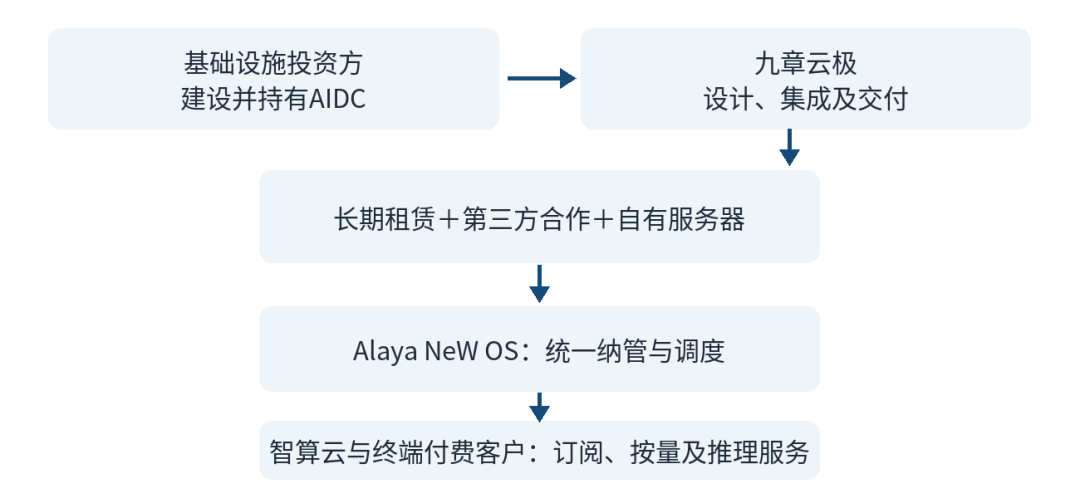
The prospectus discloses that after delivering an intelligent computing center, Jiuzhang Cloud may lease specified computing resources from the customer through a separately signed lease contract. These facilities have already deployed Jiuzhang Cloud's Alaya NeW OS during the design and construction stages and can later be incorporated into its computing power pool relatively conveniently. At the same time, Jiuzhang Cloud also leases computing power from other third-party intelligent computing centers and deploys its own servers within leased third-party data centers.
The prospectus contains very specific transaction records.
In 2024, Customer F purchased intelligent computing infrastructure solutions from Jiuzhang Cloud, contributing approximately RMB 172 million in revenue; in 2025, the same entity, as Supplier L, provided intelligent computing center leasing services to Jiuzhang Cloud, corresponding to a procurement amount of approximately RMB 294 million. In 2025, Customer Group J / Supplier Group M also had two types of transactions at the same time: Jiuzhang Cloud sold approximately RMB 231 million of infrastructure solutions to it and purchased approximately RMB 235 million of AIDC leasing services from it.
The prospectus explains that the construction contract and the lease contract underwent independent commercial negotiations, and the above relationships should not be understood as meaning that all projects must be "built and then leased back."
Jiuzhang Cloud's computing power pool is not a simple warehouse of self-owned GPUs, nor is it merely an open trading market that matches supply and demand and charges fees. Through investment cooperation, engineering delivery, lease contracts, and self-owned equipment, it actually acquires and operates a certain range of computing power usage rights and scheduling rights.
As of the latest practicable date stated in the prospectus, Jiuzhang Cloud's controllable computing power in seven Chinese provinces has exceeded 29,000 PFLOPS, but not all of it belongs to the company.
Figure 1: Synergistic relationship among construction, resource acquisition, scheduling, and continuous cloud services
This arrangement may create two-way attraction.
For local platforms, industrial investors, or facility owners, if Jiuzhang Cloud is willing to lease part of the capacity on a long-term basis, the visibility of future rental income may improve, and the risk of idle facilities may be somewhat alleviated.
For Jiuzhang Cloud, it can expand controllable computing power through facilities built with external capital without having to hold all physical assets. More importantly, Jiuzhang Cloud participates in the architecture and operating system deployment of some computing centers, so the technical cost of subsequently incorporating them into unified management may be lower.
Thus, a new question naturally arises: how can computing power from different centers and different chips be turned into services that customers are willing to buy?
02 Operating system: from heterogeneous resources to standardized services
For customers, buying a few GPUs may seem simple, but for a platform operating multiple intelligent computing centers, things are far from easy.
Different centers may use different models of GPUs and have different memory, network, and storage conditions. Even if the total theoretical computing power is the same, whether GPUs are arranged in a high-speed interconnect cluster or scattered across nodes far apart may lead to completely different actual efficiency for large model training.
Jiuzhang Cloud's Alaya NeW OS was developed precisely to manage and schedule these heterogeneous computing power resources. The prospectus positions it as the key software layer connecting intelligent computing center hardware clusters with AI applications, integrating resource management, task scheduling, and system monitoring.
It allocates computing tasks based on conditions such as workload characteristics, hardware resource availability, and network topology. It needs to determine not only "whether there are still GPUs available," but also "which group of GPUs is most suitable for completing this task."
For example, distributed large model training usually requires multiple computing nodes to operate collaboratively and exchange data frequently. If scheduling only considers the number of GPUs and ignores network connections between nodes, expensive computing resources may spend a great deal of time waiting for communication and data transmission.
Through mechanisms such as topology awareness and gang scheduling, combined with DingoStack high-performance networking, DingoFS distributed storage, DingoSpeed cache acceleration, and the HyperTrain training platform, Jiuzhang Cloud optimizes coordination among computing, network, and storage, reduces data transmission and task waiting, and improves system reliability through automated operations and fault recovery mechanisms.
In the model inference stage, Jiuzhang Cloud is also advancing technologies such as KV Cache reuse and prefill-decode separation to reduce repeated computation and improve the effective output per unit of computing power.
The commercial value of these technologies is not limited to software sales. Alaya NeW OS can be delivered along with intelligent computing center construction projects and also supports Jiuzhang Cloud's own intelligent computing cloud operations.
Its deeper value is to organize scattered and heterogeneous computing power resources into a computing platform capable of continuously providing services: under the same resource cost, strive to complete more effective training and inference tasks; while meeting the same customer demand, strive to use fewer computing resources. When this efficiency advantage can continuously play a role across a larger resource pool and more customers, software technology may transform from a project delivery capability into a core asset that improves the operating efficiency and cost competitiveness of the entire computing power platform.
To sell these computing power resources, transaction and billing issues also need to be solved. It is usually difficult for customers to compare the theoretical computing power, usage time, and actual task performance of different chips. Jiuzhang Cloud launched the "DCU" as a unified unit of measurement. 1 DCU is equivalent to 312 TFLOPS of FP16 theoretical peak computing power running continuously for one hour.
In pay-as-you-go products such as VKS, customers settle according to actually measured resource consumption; for users who need long-term stable occupation of specific resources, Jiuzhang Cloud provides DKS services based mainly on dedicated clusters and subscriptions.
Jiuzhang Cloud disclosed several cases.
An enterprise engaged in embodied AI and large model research, focusing on vision-language-action (VLA) technology and robotics applications, after switching to Jiuzhang Cloud's VKS elastic computing service, was able to dynamically expand or release computing power according to the actual needs of model training tasks and pay according to actual usage measured by "DCU," with overall computing costs falling by 73.8%.
An online social platform, due to obvious fluctuations in business traffic, had resource waste during off-peak periods under the traditional method of leasing bare-metal servers by the month. After adopting Jiuzhang Cloud's VKS service, the platform was able to elastically obtain computing resources according to concurrency demand and be billed by actual usage, saving 88.2% of its monthly computing power budget compared with the original model.
Of course, these figures are specific customer results disclosed by Jiuzhang Cloud and cannot be treated as the average cost reduction across the entire platform.
What DCU provides is a unified measurement of computing power input; it does not mean that all chips can achieve the same speed when actually executing the same task, nor does it mean that Tokens generated by different models have the same quality.
Jiuzhang Cloud co-founder and COO Shang Mingdong said in an interview with "STAR Market Daily" in September 2026 that DCU only measures how much computing power resources are input and does not promise the actual operating speed of chips; the output side is independently measured in Tokens, and input and output are not confused. He proposed first letting this standard be "used" in actual commercial operations and then seeking broader industry recognition.
Along this path, Jiuzhang Cloud further advances what customers buy from computing resources to inference output. Its Alaya Token allows customers to call selected third-party models through APIs and pay according to Token consumption; the training factory and Token factory serve model training, post-training, and inference delivery respectively.
Jiuzhang Cloud hopes to reduce the delivery cost per Token through model deployment automation, inference resource scheduling, and cache optimization.
However, as of the latest practicable date stated in the prospectus, although Alaya Token has signed about 10 contracts, no related revenue had been recognized during the track record period. It represents a new product direction, not yet a proven profit engine.
The economic significance of Jiuzhang Cloud's technical foundation is now fully apparent: upstream solves "where computing power comes from," the operating system solves "how to make computing power run efficiently," and measurement and cloud products solve "how customers can buy suitable computing power." This naturally leads to another change—what Jiuzhang Cloud operates is no longer just a small number of large construction customers.
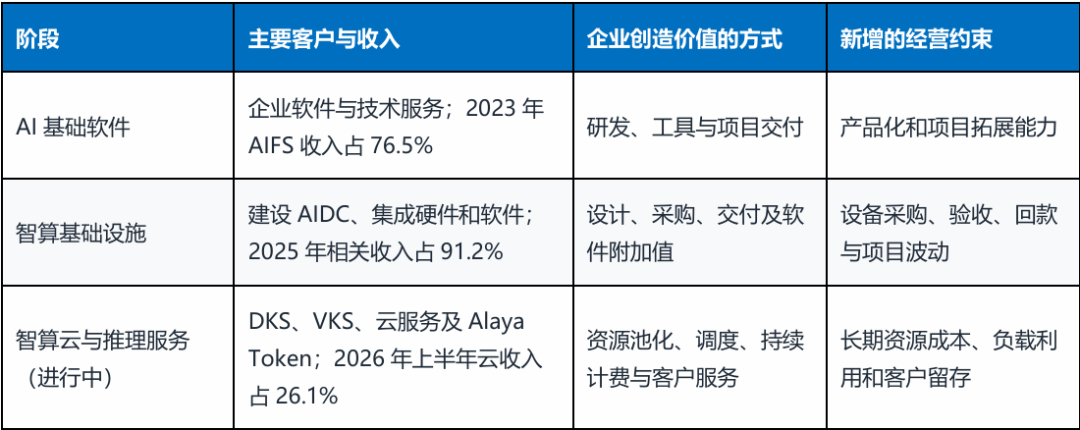
Figure 2: Jiuzhang Cloud business structure diagram
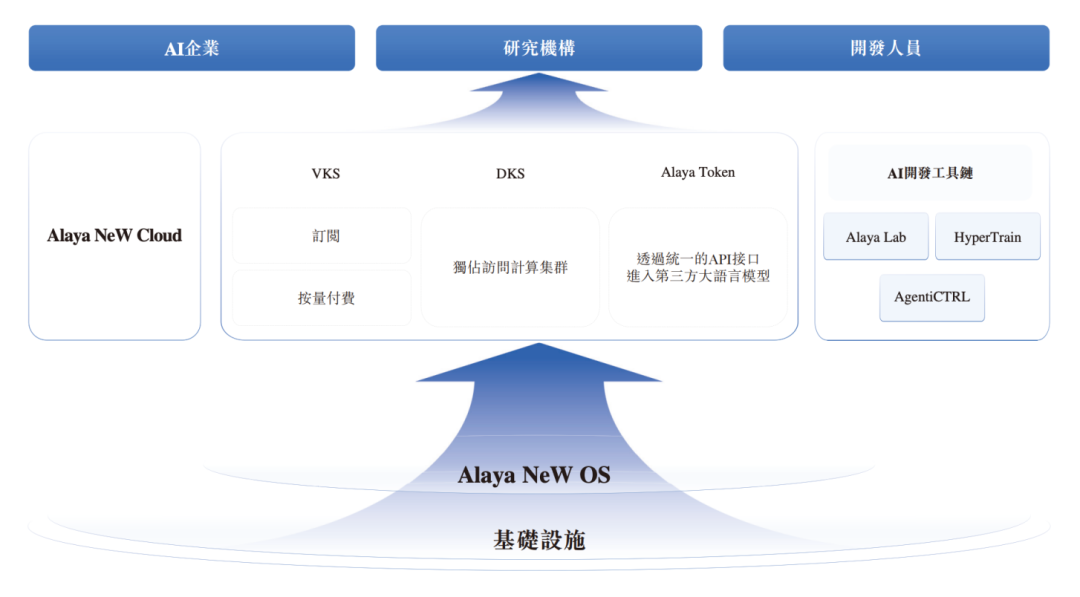
Source: Jiuzhang Cloud prospectus
03 Inclusive computing power: the long-tail market of downstream users
In its prospectus, Jiuzhang Cloud positions inclusive computing power as its core operating philosophy, emphasizing a lower barrier to intelligent computing through heterogeneous scheduling, serverless orchestration, and usage-based billing. This is not merely a low-price promotion; rather, it transforms computing power that once required self-purchase, configuration, or long-term leasing into services that are easier to obtain, easier to use, and flexibly metered.
The Inclusive Computing Power Development Report (2026), jointly released by Jiuzhang Cloud and the China Academy of Information and Communications Technology, characterizes this as a new supply model centered on serviceization—one that delivers efficient, easy-to-use, and affordable computing power to a broad range of social entities through standardized, measurable methods. Its focus is not simple subsidies or price cuts, but rather lowering the overall threshold for obtaining and using computing power through elastic use, unified interfaces, reduced idleness, and engineering optimization.
In the interview, Shang Mingdong also stressed two dimensions—"low enough cost" and "low enough threshold"—and placed the focus of reducing marginal costs on the production side.
Jiuzhang Cloud Chief Scientist Miao Xu, in a public speech in September 2026, drew specific distinctions among the computing power needs of different customers: SMEs have strong demand for digital transformation; university research scenarios may suddenly expand around paper deadlines and then quickly fall back; individual developers and small micro teams are more cost-sensitive and may be willing to use fewer GPUs over more time to complete proof of concept.
This shows that inclusive computing power is both a technical delivery method and a market entry strategy.
In the same public speech, Miao Xu also cited two scientific research cooperation cases: a world model task at Shanghai Jiao Tong University was shortened from 46 minutes to 24 minutes after optimization; GPU utilization in a scientific research scenario at Peking University increased from just over 40% to 90%.
Changes in the customer base are already reflected in the numbers. The prospectus discloses that the number of Jiuzhang Cloud's intelligent computing cloud enterprise customers increased from 2 in 2024 to 75 in 2025 and reached 84 in the first half of 2026. However, it has not separately disclosed the proportion, payment scale, renewal rate, or revenue contribution of SMEs, small micro teams, or individual developers among them.
Inclusive computing power also has policy and industry backing. The Ministry of Industry and Information Technology issued a special action notice in April 2026, requiring improved convenience for SMEs to obtain and use computing power and proposing that by the end of 2028 a broadly covering, low-cost inclusive computing power service system be basically established.
The "DCU" measurement method makes it easier for small and medium-sized customers to purchase and use computing power, while the large and sufficiently dispersed downstream customer base can provide stable expectations and cash flow sources for the company's construction, aggregation, and scheduling of computing power pools, reducing mismatch risks caused by fluctuations among large customers.
04 Pricing Power: The Evolution of the Ecological Niche
Jiuzhang Yunji is building a service ecosystem that keeps expanding at both ends: upstream, it connects more facility owners, computing resources, and partners; downstream, it connects more paying developers, enterprises, and research institutions; in the middle, Alaya NeW OS, DCU metering, and cloud products handle resource matching and delivery.
As the upstream mix of selectable hardware, regions, and cost combinations increases, the platform has the opportunity to meet differentiated needs more flexibly; as the number of downstream customers, usage frequency, and payment commitments grow, the platform may in turn improve resource utilization and strengthen its bargaining power over upstream leasing and procurement. If customers' development processes gradually become embedded in the platform's tools and services, the cooperative relationship may also become more stable.
At the same time, Alaya NeW OS adopts a combined path of "project embedding, resource access, cloud service operations, ecosystem cooperation, and overseas output," which can both integrate a broader range of computing resources and increase user scope and stickiness.
Computing scheduling, computing adaptation, computing distribution—when this ecosystem reaches a certain scale, Jiuzhang Yunji's platform capabilities and standard influence will expand further, making it possible to gain greater pricing discourse power in the computing ecosystem.
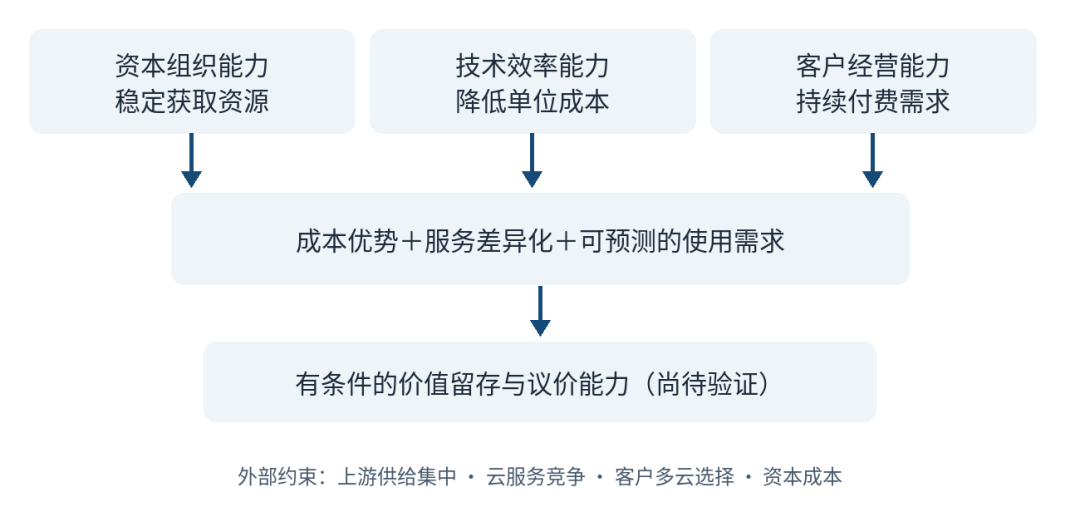
To reach this stage, Jiuzhang Yunji needs to keep pushing forward on three fronts: capital, technology, and customers.
Capital organization capability determines whether it can steadily obtain computing power at an affordable cost. The synergy between construction and leasing means it does not have to build everything itself, but long-term leasing also means ongoing payment obligations.
The prospectus shows that Jiuzhang Yunji's lease liabilities increased from 187 million yuan at the end of 2024 to 957 million yuan at the end of 2025, were 1.480 billion yuan at the end of June 2026, and rose to 3.087 billion yuan at the end of July. This shows that the expansion of computing power control requires strong capital support. At the same time, it tests how much of the lease terms, prices, and payment obligations of long-term leases can be covered by downstream customers' long-term commitments and stable consumption.
Technical efficiency capability determines the service quality and unit cost of the resource pool. The operating system needs to match heterogeneous GPUs, networks, and storage to appropriate workloads, reducing idleness, waiting, and duplicate computing; one-degree computing power helps record resource inputs, while the Token Factory attempts to increase inference output.
But to maintain a sustained advantage, Jiuzhang Yunji needs to remain adaptable to market changes and technological iteration, which requires continuous investment.
Customer operation capability determines whether the platform can continuously obtain sufficient demand. Upstream construction customers need project delivery, long-term facility operation, and capital recovery expectations; downstream cloud customers need immediate access to resources, stable services, development tools, technical support, and reasonable prices. The sales cycles and operating methods for these two types of customers are completely different.
Large customers may contribute a single huge project revenue, while small and medium-sized development teams may spend little each time but have frequent, fluctuating usage needs. Only if the platform can both win large projects and operate more continuously paying customers at reasonable acquisition and service costs can the resource pool have the opportunity to obtain sufficiently stable and complementary loads.
The three capabilities of capital, technology, and customers may form a positive feedback loop: stable demand facilitates financing and resource procurement, lower costs and better services facilitate customer acquisition, and more complementary loads increase resource output, which may in turn improve profitability. But it can also run in reverse: leasing first, insufficient customers, and pressure on profits force the company to absorb capacity at lower prices.
Figure 3: From resource scheduling to potential pricing power: three core conditions
05 IPO: A Signpost
By the first half of 2026, Jiuzhang Yunji has proven at least two things: its software and engineering capabilities can support a relatively large-scale infrastructure business; and intelligent computing cloud has grown from experimental revenue into a real business segment. But there is still a certain gap before it can form stable pricing power.
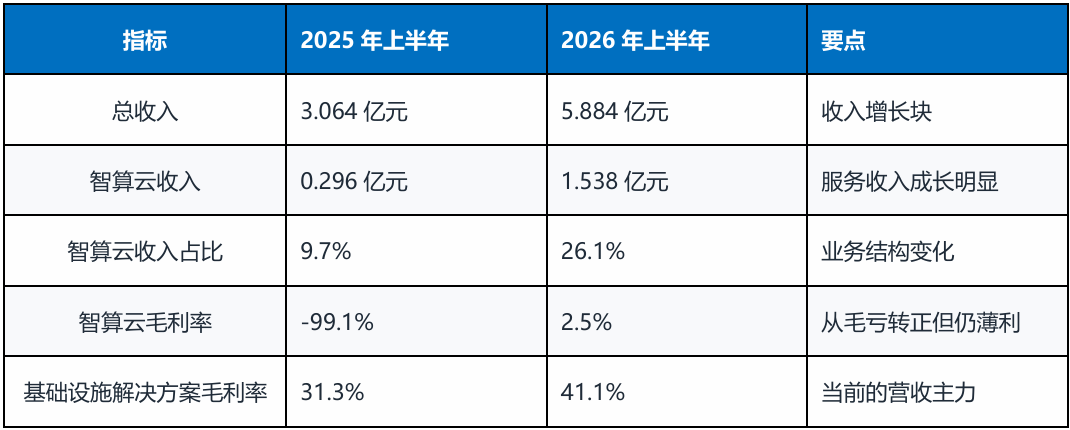
The first is the revenue and gross profit structure. In 2025, the company's revenue was 1.098 billion yuan, of which infrastructure solutions accounted for 91.2% and intelligent computing cloud accounted for 7.1%. In the first half of 2026, total revenue was 588 million yuan, and cloud business revenue was 153.8 million yuan, accounting for 26.1%, a substantial increase compared with 29.605 million yuan in the same period of 2025. However, in the first half of 2026, the gross margin of the infrastructure business reached 41.1%, while the gross margin of the cloud business, although it had turned positive, was only 2.5% (the full-year cloud business gross margin in 2025 was -93.0%).
The company explained that the higher gross margin of infrastructure projects is related to a lower proportion of hardware procurement, more software components, and higher-profit projects; the improvement in the cloud business mainly comes from early fixed resource costs being more effectively shared as customer demand and revenue grow.
The second is the customer structure. In 2025, the company's overall top five customers all purchased intelligent computing infrastructure solutions, contributing 88.0% of total revenue; in the first half of 2026, the infrastructure revenue corresponding to the overall top three customers N, O, and P totaled 434 million yuan, exactly equal to all revenue of that business in the period.
In the same period, two intelligent computing cloud customers, Q and R, entered the overall top five, contributing a total of approximately 41.56 million yuan in cloud revenue, about 27.0% of that business's revenue. The number of cloud enterprise customers rose from 2 in 2024 to 84 in the first half of 2026.
This set of data shows the direction of the transformation and also indicates the boundaries of the transformation. The construction business is highly concentrated in a small number of projects; the cloud customer base is expanding, but there is currently no complete public list of the "top five cloud business customers," nor is there disclosure of the proportion of small and medium-sized customers, customer retention rate, long-term consumption per customer, or renewal data.
In terms of pricing power, Jiuzhang Yunji does not yet have independent pricing capability. The prospectus explicitly states that "the pricing of our intelligent computing cloud services is generally adjusted in response to prevailing market prices." This means that at this stage the cloud business is a market follower in terms of price. After all, the scale of both upstream and downstream is not yet large enough, and customers are not sufficiently dispersed.
Then look at capital and cash flow. In the first half of 2026, the company's net cash outflow from operating activities was approximately 86.5 million yuan, net accounts receivable and notes rose from approximately 106 million yuan at the end of 2025 to approximately 296 million yuan at the end of June 2026, hardware prepayments increased from approximately 220 million yuan to approximately 252 million yuan; at the same time, lease liabilities rose rapidly.
Project construction requires procurement, acceptance, and collection, while the cloud business requires continuous payment of resource and operating expenses. Two different capital turnover mechanisms operate in parallel.
Jiuzhang Yunji's identity as a relatively independent third-party service provider in the computing industry is also worth noting. Unlike large technology companies that simultaneously operate cloud computing, foundation models, and AI applications, Jiuzhang Yunji explicitly states in its prospectus that it does not commercialize proprietary foundation models and does not develop AI applications, striving to maintain business neutrality toward downstream customers.
This positioning may create two-way appeal: upstream, it facilitates cooperation with intelligent computing centers owned by different parties and integrates heterogeneous computing resources through Alaya NeW OS; downstream, it may attract model companies and AI application developers that wish to avoid potential horizontal competition and reduce dependence on a single technology ecosystem.
In summary, Jiuzhang Yunji has reached a stage with clear boundaries: upstream resource organization capability already has scale, software scheduling has real products and customer cases, and downstream cloud revenue and customer numbers are expanding; however, sustained customer growth and stickiness, independent pricing advantages, and capital returns exceeding the industry are the story that Jiuzhang Yunji still needs to verify.
And the IPO is an important leap in the upgrade of Jiuzhang Yunji's business model.
The listing application version of Jiuzhang Yunji lists four categories of use of proceeds: continued research and development of the computing operating system and cloud platform, investment in AIDC and related hardware, expansion of sales channels, brand, and international business, and supplementing working capital. Jiuzhang Yunji also plans to further enhance its long-term control over computing resources through selective self-built infrastructure and participation in intelligent computing center projects with its own funds, and to more directly share the operational efficiency gains brought by the iteration of its proprietary computing operating system and related technologies.
These four categories of use precisely correspond to the three foundations of future pricing power: control of computing resources, upgrading of technical efficiency, and expansion of the customer ecosystem. They also mean that the IPO cannot be understood merely as supplementing cash for existing businesses, but rather as providing capital conditions for the next stage of business organization.
There is also a longer-term possibility. If the "one-degree computing power" measurement standard and delivery method can be accepted by the industry, and Alaya NeW OS can be widely deployed in independent third-party facilities and generate revenue through software licensing, operation management, or cross-platform scheduling services, then the expansion of Jiuzhang Yunji's computing resource management scope may no longer necessarily bring about a proportional increase in long-term lease liabilities, that is, it may not be entirely constrained by capital scale.
The prospectus outlines directions for localized overseas cooperation and a neutral cross-platform layer, offering strategic possibilities for this model. However, the scale of independent licensing revenue and the availability of replicable third-party contracts remain undisclosed.
Moving from expanded rights to schedule and allocate computing resources toward pricing power represents a business upgrade centered on value creation and value distribution. Jiuzhang Yunji has begun connecting capital, hardware, operating systems, and customers. If a sustained and effective match takes shape between more upstream resources and downstream paying demand, the company may strengthen its bargaining position through scale, efficiency, and service differentiation—and capture more returns in the competition.
Jiuzhang Yunji is traveling a road that may lead to pricing power. Whether it can arrive—and whether it can generate excess returns once there—is perhaps the kind of "imagination space" this IPO offers.
References
[1] IMF. The AI Ecosystem: Structure, Financing, and Financial Stability Considerations
[2] Hong Kong Exchanges and Clearing. Jiuzhang Yunji Application Proof Prospectus
[3] STAR Market Daily. Jiuzhang Yunji Co-founder Shang Mingdong: Computing Power Is Moving Toward Meterable Transactions—Let the DCU Metering Standard First "Be Used" and Then "Be Established"
[4] Sina Finance. Jiuzhang Yunji Miao Xu: The Essence of Inclusive Computing Power Is the Standardization and Meterability of Computing Power Services
-End-
-
![]()
Jiuzhang Cloud's IPO: Can Computing Power Metrics Determine Pricing Power?
-
Cerebras' Stock Plunged 77% Within Six Months of Going Public—What Happened to Nvidia's "Challenger"?
-
![]()
01.AI Sets Up Headquarters in Hangzhou
-
![]()
The Three German Auto Giants Have All Stalled—What Exactly Happened to Them?
-
![]()
Great Wall Motor October Sales: Why Great Wall Has a Stronger Presence in the 200,000–300,000 Yuan Range Without Relying on 100,000-Yuan-Class Models
-
![]()
How Much of Li Auto's October Sales Beyond the L Series Can Its All-Electric Vehicles Capture?
-
Optical Module Order Cut Rumors Resurface
-
![]()
Domestic Competition Hits Rock Bottom—Can Going Global Save New Energy Vehicle Makers?