100,000 Vulnerabilities in a Single Year: How AI Is Overwhelming the Internet's Security Defenses
 11/23 2026
 470
AI has pushed the security community to its breaking point.
Over the past week, Microsoft Outlook and Apple systems suffered widespread outages, and multiple U.S. banks and United Airlines were brought to a halt.
Although there is currently no evidence of a cyberattack, speculation about the cause has already spread across the internet—with the most widely circulated claim being that AI is behind it all.

Image source: Generated by Doubao AI
This wave of outages is certainly no AI-orchestrated hacker carnival. Taken individually, the cause of each incident is fairly ordinary. That said, as AI's impact on digital offense and defense deepens, researchers and analysts in the security community have gradually reached a consensus: the pace pressure brought by AI has begun to tangibly spawn real-world technical failures.
The logic is actually simple: AI-assisted vulnerability discovery has directly blown up the number of software bugs. Attackers then use AI tools to turn these vulnerabilities into attack methods faster than ever before, forcing companies to scramble desperately to patch.
Industry insiders stress that AI's biggest impact is that it has maxed out the speed of everything.
Take last week's massive Microsoft 365 outage: the root cause was a bug in an infrastructure update program, compounded by other network failures, which directly led to a full-scale collapse.
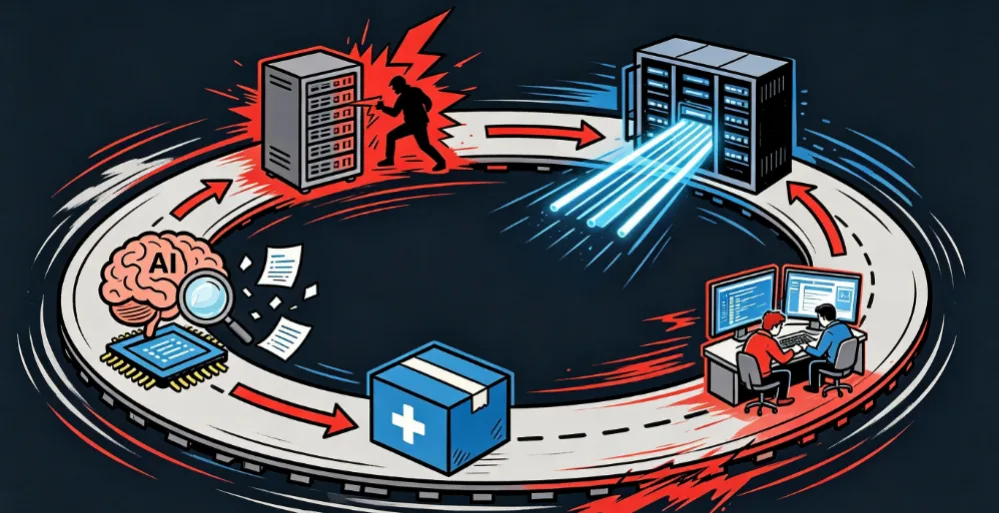
Image source: Generated by Doubao AI
U.S. Senator Mark Warner said in a statement on Tuesday that the rhythm of AI frantically discovering vulnerabilities and forcing companies to rush out patches "puts enormous pressure on systems that were never designed to withstand such rapid iteration." Microsoft CEO Satya Nadella also admitted this week that more instability may follow—because vulnerabilities are already being exploited by hackers as soon as they are exposed, patches must be pushed to production environments immediately upon release, with no time to wait.
In fact, external pressure and bugs in the patches themselves are nothing new; they have often caused failures before. Researchers also point to another problem: many companies around the world are carrying heavy "technical debt." For years they cut corners and were unwilling to invest in upgrading and maintaining digital systems. Although doing so was risky, companies lacking resources or unwilling to spend money on security mostly gambled by using legacy systems and skipping safeguards—and in most cases, no major trouble occurred.
Dataminr Director of Threat Research Jose Lovick said that just two years ago, when a vendor released a patch for a severe vulnerability, you at least still had time to validate it and then deploy it gradually. Now that option may no longer exist. The turnaround speed of vulnerabilities is so fast that you simply do not have time to verify patches.
Of course, defenders are also leveraging AI. IT administrators have begun using AI to speed things up, helping assess patches and prepare system updates, but current AI tools still cannot replace human analysis and planning.
Cloudflare CEO Matthew Prince offered a long-term prediction: over the next two years, everyone will probably feel as if the sky is falling. But he believes that in the long run, AI's acceleration effect will ultimately help defenders stabilize common vulnerabilities, and the overall level of software security will improve. By then, new types of threats and new vulnerabilities will not emerge so frequently, and the overall chaos will actually be greatly reduced.
That said, there is growing evidence that AI is completely rewriting the cybersecurity landscape. This week, the total number of vulnerabilities discovered in 2026 officially surpassed 100,000. For comparison, in 2022, before the explosion of large language models, only about 25,000 vulnerabilities were recorded for the entire year. With more than a month still left this year, the total is already twice the combined total of 2024 and 2025.

Image source: Generated by Doubao AI
Just in the past few days, researchers announced that they had used AI to discover high-severity vulnerabilities in PHP again, with new findings also in open-source server software NGINX and the programming language Java. Forbes also reported that researchers used AI to discover a total of 35 vulnerabilities across Apple's entire product line.
This year, the U.S. Cybersecurity and Infrastructure Security Agency's "Known Exploited Vulnerabilities Catalog" added only 300 entries. In other words, the vulnerabilities actually successfully exploited by hackers are far fewer than the total number of vulnerabilities. Statistics from third-party vulnerability database VulnCheck are higher: so far in 2026, 1,500 vulnerabilities are known to have been exploited, but that still accounts for only 1.5% of the total bugs discovered this year.
Finally, Schoenherr's view is worth pondering: do not shift the blame to AI whenever something goes wrong. The responsibility lies with the people and companies that choose to use AI and connect it to core infrastructure, and there must be corresponding accountability mechanisms and regulatory rules.
This article was compiled and translated by Leitech from Wired.
Original link: 100,000 vulnerabilities discovered in a single year! AI is tearing apart the internet's security defenses
Source: Leitech
Images in this article are from: 123RF licensed image library. Source: Leitech
-
Perspective on Pinduoduo's 2026 Q3 Report: Revenue Stalls, Growth Dilemma Emerges?
-
Two Companies Receive Hong Kong IPO Filing Approval
-
Pinduoduo: The Only One Quietly Making Money in China's Internet
-
![]()
399-Yuan Down Jackets Go Viral—and the Biggest Contributor Isn’t Pang Dong Lai, but Large Language Models?
-
Report | Global Computing Power Top 10 Trends Report 2027
-
![]()
100,000 Vulnerabilities in a Single Year: How AI Is Overwhelming the Internet's Security Defenses
-
Anthropic's Trillion-Dollar IPO Set to Shake Up the Semiconductor Industry
-
![]()
AI Is Flooding Everywhere! Professors Give Up Judging Right From Wrong—Whose Tragedy Is This?